What Makes Naoshima Special?
Naoshima is one of those rare places where the concept of a destination has been almost completely reinvented. What was once a small, economically struggling island in the Seto Inland Sea — home to a few hundred aging fishing families and a copper smelting facility — is now one of the world’s most celebrated contemporary art destinations, drawing hundreds of thousands of visitors annually from every corner of the globe.
The transformation began in the early 1990s when Soichiro Fukutake, chairman of the Benesse Corporation (a Japanese publishing and education company), partnered with the architect Tadao Ando to create a place where art, architecture, and nature could exist in dialogue with each other. The result was the Benesse House Museum, the world’s first museum where guests could stay overnight among the artworks. What followed was an ongoing project of extraordinary ambition: world-class museums, site-specific outdoor installations, and the conversion of traditional island houses into artworks in their own right.
Today Naoshima is justifiably famous, yet it retains a quality of quietness and discovery that more overtly popular destinations rarely manage. The island is small — you can walk across most of it in a couple of hours — the architecture is thoughtful and unshowy, and the art engages you on your own terms rather than overwhelming you with crowds or noise. For visitors with even a passing interest in contemporary art, architecture, or design, it is not to be missed.
Stay connected while exploring the island’s galleries: Get your Japan eSIM (Stay connected from day 1) →
Getting to Naoshima
Naoshima requires a ferry crossing, which is part of its charm — the island feels genuinely separate from the mainland, a quality that enhances the art experience. There are two main ways to reach the island.
From Okayama (via Uno Port)
This is the most popular route for visitors coming from Tokyo, Kyoto, or Osaka via shinkansen. Take the shinkansen to Okayama Station (approximately 45 minutes from Osaka, 55 minutes from Kyoto, or 3.5 hours from Tokyo). From Okayama Station, take the JR Uno Line to Uno Station — the ride takes about 50 minutes and costs ¥590 ($4 USD). From Uno Port, a short ferry crossing to Miyanoura Port on Naoshima takes about 20 minutes and costs ¥310 ($2 USD) for a standard passenger fare. Ferries run roughly hourly throughout the day.
The total journey time from Okayama Station to Naoshima is about 1 hour 30 minutes door-to-door.
From Takamatsu (Kagawa Prefecture)
A high-speed ferry (Marine Liner Naoshima) connects Takamatsu Port to Naoshima’s Miyanoura Port in about 30 minutes, with a fare of approximately ¥1,220 ($8 USD). Regular ferries take about 50 minutes. Takamatsu is easily reached from Osaka by shinkansen to Okayama and then the Marine Liner train (about 1.5–2 hours), making this a good option if you’re combining Naoshima with a Shikoku trip or a visit to Kagawa’s famous sanuki udon.
Once on the island, the Naoshima town bus connects the two main visitor areas: Miyanoura Port (arrival/departure) and Honmura village (the Art House Project). Cycling is also very popular — rental bicycles are available at both port areas from approximately ¥300–¥600 ($2–$4 USD) per hour or ¥1,000–¥1,500 ($7–$10 USD) for a full day. The main road across the island is manageable on a standard bicycle, though there is one significant hill between the port and Benesse Art Site.
Getting an Organized Tour
For visitors who prefer a guided experience, or who want to combine Naoshima with the neighboring art islands of Teshima and Inujima, organized day tours operate from Okayama and Takamatsu. These typically include ferry transport, a guided introduction to the key museums and art installations, and lunch at a local restaurant.
Art Museums and Installations: The Complete Guide
Chichu Art Museum — Underground Architecture and Permanent Masterworks
The Chichu Art Museum is arguably Naoshima’s most important and affecting institution. Designed by Tadao Ando and completed in 2004, the museum is built almost entirely underground — “chichu” means “inside the earth” in Japanese. From the outside, only geometric skylights and concrete walls are visible rising from the hillside. Inside, a series of corridors and chambers, all illuminated by natural light channeled through the skylights, house a permanent collection by just three artists: Claude Monet, James Turrell, and Walter De Maria.
Yes, just three artists, and one of the world’s great museums. The selection and the way each work is presented is extraordinary. The Monet room displays five of his Water Lilies paintings in a chamber designed so that the only light is natural light entering from above — the effect is that the paintings seem to glow from within, and their relationship to light and water becomes suddenly, viscerally clear in a way no photograph or reproduction can convey. The James Turrell rooms use pure colored light to dissolve the boundary between physical space and perception. Walter De Maria’s “Time/Timeless/No Time” fills an entire chamber with a large sphere and a series of wooden sculptures that create a quiet, temple-like atmosphere.
Admission: adults ¥2,500 weekdays / ¥2,700 weekends and holidays online (¥300 more at the counter). Open 10 AM–6 PM (last entry 5 PM) in summer; closes 5 PM (last entry 4 PM) in winter. Closed on Mondays. Reservations are strongly recommended during peak seasons (April–June, September–November) — book online through the official Benesse Art Site website.
Benesse House Museum — Staying Among the Art
The Benesse House Museum was the project that started everything on Naoshima. Designed by Tadao Ando in 1992, it combines a museum and a hotel in a single building overlooking the Seto Inland Sea. The architecture is characteristic Ando — raw concrete, geometric precision, dramatic use of natural light and shadow — but the building sits lightly within the hillside, integrated with the forested terrain rather than imposed upon it.
The museum’s permanent collection includes major works by Bruce Nauman, Jasper Johns, Jean-Michel Basquiat, and Richard Serra, among many others. Outdoor sculptures are placed throughout the surrounding landscape — a Serra’s massive, weathered steel arcs rise from a grassy slope above the sea; a Nauman neon text work glows from a concrete alcove — so that the art experience bleeds continuously into the natural environment.
Day visitors pay ¥1,050 ($7 USD) admission. Staying overnight at the Benesse House hotel is a significantly more expensive proposition (rates from ¥70,000 / $460 USD per person including dinner and breakfast) but is one of the most extraordinary hotel experiences in the world: waking up in a room full of original art, walking to the museum before it opens to day visitors, watching the Inland Sea from a private balcony at sunset.
Lee Ufan Museum — Space and Silence
The Lee Ufan Museum, opened in 2010 and also designed by Tadao Ando, is dedicated to the Korean-Japanese artist whose work embodies the Mono-ha (“School of Things”) movement — an art philosophy concerned with the relationship between materials, space, and perception. The museum is spare and unhurried: a few large canvases, some stone and steel installations, long corridors of bare concrete that ask you to slow down, to notice the quality of light and air.
It is an unusual museum experience — visitors accustomed to dense hang galleries full of large labels and bustling crowds may find it challenging or even frustrating at first. Give it time. The experience accumulates quietly and often reveals itself only after you’ve left. Admission: ¥1,050 ($7 USD). Same opening hours as the Chichu Art Museum.
The Art House Project — Art Woven Into Village Life
The Art House Project is one of the most innovative aspects of Naoshima’s art program. It involves the conversion of abandoned traditional houses and other structures in the Honmura village area — temples, a shrine, a dentist’s office, former homes — into permanent art installations by leading contemporary artists.
Currently there are seven Art Houses open to the public:
- Minamidera: Created by James Turrell and designed by Tadao Ando. Visitors enter a pitch-dark room and gradually, over several minutes, begin to perceive a glowing rectangle of light in the darkness. It is one of the most subtly powerful art experiences anywhere in the world.
- Kadoya: A traditional wooden farmhouse converted by Tatsuo Miyajima into a chamber where hundreds of LED counters glow and shift on the surface of a dark reflecting pool. Dazzlingly beautiful.
- Go’o Shrine: Artist Hiroshi Sugimoto has transformed the local Shinto shrine with a glass staircase descending into the earth and a series of photographs. Sacred and contemporary in equal measure.
- Haisha: Artist Shinro Ohtake turned a former dentist’s office into a maximalist collage of found materials, global pop culture, and personal memory. Astonishing and chaotic by turns.
- Ishibashi, Gokaisho, Kinza: Three further Art Houses, each with its own artist and distinctive approach to the relationship between historical space and contemporary art.
A combined ticket for the Art House Project costs ¥1,050 ($7 USD) for adults, with the exception of Kinza, which requires a separate reservation and ¥520 ($3.50 USD) additional admission. The Art Houses are generally open 10 AM–4:30 PM and closed on Mondays.
Yayoi Kusama’s Yellow Pumpkin — Naoshima’s Most Iconic Image
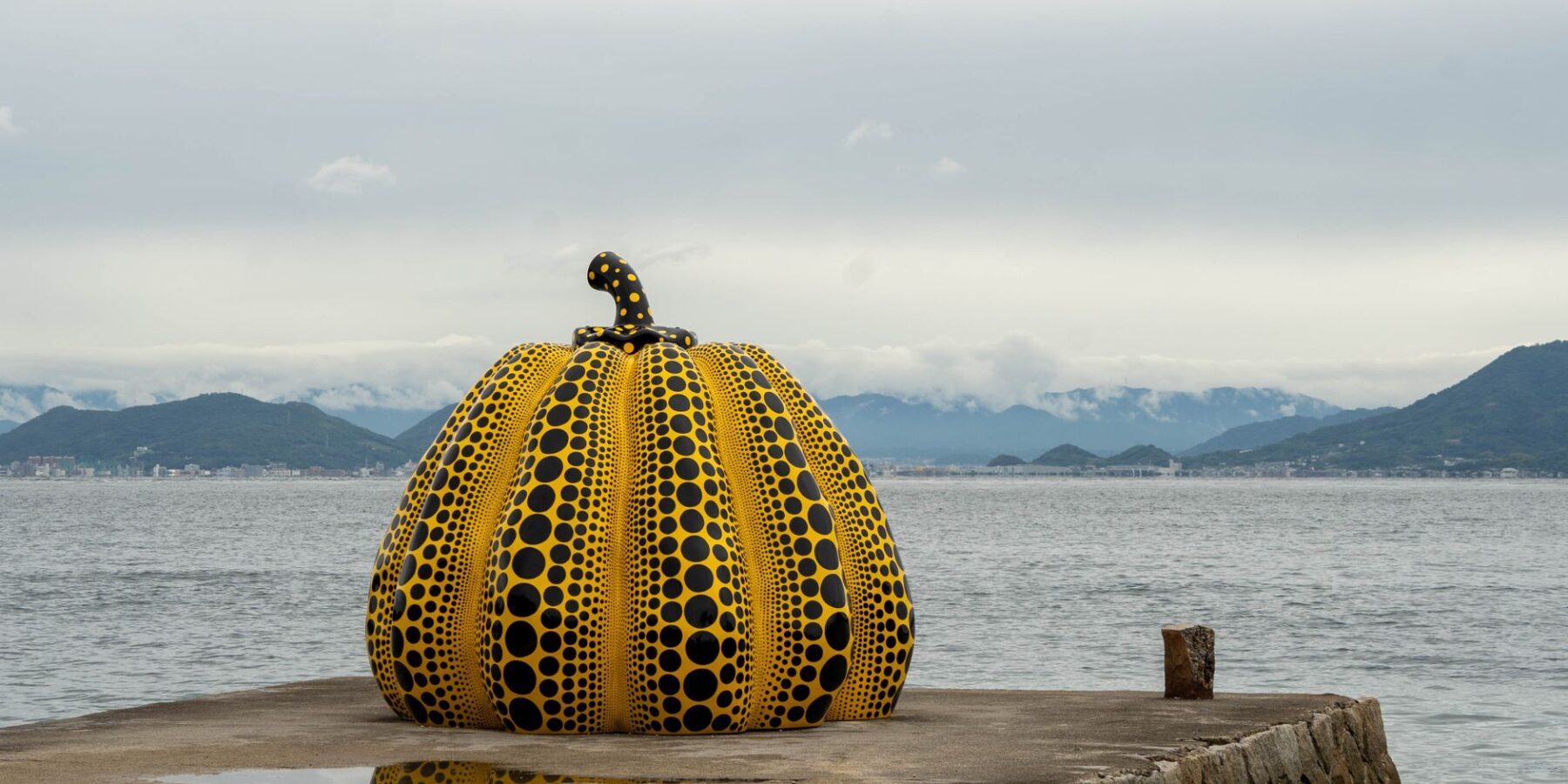
The Yellow Pumpkin is perhaps the single most photographed object on Naoshima — a large polka-dotted sculpture by Yayoi Kusama installed on a pier extending into the Seto Inland Sea. The original fiberglass sculpture was swept away by a typhoon in August 2021 and was later restored and reinstalled. It has become an unofficial symbol of the island’s artistic identity, and the scene of a huge polka-dotted pumpkin with the sea and distant islands behind it is genuinely iconic. The Red Pumpkin by the same artist sits near the Miyanoura ferry terminal and is equally beloved.
Both pumpkins are free to visit and photograph. The Yellow Pumpkin is located in the Benesse Art Site area, about a 15-minute walk from the Tsutsuji-so bus stop.
ANDO MUSEUM
A small but deeply considered museum within the Honmura village dedicated to the work of architect Tadao Ando — whose influence on Naoshima is immeasurable. An old wooden traditional house has been renovated to house concrete rooms and models of Ando’s projects, creating a conversation between traditional Japanese construction and Ando’s signature modernism. Admission: ¥520 ($3.50 USD).
What to Do Besides the Museums
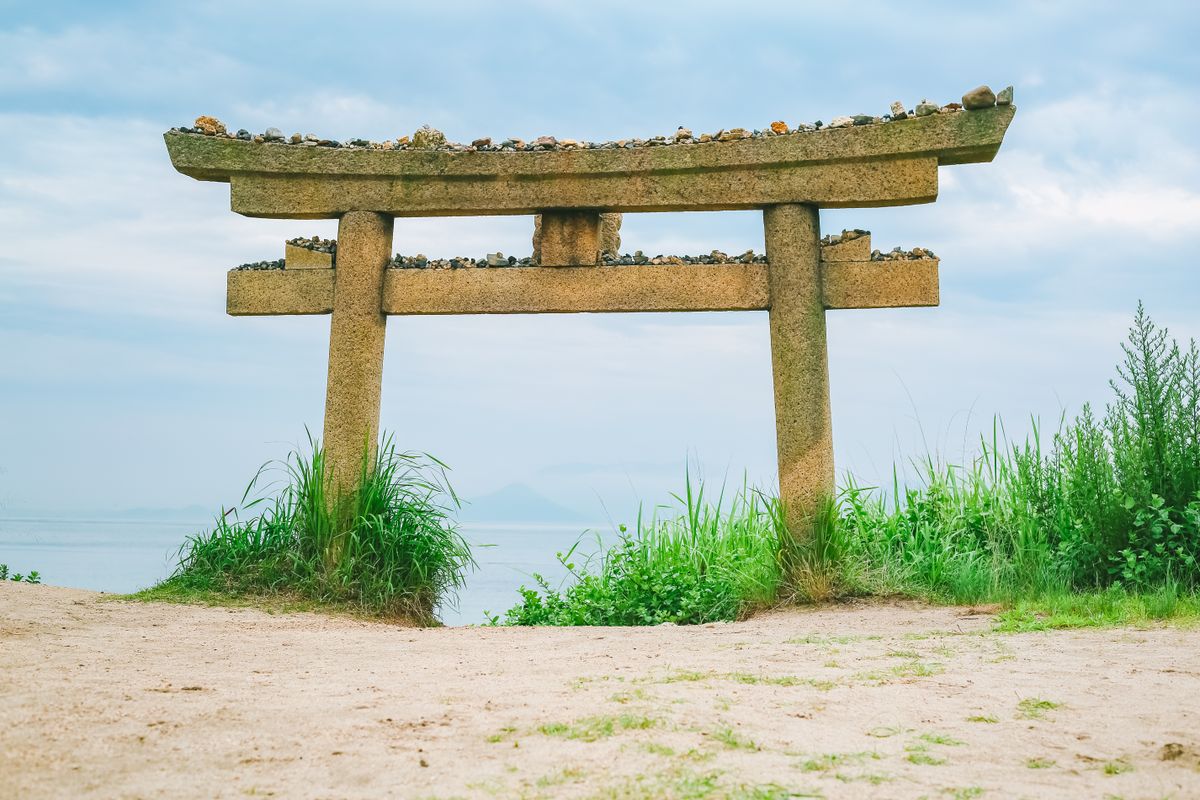
Naoshima is not exclusively an art destination — the island itself is small and beautiful, with fishing village streets, local beaches, and a genuinely peaceful atmosphere that rewards wandering without an agenda.
Explore Honmura Village on Foot
The Honmura area, where the Art Houses are located, is also just a lovely old Japanese village worth exploring on its own terms. The streets are narrow, shaded, and quiet. Old wooden houses lean between newer structures. Cats sleep on walls. Local restaurants and cafes serve seafood and handmade noodles in unhurried surroundings. Give yourself at least an hour simply to wander here without a particular destination.
Sunset at the Beach
Naoshima has a small but pleasant beach (Naoshima Beach) near the Miyanoura area, and the evening light over the Seto Inland Sea is extraordinary — the water turns copper and gold as the sun drops behind the distant islands of Shikoku. This is one of Japan’s most beautiful sunsets. Bring snacks from the ferry terminal and simply sit and watch.
Cycling Across the Island
The entire island can be explored by bicycle in about half a day. The main challenges are the steep hill between Miyanoura and the Benesse Art Site (electric-assist bikes are available for rental and are highly recommended), and the summer heat. Morning cycling, before 10 AM, is ideal: the light is beautiful, the roads are quiet, and you reach the museums before the main crowd arrives.
Sento I Love Yu — the Public Bath as Artwork
Naoshima’s public bathhouse, known as “I Love Yu,” was designed by artist Shinro Ohtake as a functioning sento (traditional public bath) that is also an art installation. The exterior is an explosion of typography, found objects, mosaic, and color. Inside, the changing room walls are covered with found materials; the bathing area features an enormous painting. Admission for bathing: ¥660 ($4.50 USD). Open afternoons and evenings, closed Tuesdays. This is one of the most unusual and enjoyable art experiences on the island precisely because it’s also functional — you can actually have a bath.
Where to Stay on Naoshima
Accommodation options on Naoshima are limited by design — the island’s development philosophy has resisted large-scale resort development. There are, however, several excellent options across a wide range of budgets.
Benesse House Hotel — Ultimate Art Experience
Staying at Benesse House is the most immersive and expensive option. Guests can access the Benesse House Museum before and after regular hours, meaning you can walk among the artworks at dawn or after sunset completely alone. The rooms are quiet, beautifully appointed, and some have direct sea views. Rates start at approximately ¥70,000 ($460 USD) per person with dinner and breakfast — a significant expense, but one that many visitors describe as a once-in-a-lifetime experience. Reservations should be made well in advance, especially for weekend stays.
Tsutsuji-so — More Accessible Benesse Accommodation
A cluster of garden cottages on the hillside near the Benesse House, these offer slightly less expensive overnight accommodation (from approximately ¥30,000 / $200 USD per person with meals) with access to the same before/after-hours museum privileges as Benesse House guests.
Guesthouses and Minshuku
Several small guesthouses and minshuku (Japanese-style B&Bs) operate in both Honmura and Miyanoura villages. These offer the most affordable accommodation on the island, with rates from approximately ¥6,000–¥10,000 ($40–$66 USD) per person. Facilities are often simple, and breakfasts are typically traditional Japanese style. Book well in advance for weekends and for the Setouchi Triennale festival periods.
Book your hotel on Agoda (Best prices guaranteed) →
Food and Dining on Naoshima
Naoshima’s food scene is modest in scale but high in quality. The island is surrounded by the Seto Inland Sea, which provides remarkably good seafood.
The Benesse House Restaurant
The main dining room at Benesse House serves a primarily French menu using locally sourced ingredients — Kagawa Prefecture vegetables, Seto Inland Sea seafood, and regional artisanal products. The setting (a serene dining room with art on the walls and sea views from the windows) is exquisite. Lunch sets run approximately ¥3,500–¥6,000 ($23–$40 USD); dinner menus from ¥10,000 ($66 USD). Reservations recommended.
Local Seafood Restaurants
Several small restaurants in Honmura and near the ferry terminal serve local fish and shellfish at reasonable prices. Grilled fish teishoku (set meals) with rice and miso soup run ¥1,000–¥1,800 ($7–$12 USD). Look for restaurant signs near the Art Houses in Honmura — the small places with handwritten menus and fishing memorabilia on the walls are typically the best.
Café Umaki
A beloved island café near the Honmura Art Houses, serving handmade pasta, local fish, and fresh salads in a traditional house converted with warmth and creativity. Lunch sets approximately ¥1,500–¥2,000 ($10–$13 USD). Arrive before noon on weekends to avoid long waits.
Convenience Store and Snacks
There is one convenience store on Naoshima (near Miyanoura Port). Stock up on drinks and snacks before heading out for a day of museum visits — the distances between facilities can be longer than they look on maps, and the summer heat can be intense.
Day Trips: Exploring the Other Seto Inland Sea Art Islands
Naoshima is the most famous of a group of islands in the Seto Inland Sea that are connected by the Setouchi Triennale art festival and the Benesse Art Site project. If you have more time, exploring the neighboring islands adds enormous richness to the experience.
Teshima
Teshima (about 30 minutes by ferry from Naoshima) is home to the Teshima Art Museum — one of the most extraordinary spaces in the world. Designed by architect Ryue Nishizawa with artist Rei Naito, it is a shell-shaped concrete structure with two oval openings in the ceiling that allow rain, wind, and light to enter the interior. On the polished concrete floor, natural spring water wells up spontaneously through the floor and moves in slow, unpredictable patterns. The experience is meditative, elemental, and impossible to describe adequately in words. Admission: ¥1,570 ($10 USD). Reservations required in peak season.
Teshima also has rice terraces (some of the most beautiful in Japan), an excellent olive grove, and the Teshima Yokoo House — another extraordinary site-specific artwork in a traditional house setting.
Inujima
The smallest of the three main art islands, Inujima (about 10 minutes from Teshima) is home to the Inujima Seirensho Art Museum — built within the ruins of a century-old copper smelting facility that operated from 1909 to 1919. Artist Yukinori Yanagi has used the preserved ruins as a canvas for a reflection on Japan’s Meiji modernization and the life of writer Mishima Yukio. The result is genuinely haunting — rusted industrial architecture, preserved chimneys, and reflective art installations in an island that now has virtually no permanent population.
Shodoshima
The largest island in the area, Shodoshima is not primarily an art island but offers beautiful landscapes, Japan’s pioneering and best-known olive groves, traditional soy sauce production that you can tour, and a popular gorge (Kankakei) that is spectacular in autumn. It can be combined with a Naoshima visit or treated as a separate day trip from Takamatsu.
Practical Tips for Visiting Naoshima
- Book in advance: The Chichu Art Museum, Lee Ufan Museum, and Kinza Art House require advance reservations during busy periods. The official Benesse Art Site website allows online booking. Go on Tuesday through Thursday for smaller crowds.
- Museum passes: A combined day ticket for the three Benesse museums (Chichu, Lee Ufan, and Benesse House Museum) costs approximately ¥4,200 ($28 USD) and offers savings over individual admission. The Art House Project has its own combined ticket.
- Closed Mondays: Almost all the museums and Art Houses on Naoshima are closed on Monday. Plan your visit for Tuesday through Sunday. Some facilities are also closed Tuesday if Monday is a national holiday.
- Setouchi Triennale: The Setouchi Triennale is a major contemporary art festival that takes place across multiple Seto Inland Sea islands (including Naoshima) every three years. During Triennale years (the 2025 edition has ended; the next opens on April 14, 2028), additional temporary artworks appear across the islands and visitor numbers increase substantially. Book accommodation many months in advance for Triennale periods.
- Heat in summer: Naoshima in July and August can be very hot and humid. Wear breathable clothing, carry water, and plan indoor museum visits during the middle of the day. Morning cycling (6–10 AM) and late afternoon outdoor exploration are most comfortable.
- Cycling on the island: The terrain between Miyanoura and the Benesse Art Site involves a significant uphill section. Electric-assist bicycles are available for rent and are strongly recommended for those not accustomed to cycling. Standard bikes are fine for the flat routes.
- Last ferry times: Check the last ferry departure times carefully before your visit — they vary by season and day. Missing the last ferry means an unplanned overnight stay (which isn’t necessarily a disaster, but it helps to plan for it). Ferry schedules are available on the Shikoku Kisen website.
How Many Days Do You Need on Naoshima?
One full day is the absolute minimum, and it will feel rushed. Two days is much more comfortable and allows you to properly experience both the Benesse Art Site area and the Honmura Art House Project without feeling hurried. Three days (including day trips to Teshima and Inujima) is the ideal amount for art enthusiasts.
Day 1 suggested schedule: Morning ferry to Naoshima, cycle or bus to Chichu Art Museum (book morning session in advance). Lunch at a local restaurant near Benesse House. Afternoon: Benesse House Museum and outdoor sculptures. Evening: walk through Honmura, dinner at a local restaurant, watch sunset over the sea.
Day 2 suggested schedule: Morning: Art House Project in Honmura village (allow 2–3 hours for all houses). Lee Ufan Museum. Lunch in Miyanoura. Afternoon: Yellow Pumpkin, Ando Museum, and Sento I Love Yu (late afternoon/evening). Evening ferry back to the mainland.
Best Time to Visit Naoshima
Naoshima can be visited year-round, but the experience varies significantly by season. Understanding the seasonal rhythms of the island will help you choose the best time for your trip.
Spring (March–May): Fresh Light, Growing Crowds
Spring is one of the most popular seasons to visit Naoshima. The light over the Seto Inland Sea in April and May has a particular quality — soft, diffuse, and luminous — that makes both the art and the landscape extraordinarily beautiful. Temperatures are comfortable, ranging from 15°C to 22°C (59–72°F), and the island’s trees and gardens are at their freshest. The downside is that spring is increasingly busy: the Setouchi art scene has grown substantially in popularity, and weekends from late March through May can see significant crowds at the major museums. Visiting on weekdays and booking museum reservations well in advance is essential.
Cherry blossoms appear across the islands in late March to early April, adding another layer of beauty to an already visually rich destination. The juxtaposition of pink sakura with Ando’s geometric concrete architecture is one of the most striking visual experiences in Japan.
Summer (June–August): Heat and Energy
Naoshima in summer is hot, humid, and crowded — particularly on weekends in July and August, which is Japan’s main holiday season. Daytime temperatures routinely reach 30–33°C (86–91°F) with high humidity. That said, summer has its own magic: the sea sparkles, outdoor sculptures are at their most vivid in the strong light, and the evenings cool enough for pleasant outdoor dining.
If visiting in summer, plan all outdoor activities (cycling, the beach, the pumpkin sculptures) for early morning (before 10 AM) or late afternoon (after 4 PM). Spend the hottest part of the day inside the air-conditioned museums. Carry a water bottle at all times and wear breathable, UV-protective clothing.
Autumn (September–November): The Best Season
Most regular visitors and locals consider autumn the ideal time to visit Naoshima. The summer heat breaks in September, temperatures settle into a comfortable 18–26°C (65–79°F) range, and the light across the Seto Inland Sea takes on a golden, autumnal quality that is genuinely magical. Museum queues are shorter than in spring or summer peak periods. The surrounding regions of Shikoku and Okayama begin their autumn foliage season in November, adding landscape beauty to any broader Setouchi itinerary.
Winter (December–February): Quiet and Contemplative
Winter is the quietest season on Naoshima, and for visitors who prefer solitude and contemplation — qualities that are central to the island’s art philosophy — it can be the most rewarding. Some days you will have a museum almost entirely to yourself. Temperatures in December through February range from 5°C to 12°C (41–54°F), and rain is possible. The Chichu Art Museum’s Monet room in particular takes on an almost ethereal quality in the soft grey winter light. Pack warm layers and prepare for the possibility of rough sea conditions that occasionally affect ferry schedules.
Naoshima for Different Types of Traveler
Naoshima is one of those rare destinations that works well for a very wide range of travelers, despite its art-focused identity.
Art and architecture enthusiasts will find Naoshima an almost overwhelming concentration of world-class work in a small, beautiful space — the combination of Tadao Ando’s buildings, the Benesse permanent collection, the Art House Project, and the outdoor sculptures is genuinely without parallel anywhere in Japan, and arguably in the world.
Couples and honeymooners who stay at Benesse House often describe it as one of the most romantic experiences of their lives: watching sunset over the Seto Inland Sea from a private terrace, waking up among original artworks, the quietness and beauty of the island morning. It is a splurge, but a deeply memorable one.
Photographers will find near-infinite subjects: the geometric interplay of Ando’s concrete and natural light, the pumpkins against the sea, the old fishing village lanes, the reflections in the Art House pools, the sunset silhouettes of the islands.
Families with older children (10+) who are beginning to engage with contemporary art will find Naoshima a genuinely exciting and mind-expanding introduction. The experiential nature of much of the art — you walk through it, sit in it, watch it change over time — makes it far more accessible than a conventional museum for young people.
Frequently Asked Questions About Naoshima
Q: Do I need to book the Chichu Art Museum in advance?
Advance booking is strongly recommended, particularly on weekends and during spring (April–May) and autumn (October–November) peak seasons. The museum limits daily visitor numbers to protect the art experience. Reservations can be made through the official Benesse Art Site website up to three months in advance. Walk-in tickets are sometimes available early in the morning (from 10 AM) on weekdays, but availability cannot be guaranteed.
Q: How do I get from Naoshima to Teshima?
Ferries connect Naoshima (Miyanoura Port) to Teshima (Ieura Port) in approximately 35 minutes. There are about 4–5 sailings per day in each direction. The ferry costs approximately ¥780 ($5 USD) each way. Check the current schedule before visiting, as sailings are less frequent on weekdays. A combined Naoshima-Teshima day trip is feasible but requires careful ferry timing.
Q: What is the Setouchi Triennale and when does it take place?
The Setouchi Triennale (officially the Setouchi International Art Festival) is one of Asia’s largest contemporary art festivals, transforming multiple Seto Inland Sea islands — including Naoshima, Teshima, Inujima, Shodoshima, and several others — with temporary outdoor and indoor art installations. It takes place every three years, with recent editions in 2019, 2022, and 2025. The next edition opens on April 14, 2028. During Triennale years, the Seto Inland Sea art islands attract significantly larger crowds and offer expanded programming. Even between Triennale editions, the permanent installations on Naoshima and its neighbors are substantial and fully worth the visit.
Q: Is Naoshima suitable for children?
The island is generally family-friendly, though the museum content itself varies in accessibility for young children. The outdoor sculptures (the pumpkins, the shoreline artworks, the gardens) are universally enjoyable for all ages. The beach near Miyanoura is a good option for families traveling with young children who need a break from gallery visits. The island’s small scale and quiet roads make it safe for cycling with older children. Museums ask visitors to be quiet and not touch the works, which can be challenging for very young children.
Q: Can I visit Naoshima as a day trip from Osaka or Kyoto?
A day trip from Osaka or Kyoto is technically possible but involves long travel times. From Osaka to Naoshima takes approximately 2.5–3 hours of transit time in each direction (via shinkansen to Okayama, local train to Uno, ferry to Naoshima). This leaves you only about 4–5 hours on the island — enough for the Chichu Art Museum and some outdoor exploration, but rushed. An overnight stay in Naoshima or Okayama is strongly recommended for a more satisfying experience.
Q: What is Yayoi Kusama’s connection to Naoshima?
Yayoi Kusama (born 1929) was one of Japan’s most celebrated artists, famous for her obsessive use of polka dots and infinity mirror rooms. Benesse Art Site Naoshima published a tribute marking her passing in August 2026, with a commitment to preserve her works on the island. Her two pumpkin sculptures on Naoshima — the Yellow Pumpkin (near the Benesse Art Site pier) and the Red Pumpkin (near Miyanoura Port) — were installed in 1994 (Yellow Pumpkin) and 2006 (Red Pumpkin) as part of the Benesse Art Site project. Kusama described her love of pumpkins as rooted in childhood experiences in the vegetable fields of her home in Nagano. The sculptures have become the most instantly recognizable and photographed artworks on the island.
Q: How much does a visit to Naoshima cost?
A comfortable day visit budget: Ferry round-trip from Uno ¥620 ($4 USD), Chichu Art Museum ¥2,100 ($14 USD), Benesse House Museum ¥1,050 ($7 USD), Art House Project ¥1,050 ($7 USD), bike rental ¥1,200 ($8 USD), lunch ¥1,500 ($10 USD), snacks and drinks ¥1,000 ($7 USD) — total approximately ¥8,520 ($57 USD) for a single-day visit including transport and all major museums. Accommodation and the Lee Ufan Museum (¥1,050) would add to this. Budget approximately ¥15,000–¥25,000 ($100–$165 USD) for a two-day visit including overnight accommodation in a guesthouse.
Q: Is there good food on Naoshima?
Yes — Naoshima’s food scene is excellent for its size, reflecting both the island’s premium positioning as an art destination and its coastal location. Seafood quality is high. The Benesse House restaurant offers elegant French-influenced dining with Seto Inland Sea ingredients. Local restaurants in Honmura and near Miyanoura Port serve excellent simple seafood meals at very reasonable prices. The one caveat: the island is small and the number of restaurants limited, so some popular spots fill up at lunchtime. Arrive early or have a backup plan.
Related guides
- Tomonoura Travel Guide 2026: A First-Timer’s Guide to Japan’s Best-Preserved Edo-Era Port Town in Hiroshima
- Shimanami Kaido Cycling Guide 2026: How to Ride Japan’s Island-Hopping Bike Route Across the Seto Inland Sea
- Miyajima Travel Guide 2026: A First-Timer’s Guide to the Floating Torii, Itsukushima Shrine, Mount Misen and Hiroshima’s Sacred Island
Going to Japan? Speak Japanese with confidence.
Hirameki Japanese — camera translate for menus and signs, a two-way conversation mode, and furigana + romaji on every phrase. Free to download with kana charts, conversation mode and starter words; a one-time purchase unlocks everything.

Plan your Japan trip
Two things every first-timer should book
Some links are affiliate links. If you book through them we may earn a small commission at no extra cost to you.