Beppu Onsen Guide: Japan’s Hot Spring Capital and the Land of Eight Hells
Beppu is unlike anywhere else in Japan. This mid-sized city on the eastern coast of Kyushu island sits atop one of the world’s most geothermally active landscapes, producing more hot spring water than any other city on earth except Yellowstone. Steam rises from street gutters, roadside vents, and the surfaces of river banks throughout the city. The smell of sulfur hangs faintly in the coastal air. And at the heart of it all, Beppu’s extraordinary collection of onsen — hot spring baths — offer some of the most varied and memorable bathing experiences in all of Japan.
A note from Jack, editor of Japan Real Guide:
Beppu is the most legitimately strange place I have been in Japan — and I say that with genuine affection. The entire town smells faintly of sulphur. Steam rises from road drains, from the river, from the sides of buildings. The Hells (Jigoku) are geothermal pools that look like they belong on another planet.
The experience I remember most was the sand bath at Beppu Kaihin Sunayu: lying buried to the neck in naturally heated volcanic sand on a beach, listening to the sea, while the heat gradually works into muscles that had been tensed from a week of city travel. It costs about ¥1,500 and takes about fifteen minutes including the wash-off. Worth doing even if you are sceptical about spa experiences.
Beppu is genuinely one of the most distinctive places in Japan. It rewards curiosity and a tolerance for slightly unpredictable experiences. This guide will help you get the best out of it.
With over 2,900 registered hot springs and more than 130,000 kiloliters of thermal water flowing daily, Beppu is the undisputed onsen capital of Japan and arguably the world. But Beppu is more than just a place to soak. The city’s famous “Eight Hells” (Beppu Jigoku) are geothermal pools so extreme in temperature and chemistry that bathing is impossible — they are natural spectacles to be observed with wonder. Sand baths on the beach, mud baths in steaming pools, steam baths in wooden boxes, and traditional wooden bathhouses offering mineral waters of every imaginable composition make Beppu a destination that can occupy days of exploration.
Understanding Beppu’s Onsen: Eight Types of Hot Springs
What makes Beppu uniquely remarkable in the world of onsen is the variety of its thermal waters. The city is famous for possessing seven of the ten types of onsen water recognized under Japanese guidelines — an extremely rare distinction that has earned Beppu its reputation as the ultimate hot spring destination. Understanding these eight types helps visitors choose which baths to prioritize.
The Eight Onsen Types of Beppu
1. Simple Spring (Tanjun-sen): The mildest and most common type, with minimal dissolved minerals. The water is clear and colorless, with a neutral pH suitable for all skin types. Ideal for those new to onsen or with sensitive skin. Temperature typically 42-45°C (108-113°F).
2. Chloride Spring (Enka-butsu-sen): Salt-rich waters that warm the body deeply and help retain heat long after bathing. The slightly salty water has a moisturizing effect on skin. These springs are particularly popular in Beppu’s Kannawa district, where the water sometimes appears milky white due to the mineral content.
3. Carbonate Spring (Tansansen): Waters rich in carbon dioxide that produce a tingling sensation on skin. The CO2 aids blood circulation and gives the water a slightly fizzy quality. These springs are highly valued for cardiovascular benefits and are relatively rare.
4. Bicarbonate Spring (Juso-sen): Alkaline waters known for their skin-softening properties. Often called “bijin no yu” (beauty water) because the slightly slippery water leaves skin feeling silky smooth. These springs are particularly popular with female visitors.
5. Sulfate Spring (Ryusan-en-sen): Waters containing dissolved sulfates, known for healing properties related to wounds and skin conditions. The water may appear slightly milky and has a distinctive mineral taste.
6. Iron Spring (Gantetsu-sen): Waters containing dissolved iron that turn reddish-brown on exposure to air. The oxidized iron gives the water its characteristic rusty color. Iron springs are relatively rare and are thought to benefit anemia and fatigue.
7. Acidic Spring (Sansen): Highly acidic waters with strong antimicrobial properties, believed to be effective against skin conditions. The acidity can feel sharp on sensitive skin, so soaking time should be limited. Myoban’s sulfur-rich springs include some notably acidic waters.
8. Radioactive Spring (Hoshano-sen): Waters containing trace amounts of radon, believed to have therapeutic properties. The radon levels in therapeutic springs are within safe limits and are thought to stimulate immune function. These springs are relatively rare.
Most public baths in Beppu charge between ¥100-500 (approximately $0.67-3.35 USD) for entry, making a day of onsen-hopping extraordinarily affordable. Many ryokan (traditional inns) also have private hot spring baths for their guests.
Book a ryokan with private onsen in Beppu: Find luxury hotels and ryokan on Agoda →
The Eight Hells of Beppu (Jigoku Meguri)
The most famous tourist attraction in Beppu is the “Jigoku Meguri” — Hell Tour — a circuit of seven dramatically different geothermal pools spread across two main areas of the city (Kannawa and Shibaseki). The name “jigoku” (hell) comes from the extreme temperatures and alien appearances of these pools, which range from brilliant cobalt blue to blood red to thick gray mud. These pools are not for bathing — many reach 98°C (208°F), near boiling point — but they are extraordinary natural spectacles that draw over a million visitors annually.
A combined ticket for all eight hells costs ¥2,000 (approximately $13.50 USD) for adults and ¥1,000 ($6.70 USD) for children. Individual hell tickets are also available at ¥400 ($2.70 USD) each. The combined ticket is far better value if you plan to visit more than five. Most visitors complete the full circuit in three to four hours.
Umi Jigoku (Sea Hell)
The largest and most spectacular of the eight hells, Umi Jigoku is named for its extraordinary cobalt blue color — caused by dissolved iron sulfate compounds that turn the water a shade of blue that seems almost artificial. The pool surface steams dramatically at 98°C (208°F), and the surrounding gardens are beautifully landscaped with lotus ponds and tropical plants that thrive in the geothermal warmth. A small separate pool of greenish-blue water sits adjacent to the main hell. Lotus leaves in summer grow to enormous sizes, fed by the mineral-rich waters. Vendors near the entrance sell eggs and sweet potato steamed over the hell vents — a unique Beppu culinary experience.
Shiraike Jigoku (White Pond Hell)
Adjacent to Umi Jigoku, Shiraike Jigoku features a milky-white pool caused by the crystallization of silica in the water as it cools slightly at the surface. The white water contrasts dramatically with the dark rocks surrounding the pool. The site also features a small aquarium (included in admission) where tropical fish thrive in tanks heated by geothermal water — a fascinating juxtaposition of fire and life.
Chinoike Jigoku (Blood Pond Hell)
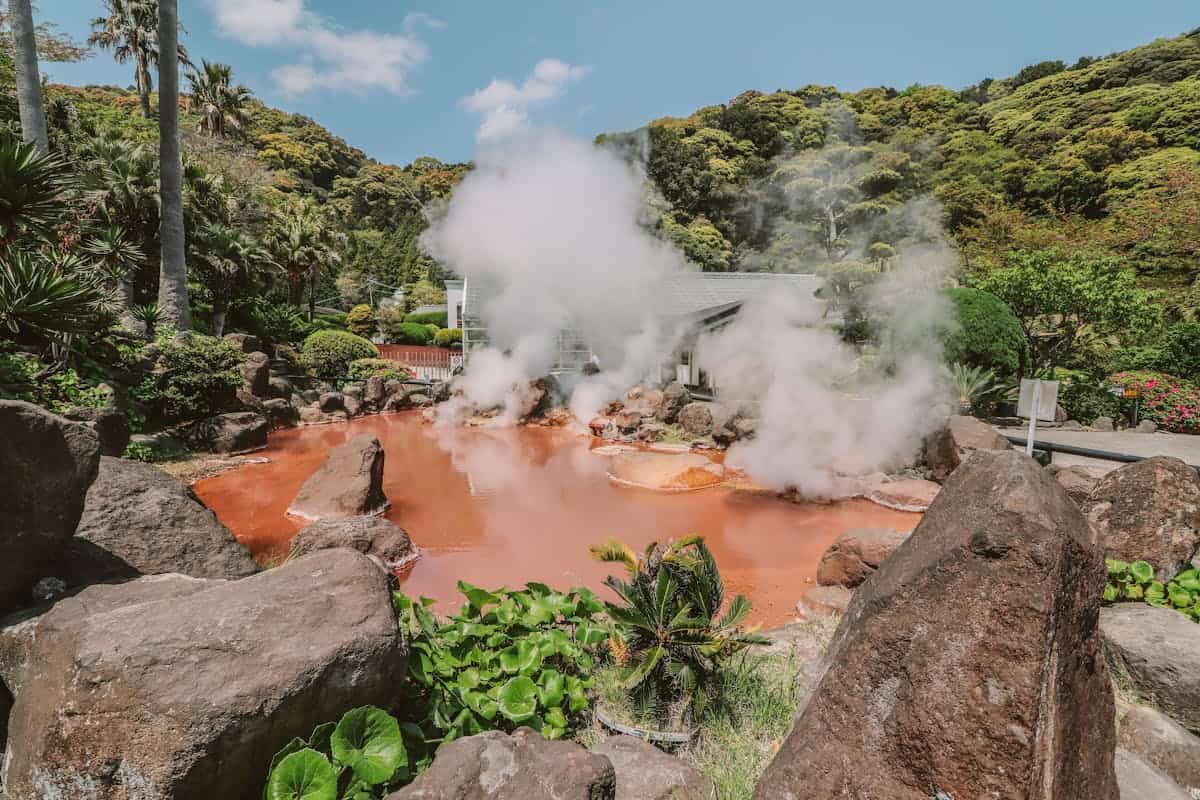
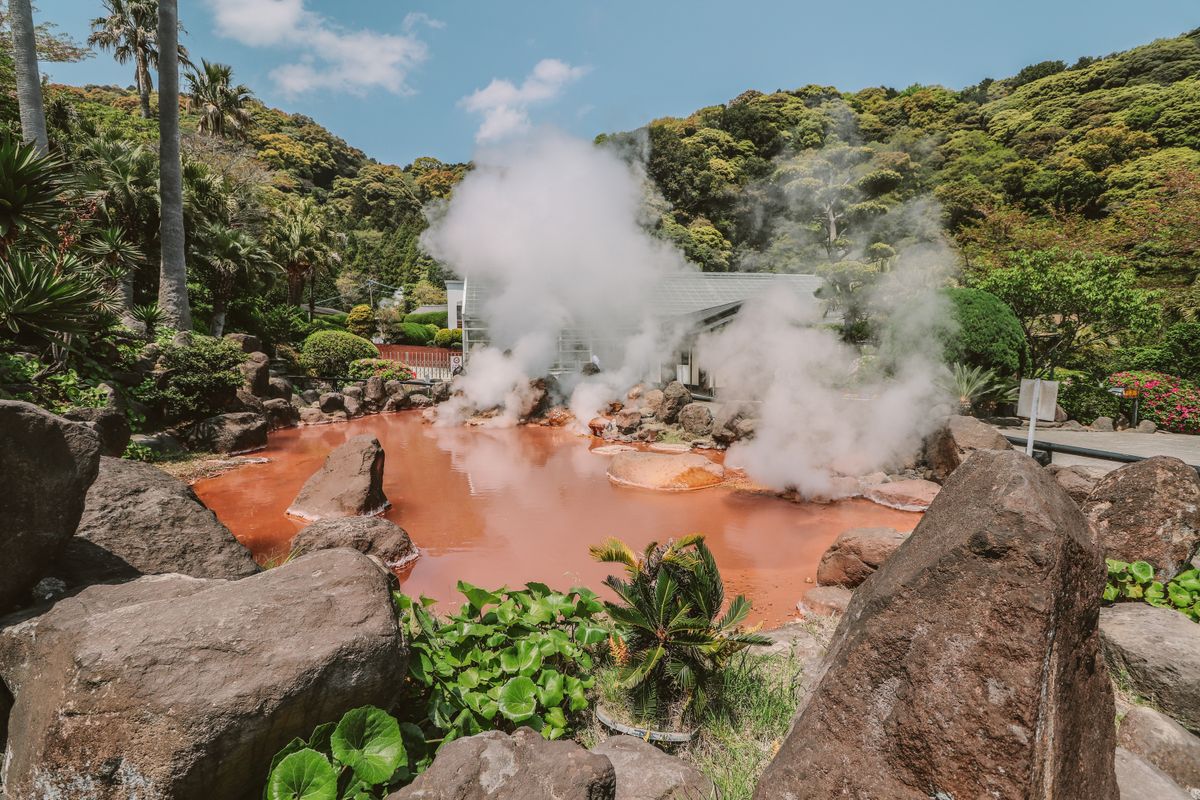
Located in the Shibaseki area, Chinoike Jigoku is the most visually dramatic of the eight hells — a blood-red pool that has been bubbling for over a thousand years. The distinctive red color comes from dissolved iron and magnesium oxide compounds in the water. At 78°C (172°F), the pool steams continuously, creating an atmosphere that does indeed evoke the Buddhist conception of hell. This is one of Japan’s oldest tourist attractions, documented in records dating back to 733 CE. The site sells “chi no ike cream” — a skin lotion made from the clay minerals extracted from the red water — said to be beneficial for skin conditions.
Tatsumaki Jigoku (Waterspout Hell)
The most dynamic of the eight hells, Tatsumaki Jigoku features a geyser that erupts regularly (approximately every 30-40 minutes), with a natural force that would send boiling water up to 50 meters (164 feet) into the air. The eruption lasts about 6-10 minutes. A stone barrier has been erected over the geyser to contain the eruption (the natural force would reach much higher). Timed perfectly, watching the eruption is one of Beppu’s most memorable moments. The schedule is posted at the entrance.
Kamado Jigoku (Cooking Pot Hell)
Kamado Jigoku is a multi-feature hell complex featuring several different colored pools, steam vents, and mud pots in a single landscaped area. The name comes from the old custom of using its steam to cook rice offerings for the festival of the local Kamado Hachiman Shrine; a large oni statue now stands on the cooking pot at the entrance. Visitors can experience onsen steam on their faces and dip their feet in a special footbath (ashiyu) heated by geothermal water. Tasting the water at a special taste-testing station is also permitted.
Oniboshi Bozu Jigoku (Shaved Head Hell)
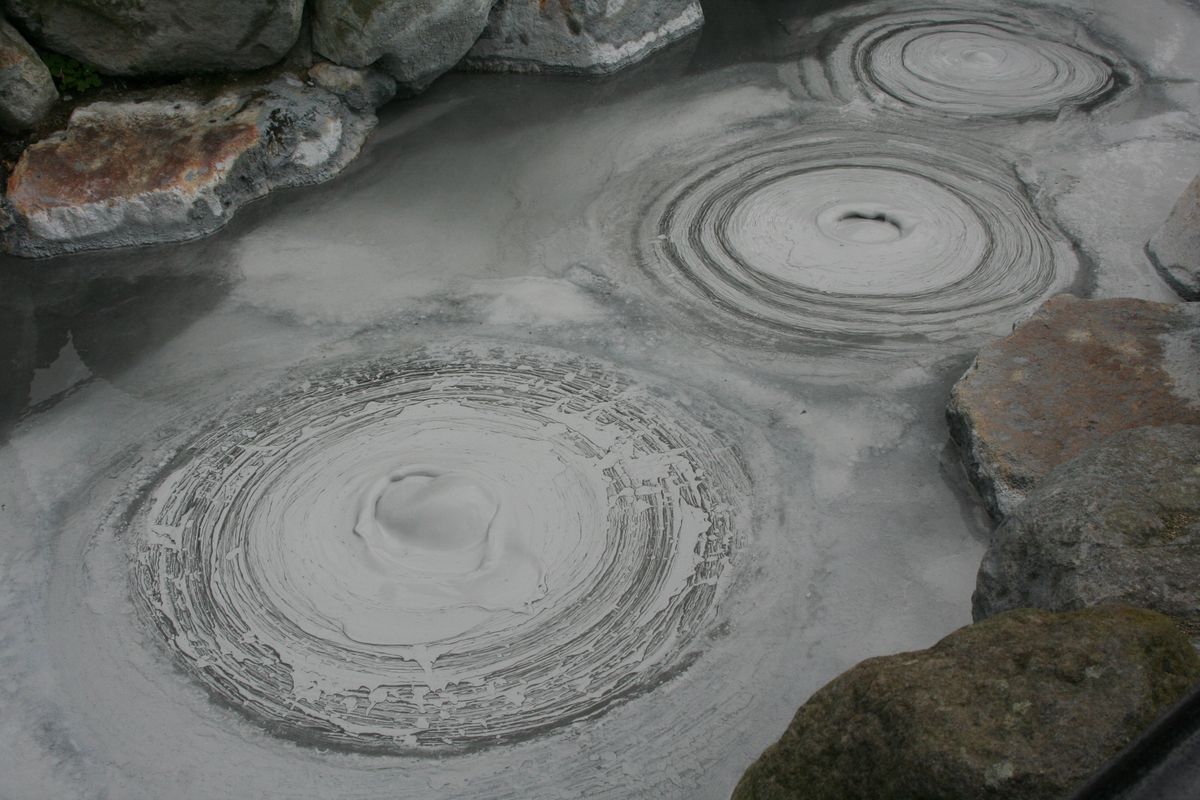
This hell takes its peculiar name from the gray mud bubbles that rise to the surface of the pool, popping and disappearing with a sound like a gentle exhalation. The tops of the mud bubbles, smooth and round before they pop, resemble the shaved heads of Buddhist monks (bozu). The gray mud circulates in lazy patterns beneath the surface. A footbath is available here as well.
Yama Jigoku (Mountain Hell)
Yama Jigoku is the smallest and most eclectic of the eight hells, featuring a small geothermal pool surrounded by a private zoo. Animals including hippopotamuses, flamingos, and various tropical birds are kept in enclosures heated by the natural geothermal energy. The zoo aspect makes this particularly popular with families with children, and the hippos — which use a geothermally heated pool to maintain their body temperature — are an unlikely delight.
Oniishi Bozu Jigoku (Demon Stone Shaved-Head Hell)
Located in the Kannawa area, Oniishi Bozu Jigoku is a cluster of bubbling gray mud pools in a compact garden setting. The gently bubbling mud creates smooth hemispheres at the surface before breaking. At 99°C (210°F), the mud pools are near boiling and the steam is substantial. Grilled eggs and vegetables prepared over the steam are sold at a small stall.
Beppu’s Unique Bathing Experiences
Sunamushi: Sand Bath at Beppu Beach
One of Beppu’s most distinctive and beloved experiences is the sunamushi (sand bath) at Shoningahama Beach. Unlike a regular hot spring bath, visitors are buried in naturally geothermally heated sand by attendants wielding wooden shovels, with only their heads protruding. The sand temperature is typically 43-45°C (109-113°F), heated from below by geothermal activity beneath the beach. Lying buried for 10-15 minutes induces deep sweating and a profound sense of heaviness and relaxation.
The experience ends with a shower to remove the sand, followed (at most facilities) by a traditional hot spring bath to complete the treatment. Yukatas (cotton robes) are provided and worn during the sand burial — bathing suits are not necessary. The main sand bath facility near the beach, now the Sand SPA in SHONIN PARK, charges ¥2,500 for adults and ¥1,800 for children aged 6–12, including the subsequent hot spring bath. Booking ahead on the website is recommended; walk-ins and same-day bookings are possible, though you may have to wait.
Doroyu: Mud Bath Experience
Beppu’s mud baths (doroyu) offer yet another distinctive onsen experience. The most accessible is at the Beppu Onsen Hoyo Land, where visitors can soak in naturally occurring thermal mud pools of varying depths and temperatures. The thick gray mud contains high concentrations of minerals and is believed to have beneficial effects on skin conditions, joint pain, and circulation. The sensation of floating in warm mud is unlike anything else — simultaneously heavy and weightless, earthy and luxurious.
The mud bath facility charges approximately ¥700-1,000 ($4.70-6.70 USD) for entry. Bathing is nude, as at most Japanese hot springs, and the outdoor mud bath is mixed-gender, so check the rules before you go. Facilities provide showers for rinsing afterward.
Mushi-yu: Steam Bath in Wooden Boxes
The mushi-yu (steam bath) is an ancient Japanese bathing tradition that has been preserved in Beppu’s traditional bathhouse districts. Bathers lie in a small stone steam room whose floor is covered with sekisho (sweet flag) leaves, heated by natural hot spring steam. Herbs are often placed on the floor of the box, infusing the steam with medicinal properties. The heat penetrates deeply, inducing sweating within minutes. Sessions typically last 10-15 minutes. The Kannawa district is home to Kannawa Mushiyu, a steam bath said to date back to the 13th century.
Beppu’s Neighborhoods and Districts
Kannawa: The Traditional Onsen Town
Kannawa is the atmospheric heart of traditional Beppu — a neighborhood of wooden bathhouses, narrow lanes paved with stone, and cooking stalls using geothermal steam to prepare local foods. The steam rising from manholes and building vents throughout the district creates a perpetually otherworldly atmosphere. Many of Beppu’s original public baths (called “kyodo-yu,” or community bathhouses) are concentrated here, with entrance fees of just ¥100-200 ($0.67-1.35 USD).
Kannawa is also famous for “jigoku mushi” — foods steamed in geothermal steam. Local restaurants and vendors offer steamed crab, sweet potato, chicken, pudding, and vegetables cooked using the natural steam. The Kannawa steam cooking experience is both delicious and unique — the steam’s mineral content is said to enhance the flavor of foods cooked in it.
Myoban District: Craftwork and Uncommon Springs
The Myoban district, situated on a hillside above central Beppu, is known for its production of “yu no hana” — crystallized mineral deposits scraped from the walls and surfaces of spring vents, used in home baths to replicate the mineral content of natural hot springs. The thatched-roof huts where yu no hana forms through the gradual crystallization of rising steam are a remarkable sight — white mineral deposits coat every surface in these small huts, and the product harvested here is sold throughout Japan as a premium bath additive. Visiting these huts is free.
The Myoban area also features several excellent ryokan with private open-air baths (rotenburo) overlooking the valley — some of the best accommodation experiences in Beppu.
Stay in a traditional ryokan with private hot spring: Book your hotel on Agoda (Best prices guaranteed) →
Food and Dining in Beppu
Toriten: Beppu’s Famous Chicken Tempura
Toriten is Oita Prefecture’s most beloved local dish — chicken pieces marinated in ginger and soy sauce, coated in a light tempura batter, and deep-fried until golden. Unlike most tempura, which uses a minimal batter, toriten has a more substantial coating that creates a satisfying crunch. It’s served with a ponzu dipping sauce and is ubiquitous in Beppu restaurants. A plate of toriten at a local restaurant costs approximately ¥600-1,200 ($4-8 USD).
Reimen: Cold Noodles with Korean Influence
Reflecting the continental cultural exchanges that shaped Kyushu over centuries, reimen is a cold noodle dish with Korean roots that has become a regional specialty. The dish features chewy noodles in an iced beef broth, typically topped with thin slices of pork or beef, kimchi, cucumber, a hard-boiled egg, and sometimes watermelon or apple. The contrast of the icy broth and spicy kimchi against the chewy noodles is refreshing and unusual. Reimen is particularly popular in summer but available year-round at specialty restaurants.
Onsen Tamago: Hot Spring Eggs
One of Beppu’s most iconic foods is onsen tamago — eggs slow-cooked in hot spring water at precisely controlled temperatures (70-75°C / 158-167°F) for 20-30 minutes. The result is a uniquely textured egg: the white is set to a silky, barely-firm consistency while the yolk remains semi-liquid and intensely rich. Onsen eggs are sold throughout the hell circuit and at Kannawa’s street stalls, typically for ¥50-100 ($0.33-0.67 USD) each. They’re eaten with a small amount of dashi broth and soy sauce.
Jigoku Mushi: Geothermal Steam Cooking
The ultimate Beppu culinary experience is jigoku mushi — cooking food directly in geothermal steam at facilities in the Kannawa district. The Jigoku Mushi Kobo Kannawa is a public cooking facility where visitors can purchase raw ingredients (or bring their own) and cook them in specially designed steam pits over natural hot spring steam. The cooking process is simple: place your food in a bamboo steamer, lower it into the pit, cover, and wait. Chicken takes about 15 minutes; sweet potato about 30 minutes; seafood varies. The steam-cooked food has a distinctive sweetness and mineral depth that regular steaming cannot replicate.
Explore Kyushu with a guided tour: Book Japan tours and activities on Klook →
Getting to Beppu
By Train from Fukuoka
Beppu is most easily reached from Fukuoka’s Hakata Station by the Sonic or Nichirin limited express trains operated by JR Kyushu. The journey takes approximately 2 hours and costs ¥4,700 (approximately $31.60 USD) for the standard reserved seat fare. The Sonic trains are comfortable with wide seats and panoramic windows. The Kyushu Rail Pass covers this journey, making it excellent value for those exploring the island extensively.
From Kumamoto, the journey to Beppu takes approximately 2.5-3 hours by Kyushu Shinkansen to Hakata followed by Sonic express, or by direct limited express across Aso via the Hohi Line. From Nagasaki, the journey takes approximately 3.5 hours with a change at Hakata.
By Bus
Highway buses run between Fukuoka (Hakata Bus Terminal) and Beppu, with the journey taking approximately 2.5-3 hours and fares starting at ¥3,000 (approximately $20 USD) one way, or significantly cheaper with advance online booking. Night buses are also available, allowing you to travel overnight and arrive in Beppu refreshed. Beppu’s main bus terminal is adjacent to the train station in the city center.
By Air
The nearest airport to Beppu is Oita Airport, located approximately 40 minutes north of the city by airport bus. All Nippon Airways (ANA) and Japan Airlines (JAL) operate flights between Oita and Tokyo Haneda, with the journey taking approximately 1 hour 20 minutes. Fares vary widely — advance purchase tickets can be found for ¥10,000-18,000 ($67-121 USD) one way, while last-minute fares may exceed ¥30,000 ($202 USD). Airport buses from Oita Airport to Beppu Station cost ¥1,500 (approximately $10 USD).
Get connected across Japan with a reliable eSIM: Get your Japan eSIM (Stay connected from day 1) →
Getting Around Beppu
Beppu’s main tourist areas are spread across a fairly wide geographic area, making some form of transportation between districts necessary. Options include:
Local buses (Kamenoi Bus): Beppu’s local bus network is comprehensive and affordable. The Kamenoi Bus “My Beppu Free” day pass costs ¥1,200 (approximately $8 USD) for the full city network and is the most economical option for visiting multiple onsen districts and attractions. Buses depart from Beppu Station and run to Kannawa, Myoban, the hell circuit, and the beach sand bath area.
Taxi: Taxis are readily available from Beppu Station. A taxi to Kannawa takes approximately 15 minutes and costs ¥1,500-2,000 ($10-13.50 USD). Taxis can also be chartered for a customized hell circuit tour — ask at your accommodation for recommended drivers who speak English.
Rental bicycle or e-bike: The flat area near the beach and city center can be explored by bicycle, though the hills leading up to Kannawa and Myoban make e-bikes much more practical than regular bicycles. Rental shops near Beppu Station offer e-bikes for approximately ¥1,000-2,000 ($6.70-13.50 USD) per day.
Ropeway: The Beppu Ropeway ascends from the urban area to Mt. Tsurumi (1,375 meters / 4,511 feet), offering panoramic views over Beppu Bay and the surrounding geothermal landscape. Round-trip ropeway fare: ¥1,800 (approximately $12 USD). Open daily except certain maintenance days.
Best Time to Visit Beppu
Spring (March-May) is an excellent time to visit. The cherry blossoms bloom in late March to early April, and the contrast of pink blossoms against rising white steam is particularly photogenic in Kannawa’s traditional neighborhoods. Temperatures are comfortable for onsen-hopping, and the humidity is lower than in summer.
Summer (June-August) is hot and humid but offers the unique appeal of the beach sand baths and the sea breeze from Beppu Bay. The Oita Tanabata Festival in neighbouring Oita City in early August is an easy evening trip. Some onsen visitors find the extreme summer heat intensifies the onsen experience in an enjoyable way.
Autumn (September-November) is arguably the best season for onsen tourism. Temperatures cool to ideal bathing range, autumn foliage colors the mountain slopes around the city in late October to November, and the crowds are smaller than in spring and summer. The Mt. Tsurumi ropeway offers spectacular autumn colors.
Winter (December-February) is prime onsen season in Japan. Soaking in hot mineral waters while cold air surrounds you is the quintessential winter onsen experience. Snow occasionally falls on Mt. Tsurumi, creating a stunning backdrop for the steam-shrouded cityscape below. Winter weekdays see the smallest crowds of the year.
Where to Stay in Beppu
Staying in a ryokan with its own hot spring (onsen-tsuki ryokan) is the quintessential Beppu experience. The ryokan stay typically includes a multi-course kaiseki dinner served in your room, a traditional breakfast, and unlimited access to the private hot spring baths. Prices range from ¥10,000 to ¥40,000+ per person per night including meals.
The Myoban district offers several excellent ryokan with open-air baths and dramatic hillside views, including Yama no Yu and Onikko-ichi. The Kannawa district has traditional style ryokan immersed in steam town atmosphere. The beach area near Shoningahama has larger resort-style hotels with multiple bath types and direct access to the sand baths.
For budget travelers, Beppu has numerous guesthouses and pension-style accommodations offering simpler rooms with access to shared hot spring baths. Some public bath facilities offer overnight accommodation for very low prices — a traditional “toji” (therapeutic bathing retreat) experience that was historically used by sick people who traveled to Beppu for extended mineral water treatments.
Find the perfect ryokan with hot spring access: Find luxury hotels and ryokan on Agoda →
Day Trips from Beppu
Yufuin: Chic Spa Town in the Mountains
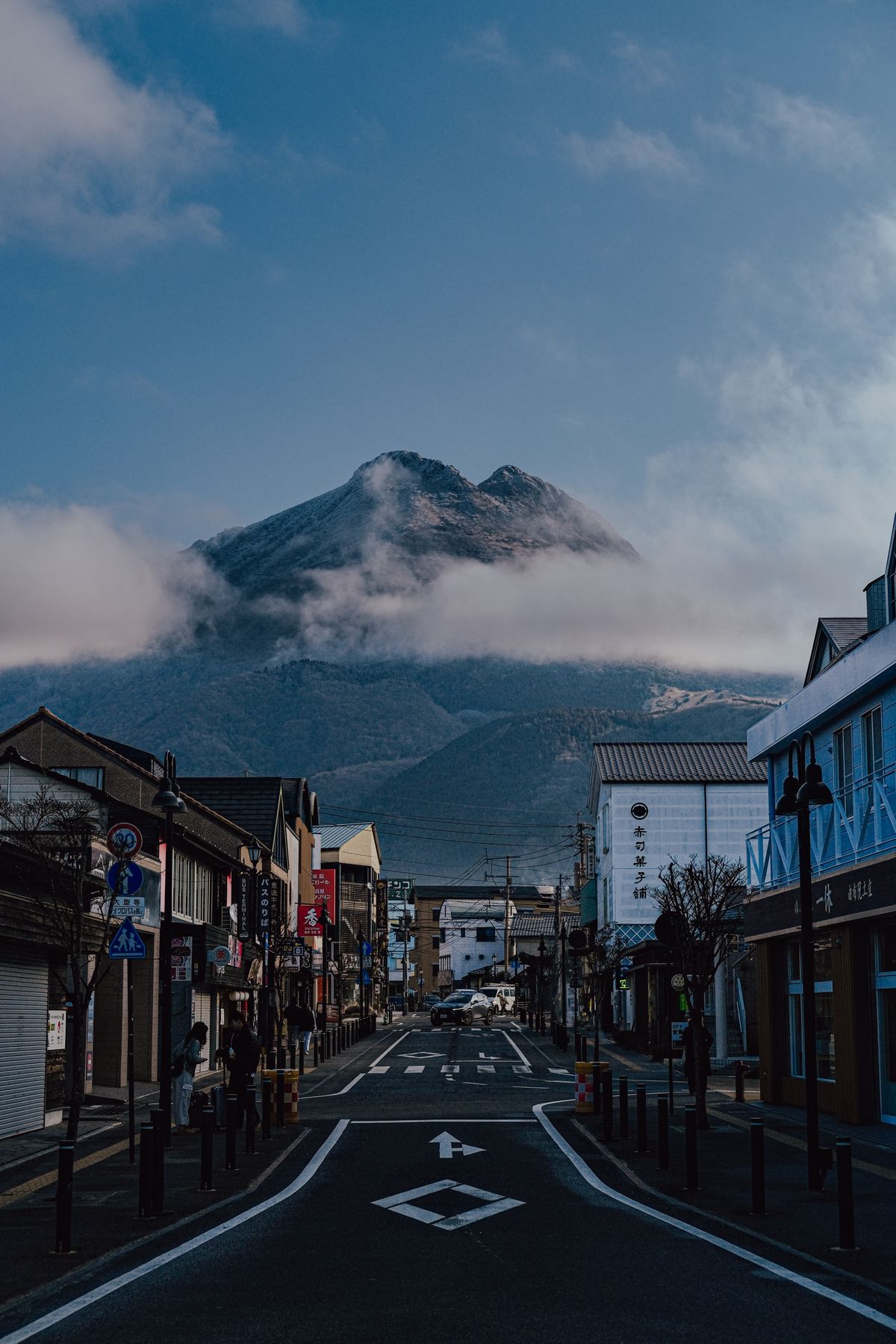
Just 45-60 minutes from Beppu by train or bus, Yufuin is Beppu’s quieter, more upscale neighbor — a fashionable spa resort town set in a mountain basin at the foot of Mt. Yufu. Where Beppu is raw and dramatic, Yufuin is refined and atmospheric, with boutique ryokan, artisan shops, galleries, and lakeside cafes strung along a picturesque main street (Yunotsubo Kaido). Lake Kinrinko at the center of town steams gently in cool weather, creating a mystical fog effect at dawn.
Yufuin is particularly popular with Japanese domestic tourists and couples seeking a romantic weekend retreat. The town’s two main streets — Yufuincho Yunotsubo Kaido and the lakeside path — are lined with shops selling local cheeses, craft items, and regional foods. Admission to Yufuin’s many galleries and small museums ranges from ¥200-800 ($1.35-5.40 USD).
Usa Shrine: Japan’s Most Important Hachiman Shrine
Located about 40 minutes north of Beppu by train, Usa Shrine (Usa Jingu) is the head shrine of the approximately 40,000 Hachiman shrines across Japan. Hachiman is the Shinto deity of archery, war, and culture, and was historically the tutelary deity of the imperial family and samurai warriors. The shrine complex, set in a forested hillside landscape, is remarkable for its size and spiritual atmosphere. The main shrine buildings, painted in the characteristic vermilion of Hachiman shrines, date from repeated reconstructions of the original 725 CE foundation. Admission: free.
Practical Tips for Visiting Beppu
Onsen Etiquette
If this is your first time at a Japanese onsen, some basic etiquette ensures a smooth experience. Bathe before entering the communal pool — all facilities have shower stations for rinsing off before soaking. Tattoos are not permitted in most traditional Japanese hot spring facilities, though some are tattoo-friendly (ask beforehand or look for “tattoo OK” signage). Swimwear is not worn in traditional hot springs; the mud bath and some tourist-oriented facilities are exceptions. Small towels are used to cover the body when walking between the shower and the bath, but should not enter the water itself. Mobile phones and cameras are not permitted in bathing areas. Speak quietly and avoid splashing.
What to Pack
Bring a small towel for onsen visits (most facilities sell or rent them for ¥50-200 / $0.33-1.35 USD). Flip-flops or sandals are convenient for moving between indoor and outdoor bath areas. If doing the sand bath, wear older underwear or a swimsuit that you don’t mind getting sandy. Light, loose clothing like a jinbei (summer wear) or casual trousers are ideal for walking between onsen in the summer heat. The Myoban and Kannawa districts involve some walking on uneven stone paths, so comfortable walking shoes are essential.
Costs and Budgeting
Beppu is one of Japan’s most affordable onsen destinations. A comfortable two-day visit budget for one person: ryokan accommodation with meals ¥15,000-25,000 ($101-168 USD) per night, eight hells combined ticket ¥2,000 ($13.50 USD), sand bath ¥1,500 ($10 USD), local buses ¥1,200 ($8 USD) day pass, meals outside the ryokan ¥2,000-4,000 ($13.50-27 USD) per day. Total for a two-day trip with comfortable ryokan accommodation: approximately ¥40,000-60,000 ($269-404 USD) per person, including a memorable kaiseki dinner.
Frequently Asked Questions About Beppu
How many days should I spend in Beppu?
Two days is the minimum for a satisfying Beppu experience — one day for the eight hells circuit and some onsen bathing, and a second day for the sand bath, Kannawa district exploration, and more onsen. Three days allows for a day trip to Yufuin and a more relaxed pace with multiple different bath types. Combining Beppu with Yufuin as a three to four day Oita Prefecture experience is ideal for onsen enthusiasts.
Are Beppu’s onsen suitable for first-timers?
Absolutely. Beppu’s long tradition of welcoming visitors includes excellent facilities for first-time onsen users, many with English signage and friendly staff accustomed to international guests. The sand bath is particularly non-intimidating for beginners as it involves lying fully clothed (in yukata) rather than nude bathing. Starting with the beach area facilities or one of the larger tourist-oriented bathhouses eases newcomers in gently. The eight hells circuit requires no bathing at all and is purely visual, making it accessible for everyone.
Can children visit Beppu’s onsen?
Yes, children are welcome at most Beppu onsen, though individual facilities have their own rules on minimum ages (particularly for hot temperatures). The eight hells are suitable for children of all ages, and the Yama Jigoku with its small zoo is particularly popular with families. The sand bath at the main beach facility has a minimum age of 6, so children aged 5 and under cannot use it, and children’s sections with lower heat levels are sometimes available. The Beppu Rakutenchi amusement park on a hillside above the city offers a full day of family entertainment separate from the onsen culture.
Do Beppu’s onsen help with health conditions?
Japanese onsen culture has a long tradition of therapeutic bathing (toji), and many of Beppu’s springs are believed to benefit specific conditions. The mineral content of various springs may help with rheumatism, skin conditions, circulation issues, and fatigue. However, people with high blood pressure, heart conditions, or recent illnesses should consult their doctor before extended hot spring bathing and should avoid very high-temperature baths. The cooler footbaths (ashiyu) available at several locations are suitable for almost everyone and provide gentle relaxation benefits.
What should I do in Beppu at night?
Beppu’s nightlife centers on the onsen culture — evening and late-night bathing is the primary evening activity. Many public baths remain open until 9-11 PM, and ryokan guests often take multiple baths throughout the evening. The Ekimae district near Beppu Station has izakaya (Japanese pub) restaurants serving local food and drinks until midnight. The Kannawa district’s steam-lit lanes are particularly atmospheric at night, with the rising steam illuminated by streetlamps creating an otherworldly ambiance. Night photography of the steaming city is a popular activity for visitors with cameras.
Book your Beppu adventure today: Book your hotel on Agoda (Best prices guaranteed) →
Beppu’s Cultural Attractions Beyond the Onsen
While onsen is undeniably Beppu’s primary draw, the city has cultural offerings that reward those who look beyond the hot springs. The Beppu City Traditional Bamboo Crafts Center showcases the extraordinary bamboo weaving tradition (Beppu bambooware, or Beppu take-zaiku) that has been practiced here for centuries. Oita Prefecture’s abundant bamboo forests supply raw material for baskets, trays, furniture, and decorative objects woven by master craftspeople whose techniques are designated as Important Intangible Cultural Properties. The center offers workshops where visitors can try bamboo weaving for approximately ¥1,500 ($10 USD).
B-Con Plaza, Beppu’s international convention center, has the Global Tower observation deck with views over the city and bay. The adjacent Beppu Tower, though no longer the tallest structure in the city, offers nostalgic views from its observation deck and is illuminated in seasonal colors at night. Beppu’s traditional shopping street, Ekimae Itchome, has resisted the full-scale chain store takeover that has homogenized many Japanese shopping districts and retains a locally owned, slightly vintage character that reflects the city’s unhurried pace.
The Beppu Museum houses a collection of local historical artifacts, folk objects, and documents relating to Beppu’s development as an onsen resort destination from the Meiji period (1868-1912) onward. Particularly interesting are the photographs and promotional materials from the early 20th century, when Beppu was actively marketed as “the Naples of the Orient” to attract Japanese and international tourists during Japan’s initial industrial prosperity. Admission: ¥300 (approximately $2 USD).
Beppu’s Hot Spring Festivals and Seasonal Events
Beppu’s calendar of events naturally revolves around its hot spring heritage. The Beppu Hatto Onsen Festival (April) is the city’s biggest annual event, celebrating the eight hot spring districts with open-air performances, food stalls, torch-lit processions, and special free admission to normally paid public baths. The festival draws visitors from across Kyushu and Japan, and the Kannawa district’s evening events — steam-lit ceremonies at the historic public bathhouses — are particularly atmospheric.
The Beppu Onsen Illumination (December through February) transforms the city’s famous steam vents and geothermal areas with colored lighting, creating surreal night-time landscapes. The illuminations are concentrated in the Kannawa district and along the seafront promenade. Winter is considered the ideal season for this event because the cold air makes the rising steam more visible and dramatically backlit. The combination of geothermal steam and illumination creates photography opportunities unlike anything else in Japan.
The Oita International Wheelchair Marathon (October/November) has been held in Beppu and Oita since 1981 and is one of the world’s most prestigious wheelchair sports events. The marathon course runs through central Beppu and along the coastal road, and thousands of spectators line the streets to cheer participants from dozens of countries. The event reflects the city’s long tradition of welcoming visitors seeking therapeutic bathing — a tradition that naturally extended into accessible tourism and inclusive sports culture.
Shopping in Beppu
Shopping in Beppu centers on onsen-related products and regional specialties. Yu no hana (hot spring flower) bath salts harvested from the Myoban district are the quintessential Beppu souvenir — these crystallized mineral deposits dissolved in home baths replicate the mineral content of Beppu’s natural springs. Available in multiple spring type varieties (sulfur, bicarbonate, etc.), they make a thoughtful and genuinely distinctive gift.
Beppu bambooware (take-zaiku) makes a more substantial and beautiful souvenir for those with luggage space — baskets, placemats, sake cup holders, and decorative objects woven with extraordinary precision from locally harvested bamboo strips. The Traditional Bamboo Crafts Center’s shop carries a wide selection at fair prices, and smaller craft shops in the Kannawa district also stock quality pieces.
Local food souvenirs worth seeking out include kabosu products — the kabosu citrus fruit, grown almost exclusively in Oita Prefecture, is the region’s most distinctive agricultural product. Its tart, fragrant juice is used as a condiment for fish, hot pot, and noodles, and kabosu ponzu, jam, and juice products make excellent gifts. Jakoten (deep-fried fish cake), a specialty of Ehime in nearby Shikoku, is available vacuum-packed at many shops and travels well.
The covered shopping arcades near Beppu Station offer everyday goods, local food specialties, and souvenir shops in a casual environment. The Tokiwa Department Store near the station is the city’s largest, with dedicated floors for regional foods and gifts. For a more atmospheric shopping experience, the streets of Kannawa have several small shops selling artisanal products alongside the steam-cooking stalls.
Beppu is a city that gets under your skin — literally. The mineral-rich waters soften it, the radiant heat relaxes every muscle, and the otherworldly spectacle of a city steaming from every surface leaves an indelible impression. Whether you’re a seasoned Japan traveler seeking authentic onsen culture, a curious first-timer ready for something unlike anything in your experience, or a food lover eager to taste jigoku mushi and toriten, Beppu rewards every visitor with something genuinely unique. There is, quite simply, nowhere else in the world quite like it.
Related guides
- Tomonoura Travel Guide 2026: A First-Timer’s Guide to Japan’s Best-Preserved Edo-Era Port Town in Hiroshima
- Chichibu Travel Guide 2026: A First-Timer’s Guide to Shibazakura, a Sacred Wolf Shrine, and Tokyo’s Best Mountain Day Trip in Saitama
- Kirishima Travel Guide 2026: A First-Timer’s Guide to Sacred Shrines, Volcanic Trails, and Kyushu’s Best Onsen in Kagoshima
Going to Japan? Speak Japanese with confidence.
Hirameki Japanese — camera translate for menus and signs, a two-way conversation mode, and furigana + romaji on every phrase. Free to download with kana charts, conversation mode and starter words; a one-time purchase unlocks everything.

Plan your Japan trip
Two things every first-timer should book
Some links are affiliate links. If you book through them we may earn a small commission at no extra cost to you.