
If you live in Japan, or spend long stretches here, you may hear about high-yield investment products linked to Dubai. Some are marketed through personal introductions, seminars and LINE groups, with advertised target returns and scheduled monthly distributions. These should not be confused with guaranteed returns.
One product marketed in Japan is ADICO Owners Club, which the ADIF group describes as a membership-interest investment scheme. ADIF also states that it is the sole appointed agent in Japan for the Dubai-based AIX Investment Group. This describes an appointment by AIX, not regulatory approval. Below, we use “AIX” as a collective reference to the group, and name the specific legal entity wherever a source identifies it.
Reports published in September 2026 described claims against companies in the AIX group and related companies in Dubai’s DIFC Courts, and a separate winding-up petition against AIX Secure SPV Ltd in the Cayman Islands. The Cayman regulator also issued a public notice about that company.
This guide separates what companies and regulators have stated, what the media has reported, and what is still unknown, and explains what to check if you hold, or are being offered, one of these products. Everything here is based on public information available as of October 17, 2026.
Key points as of October 17, 2026
- AIX Secure SPV Ltd, an AIX bond issuer, says a “limited part” of AIX’s products has been affected, that most products are unaffected, and that it has hired restructuring advisers.
- AGBI reports two claims totaling almost $10 million against companies in the AIX group and related companies in the DIFC Courts. Both were pending as of its September 29 report.
- Global Restructuring Review reports a winding-up petition against AIX Secure SPV Ltd in the Cayman Islands. A petition is a request for a court order, not an order placing the company into liquidation.
- The Cayman Islands Monetary Authority (CIMA) says that company has never been authorised by it to conduct securities investment business in or from within the Cayman Islands.
- Whether distributions to investors in Japan have stopped could not be confirmed from public information.
AIX-related developments reported by October 17, 2026
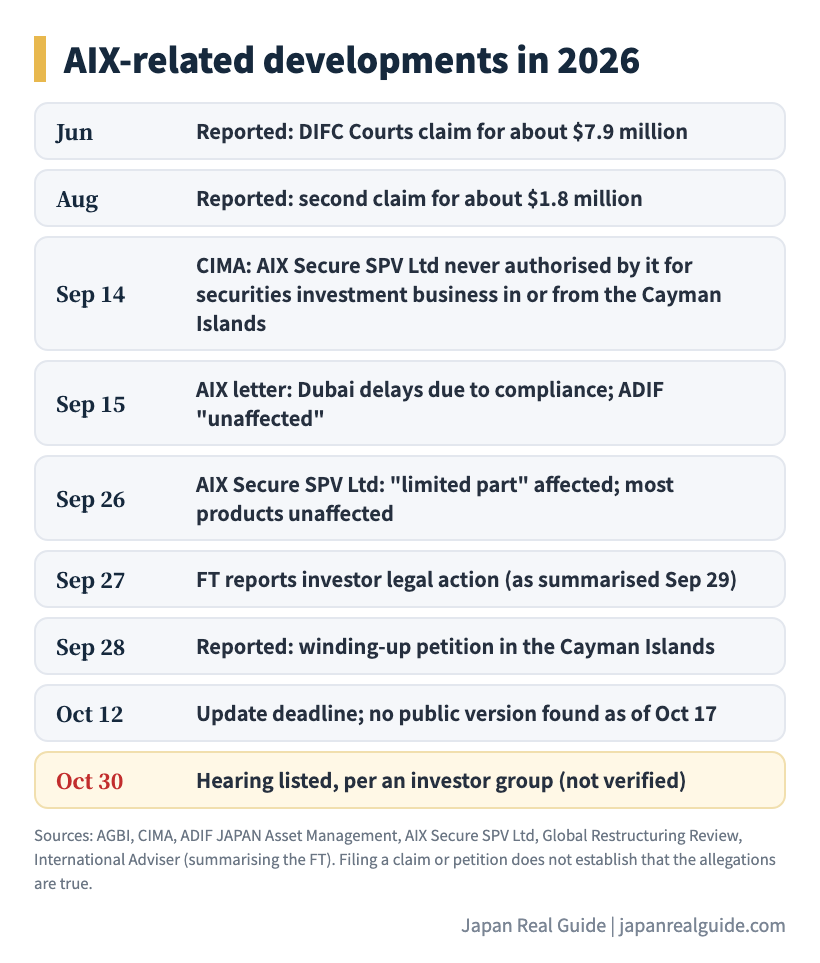
June and August (reported): AGBI, a Gulf business outlet, reported two claims in the DIFC Courts against companies in the AIX group and related companies: one filed in June for AED 29 million (about $7.9 million), alleging missed payments due in November 2025, and one filed in August for about $1.8 million. AGBI said on September 29 that both were pending and that the allegations had not been determined. We have not confirmed any later court decision.
September 14 (regulator notice): CIMA issued a public notice “in response to multiple complaints” about references to the company’s purported regulation in the Cayman Islands. It said AIX Secure SPV Ltd “is not, and has never been, registered, licensed, regulated, or otherwise authorised by the Authority to conduct securities investment business in or from within the Cayman Islands,” and advised caution where representations are made about its regulatory status there. The notice addresses the company’s status with CIMA. It is not a finding about whether any particular transaction was unlawful.
September 15 (AIX letter): In a letter to ADIF investors, AIX attributed delays in its Dubai operations to enhanced compliance procedures. It stated that “ADIF maintains its distinct operational focus and remains unaffected by these Dubai-related compliance measures.” ADIF’s Japanese asset management company published the letter on September 18.
September 26 (company statement): AIX Secure SPV Ltd said market volatility had “affected valuations and investment realisation cycles within a limited part of AIX’s product offering.” It said the majority of AIX’s products and their underlying investments were unaffected and that AIX continued to meet its obligations to investors in those products. It also said it had appointed international law firms and restructuring advisers, and that it would give investors a “substantive update” no later than October 12.
September 27 (reported): The Financial Times reported that investors were taking legal action against AIX over delayed or missing payouts. The FT article is paywalled; we rely on International Adviser’s September 29 summary of it.
September 28 (report on a late-September petition): Global Restructuring Review reported that a noteholder had petitioned the Grand Court of the Cayman Islands to wind up AIX Secure SPV Ltd, alleging that coupon payments had stopped and that maturing principal had not been repaid. Filing a petition does not establish that the allegations are true, and even if a liquidation is ordered, how much creditors recover is a separate question.
October 12: The deadline AIX Secure SPV Ltd set for its investor update. As of October 17, we could not find a public version. Whether investors received it privately could not be confirmed.
October 30 (scheduled): An investor group says the petition hearing is listed for this date. We have not independently verified this against the court listing, and dates can change.
How AIX-linked products reach investors in Japan
According to ADIF’s own documents, its Japanese products “ADICO Owners Club” and “Dubai Investor” are membership interests in Japanese limited liability companies (godo kaisha), not bonds. Investors acquire membership interests in a Japanese company, and ADIF’s January 2026 report describes how the money is then allocated.
That report says that 50% or more of investors’ contributions is routed through a Panama-incorporated company, which it describes as the ADIF group’s fund management company, into sukuk issued by AIX. Sukuk are instruments commonly referred to as Islamic bonds, and their legal and payment structures can differ from conventional bonds. The report says the remainder goes to a Japanese company responsible for operations and administration, to cover selling, general and administrative expenses, including advertising.
ADIF states that distributions to investors are funded solely by income from the AIX-issued instruments, rather than by contributions from new investors. We have not independently verified those cash flows. On ADIF’s own description, whether payments on the underlying AIX-issued instruments continue is relevant to distributions under the Japanese schemes, though it is not the only factor. Whether the Japanese money sits in the “limited part” of products that AIX Secure SPV Ltd says was affected is not public.
A September 2024 brochure for Dubai Investor (not necessarily today’s terms, or ADICO Owners Club’s) lists a minimum of 500,000 yen per unit, a target return of 9.6% a year before tax, and monthly distributions starting in the fourth month. It describes an initial four-year term, followed by automatic one-year renewals unless a cancellation request is made, and says repayment is due within two months after the contract ends. Submitting a cancellation request and receiving repayment are separate steps. The brochure also states that the target return is not a guarantee.
The same 2024 brochure says that all contributions are sent to AIX via ADIF GROUP. The January 2026 report describes the allocation differently, including a portion for sales and administrative expenses. The documents quoted here do not establish how that difference applies to any particular investor’s contract.
What Japanese regulators have said
ADIF JAPAN Asset Management appears on the Financial Services Agency’s (FSA) list of financial instruments business operators dated August 31, 2026, under registration number 1877 issued by the Director-General of the Kanto Local Finance Bureau. That registration does not mean the regulator vouches for products handled by other group companies or for individual sales pitches.
We found no entry under the names ADIF, ADICO or AIX in the FSA’s warning list of unregistered operators that we checked on October 17, 2026. This was not an exhaustive search of every Japanese authority’s publications, and absence from a list is not proof that everything is in order.
The FSA publishes a general warning about solicitations for membership interests in godo kaisha. It explains that when someone other than the company’s executive members, including employees, is involved in soliciting such interests and does so as a business, registration as a financial instruments business operator is required. ADIF states that, based on its legal advisers’ opinion, its own solicitation structure does not constitute financial instruments business requiring registration. That is ADIF’s stated legal position; this article does not determine whether any particular solicitation complies with Japanese law.
The materials discussed here do not establish that ADICO, ADIF or AIX has engaged in fraud. The regulatory notice, the civil claims and the winding-up petition address different issues and should not be treated as findings of fraud.
If you already hold one of these products
- Check every distribution. Compare the payment terms in your contract with the notices you receive and the amounts that actually arrive, and record each month. A target return is not necessarily an amount the company is obliged to pay.
- Re-read your contract. Confirm the exact legal entity you contracted with, the notice required to prevent renewal, whether early withdrawal is permitted, and when repayment becomes due.
- Ask in writing. Email the seller and ask which underlying AIX-issued instrument your investment is exposed to, through which legal entities, and whether it is among those AIX Secure SPV Ltd says were affected. Keep the replies.
- Save your evidence. Contracts, transfer records, LINE messages, brochures and seminar links can disappear.
- Pause new money and referrals. Do not add units or introduce friends until the situation is clear.
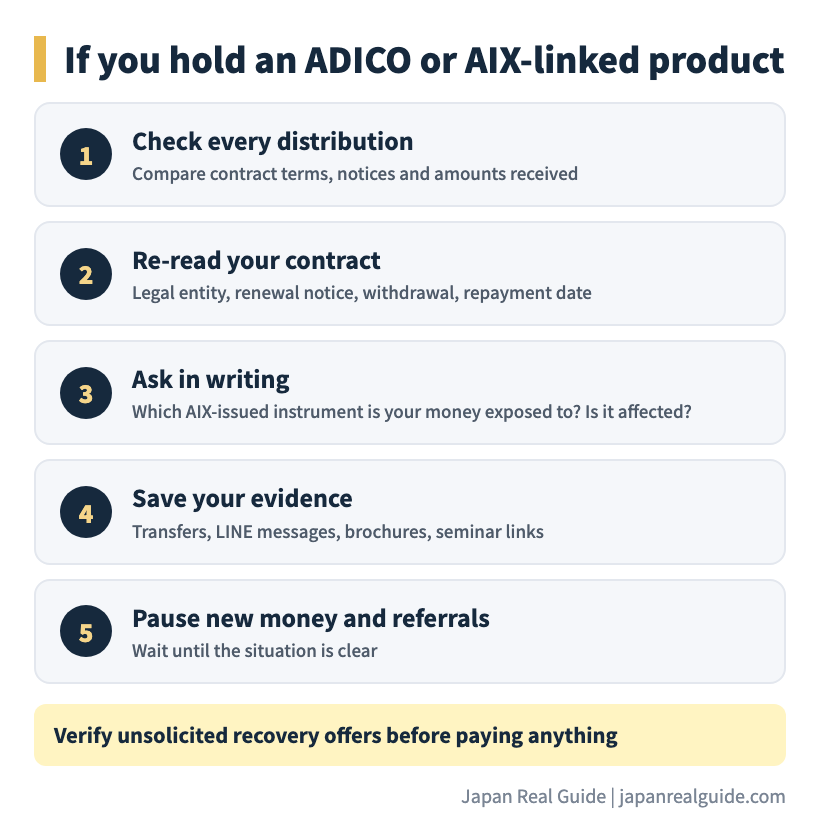
Be cautious with unsolicited recovery offers. When an investment runs into trouble, offers to recover losses often appear, sometimes asking for upfront payments or personal information. Verify the provider’s identity and professional credentials, and seek independent advice before paying anything.
Where to get help in Japan
- Consumer Hotline: dial 188 for connection to a nearby consumer affairs center or other local consumer consultation service. The hotline is available in Japanese.
- FSA Counseling Office for Financial Services Users: 0570-016811 (03-5251-6811 from IP phones), in Japanese. It receives inquiries and complaints and provides guidance, but does not resolve individual disputes or order repayment.
- Houterasu Multilingual Information Service: 0570-078377, weekdays 9:00 to 17:00. An interpreter helps you get information about Japan’s legal system and relevant consultation services, including in English. It does not itself give case-specific legal advice.
- For advice on your contractual rights, withdrawal options or repayment claims, consult a lawyer.
If someone offers you a Dubai-linked investment in Japan
The person offering it may be a friend who honestly believes in it. That is exactly why it helps to separate the person from the product. Before you send any money, get clear answers to three questions:
- Which company and which instrument will my money finally be exposed to, and through which legal entities?
- For the issuer, the company I contract with and the company soliciting me, which regulator in which country has registered or authorised them, and for what business? What documents show this?
- If distributions stop or the investment fails, what contractual rights do I have, against which legal entity, and what risks or limits apply to getting my money back?
Registration or authorisation does not guarantee that a product is safe or that your principal will be returned. If the answers are vague, it is fine to say no.
Going to Japan? Speak Japanese with confidence.
Hirameki Japanese — camera translate for menus and signs, a two-way conversation mode, and furigana + romaji on every phrase. Free to download with kana charts, conversation mode and starter words; a one-time purchase unlocks everything.
Sources
- Cayman Islands Monetary Authority, “AIX Secure SPV Ltd – Not Regulated by CIMA,” September 14, 2026
- AIX, “Statement from AIX Secure SPV Ltd,” September 26, 2026
- ADIF JAPAN Asset Management, notice relaying AIX’s September 15 letter, September 18, 2026 (Japanese and English)
- ADIF Group report on its investment business, January 19, 2026 (Japanese)
- ADIF JAPAN GK, Dubai Investor brochure, September 2024 (Japanese)
- AGBI, “Dubai’s AIX faces $10m claims over alleged missed payments,” September 29, 2026
- International Adviser, “Investors take legal action against Dubai investment group,” September 29, 2026, summarising Financial Times reporting dated September 27, 2026. We have not reviewed the full FT article.
- Global Restructuring Review, “AIX faces Cayman liquidation over alleged investor payment failures,” September 28, 2026 (paywall)
- AIX Investors United (investor group), winding-up petition page
- FSA, lists of licensed and registered operators (financial instruments business operators dated August 31, 2026)
- FSA, warning list of unregistered operators (checked October 17, 2026; Japanese)
- FSA, warning on solicitations for godo kaisha membership interests (Japanese)
- Consumer Affairs Agency, Consumer Hotline 188 (Japanese)
- FSA, Counseling Office for Financial Services Users (Japanese)
- Houterasu (Japan Legal Support Center)
This article is based on public information available as of October 17, 2026. It does not judge whether any company or product is illegal or fraudulent. Filing a claim or petition does not establish that the allegations are true. This is general information, not financial or legal advice.

Plan your Japan trip
Two things every first-timer should book
Some links are affiliate links. If you book through them we may earn a small commission at no extra cost to you.