In this guide
- How much Japanese you actually need
- How to pronounce Japanese in two minutes
- The 16 phrases that do most of the work
- Phrases you will hear, and how to answer
- At restaurants and izakaya
- Shopping with almost no Japanese
- At the konbini
- Tax-free shopping from November 2026
- Trains, buses and taxis
- Sightseeing, temples and photos
- At your hotel or ryokan
- How to ask for help
- Feeling unwell: pharmacies and clinics
- If you lose something
- Emergency numbers and phrases
- Numbers, money and counting people
- Small phrases that show good manners
- Learn them before you go
- Frequently asked questions
- Plan the rest of your trip
How much Japanese you actually need
Less than you might fear. JNTO, Japan’s national tourism organization, says English is generally understood in tourist areas, airports, hotels and on major transport, though not always in rural areas or small shops. Stations in the big cities have English signs, and most chain restaurants and shops show prices clearly.
Language is still the second most common problem visitors report. In a Japan Tourism Agency survey of 4,110 departing visitors (November 2025 to January 2026), 15.4% said communicating with staff had been a problem, behind only the lack of rubbish bins (17.2%). The fix is not fluency. It is a small set of phrases you can say with confidence, plus a translation app for everything else. Our guide to the best translation apps for Japan covers the app side.
A few phrases also change the tone of an exchange. Opening with “sumimasen” and closing with “arigatō gozaimasu” signals respect, and staff respond to that effort even when the rest of the conversation happens through a phone screen.
How to pronounce Japanese in two minutes
Japanese pronunciation is friendlier than it looks. The romaji (Latin letters) in this guide are read almost exactly as written.
- Five vowels: a as in “father”, i as in “machine”, u as in “food” (with relaxed lips), e as in “bed”, o as in “note” but shorter. They never change.
- Even rhythm: give each syllable roughly the same length and stress. “Su-mi-ma-sen” has four even beats, not “su-MEE-ma-sen”.
- Quiet u and i: between some consonants and at the end of words, u and i almost disappear. “Desu” sounds like “dess”, and “-masu” like “mass”.
- Long vowels matter: a line over a vowel (ō, ū) means hold it twice as long. “Obasan” is aunt; “obāsan” is grandmother.
- Double consonants: a doubled letter means a tiny pause. “Kite” means come; “kitte” means postage stamp.
- The r sound: somewhere between r, l and d, made with a light tap of the tongue.
Don’t worry about getting it perfect. Clear, slow and even is understood far better than fast and accurate-sounding.
The 16 phrases that do most of the work
| English | Japanese | Say it | Use it when |
|---|---|---|---|
| Excuse me / sorry | すみません | sumimasen | Getting attention, apologizing, thanking someone for trouble |
| Thank you | ありがとうございます | arigatō gozaimasu | Everywhere; the polite form |
| Hello | こんにちは | konnichiwa | Daytime greeting |
| Good morning | おはようございます | ohayō gozaimasu | Until about mid-morning |
| Good evening | こんばんは | konbanwa | After dark |
| Yes / no | はい / いいえ | hai / iie | Answering questions |
| Please (requesting) | お願いします | onegaishimasu | After naming what you want |
| … please (give me) | …をください | … o kudasai | Ordering, buying: “kore o kudasai” (this one, please) |
| Where is …? | …はどこですか? | … wa doko desu ka? | “Toire wa doko desu ka?” (where is the toilet?) |
| How much is it? | いくらですか? | ikura desu ka? | Shops, markets, taxis |
| Do you speak English? | 英語を話せますか? | eigo o hanasemasu ka? | Before switching to English |
| I don’t understand | わかりません | wakarimasen | When you are lost in the conversation |
| Once more, please | もう一度お願いします | mō ichido onegaishimasu | Asking someone to repeat |
| Slowly, please | ゆっくりお願いします | yukkuri onegaishimasu | When speech is too fast |
| It’s fine / no thank you | 大丈夫です | daijōbu desu | A soft “no thanks” to offers |
| I’m sorry | ごめんなさい | gomen nasai | A more personal apology; sumimasen is safer with strangers |
If you learn only one, make it sumimasen. It calls a waiter, gets you past someone on a train, apologizes for bumping into someone, and thanks a stranger who went out of their way. JNTO lists it as the word to use when calling staff.
The “… o kudasai” and “… wa doko desu ka?” patterns are worth learning as frames: drop in any noun and you have a new sentence. Kōhī o kudasai (coffee, please). Eki wa doko desu ka? (where is the station?).
Phrases you will hear, and how to answer
Understanding what staff say to you is often more useful than speaking. These come up again and again in shops, konbini and restaurants:
| You hear | Japanese | Meaning | Easy answer |
|---|---|---|---|
| irasshaimase | いらっしゃいませ | Welcome | No reply needed; a nod is fine |
| nanmei-sama desu ka? | 何名様ですか? | How many people? | Hold up fingers, or “futari desu” (two) |
| shōshō omachi kudasai | 少々お待ちください | Please wait a moment | “Hai” |
| tennai de omeshiagari desu ka? | 店内でお召し上がりですか? | Eating in? | “Tennai de” (eat in) or “mochikaeri de” (takeaway) |
| atatamemasu ka? | 温めますか? | Shall I heat it up? | “Hai, onegaishimasu” or “daijōbu desu” |
| fukuro wa go-riyō desu ka? | 袋はご利用ですか? | Do you need a bag? | “Hai” or “fukuro wa irimasen” (no bag) |
| pointo kādo wa omochi desu ka? | ポイントカードはお持ちですか? | Do you have a point card? | “Iie” or “daijōbu desu” |
| oshiharai wa? | お支払いは? | How will you pay? | “Kādo de” (card), “genkin de” (cash) |
| ijō de yoroshii desu ka? | 以上でよろしいですか? | Is that everything? | “Hai” |
Eating in or taking away is not just a formality. Japan’s consumption tax is 10% on food eaten in and 8% on most food and drink taken away, so the answer changes the price slightly.
Wording varies between shops, but the situation usually tells you which question you are being asked. At a konbini register, the first question is often about a bag, and when you buy a boxed meal, the next is often whether to heat it.
At restaurants and izakaya
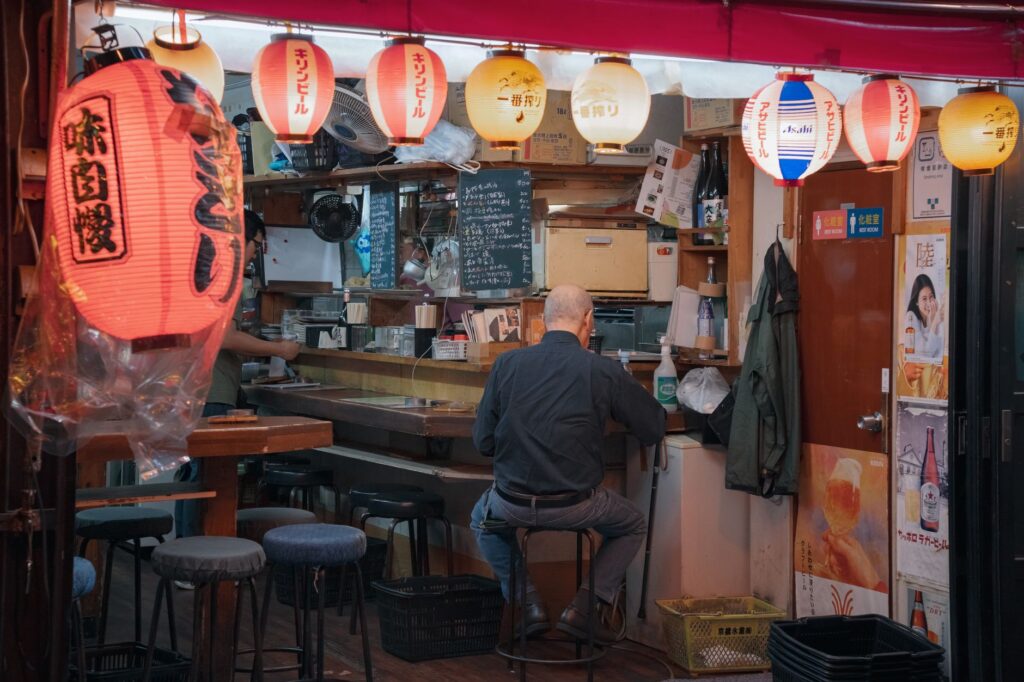
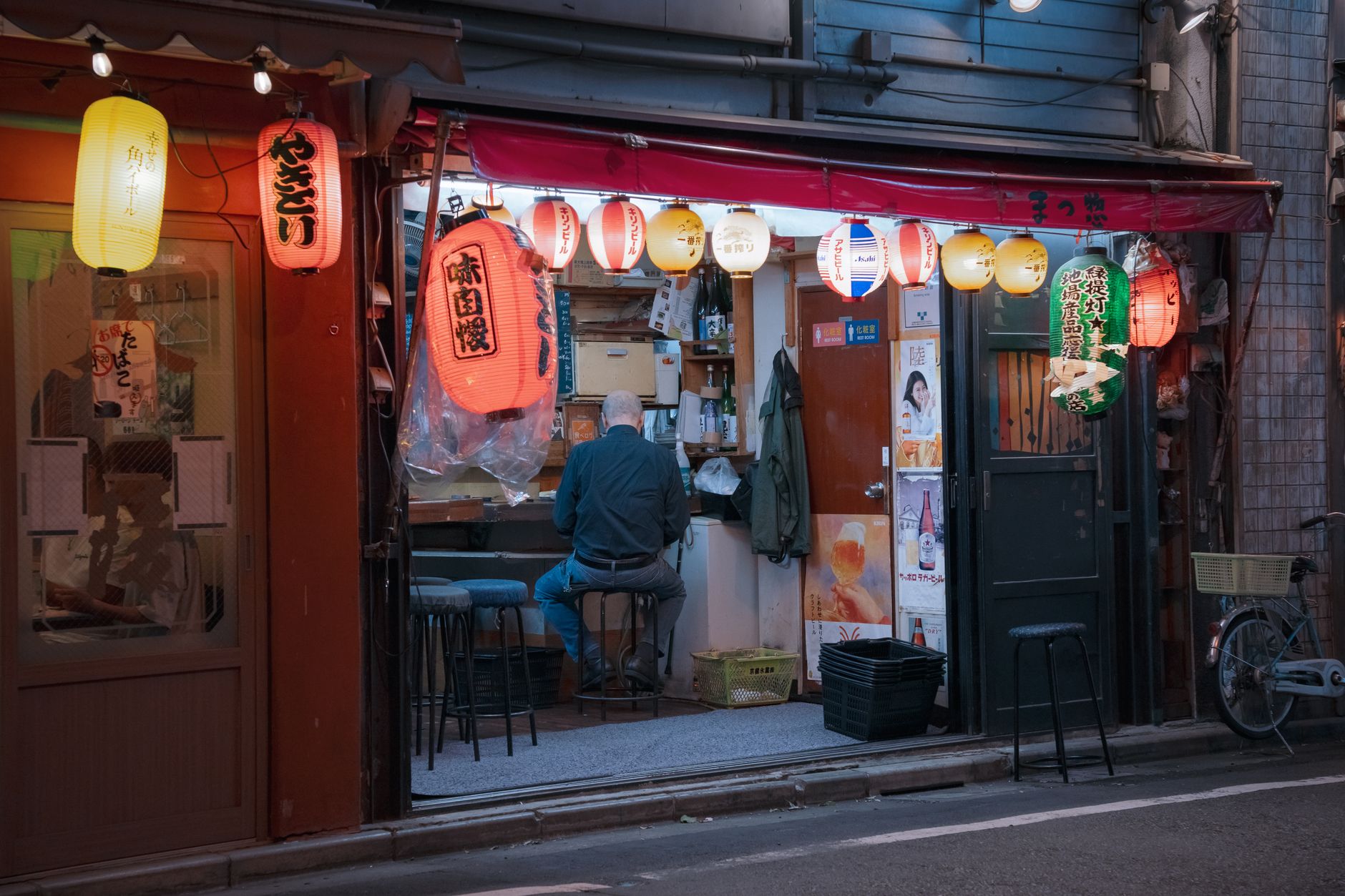
Eating out is where most travelers use their Japanese. The flow is predictable: you are greeted and asked how many, seated, given water and an oshibori (a small wet towel), you order, eat, then pay at the table or at a register by the entrance.
| English | Japanese | Say it |
|---|---|---|
| Two people, please | 二人です | futari desu |
| Do you have an English menu? | 英語のメニューはありますか。 | eigo no menyū wa arimasu ka? |
| This one, please | これをください | kore o kudasai |
| What do you recommend? | おすすめは何ですか? | osusume wa nan desu ka? |
| I’d like what that person is eating | あの人が食べているのと同じのをください。 | ano hito ga tabete iru no to onaji no o kudasai |
| I’m allergic to ___ | ___に対してアレルギーがあります。 | ___ ni taishite arerugī ga arimasu |
| Do you have a vegetarian menu? | 菜食主義者のメニューはありますか。 | saishoku shugisha no menyū wa arimasu ka? |
| Water, please | お水をください | omizu o kudasai |
| One more, please | もう一つください | mō hitotsu kudasai |
| The bill, please | お会計お願いします | okaikei onegaishimasu |
| Before eating | いただきます | itadakimasu |
| After eating: thank you for the meal | ごちそうさまでした | gochisōsama deshita |
The English menu, “same as that person”, allergy and vegetarian phrases come from JNTO’s Tourist’s Language Handbook, so they are written in a form staff will recognize.
What to know before you order
- Ticket machines: at ramen shops and other casual places with a machine by the door, buy a meal ticket first, hand it to staff, then sit, according to the Tokyo government’s GO TOKYO guide. Its ramen guide notes the machines take cash and buttons may be labeled only in Japanese, with pictures and prices beside them.
- Otoshi: at izakaya a small starter arrives with your first drink. GO TOKYO says it is “usually charged per person” and “generally not optional”.
- Oshibori: the wet towel is for your hands; avoid using it on your face or body.
- Water is usually free, and some places have a self-service dispenser.
- No tipping: JNTO says it is not common to tip in bars, cafes, restaurants, taxis or hotels. Saying “gochisōsama deshita” on your way out is the thank-you.
Allergies and diets
Japan’s mandatory allergen labeling covers packaged processed food, not restaurant menus. Since April 1, 2026 there are nine mandatory items: shrimp, crab, walnut, wheat, buckwheat, egg, milk, peanut and cashew. Cashew has a two-year transition, so some packs may not list it yet. For restaurants, carry a written card in Japanese and show it before ordering. Vegetarians should ask about dashi (stock), which is often made from fish; JNTO’s vegetarian guide suggests carrying a Japanese card and points to HappyCow, Vegewel and Japan VegeMap. For halal food, JNTO notes there is no central halal accreditation agency in Japan and points to resources such as Halal Gourmet Japan.
Shopping with almost no Japanese
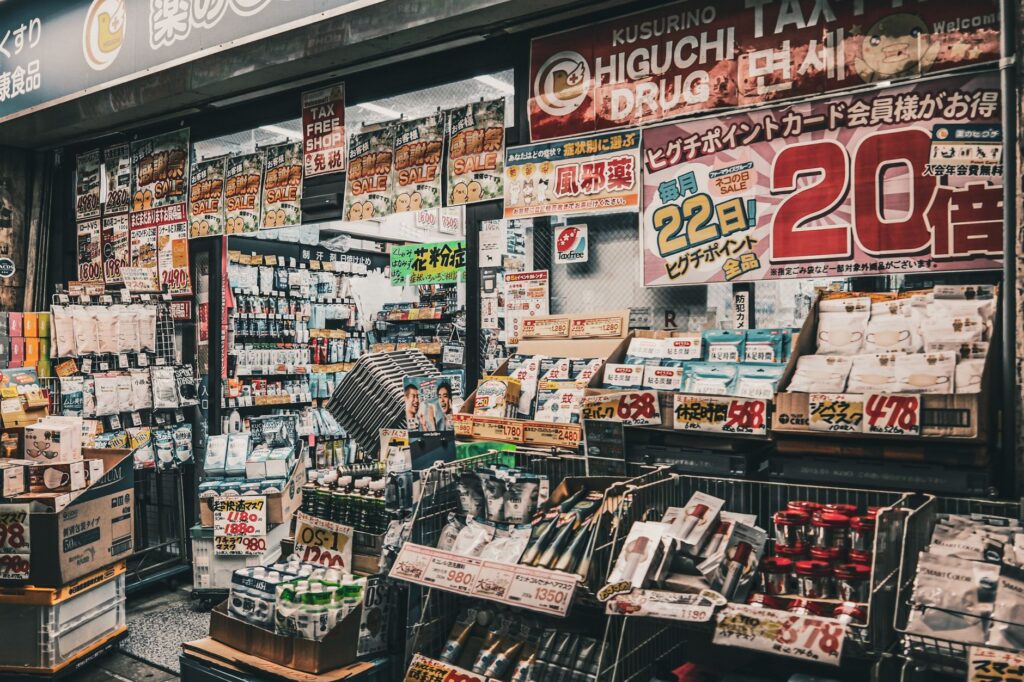
Shopping in Japan is beginner-friendly. Prices are shown in ordinary numerals, the total usually appears on a screen facing you at the register, and staff rarely push you to buy. Many shops have a small tray by the register: put your cash or card in it rather than handing it over directly.
Phrases for shops
| English | Japanese | Say it |
|---|---|---|
| How much is this? | これはいくらですか。 | kore wa ikura desu ka? |
| I’ll take this | これをください | kore o kudasai |
| Can I pay by credit card? | クレジットカードで支払えますか。 | kurejitto kādo de shiharaemasu ka? |
| Do you have a bigger / smaller one? | もっと大きい/小さいのはありますか? | motto ōkii / chiisai no wa arimasu ka? |
| Can I try this on? | これを試着できますか? | kore o shichaku dekimasu ka? |
| Could you gift-wrap this? | ギフト用にラッピングしてもらえますか? | gifuto-yō ni rappingu shite moraemasu ka? |
| Can I buy this tax-free? | これは免税で買えますか? | kore wa menzei de kaemasu ka? |
| No bag, thank you | 袋はいりません | fukuro wa irimasen |
| Just looking | 見ているだけです | mite iru dake desu |
Reading prices and tax
Japan’s consumption tax is 10%, or 8% on most food and drink taken away. Shops must show the tax-included price, but many print the pre-tax price in large numbers with the tax-included price beside it in smaller type. Look for 税込 (zeikomi, tax included) and 税抜 or 税別 (zeinuki or zeibetsu, before tax). If the big number looks too cheap, the smaller one is what you will pay.
Bags
Plastic shopping bags have been charged for at all retailers in Japan since July 1, 2020, and each shop sets its own price, which is why the bag question comes at almost every register. Carrying a foldable shopping bag saves the question and the small charge.
Cards and cash
Japan is far more cashless than it used to be. Under a new government indicator, Japan’s cashless payment ratio reached 58.0% in 2025, and credit cards made up 82.7% of that. Visa, JCB and Mastercard are the most widely accepted cards. Still, JNTO notes that small stores and guest houses may only accept cash, and that overseas phone wallets “sometimes cannot be used in Japan”. In the Japan Tourism Agency survey, 10.7% of visitors named card use as a problem. Carry some cash, especially outside the cities; our cash or card guide has the details, and an IC card covers small purchases at many konbini and vending machines.
Labels are the real barrier
Travelers rarely get stuck at the register. They get stuck at the shelf: is this shampoo or conditioner, does this snack contain peanuts, is this medicine for a cold or for hay fever? Camera translation in an app such as Google Translate, Apple Translate or our own Hirameki Japanese reads the label in seconds. For anything you will swallow or put on your skin, ask staff to confirm as well; “kore wa nan desu ka?” (what is this?) plus pointing works fine.
At the konbini
Convenience stores (konbini) are where most travelers buy breakfast, drinks and snacks, and the register follows a set script. You will usually hear some of the questions from the table above: whether you need a bag, whether to heat a boxed meal, and sometimes whether you have a point card. These answers cover almost every visit:
- “Hai, onegaishimasu”: yes, please (heat it up, or a bag).
- “Daijōbu desu”: no, thank you (no bag, no point card, no heating).
- “Ohashi o kudasai”: chopsticks, please. “Supūn o kudasai” is a spoon.
- “Kādo de”: by card. Many konbini also take IC cards; tap the card on the reader when the screen or staff ask you to.
When you buy a mix of hot and cold items, staff may ask whether to bag them separately; a nod and “hai” are fine. The konbini is also the easiest place to practice: the exchanges are short, the staff are used to visitors, and nobody minds if you mix Japanese with pointing. Our guide to Japan’s convenience stores covers what to buy and how they work.
Tax-free shopping from November 2026
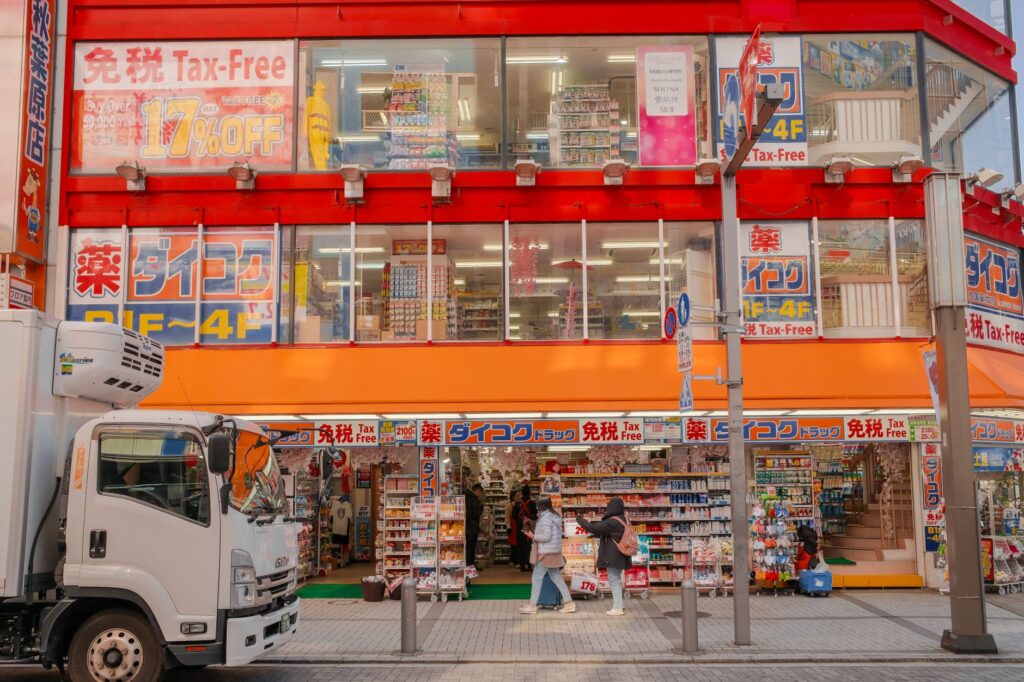
Japan’s tax-free system for visitors changes for purchases made from November 1, 2026. It becomes a refund system:
- At a tax-free shop, pay the full price including tax.
- Show your passport and register how you want the refund paid.
- Spend at least ¥5,000 before tax, in one store, on one day.
- Leave Japan within 90 days of the purchase.
- Before checking your bags at the airport, take the goods to the customs tax-free kiosk to have them confirmed. At Narita, Haneda, Kansai, Chubu, Fukuoka, New Chitose and Naha you can also use Visit Japan Web.
- The shop or its refund agent then pays the tax back; ask when you buy how and when.
The old sealed bags for consumables and the cap on consumables are gone. Useful phrases: これは免税で買えますか? (kore wa menzei de kaemasu ka? Can I buy this tax-free?) and レシートをください (reshīto o kudasai, a receipt, please). The full process is in our guide to the new tax-free refund system.
Trains, buses and taxis
Big-city stations are bilingual, and Tokyo Metro’s ticket machines have an “International Languages” button at the top right. You need Japanese mostly when something goes wrong or when you leave the main routes.
| English | Japanese | Say it |
|---|---|---|
| Where is … station? | …駅はどこですか? | … eki wa doko desu ka? |
| Does this train go to …? | この電車は…に行きますか? | kono densha wa … ni ikimasu ka? |
| Does this bus go to …? | このバスは…に行きますか? | kono basu wa … ni ikimasu ka? |
| Which platform? | 何番線ですか? | nanbansen desu ka? |
| Where do I change? | どこで乗り換えますか? | doko de norikaemasu ka? |
| One ticket to …, please | …まで一枚お願いします | … made ichimai onegaishimasu |
| To … please (taxi) | …までお願いします | … made onegaishimasu |
| Please stop here | ここで止めてください | koko de tomete kudasai |
| A receipt, please | 領収書をください | ryōshūsho o kudasai |
For taxis, show the driver your destination written in Japanese or pinned on a map, rather than only saying it. Kanji place names can be read in more than one way, and a written address removes the guesswork. For problems at a station, such as a ticket that will not open the gate, go to the staffed gate or the station office and say “sumimasen” while showing your ticket or card.
For the systems themselves, see our Suica and IC card guide and shinkansen guide.
Sightseeing, temples and photos
| English | Japanese | Say it |
|---|---|---|
| May I take a photo? | 写真を撮ってもいいですか? | shashin o totte mo ii desu ka? |
| Could you take our photo? | 写真を撮ってもらえますか? | shashin o totte moraemasu ka? |
| How much is admission? | 入場料はいくらですか? | nyūjōryō wa ikura desu ka? |
| Two adults, please | 大人二枚お願いします | otona nimai onegaishimasu |
| What time do you close? | 何時まで開いていますか? | nanji made aite imasu ka? |
| Is there a coin locker? | コインロッカーはありますか? | koin rokkā wa arimasu ka? |
| Is there a toilet? | トイレはありますか? | toire wa arimasu ka? |
Watch for 撮影禁止 (satsuei kinshi, no photography) inside temples, museums and some shops, and ask before photographing people, including staff. Where you see 土足禁止 (dosoku kinshi) or a raised wooden floor with a shoe rack, take your shoes off. Tickets are counted with -mai (one sheet, two sheets), so “ichimai” is one ticket and “nimai” two. Ask for a children’s ticket with “kodomo”.
At your hotel or ryokan
Hotel staff in cities usually speak some English, but smaller inns and ryokan may not. These cover most needs:
| English | Japanese | Say it |
|---|---|---|
| Check-in, please | チェックインお願いします | chekku-in onegaishimasu |
| I have a reservation under … | …で予約しています | … de yoyaku shite imasu |
| Could you keep my luggage? | 荷物を預かってもらえますか? | nimotsu o azukatte moraemasu ka? |
| What is the Wi-Fi password? | Wi-Fiのパスワードは何ですか? | waifai no pasuwādo wa nan desu ka? |
| What time is breakfast? | 朝ごはんは何時ですか? | asagohan wa nanji desu ka? |
| Could you call a taxi? | タクシーを呼んでもらえますか? | takushī o yonde moraemasu ka? |
| Check-out, please | チェックアウトお願いします | chekku-auto onegaishimasu |
Your hotel front desk is also your best helper for anything complicated: calling a restaurant, writing a note for a taxi driver, or finding a clinic. Asking them is normal.
How to ask for help
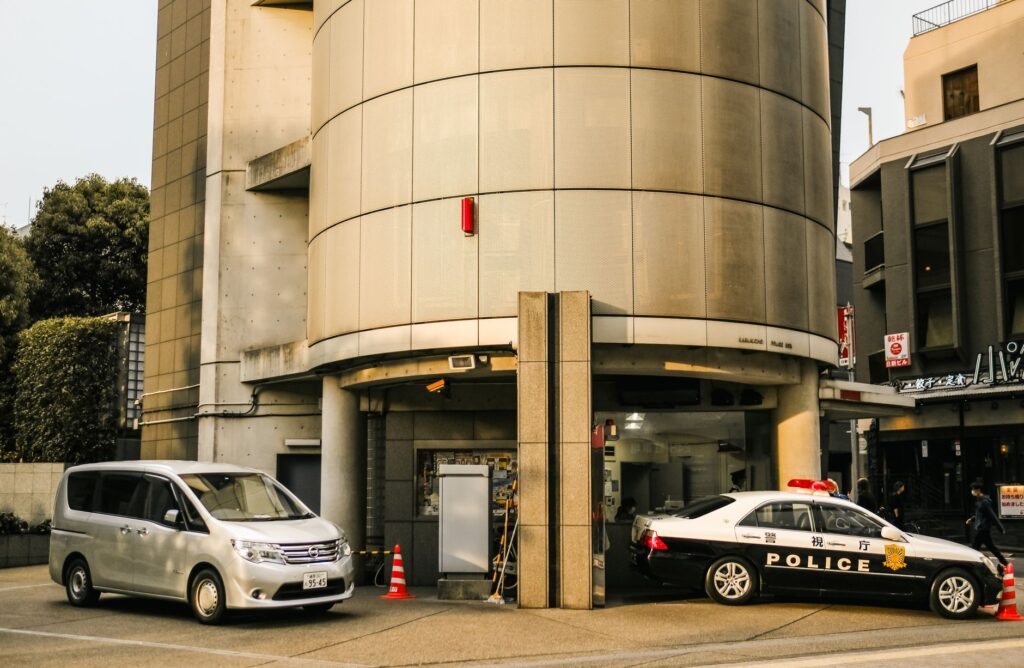
Who to ask
- Koban (police boxes): small police posts found on busy corners and near stations. Tokyo’s Metropolitan Police Department tells visitors to go to a koban if they lose belongings, get lost or are the victim of theft, and says officers there “can handle all kinds of issues”.
- Station staff: for anything about trains, tickets or items dropped on the platform. Use the staffed gate or the station office.
- Your hotel front desk: for calls, reservations, notes in Japanese and finding a doctor.
- Shop and konbini staff: for directions nearby, or where to find an ATM or taxi.
- Phone help lines: the Japan Visitor Hotline (050-3816-2787, 24 hours, English, Chinese and Korean) helps with accidents, illness and disasters as well as tourist information. The JNTO TIC Call Center (050-3416-0010, 9:00–17:00 daily) answers sightseeing questions.
The two-step method
First, say “sumimasen” with a small nod to get attention politely. Second, show your question on your phone, translated into Japanese, or point to the place name on a map. Many people who hesitate to speak English are happy to read a screen and point or reply into the app. Keep sentences short and ask one thing at a time.
| English | Japanese | Say it |
|---|---|---|
| Could you help me? | 助けてもらえますか? | tasukete moraemasu ka? |
| I’m lost | 道に迷いました | michi ni mayoimashita |
| Where is the nearest koban? | 一番近い交番はどこですか? | ichiban chikai kōban wa doko desu ka? |
| Could you write it down? | 書いてもらえますか? | kaite moraemasu ka? |
| Could you show me on the map? | 地図で教えてもらえますか? | chizu de oshiete moraemasu ka? |
For a problem with a shop, restaurant, bar, transport company or hotel, such as an unexpected charge, the Consumer Hotline for Tourists (03-5449-0906, weekdays 10:00–12:00 and 13:00–16:00) gives advice in English, Chinese, Korean, Thai, Vietnamese, French and Japanese. It received a record 698 consultations in the year to March 2026. It gives advice only and does not handle lost items, accidents or illness.
Feeling unwell: pharmacies and clinics
For a cold, a headache or a blister, a drugstore is the usual first stop. For anything more, you need a clinic or hospital.
| English | Japanese | Say it |
|---|---|---|
| I feel sick | 具合が悪いです | guai ga warui desu |
| It hurts here | ここが痛いです | koko ga itai desu |
| I have a fever | 熱があります | netsu ga arimasu |
| Where is a hospital? | 病院はどこですか? | byōin wa doko desu ka? |
| Where is a pharmacy? | 薬局はどこですか? | yakkyoku wa doko desu ka? |
| I take this medicine | この薬を飲んでいます | kono kusuri o nonde imasu |
- Finding a doctor who speaks your language: Tokyo’s HIMAWARI medical information line (03-5285-8181, 9:00–20:00 daily) helps in English, Chinese, Korean, Thai and Spanish. JNTO also has an online search for medical institutions by area, language and department.
- Should I call an ambulance? In Tokyo, #7119 is a 24-hour consultation line staffed by doctors, nurses and former paramedics who advise whether you need an ambulance; if #7119 cannot be dialed, use 03-3212-2323. The phone line may not offer English, but the web-based Tokyo EMS Guide symptom checker can be used in English.
- Paying: JNTO notes that clinics generally accept only cash, while major hospitals accept credit cards. Check what your travel insurance covers before you fly.
- Bringing medicine: if you travel with prescription medicine, check Japan’s rules for bringing it in before you leave home.
If you lose something
Tokyo’s police explain the process for visitors step by step:
- First contact the place where you lost it: the station, bus company, airline or shop.
- File a Lost Property Report at a police station or koban. Reports by email are not accepted, and items lost outside Japan cannot be reported.
- The police online lost-item search is in Japanese only, and the police generally do not make international calls, so having a Japanese phone number (or your hotel’s) helps.
- Tokyo’s police also run the MPD Lost and Found Center (1-9-11 Koraku, Bunkyo-ku, about five minutes’ walk from Iidabashi Station). Its counter is open on weekdays 8:30–16:30, and its phone line (0570-550-142) on weekdays 8:30–17:15.
- If you lose your passport, contact your embassy and ask whether you need a police certificate.
| English | Japanese | Say it |
|---|---|---|
| I lost my … | …をなくしました | … o nakushimashita |
| wallet | 財布 | saifu |
| passport | パスポート | pasupōto |
| phone | スマホ | sumaho |
| bag | かばん | kaban |
| I left it on the train | 電車に忘れました | densha ni wasuremashita |
Emergency numbers and phrases
| Number | For | Language help |
|---|---|---|
| 110 | Police: accidents and crimes | Tokyo police say an interpreter joins the call if you do not speak Japanese |
| #9110 | Non-emergency police advice | English available (Tokyo) |
| 119 | Fire, ambulance, serious illness or injury | Tokyo: English-speaking staff at all times; interpretation in Chinese, Korean, Portuguese and Spanish |
| 050-3816-2787 | Japan Visitor Hotline: accidents, illness, disasters, tourist info | English, Chinese, Korean; 24 hours |
| 03-5285-8181 | HIMAWARI: find a hospital (Tokyo) | English, Chinese, Korean, Thai, Spanish; 9:00–20:00 |
How a 119 call goes
The operator first asks 火事ですか、救急ですか (kaji desu ka, kyūkyū desu ka?): fire or ambulance? Answer kyūkyū desu (ambulance) or kaji desu (fire), or simply say “English” and wait for help. Then give the address, what happened and your name. Tokyo Fire Department notes that mobile calls can take longer to locate, so name a building, intersection or shop, and keep your phone on until help arrives, because the crew may call back. The free Tokyo Fire Department app, in English, Japanese, Korean and Chinese, has a button to call 119.
| English | Japanese | Say it |
|---|---|---|
| Help! | 助けて! | tasukete! |
| Please call an ambulance | 救急車を呼んでください。 | kyūkyūsha o yonde kudasai |
| Please call the police | 警察を呼んでください | keisatsu o yonde kudasai |
| Fire! | 火事だ! | kaji da! |
| Earthquake | 地震 | jishin |
| Where is the evacuation area? | 避難場所はどこですか? | hinan basho wa doko desu ka? |
JNTO suggests showing 救急車を呼んでください。to someone nearby if you cannot make the call yourself. For earthquake, tsunami and weather alerts in 15 languages, install the free Safety tips app, supervised by the Japan Tourism Agency.
Numbers, money and counting people
Numbers help with prices, platforms, times and telling a restaurant how many you are.
| Number | Say it | Number | Say it |
|---|---|---|---|
| 1 | ichi | 6 | roku |
| 2 | ni | 7 | nana (or shichi) |
| 3 | san | 8 | hachi |
| 4 | yon (or shi) | 9 | kyū |
| 5 | go | 10 | jū |
| 100 | hyaku | 1,000 | sen |
| 10,000 | man (ichiman) | ¥1,500 | sen gohyaku en |
Japanese counts large numbers in units of 10,000 (man), so ¥10,000 is “ichiman en” and ¥30,000 is “sanman en”. Counting people uses its own words: one person is hitori, two is futari, then sannin (three) and yonin (four). For things, the general counter is easiest: hitotsu (one), futatsu (two), mittsu (three). “Kore o futatsu kudasai” means “two of these, please”. Times use ji: “sanji” is three o’clock.
Small phrases that show good manners
- Itadakimasu before eating and gochisōsama deshita after: staff notice and appreciate it.
- Sumimasen when you squeeze past someone on a train or in a narrow shop.
- Onegaishimasu when you hand over something to be done, such as luggage, a ticket or an order.
- Daijōbu desu to decline offers kindly, instead of a flat “no”.
- Arigatō gozaimashita (the past form of thank you) when leaving a shop or a meal: “thank you for what you did”.
- A small nod of the head with greetings and thanks is enough; nobody expects a deep bow from a visitor.
- Kudasai or onegaishimasu? Both work for requests. “Kore o kudasai” asks for a thing; “onegaishimasu” is a little softer and also works on its own when you hand something over or accept an offer.
- Skip “sayōnara” with shop staff. It sounds rather final and is rarely used in shops; “arigatō gozaimashita” or “dōmo” (thanks) fits better as you leave.
Speaking a little Japanese also changes how replies come back. If you open in Japanese, staff may reply in fast Japanese; “sumimasen, eigo o hanasemasu ka?” or “yukkuri onegaishimasu” brings the pace back down.
Learn them before you go
You do not need classes. A short routine in the two or three weeks before your trip is enough to make these phrases automatic:
- Week one: the 16 core phrases. Say each one aloud several times a day; aim for even rhythm.
- Week two: the “you will hear” table and the restaurant phrases, so you recognize questions at a register or a restaurant door.
- Week three: numbers, counting people and your own needs: allergy, medicine, the name of your hotel.
- Bonus: learn katakana, the script used for most borrowed words. With its 46 basic characters you can sound out words such as コーヒー (kōhī, coffee) and メニュー (menyū, menu) on signs and menus.
Full disclosure: we make an app for exactly this, Hirameki Japanese. It shows natural Japanese with furigana, romaji and audio for anything you type in English, includes free hiragana and katakana charts with quizzes, and has a two-way conversation mode that is free and unlimited, plus camera translation for menus and signs. The free version includes the first 40 beginner words and two themed sets; a one-time purchase unlocks more than 1,100 flashcards (JLPT N5 to N3) and unlimited translation. It runs on iPhone and iPad with iOS 18 or later, with no ads and no account.
Whatever you use, keep a data connection for maps and translation: Airalo’s Japan eSIM installs before you fly, and our eSIM comparison covers the alternatives.
Frequently asked questions
Can I travel Japan without speaking Japanese? Yes. JNTO says English is generally understood in tourist areas, airports, hotels and major transport, though less in rural areas and small shops. A few phrases and a translation app cover the rest.
What is the most useful Japanese word for travelers? Sumimasen. It means excuse me, sorry and thank you for your trouble, and it is how you call staff in a restaurant.
How do I say “no bag” in Japanese? “Fukuro wa irimasen” (I don’t need a bag), or simply “daijōbu desu”. Plastic bags have been charged for at all retailers since July 2020, so staff ask at most registers.
What do I say at the start and end of a meal? “Itadakimasu” before eating and “gochisōsama deshita” after. For the bill, say “okaikei onegaishimasu”.
Is it rude to speak English in Japan? No. Opening with “sumimasen” and asking “eigo o hanasemasu ka?” is polite, and many people will happily read a translated screen.
Do Japanese emergency numbers have English? Tokyo’s police say an interpreter joins 110 calls if you do not speak Japanese, and Tokyo’s 119 centers have English-speaking staff at all times. The Japan Visitor Hotline (050-3816-2787) helps 24 hours in English, Chinese and Korean.
Where do I go if I lose something? Contact the place where you lost it first, then file a Lost Property Report at a koban or police station. Tokyo’s police also run a Lost and Found Center near Iidabashi Station.
How does tax-free shopping work now? For purchases from November 1, 2026, you pay the full price and get the tax refunded after customs confirms the goods at the airport. You must spend at least ¥5,000 before tax in one store on one day and leave Japan within 90 days.
How do I ask where the toilet is? “Toire wa doko desu ka?” works everywhere; “otearai wa doko desu ka?” is a little more polite. Signs may say トイレ or お手洗い.
Is “arigatō” enough, or should I say “arigatō gozaimasu”? “Arigatō” is casual and fine with friends. With staff and strangers, “arigatō gozaimasu” is the safe choice, and “arigatō gozaimashita” when you leave after a meal or a service.
Should I tip in Japan? No. JNTO says tipping is not common in restaurants, bars, cafes, taxis or hotels. A sincere “arigatō gozaimashita” is the thank-you.
Plan the rest of your trip
- Best translation apps for Japan
- Traveling Japan without speaking Japanese
- Japan’s new tax-free refund system
- Japan convenience stores guide
- Cash or card in Japan
- Solo travel in Japan for women
- Hirameki Japanese app
Sources: JNTO (Japanese language page, Tourist’s Language Handbook, FAQ, tipping, cashless, vegetarian and Muslim traveler pages, medical guide, hotline and TIC Call Center release of March 2026); Japan Tourism Agency visitor survey (April 2026); GO TOKYO (restaurant and ramen guides); Tokyo Metropolitan Police Department (For Visitors to Tokyo, lost property, Lost and Found Center); Tokyo Fire Department (119, #7119, app); Tokyo Metropolitan Government (HIMAWARI); National Consumer Affairs Center (Consumer Hotline for Tourists); Consumer Affairs Agency (allergen labeling, April 2026); Ministry of Economy, Trade and Industry (cashless ratio, March 2026; plastic bag charge); Tokyo Metro; our tax-free refund guide (checked October 2026). Phone hours and services change; if you spot something out of date, please let us know.
Going to Japan? Speak Japanese with confidence.
Hirameki Japanese — camera translate for menus and signs, a two-way conversation mode, and furigana + romaji on every phrase. Free to download with kana charts, conversation mode and starter words; a one-time purchase unlocks everything.

Plan your Japan trip
Two things every first-timer should book
Some links are affiliate links. If you book through them we may earn a small commission at no extra cost to you.