Tucked along the northern shore of the Seto Inland Sea in Hiroshima Prefecture, Onomichi is one of western Japan’s most beguiling and undervisited towns. A prosperous port that thrived on the textile and salt trade during the Edo period, Onomichi today offers a rare combination: 25 temples connected by hillside paths through a cat-filled neighbourhood, a world-famous cycling route departing from its waterfront across six island-hopping bridges, and a relaxed everyday atmosphere of fishing boats, narrow alleys, and brilliant local ramen that feels entirely authentic and entirely Japanese.
For first-time visitors to Japan, Onomichi delivers remarkable density of experience for its modest size. Within a single day you can walk the hillside temple circuit, take a ropeway to panoramic views over the islands of the Seto Inland Sea, explore the cat-filled backstreets of the old town, eat outstanding local ramen for lunch, and cycle the first section of the Shimanami Kaido as the sun lowers over the water. It’s the kind of place that surprises visitors who expected a quick stop and converts them into advocates who return again and again.
The city also carries unusual cultural depth through its literary and cinematic heritage. Filmmaker Nobuhiko Obayashi was born here. Novelist Naoya Shiga set crucial scenes of his masterwork in these streets. The covered shopping arcade and the hillside neighbourhood look much as they did in the early 20th century. This sense of continuity — of a town that has managed to remain genuinely itself — is increasingly rare in Japan and increasingly precious.
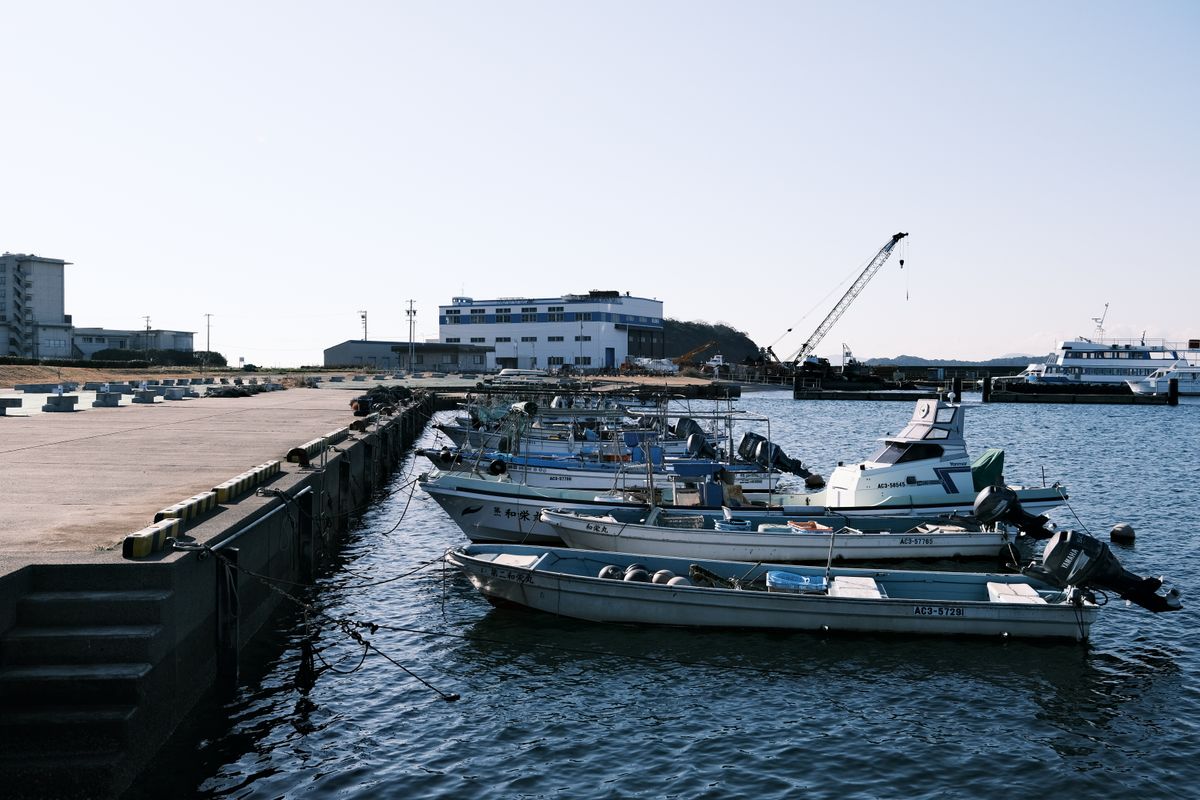
Why Onomichi Deserves More Attention
Most foreign visitors to western Japan follow the Hiroshima–Miyajima route and then continue directly to Kyoto or Osaka. Onomichi sits about an hour to an hour and a half east of Hiroshima by train and is almost universally missed. This is a genuine oversight for anyone who wants to experience Japan beyond the curated highlights.
The city has extraordinary density of experience for its size. Onomichi is small enough to understand entirely — to walk from end to end, to see the same faces twice, to find your bearings quickly — while being rich enough to reward every hour of attention. The hillside is Japan’s best temple-dense neighbourhood outside Kyoto, and without Kyoto’s crowds. The waterfront has genuine working port character. The covered arcade preserves pre-war architectural character. The cats are completely real and completely charming.
The Shimanami Kaido alone would justify a visit. Stretching 70 kilometres from Onomichi to Imabari in Shikoku across six islands and a series of suspension bridges, it is consistently ranked among the finest cycling routes in Asia — perhaps in the world. Even for non-cyclists who complete just the first bridge to Innoshima and back, the experience of cycling over the azure Seto Inland Sea with the islands spread out in every direction is extraordinary.
For those building a Chugoku region itinerary, Onomichi pairs beautifully with Hiroshima and Miyajima — the solemn grandeur of the Peace Memorial and the Itsukushima floating torii perfectly contrasting with Onomichi’s warm, lived-in hillside character.
How to Get to Onomichi
Onomichi is well-served by the JR Sanyo Main Line, making it straightforward to include in a western Japan itinerary.
From Hiroshima
Take the JR Sanyo Main Line from Hiroshima Station to Onomichi Station: approximately 1 hour 15 minutes to 1 hour 30 minutes on local or rapid service, approximately ¥1,330 one way (~$9 USD). JR Pass holders travel free. For a faster connection, take the Shinkansen from Hiroshima to Fukuyama (under an hour, from ¥4,510 non-reserved), then transfer to the Sanyo Main Line for a further 25 minutes to Onomichi.
From Osaka
Shinkansen from Shin-Osaka to Fukuyama (approximately 1 hour, ¥7,470 non-reserved), then Sanyo Main Line to Onomichi (25 minutes). Total: approximately 1 hour 30 minutes. JR Pass holders use the Shinkansen section free of charge.
From Tokyo
Shinkansen to Fukuyama (approximately 3 hours 30 minutes on Nozomi, or about 4 hours on Hikari; JR Pass holders can take the Hikari at no extra cost or add a one-way NOZOMI MIZUHO Ticket for the Nozomi), then local train to Onomichi (25 minutes). Total: approximately 4–5 hours from Tokyo.
By Car
Onomichi is on the San-yo Expressway, approximately 1 hour 20 minutes east of Hiroshima. City parking is limited — use the designated waterfront parking areas. Reliable navigation: Get your Japan eSIM (Stay connected from day 1) →
Getting Around Onomichi
The hillside temple walk, waterfront, and old town are all accessible on foot from Onomichi Station. The ropeway (¥280 / ~$2 USD one way; ¥500 / ~$3 USD return) provides a shortcut to the hilltop. Bicycles are available for rent from several waterfront shops — city bikes from approximately ¥500/hour or ¥1,200/day; road bikes from ¥2,000–3,000/day for the Shimanami Kaido.
The Onomichi Temple Walk: 25 Temples on a Hillside
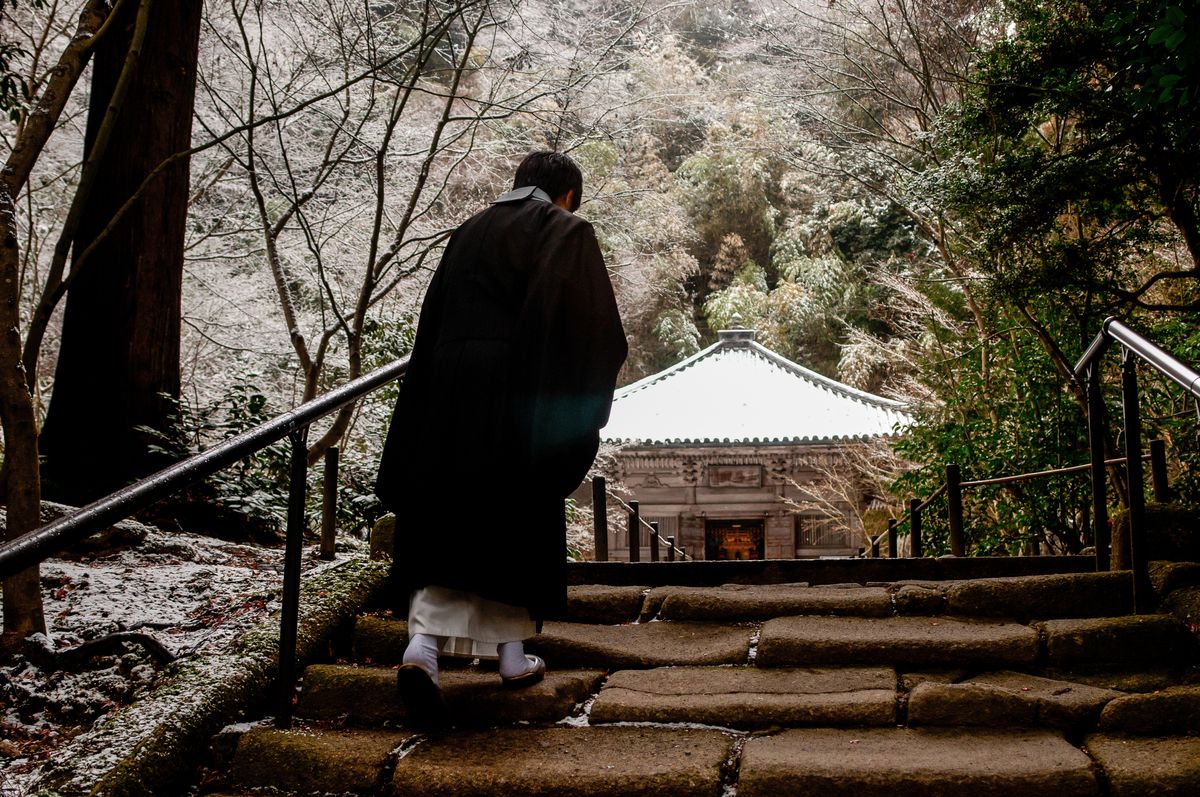
Onomichi has 25 temples in a remarkably compact area, many clustered along the hillside behind the town. The Onomichi Temple Walk connects these sites via stone-paved paths, steep staircases, and narrow lanes winding through residential streets where cats sleep in doorways and laundry hangs on bamboo poles. The walk is equally a journey through the hillside neighbourhood itself — full of beautifully weathered architecture and unexpected views over the Seto Inland Sea.
The full 25-temple circuit takes 3–4 hours; most visitors follow a highlights route of 7–10 key temples, which takes 2–3 hours. Start from the top (via the ropeway) and walk downward — the descent is far more enjoyable than the steep climb from the bottom.
Key Temples
Senkoji Temple (千光寺) is the most important and most visited. Founded in the early 9th century and built into the rock face in the style of Kyoto’s Kiyomizudera, the temple sits near the summit of Senkoji Mountain. Its view — over the rooftops of Onomichi, across the narrow Onomichi Channel, and to the countless islands of the Seto Inland Sea — is magnificent. Entry to the main hall: ¥500 (~$3 USD). The surrounding Senkoji Park is Hiroshima Prefecture’s finest cherry blossom spot.
Jodo-ji Temple (浄土寺) is Onomichi’s oldest, founded in 616 CE. Its 14th-century main hall and Tahoto pagoda are designated National Treasures — among the finest examples of Kamakura-period religious architecture in the Chugoku region. The temple grounds are quiet and contemplative, with moss-covered stone arrangements and ancient trees. Free entry (small fee for inner halls).
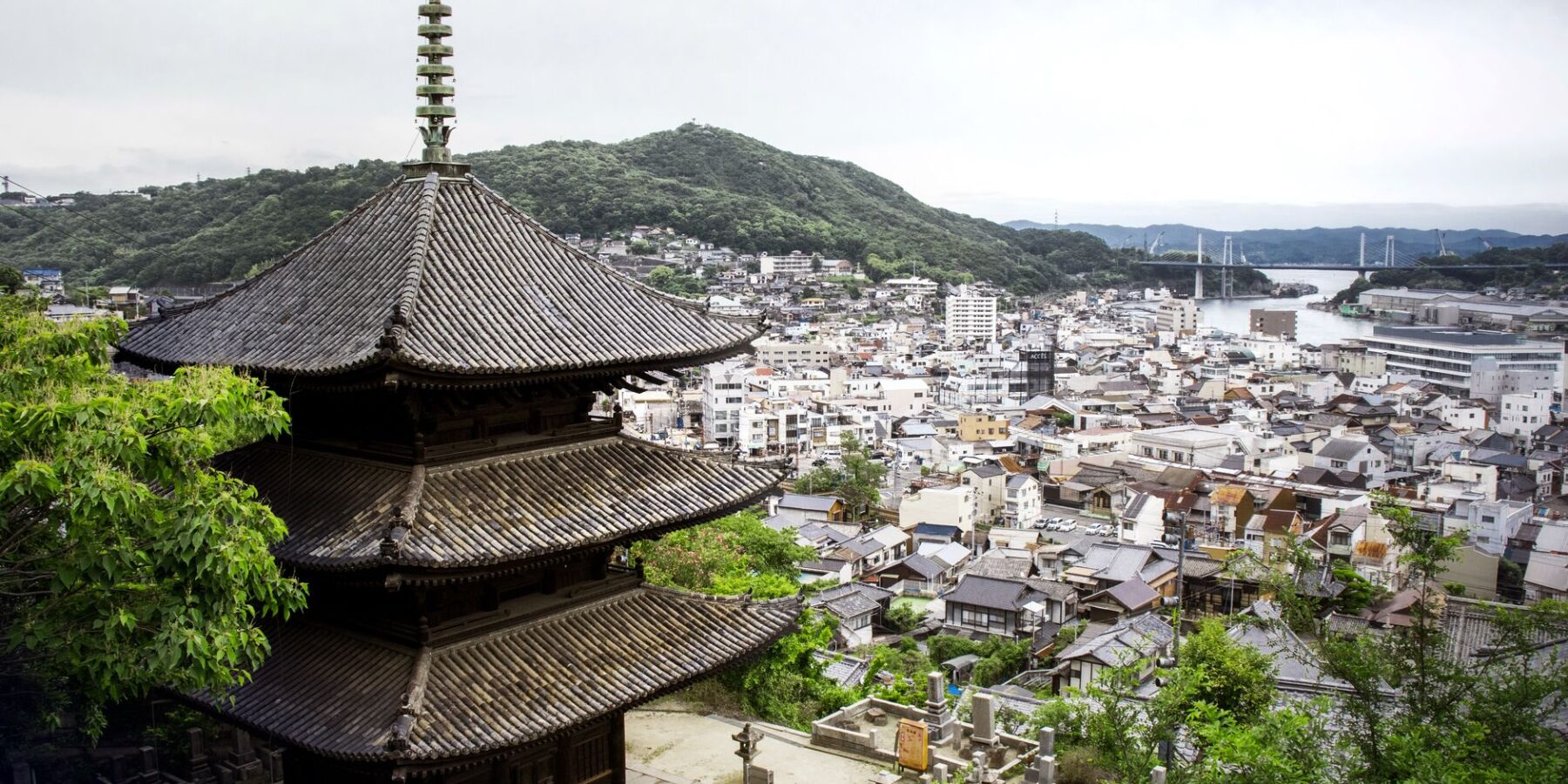
Tenneiji Temple (天寧寺) occupies a dramatic hillside site with one of the best panoramic viewpoints in the town. Its three-storey pagoda, originally built as a five-storey tower in 1388, stands against the hillside and is one of Onomichi’s most photographed structures. The view from the terrace extends across the Onomichi Channel to Mukaishima Island.
Fukuzenji Temple (福禅寺) is not in Onomichi but in nearby Tomonoura, where its Taichoro guest hall was praised by Edo-period Korean envoys as offering the finest view in all Japan, making it a worthwhile side trip. The vista across Seto Inland Sea islands has changed remarkably little in 400 years. Entry ¥200 (~$1.50 USD).
Neko no Hosomichi: Onomichi’s Famous Cat Alley
Onomichi has long been known as a cat town. The hillside neighbourhood, with its maze of narrow lanes, abundant fish from the sea, and warm-hearted elderly residents who feed and care for the neighbourhood cats, has built and maintained a substantial feline community over the generations.
The most famous area is Neko no Hosomichi (“Cat Alley”), a short but extremely narrow lane in the upper town connecting Tenneiji Temple to nearby streets. The lane is lined with small artworks, ceramics, and illustrations featuring cats created by local artists, and actual cats who have learned that tourists mean attention. The lane leads to the tiny Nekonomichi Shrine — a single stone lantern and a few cat figurines perched on a hilltop, with views straight down to the channel below.
The cats of Onomichi are well cared for by local residents. Visitors are welcome to observe and photograph them. Please do not chase or force interactions — the cats are living their lives in their neighbourhood and deserve to be treated accordingly.
The Shimanami Kaido: World-Class Cycling from Onomichi
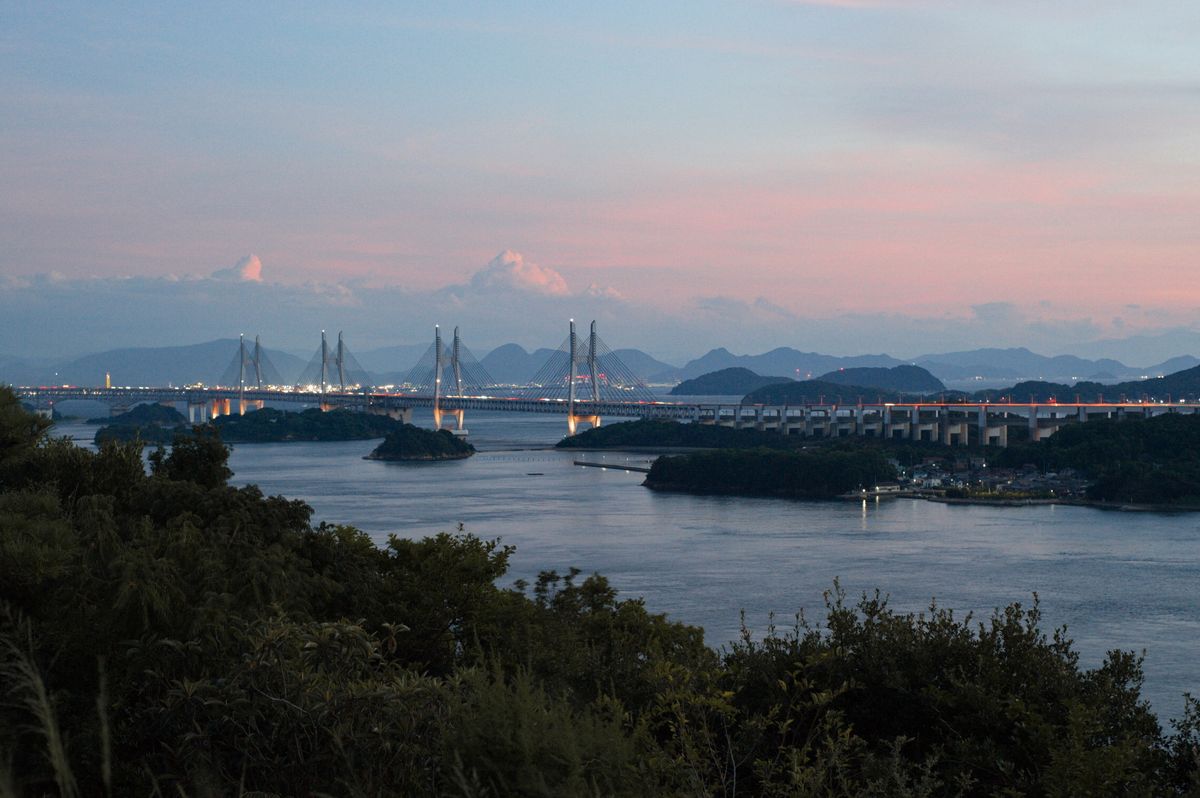
The Nishiseto Expressway (Shimanami Kaido) is one of the world’s most celebrated cycling routes — 70 kilometres from Onomichi to Imabari in Ehime Prefecture (Shikoku), hopping across six islands via dedicated cycle paths on a series of suspension bridges. Ranked consistently among Asia’s finest cycling experiences, the route combines breathtaking sea views with gentle island life, small port towns, citrus orchards, and a series of bridges that rank among Japan’s most spectacular engineering achievements.
The Islands of the Shimanami Kaido
Mukaishima Island is the first stop, reached by a short 5-minute ferry from Onomichi Port (¥110 for cyclists). A gentle, flat island with orange and lemon orchards, Mukaishima offers the first view back across the channel to Onomichi town and is where the dedicated cycling path officially begins.
Innoshima Island is connected to Mukaishima by the elegant Innoshima Bridge (suspended 45 metres above the sea). The island is famous for its pirate history — the Murakami Kaizoku (sea pirates/naval lords) who controlled these waters in the Sengoku period were based here. The Innoshima Suigun Castle and Hassaku Shrine are well worth a stop. The island also produces a local variety of citrus called hassaku, and local shops sell hassaku juice and sweets throughout the year.
Ikuchijima Island is perhaps the most artistically rich island on the route, home to the extraordinary Kosanji Temple — a complex built by a wealthy industrialist in the 20th century in faithful reproduction of Japan’s most famous historical temple architectural styles, from the Yomeimon gate of Nikko to the five-storey pagoda of Horyu-ji. The result is idiosyncratic but genuinely impressive. Adjacent to Kosanji is the Hirayama Ikuo Museum of Art, dedicated to the internationally acclaimed Japanese painter born on Ikuchijima, whose Silk Road paintings are considered among the finest 20th-century Japanese works. The island also has a white sand beach at the southern tip — a rare and beautiful find.
Oshima Island is the last island before the final bridge to Imabari on Shikoku, reached after crossing Omishima and Hakatajima. The island’s cycling paths wind through countryside with spectacular views of the many smaller islands scattered across the Seto Inland Sea. The Kirosan Observatory on Oshima’s hilltop offers one of the finest panoramic views of the entire route.
Cycling Logistics
Bicycle rental: Multiple shops near Onomichi Station rent bikes, including the Giant Store Onomichi. Standard city bikes from ¥500/hour or ¥1,200/day. Road bikes and e-bikes from ¥2,000–3,000/day. One-way rentals allow you to return at Imabari for a fee of approximately ¥2,000–3,000.
Ferry to Mukaishima: Ferries run every 10–15 minutes from Onomichi Port (¥110 for cyclists, 5 minutes). The cycling path begins immediately on the island.
Bridge tolls: ¥50–200 per bridge (approximately ¥500 total for the full one-way route).
Partial routes: Even cycling from Onomichi to Innoshima and back (approximately 4–5 hours, suitable for all fitness levels) gives a genuine taste of the route’s extraordinary scenery. E-bikes make the bridge ramp climbs accessible to virtually everyone.
Onomichi Ramen: The Local Specialty You Must Not Miss
Onomichi Ramen (尾道ラーメン) is one of Japan’s most distinctive regional ramen styles. The broth is a richly flavoured soy sauce base made from chicken and local flat fish (Pacific sardines and other small Seto Inland Sea species), topped with flat noodles and, most distinctively, small chunks of pork back fat (背脂) that melt gradually into the broth as you eat. The result is deeply flavoured, moreish, and warming in a way that is simultaneously lighter and more complex than the thick pork-bone broth styles more common in Kyushu.
The city has dozens of ramen shops and passionate local disagreements about which is best. Ichibankan is the most famous; Shukaen in the covered arcade is beloved by locals; Pao Pao near the station is reliable for first visits. Expect to pay ¥700–900 (~$4.60–6 USD) per bowl. Queue times at popular shops can be 20–30 minutes at lunch — arrive before 11:30 AM or after 1:30 PM to minimise waiting.
Onomichi’s Arts, Literature, and Cinema Heritage
Onomichi has an unusually rich connection to Japanese arts and letters that gives the town unusual cultural depth beyond its physical beauty.
Naoya Shiga, considered one of the greatest prose stylists in Japanese literature, lived here during a productive period and set key scenes of his masterwork An’ya Koro (“A Dark Night’s Passing”) in Onomichi. The town’s character — its hillside paths, its harbour light, its unhurried pace — infuses his writing. Reading his prose while walking the town creates a doubled experience of place that is genuinely moving.
Nobuhiko Obayashi was born in Onomichi and returned to it repeatedly as a subject throughout his career. His 1983 film Toki wo Kakeru Shojo (The Girl Who Leapt Through Time) used the town’s hillside landscape throughout, and the filming locations have become pilgrimage sites for fans of Japanese cinema. His 2019 final film, made while he was terminally ill with cancer, also returned to Onomichi for its setting. The town repays cinephile visitors with remarkable persistence — the streets have changed remarkably little since his films were made.
The Onomichi Literary Museum (文学記念館) in Senkoji Park celebrates the literary heritage in a thoughtfully curated space. Entry approximately ¥200 (~$1.30 USD). The Onomichi City Museum of Art focuses on contemporary Japanese art with particular attention to artists connected to the Chugoku and Shikoku regions.
Where to Stay in Onomichi
Onomichi’s best accommodation reflects the town’s character — beautifully renovated historic buildings with genuine personality rather than generic chain hotels.
Onomichi U2 is the standout property: a spectacularly designed boutique hotel built inside a converted WWII-era shipping warehouse directly on the waterfront. The cycling theme is thorough — dedicated bike storage, maintenance stands, and Japan’s finest cycle-focused café on site. Rooms from approximately ¥18,000–25,000 ($118–163 USD) per room. Book months ahead; this property is genuinely world-class.
Hostel Mizunomi-Yado Mikuni is a beautifully renovated traditional machiya townhouse guesthouse in the hillside neighbourhood. Dormitory beds and private rooms from approximately ¥3,500–8,000 ($23–52 USD). The building itself is worth staying in.
Nishiyama Ryokan offers classic Japanese inn accommodation with tatami rooms and home-cooked breakfast and dinner, from approximately ¥6,000–8,000 ($39–52 USD) per person with meals.
Book well in advance, especially for cherry blossom season and major cycling events: Book your Onomichi hotel on Agoda (Best prices guaranteed) →
What to Eat and Drink in Onomichi
Seto Inland Sea Seafood
The waters around Onomichi produce excellent octopus, sea bream, oysters (October–March), and the small flat fish used in the local ramen broth. The morning fish market at the port is worth visiting even as a spectator. Sashimi platters at local restaurants showcase the extraordinary quality of the day’s catch.
Takomeshi (Octopus Rice)
A local specialty: rice cooked with Seto Inland Sea octopus, seasoned with soy sauce and mirin. The octopus is tender and the rice absorbs the broth to become intensely flavourful. Available at traditional restaurants and as a take-away bento at the station — an excellent choice for eating on the train or ferry.
Local Sake
Onomichi’s local sake, brewed with Seto Inland Sea water, includes the well-regarded “Yuki no Botan” (Snow Peony) label — a clean, elegant sake that pairs perfectly with local seafood. Available at the brewery shop and at most restaurants.
Suggested Itineraries for Onomichi
One Full Day in Onomichi
- 8:30 AM: Take the ropeway to the hilltop and begin the temple walk downward. Visit Senkoji Temple for panoramic views, then descend via the Cat Alley and Tenneiji.
- 11:30 AM: Arrive at a ramen shop before the lunch queue. Onomichi ramen at Ichibankan or Shukaen.
- 1:00 PM: Walk the waterfront, visit Fukuzenji Temple, and explore the covered shopping arcade.
- 2:30 PM: Rent a bicycle and take the ferry to Mukaishima Island. Cycle to the Innoshima Bridge viewpoint (approximately 1 hour each way) for spectacular sea views.
- 5:30 PM: Return to Onomichi waterfront for evening light over the channel. Dinner at a seafood restaurant by the harbour.
Two Days in Onomichi (Recommended)
- Day 1: Complete temple walk, ramen lunch, afternoon exploration of the old town, Cat Alley, and the literary and cinema heritage sites.
- Day 2: Full cycling day on the Shimanami Kaido — Onomichi to Ikuchijima (or further if fitness allows), stopping at Innoshima pirate castle and Kosanji Temple, returning by ferry from the last island you reach. Evening dinner at Onomichi U2’s waterfront restaurant.
Day Trips from Onomichi
Hiroshima and Miyajima (45 min by train)
The natural companion destination. The contrast between Hiroshima’s solemn memorial and Onomichi’s warm everyday character is both striking and emotionally satisfying. A 3-night itinerary — Hiroshima (1 night), Miyajima (1 night), Onomichi (1 night) — covers the best of western Hiroshima Prefecture. Read our full Hiroshima and Miyajima guide for detailed planning advice.
Tomonoura (30 min by bus from Fukuyama)
One of Japan’s best-preserved Edo-period harbour townscapes, reportedly the inspiration for Hayao Miyazaki’s Ponyo. Combine with Onomichi for an excellent western Japan “historic harbour towns” route.
Imabari and Dogo Onsen (via Shimanami Kaido)
For cyclists completing the full route, Imabari leads to Matsuyama (40 minutes by JR), home to the famous Dogo Onsen — Japan’s oldest hot spring — and Matsuyama Castle. Explore more Japan destinations for a complete western Japan circuit.
Best Time to Visit Onomichi
Spring (March–May) is the most popular season. Senkoji Park’s cherry blossoms are among Hiroshima Prefecture’s finest. Mild weather makes the temple walk and cycling ideal.
Autumn (October–November) brings maple foliage to the hillside temple paths and equally excellent cycling weather (15–22°C).
Summer (June–August) is hot and humid but the waterfront and harbour have an especially lively character. Avoid cycling in the midday heat.
Winter (December–February) is quiet with mild temperatures (8–14°C) and very few crowds. New Year temple visits at Senkoji and Jodo-ji are atmospheric and celebrated locally.
Practical Tips for Visiting Onomichi
- Start early: The hillside temple walk is most atmospheric before 9 AM, before tour groups arrive.
- Take the ropeway down, not up: Start at the summit and walk down. The descent is far more pleasant than climbing the steep stone paths from below.
- Book Onomichi U2 well ahead: This is one of Japan’s finest boutique hotels and fills quickly, especially in spring and autumn.
- Cash for smaller restaurants: Most ramen shops and small restaurants prefer cash. Have yen available for meals.
- Combine with Hiroshima: Onomichi works best as part of a western Japan circuit. Hiroshima–Miyajima–Onomichi is a natural and deeply satisfying combination.
- Cycling gear: Padded shorts and lightweight gloves significantly improve comfort on the Shimanami Kaido. Most rental shops can provide basic gear.
- Wear sturdy shoes: The hillside temple paths involve significant uneven stone sections and steep staircases.
- eSIM for navigation: Onomichi’s hillside lanes and the Shimanami Kaido route require reliable GPS. Get your Japan eSIM (Stay connected from day 1) →
Frequently Asked Questions About Onomichi
Is Onomichi worth a day trip from Hiroshima?
Absolutely — one of the best day trips from Hiroshima. Approximately 1 hour 15 minutes by JR train, and the contrast between Hiroshima’s solemnity and Onomichi’s warm hillside character is genuinely moving. One overnight stay allows you to add the early morning temple walk and the evening waterfront light, both significantly more atmospheric without day-trip crowds.
How much time do I need in Onomichi?
A full day covers the main highlights: ropeway, temple walk highlights, Cat Alley, waterfront, and ramen lunch. One overnight adds the evening waterfront, early morning quiet, and possibly a first section of the Shimanami Kaido. Two nights allows a full cycling day plus thorough town exploration.
Do I need to be fit to cycle the Shimanami Kaido?
The full 70-km route requires reasonable fitness, but the early sections are gentle and accessible to casual cyclists. E-bikes make the bridge ramps accessible to virtually everyone. A round trip from Onomichi to Innoshima (approximately 4–5 hours) suits almost all fitness levels and gives a genuine taste of the route’s exceptional scenery.
Can I rent a bicycle in Onomichi and return it in Imabari?
Yes. Most rental shops participate in a shared return system allowing one-way rental with return in Imabari (or vice versa), for a fee of approximately ¥1,100–2,000. Book rental bikes in advance in spring and summer when demand peaks.
What is the best place to eat Onomichi ramen?
Genuinely contested among locals. Ichibankan is the most famous; Shukaen in the covered arcade is beloved by regulars; Kingyoya near the station serves an excellent traditional version. Arrive before 11:30 AM at any of these to minimise queuing. Budget ¥700–900 ($4.60–6 USD) per bowl.
Is Onomichi accessible for people with mobility challenges?
The flat waterfront and lower town are accessible for wheelchairs and pushchairs. The hillside temple walk involves steep staircases and uneven paving that is not wheelchair accessible. The ropeway accommodates wheelchairs for access to the hilltop. The waterfront, harbour market, and lower town temples can be fully enjoyed regardless of mobility level.
What should I buy as a souvenir from Onomichi?
Packaged Onomichi ramen noodle sets (available at the station shop and local grocery stores) are lightweight, delicious, and make excellent gifts. Local sake, dried Seto Inland Sea fish, and small artworks and ceramics from the Cat Alley craft shops are all distinctive local options. The Cat Alley shops support local artists directly with every purchase.
How does Onomichi compare to Kyoto for temple visiting?
Onomichi’s temples are significantly less famous than Kyoto’s great monuments, but the hillside temple walk offers something Kyoto cannot — the experience of exploring ancient sacred sites woven into a living neighbourhood, with sea views and everyday Japanese life surrounding you at every turn, and without the dense tourist crowds that make some Kyoto sites exhausting. For first-time Japan visitors, Kyoto is essential; Onomichi is the reward for those who come back for more.
Final Thoughts: Why Onomichi Rewards the Curious Traveller
Japan’s most celebrated destinations are magnificent for excellent reason. But there is another layer of Japan that many visitors never reach — the towns that have genuine character without manufactured hype, natural beauty without crowds, and a way of daily life that feels connected to the long human story of a place rather than curated for external consumption. Onomichi is one of those towns.
Its hillside lanes and ancient temples, its cats and its cyclists, its morning fish market and its legendary ramen, its literary soul and its panoramic views over one of the world’s most beautiful inland seas — these things add up to something that is harder to define than “tourist attraction” but infinitely more lasting. Onomichi is the kind of place you find yourself thinking about weeks later, wondering when you can return.
For those who love Japan deeply or want to begin understanding it more deeply, Onomichi is an essential destination. Plan your visit alongside Hiroshima and Miyajima, and you have the foundation of one of Japan’s finest regional itineraries.
Book your Onomichi hotel on Agoda (Best prices guaranteed) →
Onomichi’s History: From Medieval Trading Port to Modern Cultural Town
Understanding Onomichi’s history helps explain the town’s exceptional density of temples, its remarkably preserved old-town architecture, and the unusual combination of industries — cycling tourism, contemporary art, artisan food production — that thrive in what would otherwise be just another modest Seto Inland Sea port.
Onomichi’s story begins with geography. The town sits at a point where the Seto Inland Sea narrows to just 200 metres at the Onomichi Channel, making it a natural harbour where ships travelling between western Japan and the Kinai region (Osaka, Kyoto) had to slow, anchor, or transship their cargo. From at least the Heian period (794–1185 CE), Onomichi was a significant waypoint on Japan’s most important maritime trade route.
The town’s medieval prosperity is written in its temples. Twenty-five of them within a compact hillside area is not coincidence — it reflects the patronage of wealthy merchants and shipping families who endowed sacred buildings as acts of piety and as markers of social status. Jodo-ji Temple (founded 616 CE) predates the town’s commercial rise, but the majority of Onomichi’s temples were built or substantially expanded during the 12th to 16th centuries, precisely when the town was at the height of its importance as a transshipment point for goods moving between western Honshu, Kyushu, and the Kansai heartland.
The Edo period (1603–1868) brought another wave of prosperity. Onomichi became an important collection and distribution point for the cotton trade — the Bingo region to the north produced cotton of exceptional quality, which was processed, traded, and shipped from Onomichi’s port to merchants throughout Japan. Cotton-trade wealth funded the renovation and expansion of the town’s temples, the building of the merchant townhouses (machiya) whose renovated successors you can stay in today, and the establishment of the covered shopping arcade that still runs through the town centre.
The Meiji period (1868–1912) brought modernisation and eventually decline in maritime trade as railways and later roads supplanted sea transport. Onomichi’s deep port, which had been its commercial advantage for centuries, became less relevant. The city shrank in economic importance relative to Hiroshima and Fukuyama. But this economic stagnation had an unintended preservationist effect: the lack of modern redevelopment pressure meant that Onomichi’s Meiji and Taisho-era architecture largely survived intact while comparable buildings in more prosperous cities were demolished. The covered shopping arcade, the merchant district lanes, and the hillside temple neighbourhood all look today much as they did in the early 20th century — a historical accident that has become the town’s greatest contemporary asset.
The late 20th century brought a new kind of attention. When filmmaker Nobuhiko Obayashi began using Onomichi as a setting for his distinctive, nostalgic films in the 1980s, the town began attracting a different kind of visitor — people drawn by its on-screen beauty rather than its heritage. The opening of the Shimanami Kaido in 1999 added a completely different category of visitor: domestic and international cyclists. The 2010s saw a wave of creative renovation projects — Onomichi U2, the machiya guesthouses, the Cat Alley art installations — that positioned the town as a destination for design-conscious travellers. Today Onomichi is one of the most carefully observed and well-documented small towns in Japan, beloved by architects, designers, writers, filmmakers, cyclists, and anyone who appreciates places where genuine character has been allowed to accumulate rather than being engineered from scratch.
Onomichi’s Art Scene: Beyond the Famous Temples
In recent years Onomichi has developed a small but serious contemporary art scene, concentrated in several renovated buildings in the old town and hillside neighbourhood.
The Onomichi City Museum of Art (尾道市立美術館) occupies a building in Senkoji Park designed by Tadao Ando, Japan’s most internationally acclaimed architect. Ando’s characteristic raw concrete forms — monumental, textured, dramatically lit by natural light through narrow apertures — sit in productive contrast with the traditional hillside landscape surrounding them. The museum’s collection focuses on 20th and 21st-century Japanese art, with particular strength in artists from western Japan. Entry approximately ¥500 ($3.30 USD). Temporary exhibitions run throughout the year and are frequently excellent.
The Hirayama Ikuo Museum of Art (平山郁夫美術館) on Ikuchijima Island (accessible via the Shimanami Kaido cycling route, 45 minutes from Onomichi) is dedicated to the extraordinary Silk Road paintings of Ikuchijima-born artist Hirayama Ikuo (1930–2009). Hirayama survived the Hiroshima atomic bombing as a teenager and later became one of Japan’s most honoured painters, devoting his career to documenting the historic Silk Road from Japan through China, Central Asia, and the Middle East in large-format paintings of piercing beauty and spiritual weight. The museum is a remarkable place — quiet, beautifully designed, and housing some of the finest Japanese paintings of the 20th century.
Several smaller galleries and artist studios occupy renovated spaces in the hillside neighbourhood and old town. The annual Onomichi Art Festival (typically held in autumn) brings temporary art installations to unexpected locations throughout the hillside — in disused buildings, on temple grounds, and along the Cat Alley lanes. If your visit coincides with the festival, the art becomes a second layer to the already rich experience of walking the hillside.
Responsible Tourism in Onomichi
Onomichi is a living town, not a museum or a theme park. The residents who live in the hillside neighbourhood alongside the temples are not performers in a historical recreation — they are people going about their daily lives in a neighbourhood that happens to be exceptionally beautiful and historically significant. Visiting thoughtfully means observing a few principles that make the experience better for both visitors and residents.
The hillside lanes above the main temple walk are residential. Keep your voice low, especially in the early morning and evening. Do not enter private properties (many buildings are unlabelled and the line between temple grounds and private garden is not always obvious). Ask before photographing individuals who are not in explicitly public spaces.
The cats of Onomichi are genuinely wild and are cared for by the local community under a TNR (Trap, Neuter, Return) programme that has managed the population humanely for decades. They have learned to tolerate tourists because the local community has raised them in that environment. Please do not attempt to feed the cats with your own food (their diet is managed by local carers), do not chase them, and do not attempt to pick them up. Simply enjoy their company at the distance they are comfortable with.
Onomichi’s best small restaurants, ramen shops, and craft shops are genuine local businesses — not tourism facilities. Some do not have English menus or English-speaking staff. The willingness to communicate through pointing, gesturing, or using a translation app is welcomed and appreciated. The reward for engaging genuinely with local businesses rather than limiting yourself to places with English signage is an infinitely more authentic and memorable experience of the town.
Getting the Most from Your Onomichi Visit: Final Planning Advice
Onomichi rewards visitors who pay attention to the small things as much as the headline attractions. Some final suggestions for making the most of your time here:
The covered shopping arcade (Hon-dori) is best explored at a slow pace with eyes open for detail: the architectural mixture of Taisho, Showa, and Heisei-era shopfronts, the mix of traditional and contemporary businesses (a centuries-old sake shop next to a specialty coffee roaster), and the human character of a Japanese shopping street that serves locals rather than tourists. The arcade runs approximately 900 metres through the heart of the old town and is genuinely one of western Japan’s finest surviving examples of pre-war townscape.
The Onomichi Channel ferry (渡船) that connects the town waterfront to Mukaishima Island is one of the cheapest and most relaxing experiences in Japan. The 5-minute crossing costs just ¥100 for pedestrians and provides a unique perspective looking back at the Onomichi hillside from the water — the stacked profile of temples, residential buildings, and forested hill is one of the finest townscape views in western Japan. Even if you are not cycling the Shimanami Kaido, a round trip on the ferry is worth doing simply for this view.
Finally, before you leave, take a few minutes to sit on the waterfront by the port in the late afternoon. Watch the ferries crossing, the fishing boats returning, the light changing on the hills above the town. Onomichi has been watching the Seto Inland Sea from this shore for well over a thousand years. In that moment of stillness, it’s easy to feel the weight and the richness of that accumulated time — and to understand why this small, unpretentious, entirely remarkable town holds such a special place in the hearts of everyone who discovers it.
Book your Onomichi accommodation on Agoda (Best prices guaranteed) →
Stay in Onomichi & Explore the Shimanami Kaido
Book a charming guesthouse or traditional inn in Onomichi. Perfect base for cycling the Shimanami Kaido.
🚴 Book Your Onomichi Hotel on Agoda →
Bicycle-friendly accommodations • Shimanami Kaido gateway
Going to Japan? Speak Japanese with confidence.
Hirameki Japanese — camera translate for menus and signs, a two-way conversation mode, and furigana + romaji on every phrase. Free to download with kana charts, conversation mode and starter words; a one-time purchase unlocks everything.

Plan your Japan trip
Two things every first-timer should book
Some links are affiliate links. If you book through them we may earn a small commission at no extra cost to you.