In this guide
- What the Shimanami Kaido actually is
- The six bridges, one by one
- How long it takes: one day, two days, or a section
- Which direction: Onomichi to Imabari, or the reverse
- Renting a bike, step by step
- What to do with your luggage
- Getting back, or quitting early: ferries, buses and trains
- Island by island: what to see and what it costs
- Where to stay along the route
- Getting to Onomichi and Imabari
- Seasons, weather, typhoons and closures
- Safety, rules and the 2026 bicycle fines
- What a Shimanami trip costs
- Three sample plans
- Pre-ride checklist
- Frequently asked questions
- Plan the rest of your trip
What the Shimanami Kaido actually is
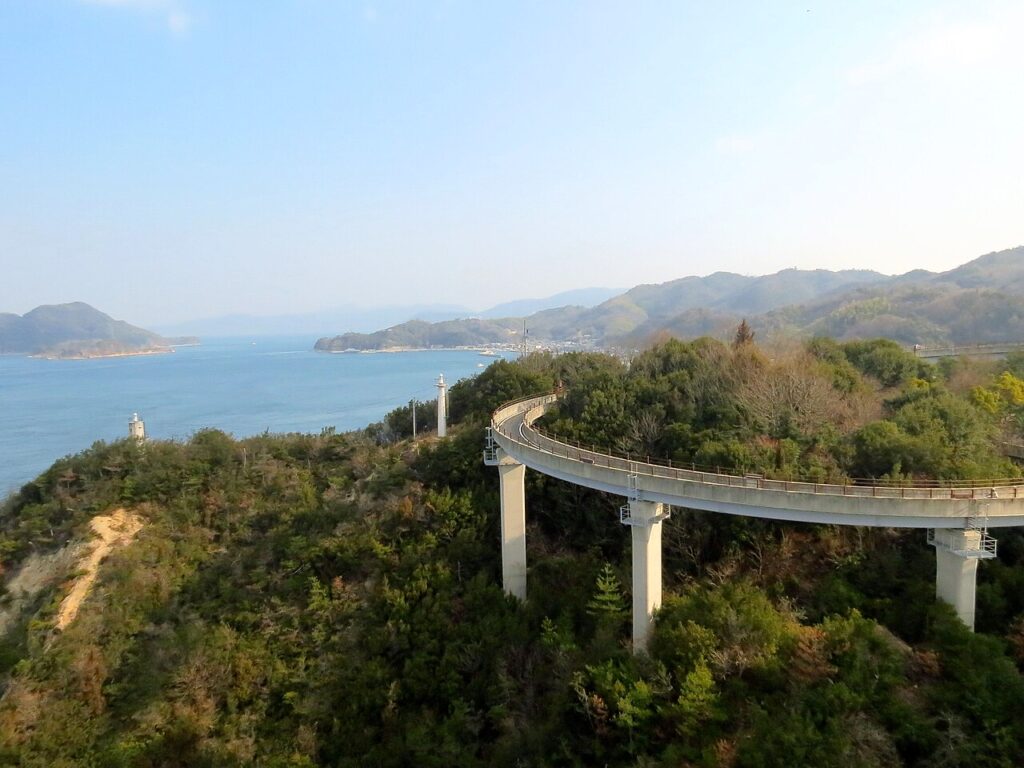
I grew up in Ozu, in southern Ehime, and I still come back whenever I visit family. The Imabari end of this route is in my home prefecture, which is one reason I wanted this guide to be as accurate as I could make it.
The Shimanami Kaido is the expressway that links Honshu and Shikoku through the islands of the Seto Inland Sea between Onomichi and Imabari. What makes it famous is that every one of its bridges has a separate path for bicycles, pedestrians and mopeds, so you can ride from one main island of Japan to another over the sea. The cycling route is designated a National Cycle Route and measures about 70 km from JR Onomichi Station to Sunrise Itoyama, the cyclists’ base at the foot of the last bridge in Imabari. The painted blue line that marks the recommended course continues from there to JR Imabari Station.
The order of islands and bridges, riding from the Hiroshima side, is:
- Onomichi → short ferry → Mukaishima
- Innoshima Bridge → Innoshima
- Ikuchi Bridge → Ikuchijima (the town of Setoda is here)
- Tatara Bridge (the Hiroshima/Ehime border) → Omishima
- Omishima Bridge → Hakatajima
- Hakata-Oshima Bridge → Oshima
- Kurushima-Kaikyo Bridge → Imabari
Three things about this list surprise first-timers.
You start on a boat, not a bridge. The two road bridges between Onomichi and Mukaishima are not for cyclists: the Shin-Onomichi Bridge has no bicycle lane, and the sidewalk on the older Onomichi Bridge is narrow. Everyone takes one of the two small ferries across the channel instead (adult ¥100, bicycle ¥110, about five minutes). This is the official route, not a shortcut.
The blue line is the whole navigation system. It runs along the left edge of the road from Onomichi to Imabari, with painted distance markers to both ends. Follow it and you will be taken to the bicycle entrance of each bridge, which is a separate ramp from the expressway interchange that cars use. If you see signs for an “IC” (interchange), that is for cars; stay on the line.
The route is not flat, but the climbs are predictable. You will read that the Shimanami Kaido has “only 20 m of elevation difference.” That figure is the difference between the height of the start and the finish. It says nothing about what is in between. The bridge decks sit between 34 and 78 m above the sea, so every bridge means a climb up a long approach ramp and a descent on the other side. The transport ministry (MLIT) lists 15 steep stretches on the route, and all of them are bridge approaches. We could not find an official total elevation gain figure, so treat anyone who quotes one with care. The practical truth is this: six bridges means six climbs of a few dozen meters each on a gentle, engineered gradient, plus whatever hills you choose to add on the islands. The descents are steeper than you expect, especially coming off the big bridges, so keep your speed down.
The six bridges, one by one
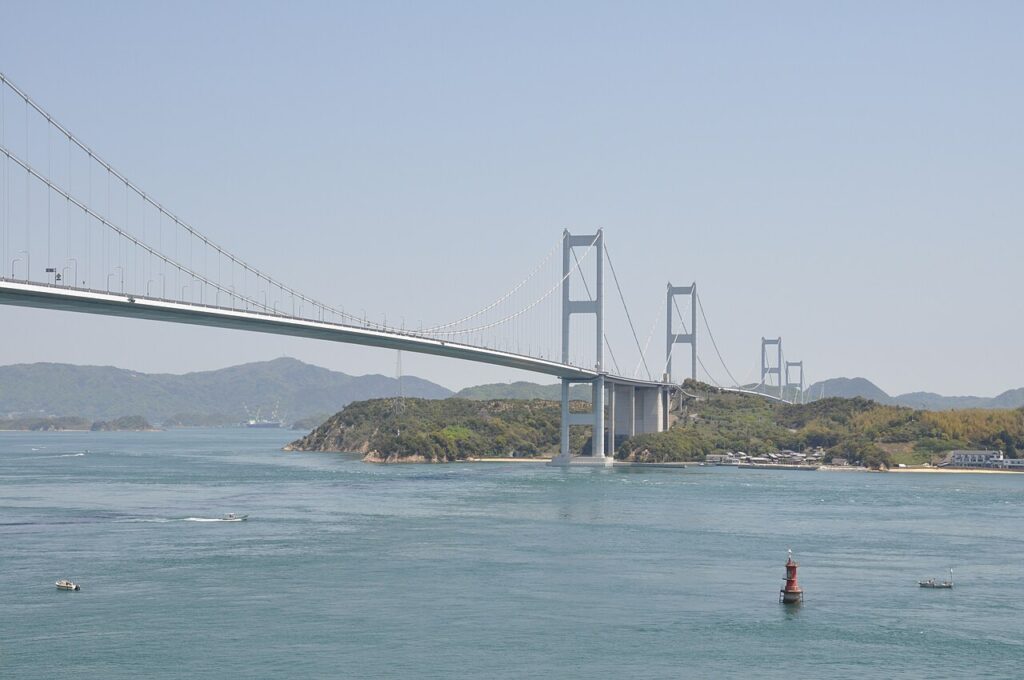
Each bridge has its own character, and, more usefully, its own rules about who shares the path with you. On three bridges you ride alongside mopeds; on the other three you share with pedestrians, who have priority. Here is the full set.
| Bridge | Type | Length | Bike path above sea | You share the path with |
|---|---|---|---|---|
| Innoshima Bridge (Mukaishima – Innoshima) | Suspension | 1,270 m | 58 m | Mopeds; the path runs inside the girder beneath the car deck |
| Ikuchi Bridge (Innoshima – Ikuchijima) | Cable-stayed | 790 m | 35 m | Pedestrians (they have priority) |
| Tatara Bridge (Ikuchijima – Omishima) | Cable-stayed | 1,480 m | 48 m | Pedestrians |
| Omishima Bridge (Omishima – Hakatajima) | Arch | 328 m | 41 m | Mopeds |
| Hakata-Oshima Bridge (Hakatajima – Oshima) | Two linked bridges | 325 m + 840 m | 34 m / 39 m | Mopeds |
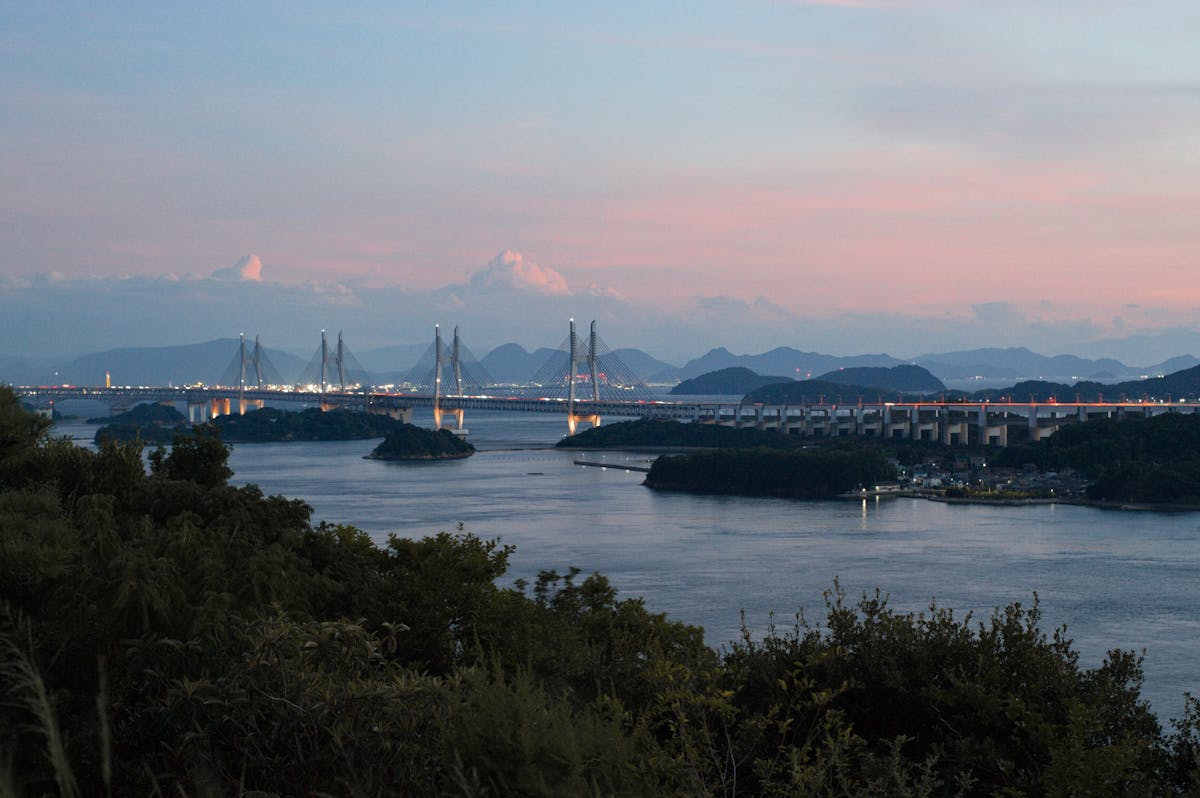
| Kurushima-Kaikyo Bridge (Oshima – Imabari) | Triple suspension | 4,105 m (960 / 1,515 / 1,570 m) | 58 / 78 / 78 m | Pedestrians |
A few notes that will make each crossing more interesting, or less stressful:
- Innoshima Bridge is the one that feels strangest. Instead of riding on top, you ride in an enclosed lane inside the steel girder, underneath the cars, with mopeds passing in the same space. Being enclosed, it is less exposed to the wind than the other bridges. This is the first big bridge after the ferry, and its deck is already 58 m above the water, so your first real climb of the day comes early.
- Ikuchi Bridge is the lowest and shortest of the suspension and cable-stayed bridges, a gentle introduction before Setoda.
- Tatara Bridge marks the border between Hiroshima and Ehime prefectures. Under its tower there is a spot where you can clap a pair of wooden clappers and hear the naki-ryu, the “singing dragon” echo. Look for the clappers under the tower.
- Omishima Bridge is the small arch bridge, the shortest of the six at 328 m, shared with mopeds.
- Hakata-Oshima Bridge is really two bridges, 325 m and 840 m long. Beneath it lies the tiny island of Mijikajima, a campsite you can reach only by bicycle, moped or on foot.
- Kurushima-Kaikyo Bridge was the world’s first triple suspension bridge when it opened in 1999 and is by far the longest crossing of the route at just over 4 km. The path is 58 to 78 m above the strait. Partway across there is an elevator down to the small island of Umashima, and there are two rest bays on the sea side where you can stop for photos without blocking the path. Pedestrians have priority here, and the wind can be strong.
Wind is the one thing a bridge table cannot show you. All six decks are exposed, and the Kurushima-Kaikyo crossing in particular can be gusty. Ride single file, keep both hands on the bars, and do not stop in the travel lane to take photos; use the rest bays.
How long it takes: one day, two days, or a section
The official Shimanami Japan FAQ (updated May 2025) gives three figures for the full 70 km:
| Rider | Time for Onomichi – Imabari |
|---|---|
| Fit, regular cyclist | 4 to 5 hours |
| Confident but not sporty | 5 to 6 hours |
| Beginner, or anyone who stops a lot | About 10 hours |
A guidebook adds pace figures that are useful for planning: beginners average about 10 km/h once you count stops, which works out to about 30 km in a half day and about 50 km in a full day. An intermediate rider covers the 70 km in 6 to 8 hours including sightseeing.
Put those numbers next to the rental hours and you see the problem. The Onomichi terminal opens at 8:00. The island terminals close at 17:00, and the Imabari terminals close at 19:00 (18:00 from December to February). A beginner who starts at 8:00 and genuinely needs 10 hours arrives at 18:00 with no margin for a flat tire, a long lunch or a wrong turn. That is why we do not recommend the full route in one day to a first-timer on a standard bike unless you are already comfortable riding 50 km with hills.
Option 1: One day, full route
Realistic if you ride regularly, or if you rent an e-assist bike (¥4,000) and keep sightseeing to short stops. Start when the terminal opens, have your luggage forwarded, and know your return transport before you set off (see getting back).
Option 2: Two days with a night on an island
There is no official “do it in two days” recommendation, but the rental system allows it: cross bikes, city bikes and e-assist bikes can be rented for multiple days at ¥3,000 or ¥4,000 per day (the ¥8,000 e-bike and the tandem are same-day only). Setoda on Ikuchijima and Omishima both have places to stay and both have alternative transport if the weather turns. Two days turns the ride from a test of endurance into a trip: you can walk Setoda’s Shiomachi street, visit Kosanji, see the national treasures at Oyamazumi Shrine, and still cross the Kurushima-Kaikyo Bridge with energy to spare.
Option 3: A section, with a boat or bus back
Onomichi to Setoda, then the boat back to Onomichi, is the natural half-day. You cross the first two bridges, see the town of Setoda, and finish with a 40-minute boat ride. If you start from Imabari instead, the Kurushima-Kaikyo Bridge to Oshima and back is a short out-and-back with the biggest view on the route. Both are covered in the sample plans.
Whatever you choose, build your day around three fixed times: the terminal’s opening hour, the closing hour of the terminal where you plan to return the bike, and the departure of your boat, bus or train. Everything else is flexible.
Which direction: Onomichi to Imabari, or the reverse
We looked for an official recommendation on direction and found none. Here is how the two directions compare on the facts.
| Start in Onomichi, finish in Imabari | Start in Imabari, finish in Onomichi | |
|---|---|---|
| Getting to the start | Fukuyama Shinkansen station is about 20 minutes away by local train (¥420); Shin-Onomichi (Kodama trains) is a 16-minute bus ride (¥190). | Imabari is about 38 minutes from Matsuyama by limited express (¥1,840) and about 2 hours from Okayama. Convenient if you are already on Shikoku or fly into Matsuyama. |
| First challenge | A five-minute ferry, then the Innoshima Bridge (58 m) as the first climb. | The Kurushima-Kaikyo Bridge, the longest and highest, while you are fresh. |
| Finale | The 4 km Kurushima-Kaikyo Bridge with the Kurushima Strait Observatory at the end. | The ferry into Onomichi, then the Senkoji Ropeway above the town. |
| Bail-out point | Setoda comes early (island three), so if you quit there you have crossed only two of the six bridges, but the boat takes you straight back to your starting town. | Setoda comes late, after four of the six bridges including the Kurushima-Kaikyo. The boat from Setoda to Onomichi (last departure 17:00) then finishes your journey in the right direction, which is an elegant way to shorten the ride. |
| Getting back to Honshu afterward | Shimanami Liner bus Imabari – Fukuyama, about 1 h 35 min, 17 a day, ¥3,300. | You are already on Honshu; Shinkansen from Fukuyama, Shin-Onomichi or Mihara. |
| Getting back to Shikoku afterward | You are already there; train to Matsuyama in about 38 minutes. | No direct bus Imabari-bound from Onomichi Station: take the Innoshima – Onomichi bus to Mukaishima BS and change to the Shimanami Liner, or ride the Liner from Setoda BS or Omishima BS if you return the bike on an island. |
| GIANT one-way rentals | Available, but not on Tuesdays (the Imabari store is closed). | Available any day the Onomichi store is open. |
In short: if you arrive by Shinkansen and want the longest bridge as your finish, go Onomichi to Imabari. If you are touring Shikoku, flying into Matsuyama, or like the idea of ending the day on a boat into Onomichi, go the other way. Neither is wrong. We have no evidence that wind or gradient favors one direction, so do not let anyone tell you one is “downhill.”
Renting a bike, step by step
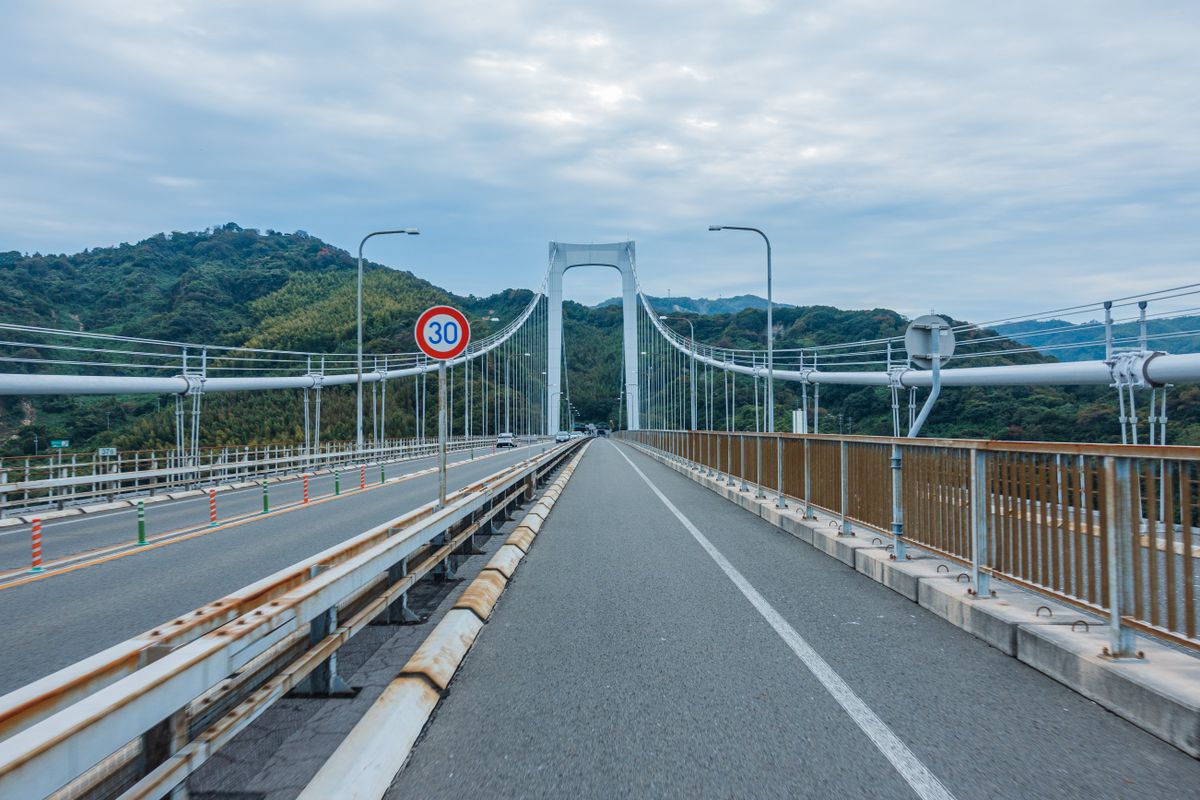
There are two rental systems you will realistically use: the public Shimanami Rental Cycle run by Shimanami Japan, with ten terminals and roughly 2,000 bikes, and the GIANT stores in Onomichi and Imabari for sportier road bikes. We cover the public system first, because it is the one that lets you drop the bike almost anywhere.
Step 1: Choose the bike
| Bike type | Price per day | Where you can rent it | Return rules | Notes |
|---|---|---|---|---|
| Cross bike / city bike | ¥3,000 adult; ¥1,000 elementary school and under | All ten terminals | Any terminal; multi-day OK | The default choice. Gears, upright position. |
| Children’s bike | ¥1,000 | Terminals with stock | Any terminal | For kids too small for a city bike. |
| E-assist bike (electric assist) | ¥4,000 | Onomichi Station-mae, Setoda information center, Setoda Sunset Beach, Omishima, Imabari Itoyama, Imabari Station | Any terminal; multi-day OK | Range about 200 km in eco mode; battery swaps at Setoda (two terminals) and Omishima. Sells out first, even on weekdays. |
| E-bike (sports type) | ¥8,000 | Onomichi Station-mae, Imabari Itoyama, Imabari Station | Same-day return only | Rider must be 145 cm or taller. |
| Tandem | ¥4,000 | Setoda Sunset Beach, Omishima, Imabari Itoyama | Same terminal, same day | Riders 155 cm or taller. Cannot U-turn on the Ikuchi, Tatara or Kurushima-Kaikyo bridges, and cannot use the Umashima elevator. |
Other price rules: a one-way drop at a different terminal costs an extra ¥1,000 for junior high school age and up, ¥500 for elementary school and under. People with a disability certificate pay half. Student groups pay ¥2,000. There is no longer a deposit system (it was abolished when the current ¥3,000 price came in on September 1, 2023), so what you see is what you pay. There is no refund for returning early, and there is a late fee for returning after closing.
Which should you take? For most first-timers doing the full route in one day, the e-assist bike at ¥4,000 is the best ¥1,000 you will spend on this trip. It flattens the bridge ramps and makes the 10-hour beginner estimate shrink toward the 6-hour one. For a two-day ride or the Onomichi–Setoda section, a cross bike at ¥3,000 is fine.
Step 2: Reserve, especially for weekends, holidays and e-assist
Reservations are not required, but Shimanami Japan strongly advises them. On public holidays bikes can sell out by around 10:00, during Golden Week and Obon the whole fleet of about 2,000 bikes can be gone, and e-assist bikes go early even on weekdays. The official booking site is shimanami-bike-rental.com. We could not confirm how many days in advance booking opens or the cancellation terms, so check those on the site when you book. One terminal, Mukaishima, has been reservation-only since April 2025.
Demand is rising fast. In fiscal 2025 the system recorded 79,502 rental transactions covering 173,279 bikes, both records, and use by foreign visitors rose about 70%. Do not assume a weekday in autumn means spare bikes.
Step 3: Pick up the bike
In Onomichi, the terminal moved. On October 8, 2025 the main terminal relocated from Onomichi Port to Onomichi Station-mae Rental Cycle at Higashigoshocho 1-10, about 130 m from the south exit of JR Onomichi Station. Many older guides, maps and blog posts still send you to the port. If a taxi driver or hotel suggests the port, ask for the station.
In Imabari there are two terminals: Imabari Station, and Imabari Itoyama at the foot of the Kurushima-Kaikyo Bridge, next door to the (temporarily closed) Sunrise Itoyama hotel. The Itoyama terminal is open as normal.
| Terminal | Hours |
|---|---|
| Onomichi Station-mae, Imabari Itoyama, Imabari Station | 8:00 – 19:00 (March to November); 8:00 – 18:00 (December to February) |
| Mukaishima (reservation only), Innoshima (Onomichi city central car park), Setoda information center, Setoda Sunset Beach, Omishima (Tatara Shimanami Park roadside station), Hakatajima (Hakata S-C Park), Oshima (Yoshiumi Ikiikikan) | 9:00 – 17:00 |
Some terminals close over the New Year holiday. Helmets are free with every rental (you cannot rent a helmet alone). Payment options include transport IC cards, e-money, QR code payments, WeChat Pay, Alipay and UnionPay. Bring your passport or other ID in case it is asked for.
Before you ride off, check the brakes, the tire pressure and the saddle height, and take a photo of the bike number. If the bike has a lock, learn how it works at the counter rather than at a shrine car park.
Step 4: On the road
If the bike breaks down, call Shimanami Japan at 0848-22-3911. The standard fix is a swap for a working bike at the nearest terminal; an on-site swap service runs from 9:00 to 17:00. Keep the number in your phone before you leave the terminal, and make sure your phone works in Japan (an eSIM such as Airalo set up before you fly is the simplest way; see our eSIM comparison).
The rental includes insurance, but read what it covers: it pays a fixed amount per day of hospitalization (¥4,500 a day), and nothing for outpatient treatment. It is not liability insurance for damage you cause to others. Both Hiroshima and Ehime prefectures make bicycle liability insurance mandatory (since April 2023 and April 2020 respectively), so check whether your travel insurance includes personal liability while cycling. More on this in the safety section.
Step 5: Return the bike
Cross bikes, city bikes and e-assist bikes can be returned to any of the ten terminals, and designated hotels in Imabari also accept returns. Remember the hours: island terminals close at 17:00, Onomichi and Imabari at 19:00 (18:00 in winter). If you return to a terminal other than the one you rented from, you pay the ¥1,000 drop-off fee there. Rental bikes may not be ridden at night, and the islands are genuinely dark after sunset, so plan to be off the bike before then.
The GIANT alternative: proper road bikes
If you ride a road bike at home and want one here, the GIANT stores in Onomichi and Imabari rent them. The Onomichi store is inside the ONOMICHI U2 complex (9:00 – 18:00, closed Tuesdays, but open on Tuesdays from September 1 to November 30, 2026). The Imabari store is inside JR Imabari Station (9:00 – 19:00, closed Tuesdays).
| GIANT bike | One-day price (insurance included) |
|---|---|
| Cross bike | ¥3,960 – 5,280 |
| Aluminum road bike | ¥4,950 – 6,600 |
| Carbon road bike | ¥6,930 – 9,240 |
| E-bike | ¥9,900 – 13,200 |
The rules are stricter than the public system. Reservations open 60 days ahead and close 2 days ahead at 15:00. You need ID. Bikes must be back by 18:00. A helmet is included. One-way rental exists only between the two stores (Onomichi to Imabari or the reverse), only for road bikes, only in limited numbers, only pre-booked, and it costs ¥3,300 on top of the rental. Because the Imabari store is closed on Tuesdays, there is no one-way rental to Imabari on a Tuesday. Prices above are from bicyclerental.jp and vary by model.
Our advice: unless you are a confident road cyclist, the public e-assist bike is the better tool for this route. The GIANT bikes are lighter and faster, but you lose the freedom to return at any island terminal, and you lose the 17:00 island bail-out.
What to do with your luggage
You cannot ride 70 km with a suitcase, and you do not have to. Three services exist specifically for this route, plus ordinary coin lockers. For the general system of shipping bags between cities, see our luggage forwarding guide; what follows is the Shimanami-specific version.
Sagawa “Shimanami Kaido Hands-free Cycling” (same-day bag transfer)
- Price: ¥2,200 per bag (up to 160 cm total dimensions and 30 kg); a bike box costs ¥6,600.
- Where to drop off: about 90 partner hotels and facilities, including the Onomichi Station-mae rental terminal and the Imabari Station cycling terminal.
- Deadline: drop off by 9:00 in Onomichi, Innoshima and Ikuchijima; by 10:00 on Hakatajima, Omishima, Oshima and in Imabari.
- Delivery: after 18:00 for hotels in Onomichi and on the islands; after 16:00 for hotels in Imabari.
- Booking: none needed for individuals (groups should book).
The 9:00 Onomichi deadline is the one that catches people. The rental terminal opens at 8:00, so arrive at 8:00, hand over the bag, then collect the bike. If you are staying in Onomichi the night before, ask the hotel whether it is a Sagawa partner so you can leave the bag at breakfast.
pikuraku PORTER (smart lockers to your hotel)
Smart lockers at JR Onomichi Station, the Onomichi Station-mae rental terminal, Setoda Port and JR Imabari Station. You put your bag in a locker, order delivery to that night’s hotel by 14:00, and it arrives by about 20:00. Prices run from ¥1,000 to ¥6,000 per locker depending on size and destination; Onomichi Station to an Imabari hotel is ¥4,000 to 5,000. Payment is cashless only, and more than 60 hotels participate. The 14:00 deadline makes this the fallback if you miss Sagawa’s 9:00.
WAKKA light-truck transfers
The WAKKA guesthouse on Omishima runs light-truck transfers of people, bikes and bags from ¥4,500, with Onomichi to Imabari at ¥13,000. Expensive, but it carries your bike as well as you, which the public buses mostly do not.
Coin lockers
| Location | Hours | Large locker |
|---|---|---|
| JR Onomichi Station | 4:00 – 23:59 | ¥600 for 3 hours or ¥1,500 for 24 hours; the first 60 minutes are free |
| JR Imabari Station | 24 hours | ¥500 for 3 hours or ¥1,500 for 24 hours |
| Onomichi Station-mae Rental Cycle | Terminal hours | Lockers inside the terminal |
Lockers only make sense for a round trip (Onomichi to Setoda and back by boat, for example). For a one-way ride, use Sagawa or PORTER.
Getting back, or quitting early: ferries, buses and trains
This is the section to read twice. The Shimanami Kaido is a one-way linear route, and the single biggest cause of a bad day is not knowing how you will get back, or how you will get out if the weather, your legs or a mechanical problem stop you partway. Here are all the options, with the traps.
The Setoda boat: your main escape hatch
Setouchi Cruising runs a passenger boat between the pier at Onomichi Station and Setoda on Ikuchijima, about 40 minutes, six round trips a day. The fare is ¥1,500 per adult plus ¥500 per bicycle (the same ¥500 for an e-bike). Cash, cards and transport IC cards are accepted.
| Onomichi → Setoda | Setoda → Onomichi |
|---|---|
| 7:10 | 7:50 |
| 9:15 | 10:00 |
| 10:45 | 11:25 |
| 12:40 | 13:25 |
| 14:10 | 15:00 |
| 16:00 | 17:00 |
Two ways to use it. If you rented in Onomichi, ride to Setoda, return the bike at the Setoda information center terminal (pay the ¥1,000 drop-off fee) and take the boat back as a passenger. Or keep the bike, pay the ¥500 bike fare, and return it at Onomichi Station-mae, which avoids the drop-off fee because you return where you rented. The boat also works in the other direction: take the 7:10 or 9:15 from Onomichi to Setoda with a bike aboard and start your ride from Setoda, skipping the first two islands.
Setoda to Mihara (for the Shinkansen)
From Setoda’s Sawa port there are 12 boats a day to Mihara, 25 to 30 minutes, ¥920 plus ¥120 for a bicycle. Mihara port is a five-minute walk from JR Mihara Station, which is a Shinkansen stop. If you are heading on to Osaka or Tokyo, this can be faster than going back through Onomichi. From Habu on Innoshima there is also a high-speed boat to Mihara, about 50 minutes, ¥1,500 plus ¥300 for a bicycle.
The Innoshima – Ikuchijima ferry: a weekday-only shortcut
Between Kanayama on Innoshima and Akasaki on Ikuchijima there is a four-minute ferry every 20 minutes, ¥80 per adult or ¥130 for a bicycle and rider. It lets you skip the Ikuchi Bridge climb. The trap: it does not run on weekends, public holidays or over New Year. On a Saturday you will arrive at the slipway and find nothing. Use the bridge.
The Onomichi – Mukaishima ferries
Two ferries cross the Onomichi channel: Ekimae to Tomihama (6:06 to 22:10) and Tsuchido to Kaneyoshi (6:05 to 22:00). Adults pay ¥100 and a bicycle is listed at ¥110; the published fares do not make clear whether the bicycle price includes its rider, so have about ¥210 ready and pay what the attendant asks. A third ferry, the Fukumoto service, was abolished on March 31, 2025; ignore any guide that lists it. The Ekimae ferry leaves from close to the station and the rental terminal, which makes it the natural choice if you rent at the station.
The seasonal Cycle Ship
In autumn 2026 a seasonal “Cycle Ship” runs Onomichi – Setoda – Inokuchi – Edakoshi – Shitadami – Imabari on weekends only: October 3, 4, 10, 11, 17, 18 and 31, and November 1, 7, 8, 14, 15, 21, 22, 28 and 29. It does not run on October 24 and 25 (race weekend). A one-day “Shimanami Cruising Pass” costs ¥5,500 including your bike; a single section is ¥2,000 plus ¥500 for the bike, and partner rental bikes load free. On a running day this is a boat that links the two ends of the route directly, and it lets you ride one half and sail the other.
Shimanami Liner: the Imabari – Fukuyama highway bus
The Shimanami Liner is the bus that most riders finishing in Imabari use to get back to the Shinkansen. It runs Imabari – Fukuyama in about 1 hour 35 minutes, 17 departures a day in each direction, along the expressway over the same bridges you just rode. Fares from October 1, 2026: Imabari Station – Fukuyama Station ¥3,300 (¥2,970 if you pay online); Imabari – Mukaishima BS ¥2,000; Omishima BS – Fukuyama ¥2,400; Setoda BS – Fukuyama ¥1,900.
Three changes you must know about:
- All seats are reserved from October 1, 2026. You can still board without a reservation if seats are free, but on a weekend afternoon that is a gamble. Book.
- Transport IC cards are no longer accepted on board since September 30, 2026. Pay online or by other means.
- Within Onomichi city the Liner stops only at Mukaishima BS and Muko-higashi BS, not at Onomichi Station. There is no direct bus from Imabari Station to Onomichi Station.
Bicycles: folding or disassembled bikes in a bag are carried in the hold, space permitting. Rental bikes cannot go. On October 25 (Cycling Shimanami race day) the Liner is disrupted.
Other buses
- Imabari – Hiroshima bus: ¥4,200, about 2 hours 50 minutes, 3 a day. No bicycles at all, even bagged. If you need to get yourself and a bike to Hiroshima, go to Fukuyama by Liner and take the train.
- Imabari Station – Onomichi Station: no direct service. Take the Liner to Mukaishima BS and change to the Innoshima – Onomichi bus. A guidebook from July 2025 listed a ¥2,300 through ticket for this; we could not confirm it is still sold, so ask at Imabari Station.
- Omishima (Miyaura port) – Imabari Station bus: about 68 minutes, ¥1,340 from October 1, 2026. Express buses carry bagged bikes; we could not confirm the rule for ordinary local buses.
- Innoshima – Onomichi bus: about 20 a day, about 48 minutes.
- Imabari port – Munakata (Omishima) boat: ¥760 per adult plus ¥250 for a bicycle.
Trains, with and without a bike bag
On JR, a bicycle travels free as hand luggage if it is bagged and within the limits: the three dimensions must add up to no more than 250 cm, the longest side no more than 2 m, and the weight no more than 30 kg. This is the rinko system, and it applies on the Shinkansen too.
On the Ehime side there is a friendlier rule. JR Shikoku’s “Ehime Shimanami Rin Rin Train” lets you take an unbagged bike onto some local trains between Matsuyama and Iyo-Saijo (which includes Imabari) on weekends and public holidays, first come, first served. The scheme has been extended to February 28, 2027. If you own or have hired a bike and are heading to Matsuyama, this saves the bagging.
Quick reference: if you stop at …
| You stop at | Best way onward |
|---|---|
| Innoshima | Innoshima – Onomichi bus (about 20 a day); or the Habu – Mihara boat for the Shinkansen |
| Setoda (Ikuchijima) | Boat to Onomichi (last 17:00); boat to Mihara (12 a day); Shimanami Liner from Setoda BS to Fukuyama (¥1,900) |
| Omishima | Shimanami Liner from Omishima BS to Fukuyama (¥2,400); bus to Imabari Station (¥1,340, 68 min); boat Munakata – Imabari port |
| Imabari | Train to Matsuyama (about 38 min); Shimanami Liner to Fukuyama (¥3,300); Hiroshima bus (no bikes) |
Island by island: what to see and what it costs
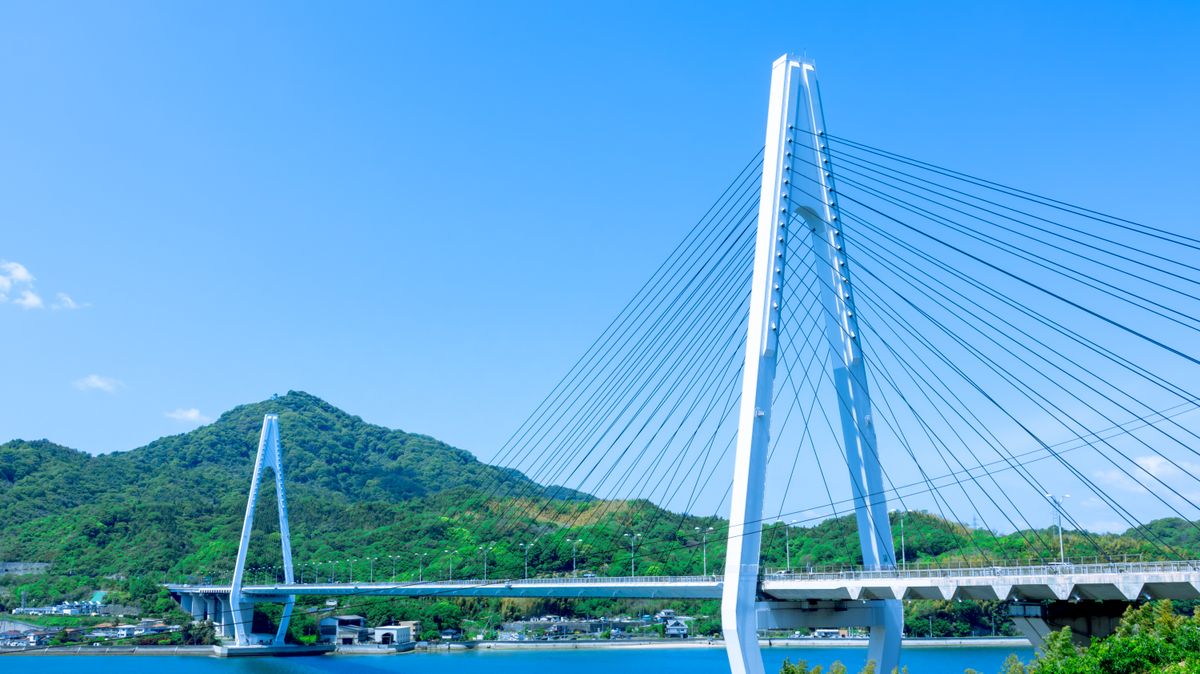
You can ride straight through and see nothing but road and sea, and that is a fine day. But each island has one or two things worth getting off the bike for, and some of them have 2026 price and closure changes you will not find in older guides. Prices are adult admission unless stated.
Onomichi (the start)
Onomichi is a hillside port town. If you have a spare hour before or after the ride, the Senkoji Ropeway runs every 15 minutes from 9:00 to 17:15 (¥500 one way, ¥700 round trip) up the hill above the town. The ONOMICHI U2 complex houses the GIANT store and the HOTEL CYCLE, where you check in with your bike and can take it into any room (twin rooms from ¥19,800).
Mukaishima
Mostly a transit island for cyclists, but Mt. Takami (283 m, free) gives a view of the Innoshima Bridge you are about to cross. It is a real climb, so only detour if you are doing two days or a short ride.
Innoshima
Innoshima is one of the islands of the Murakami Kaizoku, the “Murakami pirates,” whose story was designated a Japan Heritage in 2016. The Innoshima Suigun Castle, with exhibits on the pirates, charges ¥330 (¥500 during special exhibitions), opens 9:30 to 17:00, and is closed on Thursdays unless the Thursday is a public holiday. Nearby, Shirotakiyama has about 700 stone Buddhas on a hillside and is free.
Ikuchijima and Setoda
Setoda is where most of the plans in this guide pause, because it has sights, places to stay, and boats out in two directions. From the port, the Shiomachi shopping street runs about 600 m to Kosanji. This is lemon country: Hiroshima Prefecture grows about 48% of Japan’s lemons (4,659 metric tons in 2023), and Setoda is one of its best-known lemon areas. The lemon cake shop Shimagokoro is on this street.
Kosanji Temple Museum is the island’s big sight: the temple grounds, the Hill of Hope (Miraishin no Oka), a garden of white marble, and the Kongokan art hall, all on one ticket. Admission is ¥1,800 for adults from April 1, 2026 (it was ¥1,400), ¥1,200 for high school and university students, and free for junior high school and younger. One ticket covers the temple grounds, the Hill of Hope and the Kongokan art hall. The Choseikaku villa is an extra ¥500. Open daily 9:00 to 17:00, last entry 16:30.
The Hirayama Ikuo Museum is ¥1,200 (varies with the exhibition), open 9:00 to 17:00, and closed on December 8, 2026. Setoda Sunset Beach, elsewhere on the island, has a second rental terminal with battery swaps for e-assist bikes.
Omishima
Omishima is the first island in Ehime. Oyamazumi Shrine is the reason to come: its treasure hall holds about 80% of all the armor and weapons in Japan designated as National Treasures or Important Cultural Properties. The grounds are free; the treasure hall is ¥1,000. Published opening hours differ between the shrine and the city (9:00 to 16:30 versus 8:30 to 17:00), so check before you plan a late visit.
Also on Omishima: the Tatara Shimanami Park roadside station, home to the official rental terminal and the “Cyclists’ Sanctuary” monument where riders stop for a photo; the Toyo Ito Museum of Architecture (¥840, closed Mondays); and the Tokoro Museum Omishima (¥310, closed Mondays).
And one correction to many English guides: the Hakata Salt factory, despite its name, is on Omishima, not Hakatajima (Omishimacho Dai 32). The factory tour is free, runs 9:00 to 16:00, is usually closed on Wednesdays, and needs no booking for fewer than 10 people. Its observation corridor is closed October 20 to 22, 2026 and reopens October 23.
Hakatajima
The rental terminal is at Hakata S-C Park, whose shop is open 9:00 to 17:00 (closed Tuesdays from January 1 to March 16). This is a good lunch and rest stop before the Hakata-Oshima Bridge. Note the full-island closure on the morning of October 18, 2026 (see seasons and closures).
Oshima
Oshima faces the Kurushima Strait and has the Imabari side of the Murakami Kaizoku story. The Imabari City Murakami Kaizoku Museum is ¥310 (free for high school students and younger), open 9:00 to 17:00, closed Mondays. The Noshima tidal-current boat takes you out onto the strait’s currents for 40 minutes: ¥1,800 for adults, ¥1,000 for elementary school children, hourly from 9:00 to 15:00. Since July 2026 it is closed on both Monday and Tuesday, so a Monday or Tuesday ride means no boat.
The optional climb of the route is Kirosan Observatory Park, designed by the architect Kengo Kuma and free to enter, looking out toward the Kurushima-Kaikyo Bridge. By bike it is about 2.7 km from the route with roughly 230 m of climbing, and the last 300 m are at a 15% gradient. On an e-assist bike with charge to spare it is doable; on a standard bike expect to walk the final stretch. Budget an hour.
Imabari (the finish)
The route ends at Sunrise Itoyama, below the Kurushima-Kaikyo Bridge. The hotel there closed temporarily on March 31, 2026 and is expected to reopen around the winter of fiscal 2027, but the Kurushima Strait Observatory in Itoyama Park is open and free (9:00 to 18:00 March to November, 9:00 to 17:00 December to February) and looks out over the bridge you just crossed. The rental terminal next to the hotel is open as usual. From Itoyama the blue line continues to JR Imabari Station. For what to do in the rest of Ehime, including Matsuyama and Dogo Onsen, see our Matsuyama and Ehime guide.
Where to stay along the route
We will only list places whose details we could confirm, and we give prices only where the operator publishes them. Rates change by season, so treat them as a starting point. There is no official “cyclist-friendly lodging” certification on the route, so the bike-handling notes below are what each place itself states.
Onomichi
- ONOMICHI U2 HOTEL CYCLE: inside the converted warehouse by the port, with the GIANT store downstairs. You check in with your bike and can bring it into any room. Twin rooms from ¥19,800.
- LOG: a six-room hotel, guests aged 13 and over only. Prices are not published; inquire.
- Anago no Nedoko: a guesthouse with dormitory beds at ¥3,300 to 4,000, the budget option in town.
Setoda (Ikuchijima)
- yubune: a 14-room inn built around a public bath (sento). Ground-floor rooms let you bring the bike inside. Non-guests can use the bath for ¥900 on weekdays, ¥1,200 on weekends.
- SOIL Setoda: on the Shiomachi street itself, by the port.
- Azumi Setoda: the luxury ryokan option in town. Prices are not published; expect the top of the range.
Omishima
- Omishima Ikoi no Ie: lodging in a former school building. We could not confirm current prices.
- WAKKA and I-LINK HOSTEL: guesthouses; WAKKA also runs the bike-and-luggage truck transfers described above.
Imabari
- Sunrise Itoyama: closed temporarily since March 31, 2026, reopening around the winter of fiscal 2027. Do not plan on it.
- Cyclo no Ie: a cyclists’ guesthouse near Imabari Station, dormitory ¥3,200, private twin ¥7,400.
- JR Clement Inn Imabari: a hotel with bike-friendly rooms.
One tax note: Hiroshima Prefecture introduced an accommodation tax on April 1, 2026 of ¥200 per person per night, not charged when the room-only rate is under ¥6,000 before tax. It applies in Onomichi and Setoda, which are in Hiroshima. We could not confirm an equivalent tax on the Ehime side. To see current rates and availability for the whole corridor in one place, compare Onomichi, Setoda and Imabari hotels on Agoda; filter by the night you need and check the property’s own bike policy before booking.
Getting to Onomichi and Imabari
The two ends of the route are in different prefectures on different main islands, so they have different gateways. Pick your start point partly by which gateway is easier for you.
Onomichi (Hiroshima side)
- By Shinkansen via Fukuyama: Fukuyama is served by Nozomi trains. From Fukuyama a local train to Onomichi takes about 20 minutes (¥420). From Shin-Osaka, the whole trip is about 1 hour 30 minutes; from Tokyo about 4 hours 20 minutes, changing at Fukuyama.
- By Shinkansen via Shin-Onomichi: only Kodama trains stop here; a bus to Onomichi Station takes about 16 minutes (¥190).
- By Shinkansen via Mihara: a local train from Mihara to Onomichi takes about 13 minutes (¥240). Mihara also has the boats to Setoda and Habu.
- From Hiroshima Airport: the “Onomichi Airport Liner” shared taxi takes about 60 minutes and costs ¥4,000, but carries no bicycles, even bagged. The cheaper route is the airport bus to Mihara Station (about 38 minutes, ¥1,000), then JR to Onomichi.
If you have a few days on the Hiroshima side, Onomichi combines well with Hiroshima and Miyajima and with Tomonoura, the Edo-era port town. If you are wondering whether a nationwide JR Pass pays off for this part of Japan, our rail pass article does the arithmetic.
Imabari (Ehime side)
- From Matsuyama: the Shiokaze or Ishizuchi limited express takes 35 to 41 minutes, ¥1,840 non-reserved or ¥2,370 reserved; a local train takes about 1 hour 20 minutes for ¥1,080. Note that the Shiokaze becomes all-reserved from spring 2027.
- From Okayama: about 2 hours 6 minutes by limited express, which is the way in from the Tokyo–Osaka Shinkansen if you want to start on the Shikoku side.
- From Matsuyama Airport: a reservation-only limousine bus run by Izumi Kanko Bus goes directly to Imabari Station, 3 a day, about 85 minutes, ¥2,500. Bicycles are accepted if you declare them when booking. Matsuyama Airport has domestic flights from Haneda, Narita, Itami, Chubu, Fukuoka, Kagoshima and Okinawa, and international flights from Seoul, Busan and Taipei.
- From Hiroshima by sea: the Linear Jet high-speed boat from Hiroshima (Ujina) to Matsuyama Kanko-ko takes about 70 minutes and costs ¥9,000 (from September 1, 2026); the slower cruise ferry takes about 2 hours 40 minutes for ¥6,000. Then the train to Imabari.
Rail passes: the nationwide Japan Rail Pass covers JR Shikoku trains such as the Shiokaze. The ALL SHIKOKU Rail Pass is sold from October 1, 2026 only as a 3-day (¥12,000) or 7-day (¥20,000) pass, children half price; it covers JR Shikoku but not the Iyotetsu trams in Matsuyama. Buying it through Klook gives you a QR code that works at the ticket gates. It is worth it only if you are also crossing Shikoku to Kochi, Takamatsu or the Iya Valley; for Matsuyama–Imabari alone, buy a ticket.
Seasons, weather, typhoons and closures
Start with the numbers. Imabari’s long-term climate normals: annual rainfall about 1,325 mm, with the wettest months June (196 mm), July (192 mm) and September (165 mm), and an average August high of 32.2°C.
Month by month
- March to May: the first of the two peak seasons. Comfortable temperatures. Golden Week (late April to early May) can see every one of the roughly 2,000 rental bikes taken; reserve weeks ahead or avoid those dates.
- June and July: the rainy season, and the two wettest months. In 2026 rentals were suspended on June 2 for a typhoon, and heavy rain closed the bicycle path between Mukaishima and Oshima on June 25 and 26. Rideable on dry days, but have a plan B.
- August: hot (average high 32.2°C) and humid, with the Obon holiday in mid-August as busy as Golden Week. Start at 8:00, carry more water than you think you need, and consider finishing at Setoda.
- September: still warm and the third-wettest month; peak typhoon season. Watch the forecast a few days out.
- October and November: the second peak and, going by rental numbers, the most popular time to ride. In a recent year the system recorded about 15,000 rentals in October and about 11,000 in November, falling to about 5,000 in December. Note the two October event dates below.
- December to February: quiet, cold in the wind on the bridges, with shorter rental hours at the end terminals (18:00 close) and some terminals shut over New Year.
Checking for closures before you ride
The bridge paths close in high winds, heavy rain and typhoons, and the rental system can suspend operations. The authoritative source is the JB Honshi (Honshu-Shikoku Bridge Expressway) top page, which posts a “二輪車 通行止め” (two-wheeler closure) notice when the bicycle and moped paths are shut. It is in Japanese; a translation app handles it, or ask at your hotel or the rental terminal the evening before. If a typhoon is forecast, assume the route will be closed and the boats may be too.
Two dates in October 2026
Sunday, October 25: Cycling Shimanami 2026. About 7,000 riders, including around 900 from overseas, ride the expressway itself, which is closed to cars (Imabari IC to Innoshima-kita IC 6:00 to 12:40; Innoshima-kita to the Onomichi Bridge 6:00 to 10:00). The ordinary bicycle and pedestrian paths on the bridges remain open, so you can still ride the normal route, but the highway buses including the Shimanami Liner are cancelled or rerouted, the Cycle Ship does not run that weekend, and there are road restrictions around Sunrise Itoyama from 10:00 to 17:00. Expect hotels and rental bikes to be in heavy demand that weekend.
Sunday, October 18: Hakatajima closed 8:00 to 11:00. A triathlon closes the island’s roads to everyone, including bicycles. If you are riding through that morning, you will be held; either start later or plan to be past Hakatajima before 8:00 (unrealistic from Onomichi) or after 11:00.
Looking further ahead, the Velo-city 2027 cycling conference will be held in Matsuyama from May 25 to 28, 2027.
Safety, rules and the 2026 bicycle fines
This is a public road shared with cars on the islands and with mopeds or pedestrians on the bridges. Japan has tightened its bicycle rules considerably in the last three years, and the rules apply to visitors. Here is what you need to know.
The basics
- Ride on the left, in single file. Riding side by side is a ticketable offense.
- Helmets: since April 1, 2023 every cyclist in Japan is expected to wear one. It is an “effort obligation” with no fine, but the rental includes a free helmet and the bridges are high and windy. Wear it.
- On moped-shared bridges (Innoshima, Omishima, Hakata-Oshima), keep to the speed limit and expect to be overtaken. On pedestrian-shared bridges (Ikuchi, Tatara, Kurushima-Kaikyo), pedestrians have priority; slow down and pass wide.
- No night riding on rental bikes, and no sensible night riding on your own bike either: the islands and the sea are pitch dark and the paths are unlit.
- Descents: the bridge off-ramps are the steepest parts of the route. Brake early; a loaded rental bike is heavy.
The “blue ticket” fines since April 1, 2026
Japan introduced on-the-spot fines for cyclists aged 16 and over on April 1, 2026, the so-called blue tickets. Police generally give a warning first and reserve tickets for serious or dangerous violations, but the amounts are real and apply to you on a rental bike.
| Violation | Fine |
|---|---|
| Using a phone while riding | ¥12,000 |
| Ignoring a red light; riding against traffic; riding on a sidewalk where not permitted | ¥6,000 |
| Not stopping at a stop sign; no light at night | ¥5,000 |
| Riding side by side; two people on one bike | ¥3,000 |
The phone rule matters most for visitors: do not check your map while rolling. Stop, then look. The blue line makes this easy, since you rarely need the map at all.
Insurance
Bicycle liability insurance is mandatory by prefectural ordinance in both Hiroshima (since April 2023) and Ehime (since April 2020). The insurance bundled with the official rental only pays a daily amount if you are hospitalized (¥4,500 a day) and does not cover outpatient care or your liability to others. The GIANT rentals include insurance in the price. Before you travel, check that your travel insurance covers cycling and includes personal liability; if not, consider adding it.
Tolls
Bicycle tolls on all six bridges are free until March 31, 2028 (JB Honshi extended the waiver in March 2026). There is nothing to do or show; you just ride through. Pedestrians are also free. Mopeds and e-kickboards do pay: ¥50 each for the Innoshima, Ikuchi, Omishima and Hakata-Oshima bridges, ¥100 for Tatara and ¥200 for Kurushima-Kaikyo, ¥500 for the whole route. A ¥500 “moped ticket” book of ten ¥50 coupons is sold at the Senkoji Ropeway, the JR Onomichi tourist information office, the Setoda information center, the Kurushima Strait Observatory and the toll booths. E-kickboards use the bicycle and pedestrian path.
Help along the way
- Cycle Oasis: around 150 participating shops, cafes, temples and facilities (published counts range from 140 to 160) display the Cycle Oasis sign and offer an air pump, water and a toilet to passing riders. On the Ehime side they also lend basic tool kits for free.
- Shimanami Tosou Rescue: a network of bicycle shops, petrol stations and taxis fitted to carry bikes, coordinated by the NPO Cyclo Tourism Shimanami. Fees vary by provider and distance; ask any Cycle Oasis or terminal to call one for you.
- Rental breakdowns: Shimanami Japan, 0848-22-3911, swap at the nearest terminal (on-site service 9:00 to 17:00).
- Tandems longer than 2.5 m cannot turn around on the Ikuchi, Tatara or Kurushima-Kaikyo bridges and cannot use the Umashima elevator.
We could not verify the locations of convenience stores along the route, so do not count on one appearing when you need it. Carry water and snacks from each town you pass through, and top up at Cycle Oasis stops.
What a Shimanami trip costs
Here are three real budgets built only from the prices in this guide. Food, souvenirs and admissions are left out so you can add your own. All figures are per adult.
| Item | Half day: Onomichi – Setoda – boat back | One day: Onomichi → Imabari, back to Fukuyama | Two days: Onomichi → Setoda (night) → Imabari |
|---|---|---|---|
| Bike rental (official) | ¥3,000 cross bike | ¥4,000 e-assist | ¥6,000 (cross bike × 2 days) or ¥8,000 (e-assist × 2) |
| One-way drop-off fee | ¥0 if you boat the bike back; ¥1,000 if you return it at Setoda | ¥1,000 | ¥1,000 |
| Onomichi – Mukaishima ferry | about ¥210 (adult ¥100 + bike ¥110) | about ¥210 | about ¥210 |
| Boat Setoda → Onomichi | ¥1,500 + ¥500 bike | — | — |
| Luggage | Locker ¥600 (3 h) to ¥1,500 (24 h) | Sagawa ¥2,200 per bag | Sagawa ¥2,200 × 2 (or carry a small bag) |
| Return to Honshu | — | Shimanami Liner to Fukuyama ¥3,300 (¥2,970 online) | ¥3,300 (¥2,970 online) |
| Accommodation tax (Hiroshima side) | — | — | ¥200 per night in Setoda if room-only rate is ¥6,000 or more |
| Approximate total, excluding food, admissions and lodging | about ¥5,800 – 6,700 | about ¥10,700 | about ¥15,100 – 17,100 |
For context, the one-day total is about the same as three Kosanji admissions. A road bike from GIANT with one-way service adds roughly ¥4,300 to 8,500 to the one-day column (bike ¥4,950 to 9,240 plus the ¥3,300 one-way fee, minus the ¥4,000 public rental you no longer need). Cash is useful for small ferries and shops; our cash versus card guide explains where cards fail in Japan.
Three sample plans
Each plan uses only the opening hours, timetables and prices above. Adjust the times to your own pace, and check the Setoda boat and Liner timetables on the day in case they have changed.
Plan A: The full route in one day, Onomichi to Imabari
For reasonably fit riders, or anyone on an e-assist bike who keeps stops short.
- Night before: sleep in Onomichi. Reserve the bike (e-assist if in doubt) and a seat on an evening Shimanami Liner from Imabari to Fukuyama, or book your Imabari hotel.
- 8:00 Arrive at Onomichi Station-mae Rental Cycle. Hand your bag to the Sagawa counter before 9:00 for delivery to your Imabari hotel after 16:00, or use the PORTER locker by 14:00. Collect the bike and helmet, check brakes and saddle, save 0848-22-3911.
- 8:30 Ekimae ferry to Mukaishima (about ¥210 with the bike). Pick up the blue line.
- Morning: Innoshima Bridge (your first climb), Innoshima, Ikuchi Bridge, Setoda. Swap the e-assist battery at a Setoda terminal if the gauge is low. Lemon cake from Shimagokoro; Kosanji only if you are ahead of schedule (allow an hour).
- Midday: Tatara Bridge into Ehime; clap the clappers under the tower. Lunch at Tatara Shimanami Park; photo at the Cyclists’ Sanctuary. Battery swap available here too.
- Afternoon: Omishima Bridge, Hakatajima (rest at S-C Park), Hakata-Oshima Bridge, Oshima. Skip Kirosan unless you are well ahead and on e-assist.
- Late afternoon: Kurushima-Kaikyo Bridge, 4 km. Stop in the sea-side rest bays, not the lane. Descend to Itoyama; walk up to the Kurushima Strait Observatory (free, open to 18:00 March to November).
- Finish: return the bike at Imabari Itoyama or ride the blue line on to Imabari Station and return it there (both open until 19:00 March to November, 18:00 in winter). Pay the ¥1,000 drop-off fee.
- Evening: Shimanami Liner to Fukuyama (1 h 35 min, ¥3,300, reserved seat) for the Shinkansen, or the train to Matsuyama (about 38 minutes) for a night at Dogo Onsen, which is exactly what tired legs want.
Plan B: Two days with a night in Setoda or on Omishima
The plan we would give a friend who has not ridden 70 km before.
Day 1, Onomichi to Setoda (or Omishima):
- 8:00 Rent a cross bike or e-assist for two days at Onomichi Station-mae. Send your main bag by Sagawa to your Day 2 hotel in Imabari (after 16:00 delivery); keep a small overnight bag on the bike.
- Ferry to Mukaishima. Optional detour up Mt. Takami (283 m) for the Innoshima Bridge view; you have time today.
- Innoshima: Suigun Castle (¥330, closed Thursdays) and the Shirotakiyama stone Buddhas.
- Ikuchi Bridge to Setoda. Check in at yubune (ground-floor rooms take bikes inside), SOIL Setoda or Azumi Setoda. Kosanji and the Hill of Hope before 16:30 last entry; Hirayama Ikuo Museum; dinner on Shiomachi street; a bath at yubune even if you are not staying (¥900 weekdays, ¥1,200 weekends).
- Variant: if you feel strong, continue over the Tatara Bridge and sleep on Omishima (WAKKA, I-LINK HOSTEL or Omishima Ikoi no Ie), visiting Oyamazumi Shrine that afternoon.
Day 2, Setoda to Imabari:
- Leave by 9:00. Tatara Bridge and the singing dragon. Oyamazumi Shrine treasure hall (¥1,000) on Omishima; Hakata Salt factory tour (free, closed Wednesdays, corridor closed October 20 to 22, 2026) if the timing works.
- Omishima Bridge, Hakatajima, Hakata-Oshima Bridge. Lunch on Oshima.
- Oshima: Murakami Kaizoku Museum (¥310, closed Mondays). If it is Wednesday to Sunday, the Noshima tidal boat (¥1,800, hourly 9:00 to 15:00). Kirosan if you have legs and daylight.
- Kurushima-Kaikyo Bridge, Itoyama observatory, return the bike by 19:00 (18:00 in winter) and pay the ¥1,000 drop-off fee.
- Night in Imabari (Cyclo no Ie, JR Clement Inn) and on to Matsuyama next morning, or straight onto the Liner to Fukuyama.
Plan C: Half day, Onomichi to Setoda and the boat back
If you have one morning, are traveling with children, or want to test your legs before committing.
- 8:00 Rent at Onomichi Station-mae; drop your luggage in a locker at the terminal or JR Onomichi (¥600 for 3 hours, ¥1,500 for 24 hours). No one-way fee if you bring the bike back by boat.
- Ferry to Mukaishima; Innoshima Bridge; Innoshima; Ikuchi Bridge; Setoda. At a beginner’s 10 km/h with stops, allow the whole morning and do not plan on the 11:25 boat.
- Setoda: Shiomachi street, lemon cake, Kosanji (¥1,800) or the Hill of Hope alone if you are short on time, lunch.
- Return boat at 13:25, 15:00 or 17:00 with the bike (¥1,500 + ¥500). Or return the bike at the Setoda information center terminal (¥1,000 fee) and ride the boat without it.
- Back in Onomichi by about 14:05, 15:40 or 17:40; return the bike at Onomichi Station-mae (open until 19:00 March to November) and ride the Senkoji Ropeway (until 17:15) if there is time.
A reverse variant for people based on the Shikoku side: rent at Imabari Itoyama or Imabari Station, ride the Kurushima-Kaikyo Bridge to Oshima, visit the Murakami Kaizoku Museum or Kirosan, and ride back. You cross the biggest bridge twice and return the bike where you took it, with no drop-off fee.
Pre-ride checklist
- Bike reserved at shimanami-bike-rental.com (e-assist if you are not a regular rider); or GIANT booked 2 to 60 days ahead, not a Tuesday for one-way to Imabari.
- Return transport reserved: Shimanami Liner seat (all reserved from October 1, 2026, no IC cards), or Setoda boat times written down (last to Onomichi 17:00).
- Luggage plan: Sagawa bag at the terminal before 9:00, PORTER locker by 14:00, or a coin locker for a round trip.
- JB Honshi closure page checked the night before and the morning of the ride; forecast checked for wind and rain.
- Day of week checked against: Noshima boat (closed Monday and Tuesday), Toyo Ito and Tokoro museums and Murakami Kaizoku Museum (closed Monday), Innoshima Suigun Castle (closed Thursday), Hakata Salt tour (closed Wednesday), Innoshima – Ikuchijima ferry (weekdays only), GIANT stores (closed Tuesday).
- October 2026 only: not on Hakatajima between 8:00 and 11:00 on the 18th; no Liner or Cycle Ship on the 25th.
- Phone working in Japan (eSIM installed, such as Airalo), with 0848-22-3911 saved and your hotel address in Japanese.
- Travel insurance that covers cycling and personal liability (mandatory in Hiroshima and Ehime).
- Helmet on (free with the rental). Gloves and sunglasses for the bridges. A light layer for the wind on Kurushima-Kaikyo.
- Water and snacks from the last town; do not count on convenience stores. Cash in small notes and coins for ferries.
- Passport or ID for rental counters and tax-free shopping afterward (see our tax-free guide).
- A few Japanese phrases: “sumimasen” (excuse me), “arigato gozaimasu” (thank you), “jitensha” (bicycle). More in our phrase guide.
- Know the closing time of the terminal where you will return the bike: 17:00 on the islands, 19:00 at the ends (18:00 December to February).
Frequently asked questions
Do I need to reserve a rental bike? Not strictly, but you should. On holidays, bikes can be gone by about 10:00, e-assist bikes go early even on weekdays, and Golden Week and Obon can empty the whole fleet of about 2,000 bikes. Book at shimanami-bike-rental.com. The Mukaishima terminal is reservation-only.
How fit do I need to be? The official estimate is 4 to 5 hours for fit riders, 5 to 6 for confident riders and about 10 hours for beginners. The climbs are the bridge ramps, each up to 34 to 78 m above the sea, on gentle gradients. If you can ride 50 km with a few hills at home, you can ride the full route on a standard bike. If not, take an e-assist bike, split it over two days, or ride to Setoda and take the boat.
Can I do it in two days? Yes. There is no official two-day plan, but cross, city and e-assist bikes can be rented for multiple days (¥3,000 or ¥4,000 per day) and there are places to stay in Setoda and on Omishima. The ¥8,000 e-bike and the tandem are same-day only.
Which direction is better? There is no official preference and we found no evidence that one direction is easier. Start in Onomichi if you arrive by Shinkansen and want the Kurushima-Kaikyo Bridge as your finale; start in Imabari if you are already on Shikoku or want to finish with the boat from Setoda into Onomichi.
Are there tolls for bicycles? No. Bicycle tolls on all six bridges are waived until March 31, 2028, with no procedure. Mopeds and e-kickboards pay ¥500 for the full route.
Can I take a rental bike on the ferry or bus? On the Setoda – Onomichi boat, yes, for ¥500. On the Setoda – Mihara boat, yes, for ¥120. The Cycle Ship loads partner rental bikes free. The Shimanami Liner and other highway buses take only folding or disassembled bikes in bags, so a rental bike cannot go. The Imabari – Hiroshima bus takes no bikes at all.
Can I bring my own bike? Yes. On JR trains a bagged bike within 250 cm total, 2 m longest side and 30 kg travels free. On weekends and holidays, some JR Shikoku local trains between Matsuyama and Iyo-Saijo (including Imabari) take unbagged bikes under the Ehime Shimanami Rin Rin Train scheme, extended to February 28, 2027. Sagawa ships a bike box for ¥6,600. The Hiroshima Airport shared taxi to Onomichi does not carry bikes, even bagged; use the bus to Mihara and JR instead.
What happens if the bike breaks? Call Shimanami Japan on 0848-22-3911. They swap the bike at the nearest terminal, with an on-site swap service from 9:00 to 17:00. For your own bike, the Shimanami Tosou Rescue network of shops and bike-carrying taxis can help for a fee.
What if I cannot finish? From Setoda, boats to Onomichi (last 17:00) and Mihara; from Setoda BS or Omishima BS, the Shimanami Liner to Fukuyama; from Omishima, a bus to Imabari Station (¥1,340); from Innoshima, buses to Onomichi. Return the rental bike at the island terminal before 17:00 and pay the ¥1,000 drop-off fee.
Is a helmet required? Since April 1, 2023 all cyclists in Japan are expected to wear one. It is an obligation to make an effort rather than a fineable offense, but the rental includes a free helmet and the bridges are high and exposed. Wear it.
Will I be fined for anything? Since April 1, 2026 police can issue on-the-spot fines to cyclists aged 16 and over: ¥12,000 for using a phone while riding, ¥6,000 for ignoring a red light, riding against traffic or riding on a sidewalk where not allowed, ¥5,000 for not stopping or riding without a light, ¥3,000 for riding side by side or two on a bike. Warnings are the norm, but the rules apply to you.
Is the route suitable for children? Children’s bikes cost ¥1,000 a day and tandems ¥4,000 (riders 155 cm and up, same-day, same-terminal return). The Onomichi – Setoda half day with the boat back is the family version; the full 70 km is a long day for most children. Children of elementary school age and under pay ¥500 for the one-way drop-off fee and junior high and under enter Kosanji free.
What about the Cycling Shimanami race on October 25, 2026? The expressway closes to cars for about 7,000 riders, but the normal bicycle and pedestrian paths on the bridges stay open, so you can ride the regular route. Highway buses including the Shimanami Liner are disrupted, the Cycle Ship does not run that weekend, and there are road restrictions around Sunrise Itoyama from 10:00 to 17:00. Also note that Hakatajima is fully closed from 8:00 to 11:00 on October 18 for a triathlon.
Where did the Onomichi rental terminal go? It moved on October 8, 2025 from Onomichi Port to Onomichi Station-mae Rental Cycle, Higashigoshocho 1-10, about 130 m from the south exit of JR Onomichi Station. Older guides still show the port.
Is Sunrise Itoyama open? The hotel closed temporarily on March 31, 2026 and is expected to reopen around the winter of fiscal 2027. The Imabari Itoyama rental terminal next to it is open, and so is the free Kurushima Strait Observatory in Itoyama Park.
Can I pay by card? The official rental accepts transport IC cards, e-money, QR payments, WeChat Pay, Alipay and UnionPay; PORTER lockers are cashless only; the Setoda boat takes cash, cards and IC. The Shimanami Liner stopped accepting transport IC cards on September 30, 2026, so pay online or in cash. Carry coins for the Onomichi – Mukaishima ferry.
What should I eat along the way? Lemons are the local specialty around Setoda, and the lemon cake shop Shimagokoro on Shiomachi street is the obvious stop. We could not verify convenience store locations along the route, so buy water and snacks in each town and use Cycle Oasis stops to refill.
Plan the rest of your trip
- Matsuyama and Ehime travel guide (the Imabari end)
- Dogo Onsen: the complete guide
- Japanese onsen etiquette
- Uchiko travel guide
- Shikoku 88 temple pilgrimage guide
- Hiroshima and Miyajima guide (the Onomichi end)
- Miyajima travel guide
- Tomonoura, the Edo-era port town in Hiroshima
- Okayama travel guide
- Naoshima art island guide
- Kagawa travel guide
- Iya Valley guide
- Kochi travel guide
- Japan luggage forwarding guide
- Is the Japan Rail Pass worth it?
- Best eSIM for Japan
- Cash versus card in Japan
- Tax-free shopping in Japan
- Essential Japanese phrases for travelers
Sources: Shimanami Japan rental cycle pages and FAQ (May 2025 update; terminal relocation notice October 2025), shimanami-bike-rental.com, JB Honshi (Honshu-Shikoku Bridge Expressway) toll and closure notices (March 2026), MLIT National Cycle Route materials, GIANT bicyclerental.jp, Sagawa Express “Shimanami Kaido Hands-free Cycling”, pikuraku PORTER, Setouchi Cruising and Setoda–Mihara ferry timetables, Shimanami Liner fare and reservation notices (October 2026), Imabari city bus notices, JR Shikoku “Ehime Shimanami Rin Rin Train” notice and ALL SHIKOKU Rail Pass notices, JR West rinko rules, Kosanji Temple Museum, Hirayama Ikuo Museum, Oyamazumi Shrine and Imabari city pages, Hakata Salt, Imabari City Murakami Kaizoku Museum and Noshima boat notices, Innoshima Suigun Castle, Senkoji Ropeway, Sunrise Itoyama closure notice, Hiroshima Prefecture accommodation tax notice, National Police Agency blue ticket material (April 2026), Hiroshima and Ehime prefectural bicycle insurance ordinances, Japan Meteorological Agency climate normals for Imabari, Cycling Shimanami 2026 organizers, Matsuyama Airport and Izumi Kanko Bus, Hiroshima Airport access pages, hotel and guesthouse official sites (checked October 2026). Prices and hours change; if you spot something out of date, please let us know.
Going to Japan? Speak Japanese with confidence.
Hirameki Japanese — camera translate for menus and signs, a two-way conversation mode, and furigana + romaji on every phrase. Free to download with kana charts, conversation mode and starter words; a one-time purchase unlocks everything.

Plan your Japan trip
Two things every first-timer should book
Some links are affiliate links. If you book through them we may earn a small commission at no extra cost to you.