In central Hokkaido, where the great Daisetsuzan mountain range gives way to gently rolling farmland, two small towns offer some of the most beautiful summer scenery in all of Japan. Furano (富良野) and Biei (美瑛) are best known internationally for their stunning lavender fields, but they are far more than that — they are a year-round patchwork of flower farms, panoramic hills, sunflower meadows, autumn colours, world-class ski runs, and some of the freshest dairy and produce in the country.
For first-time visitors to Japan, Furano and Biei provide a rare opportunity: the chance to step away from neon-lit cities and dense urban experiences and into a quiet, almost European-feeling rural landscape that nevertheless remains unmistakably Japanese. From mid-July to mid-August the lavender is in full bloom, but May through October is broadly the "flower season," when the rolling fields shift colour from tulips and lupines to lavender, sunflowers, salvia, and finally cosmos. In winter, the same hills become a powder-snow paradise.
This complete guide walks you through everything you need to plan a Furano and Biei trip: how to get there from Sapporo or New Chitose Airport, when to visit for which flowers, the must-see scenic viewpoints (the famous Patchwork Road and Panorama Road in Biei, Farm Tomita in Furano), where to stay, what to eat (Hokkaido melon, sweet corn, soup curry, dairy ice cream), and how to combine these towns with the rest of Hokkaido. Whether you have a single day or a full week, Furano and Biei will leave a lasting impression.
Before you set off into Hokkaido’s countryside, make sure your phone is ready for navigation, translation, and ride-hailing on the road. Get your Japan eSIM (Stay connected from day 1) →
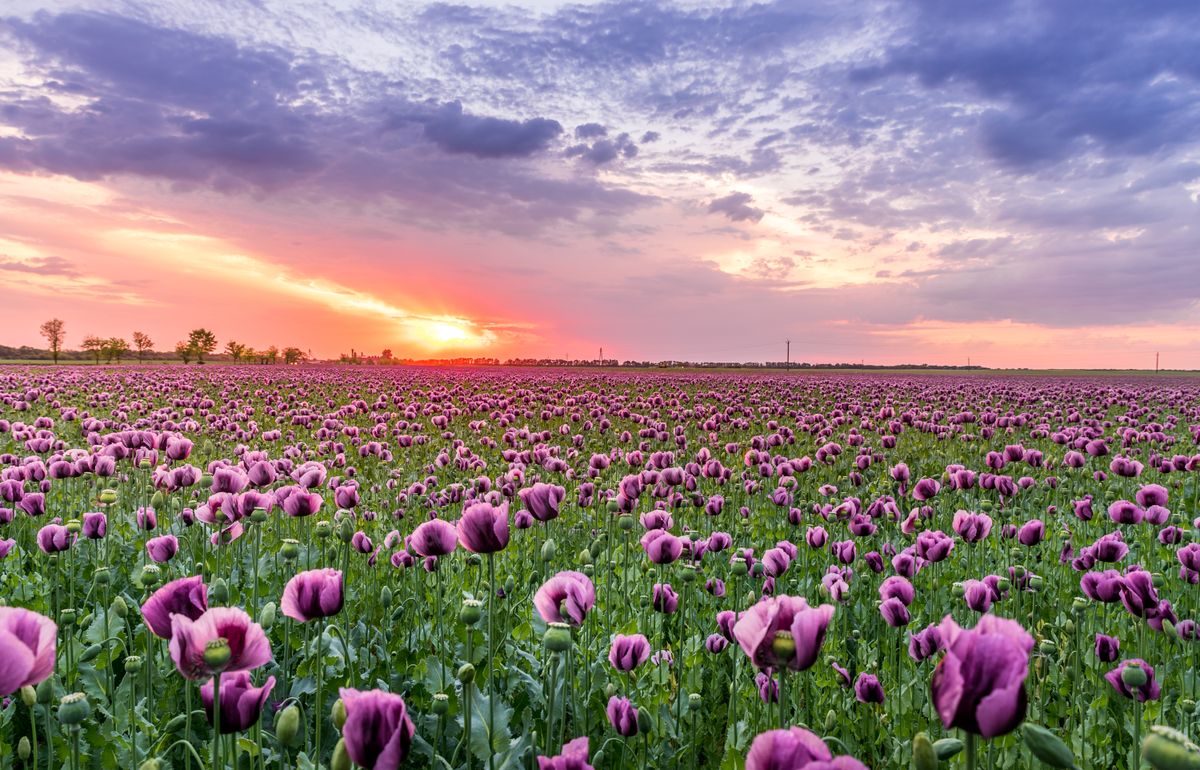
Where Are Furano and Biei? Understanding Central Hokkaido
Furano and Biei sit in the centre of Hokkaido, Japan’s northernmost main island, roughly midway between the regional capital of Sapporo (to the southwest) and Asahikawa (just to the north). Biei is a quiet farming town of about 9,000 people known for its photogenic rolling hills, single trees on hilltops, and patchwork of multi-coloured crop rows. Furano, slightly larger at around 21,000 residents, is famous worldwide as a lavender destination and as a major ski resort in winter.
The two towns are only about 25 km apart and are typically visited together in a single trip. Most travellers base themselves in either Furano or Biei (or split between them) and rent a car to explore the surrounding countryside, since the most beautiful scenery — the iconic patchwork hills, scattered flower farms, ponds, and viewpoints — lies on rural roads between and around the towns rather than in the town centres themselves.
Geographically, the area is shaped by the Tokachi mountain range to the east and the Daisetsuzan National Park just beyond. Snowmelt from these mountains feeds the rich volcanic soil that produces some of Japan’s best vegetables, melons, dairy, and (more recently) wine. The combination of clean air, dramatic mountain backdrops, and orderly farmland is what gives Biei its almost painted, dreamlike quality.
Why Visit Furano and Biei?
If you have already seen Tokyo, Kyoto, and Osaka, Furano and Biei offer a complete change of pace. Here is what makes the area worth a visit:
- Iconic flower fields — most famously lavender, but also sunflowers, lupines, poppies, salvia, and cosmos throughout the summer and autumn.
- Patchwork landscape photography — Biei’s rolling hills are one of the most photographed countryside settings in Japan.
- World-class winter sports — Furano Ski Resort is one of the highest-quality powder destinations in central Hokkaido.
- Outstanding food — Furano melon, Biei corn, fresh dairy and ice cream, soup curry, omu-curry, and Hokkaido sake and wine.
- Onsen and ryokan culture — natural hot springs at Tokachidake and Shirogane Onsen offer an authentic mountain spa experience.
- A break from crowds — even in peak lavender season, the wide-open landscape absorbs visitors and never feels as packed as Kyoto’s temple districts.
How to Get to Furano and Biei from Sapporo and New Chitose Airport
Most visitors arrive in Hokkaido via New Chitose Airport (CTS), the main international gateway just south of Sapporo. From the airport, there are several ways to reach Furano and Biei.
By Train (the simplest public transport option)
From New Chitose Airport, take the JR Rapid Airport train to Sapporo Station (about 37 minutes, ¥1,230 / approx. USD $8). From Sapporo, you have two main rail routes:
- To Biei: Take the JR Limited Express Kamui or Lilac to Asahikawa (about 1 hour 25 minutes, ¥4,810 reserved seat / approx. USD $32.50), then transfer to the JR Furano Line to Biei (about 35 minutes, ¥640 / approx. USD $4.40). Total journey from Sapporo: roughly 2 hours 30 minutes.
- To Furano: Either continue from Biei on the JR Furano Line (another 35 minutes), or in summer take the seasonal "Furano Lavender Express" direct from Sapporo to Furano (about 2 hours, around ¥4,790 reserved / approx. USD $32.40).
The JR Hokkaido Rail Pass (3, 5, 7, or 10 days) covers all of these trains and is excellent value for visitors planning to explore wider Hokkaido — Sapporo, Otaru, Asahikawa, Furano, Biei, and beyond. A 5-day pass currently costs ¥27,430 (approx. USD $185) for adults.
By Car (the recommended option for Furano-Biei)
Renting a car is by far the most popular and practical way to experience Furano and Biei. The most beautiful viewpoints — Shikisai-no-Oka, Zerubu Hill, Patchwork Road, Panorama Road, Blue Pond, and the various farms — are spread across the countryside and most are not directly accessible by train. Driving distances:
- New Chitose Airport → Furano: approximately 2 hours 30 minutes via the Doto Expressway and Route 38.
- Sapporo → Furano: approximately 2 hours via the Hokkaido Expressway to Takikawa and Route 38.
- Asahikawa Airport → Biei: approximately 15 minutes — Biei is in fact much closer to Asahikawa Airport than to either Sapporo or New Chitose. If your itinerary allows, flying domestically into Asahikawa Airport (AKJ) is the fastest route.
Compact rental cars typically start around ¥6,000–¥9,000 per day (approx. USD $40–$60). Reserve in advance during peak summer (July–August) and ski season (December–February). You must carry your home licence plus a 1949 Geneva-format international driving permit (Vienna-format IDPs are not valid); Swiss, German, French, Belgian, Monaco and Taiwanese licences need an official Japanese translation instead.
By Bus and Tour
If you are uncomfortable driving in Japan, several companies operate seasonal day tours from Sapporo to the Furano-Biei area. These bundle transport, lunch, and entries to one or two of the major flower farms, and typically run from late June through August. Day tours start around ¥9,000–¥14,000 per person (approx. USD $60–$95). It is a comfortable option but inevitably less flexible than self-drive.
Furano: The Lavender Capital of Japan
Furano is the heart of Hokkaido’s lavender industry, which began commercially in the 1940s when the climate was found to be similar enough to Provence, France, to grow the same fragrant herb successfully. The lavender boom faded as synthetic perfume oils replaced natural ones in the 1970s — but a single farmer, Tokio Tomita, refused to give up his fields. His persistence was rewarded when his farm was featured on a Japanese National Railways (JNR) calendar in 1976. Almost overnight, Furano became famous, and lavender tourism was born.
Farm Tomita (ファーム富田): The Birthplace of Modern Lavender Tourism
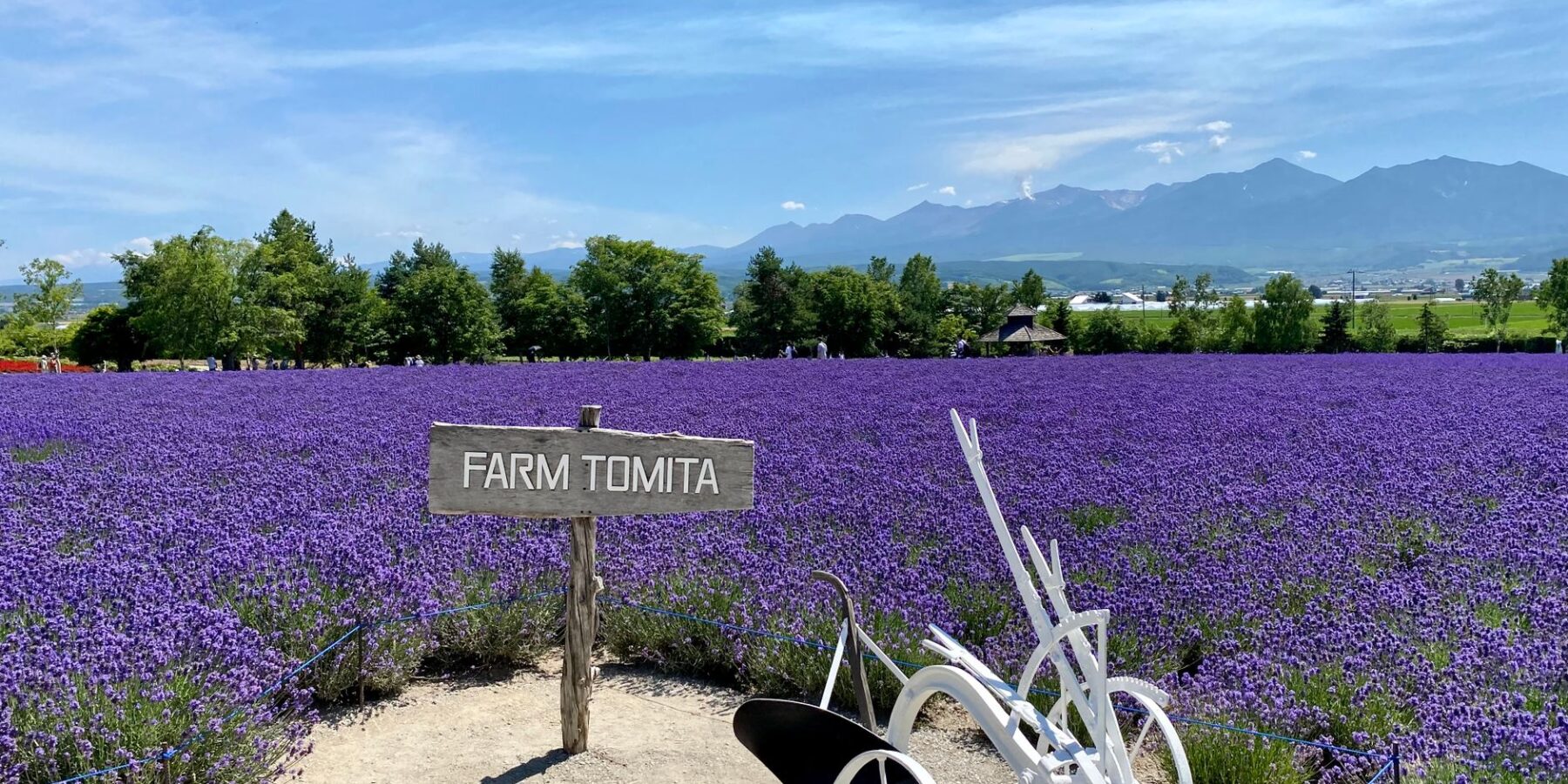
Farm Tomita is the most famous lavender farm in Japan and the spiritual heart of Furano’s flower tourism. The 30-hectare farm grows multiple varieties of lavender along with poppies, salvia, baby’s breath (gypsophila), and other seasonal flowers across distinct themed gardens, including the iconic "Traditional Lavender Garden" (Sakiwai Field) — the original calendar-photograph slope.
Practical details:
- Address: Kisen-kita 15-go, Nakafurano-cho, Sorachi-gun, Hokkaido
- Opening hours: Approximately 9:00 am to 5:00 pm in summer; some facilities open earlier in peak season (June–August).
- Admission: Free entry to the farm and gardens.
- Best time to visit: Lavender peak is typically July 10 to July 25; the wider flower colours are spectacular from late June to early August.
- Access: A summer-only seasonal JR station, "Lavender-batake" (Lavender Field) Station, sits adjacent to the farm. From mid-June through mid-August, the JR Furano Line stops here several times per day. By car, parking is free and ample.
On site you can sample fresh lavender ice cream (¥350 / approx. USD $2.40), buy lavender cosmetics, soaps, and dried bouquets, and watch the historic lavender oil distillery in operation. The on-site café serves seasonal Furano produce. Plan at least 2–3 hours to fully enjoy the farm; on weekends in peak season, you may want to arrive at opening time to beat the bus tours.
Other Furano Flower Farms
Beyond Farm Tomita, several smaller farms offer a more intimate flower experience and rarely the same crowds:
- Lavender East — operated by Farm Tomita, this is reportedly the largest single lavender field in Japan (around 14 hectares), opening only briefly in peak season.
- Saika no Sato — a small but lovely farm with a wide variety of summer flowers and a charming "floral road".
- Hinode Park Lavender Garden — a free public lavender garden in central Kamifurano, offering panoramic views over the surrounding hills, especially at sunset.
- Choei Lavender Park — a hillside park with chairlift rides above flowering fields and views of the Tokachi mountain range.
Furano Town and Surroundings
Furano town centre is small and walkable, with a JR station, a few hotels, restaurants, and an arts and crafts complex called Ningle Terrace, located a short drive away in the forest beside the New Furano Prince Hotel — a tiny village of cabin-like wooden cottages tucked into a wooded hillside, each housing a different small artisan studio (pottery, jewellery, candles, leather, paper crafts). The cottages are illuminated at night and create a magical, almost fairy-tale atmosphere. Free entry; especially atmospheric after sunset.
Just outside town is the Furano Cheese Factory, where you can watch cheese being made, taste a range of Hokkaido cheeses, and try cheese-making yourself in a workshop. Pizza, ice cream, and butter are also produced and sold on site.
Biei: A Patchwork of Painted Hills
If Furano is famous for its concentrated flower farms, Biei is famous for its landscape itself — endless rolling hills planted in geometric patches of green wheat, golden barley, white potato flowers, yellow rapeseed, purple and pink lupines, and many more. The result, viewed from any of the area’s hilltop roads, is a painterly patchwork that has become a defining image of the Japanese countryside in summer.
Biei’s scenery owes its fame in large part to landscape photographer Shinzō Maeda, whose work in the 1970s and 1980s introduced Japan to the area’s painterly possibilities. Today, his work is showcased at the Takushinkan gallery on Panorama Road, and many travellers retrace his photographs along the routes described below.
Patchwork Road (パッチワークの路)
Patchwork Road is the looped driving route through the gentle hills north of Biei Station. It takes its name from the patchwork-quilt visual created by the alternating colours of agricultural fields. Highlights along the route include:
- Ken & Mary Tree — a single, perfectly shaped poplar that became famous after appearing in a 1970s television advertisement for the Skyline car. The tree stands alone on a gentle ridge with magnificent views.
- Seven Stars Tree — an oak tree photographed for a cigarette package campaign, hence the name. Now an iconic stop.
- Mild Seven Hill — a row of larch trees that featured in Mild Seven cigarette ads and are particularly striking in winter when snow blankets the landscape.
- Hokusei-no-Oka Observatory Park — a free public viewpoint with sweeping views over the patchwork.
- Zerubu Hill — a working farm with flowerbeds you can walk through, plus an observation tower; fee-paying buggy rides take you through the fields. Small admission fee around ¥500 (approx. USD $3.40).
Total driving distance for the loop is around 25 km. Allow 2–3 hours, more if you stop at every viewpoint.
Panorama Road (パノラマロード)
Panorama Road runs through the hills south of Biei Station, on slightly higher ground with wider views. Highlights include:
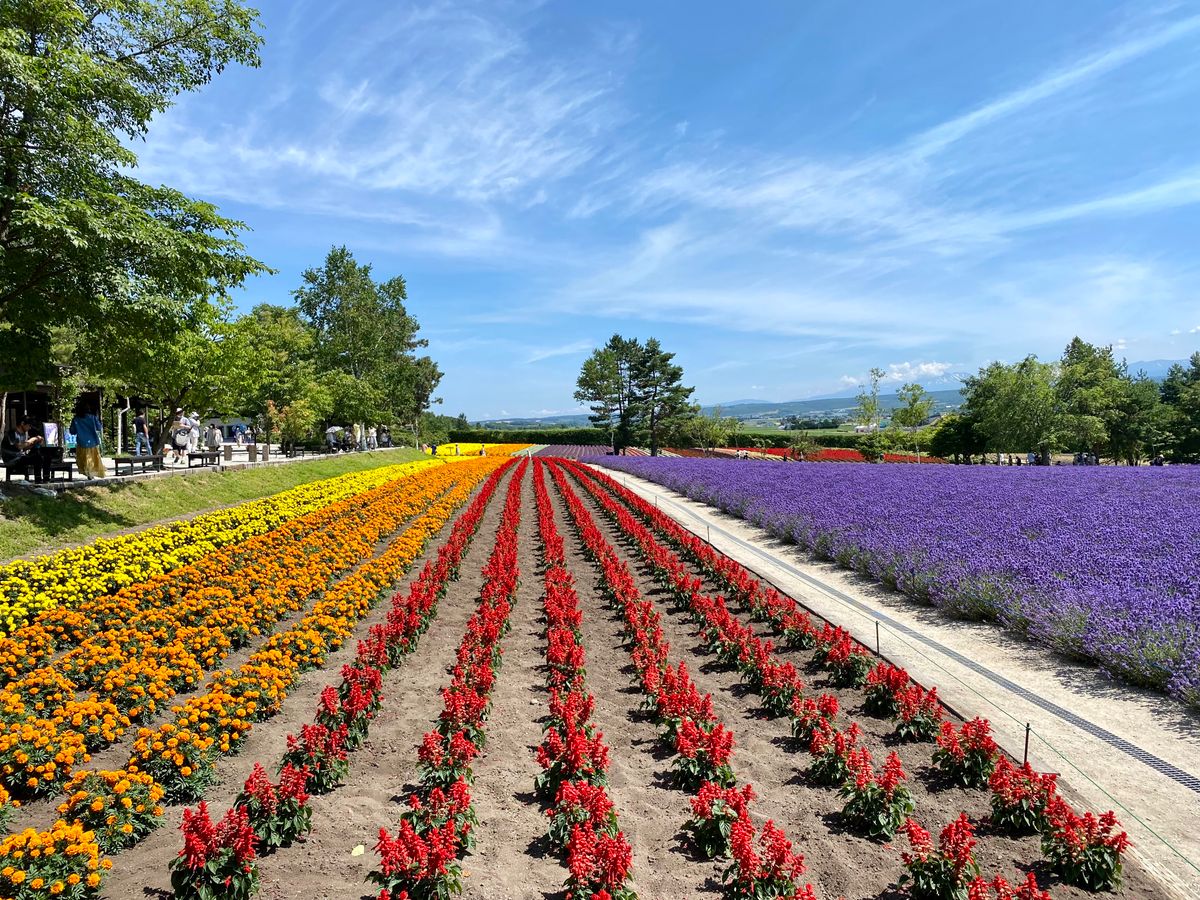
- Shikisai-no-Oka (四季彩の丘) — "Hill of the Four Seasons," one of the most photographed flower farms in all of Japan. Bands of marigolds, salvia, sunflowers, and dozens of other flowers are planted in horizontal stripes across a south-facing hillside, giving an unbelievable rainbow appearance from late June through October. Admission ¥500 (approx. USD $3.40); buggy or tractor rides around the fields are extra.
- Takushinkan Photo Gallery — a museum dedicated to Shinzō Maeda’s landscape photography, set in a converted former elementary school. Modest admission fee.
- Crocus Hill / Saint Valentine Hill — minor but charming photogenic stops along quiet farm roads.
- Shinei-no-Oka Observatory — free panoramic viewpoint over rolling fields and the distant Tokachi mountains.
Drive distance for the Panorama Road loop is similar to Patchwork Road, around 20–25 km, with 2–3 hours recommended.
Shirogane Blue Pond (白金青い池) and Shirogane Onsen
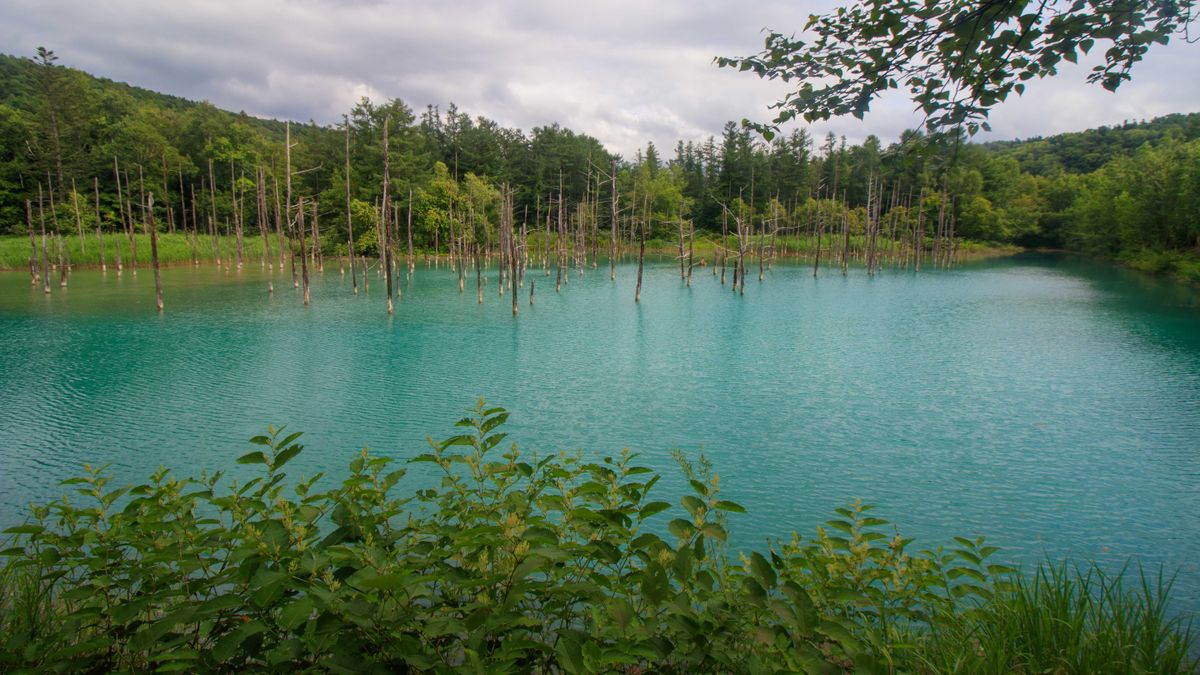
About 20 minutes’ drive east of central Biei, deep in the forest at the foot of the Tokachi mountains, lies one of Japan’s most photographed natural sights: Shirogane Aoiike, the "Blue Pond". The pond’s surreal turquoise-blue colour is caused by colloidal aluminium hydroxide naturally dissolved in the water, refracting blue and green light. Dead birch and larch trees that died when the pond was formed (after a 1988 dam was built to protect against volcanic mudflows) still stand eerily in the water, creating an unforgettable, almost otherworldly composition.
The Blue Pond appeared as one of the bundled desktop wallpapers on Apple’s OS X Mountain Lion in 2012, exposing it to a global audience. Today it is illuminated nightly in winter (early November to early April), creating a magical effect against the snow.
Just 5 km further up the valley is Shirogane Onsen, a small mountain hot spring resort with several inns offering day-use baths and overnight stays. The slightly milky, iron-rich water is excellent for tired travellers after a day of countryside touring.
When to Visit: A Month-by-Month Guide
Furano and Biei are spectacular at every time of year — but each season offers a totally different experience.
May
Late spring brings the first colour to the fields: tulips (the famous Kamiyubetsu Tulip Park is a long drive away on the Okhotsk coast), magnolias and cherry blossoms (slightly later than the rest of Honshu), and fresh greenery everywhere. Quiet, photogenic, and uncrowded.
June
The hills turn a vivid green. Lupines bloom from mid-June, alongside potato flowers (white) and rapeseed (yellow). Lavender begins to appear by the end of the month. This is one of the most beautiful and least crowded months overall.
July (Peak Lavender Season)
The reason most international visitors come. Lavender peaks roughly from July 10 to July 25, with the exact timing depending on the year’s temperatures. Sunflowers begin opening late in the month; poppies, salvia, and other summer flowers are at their peak. Expect the busiest crowds of the year, especially on weekends.
August
Lavender is fading by mid-month, but sunflowers are at their absolute peak, especially at the famous Hokuryu Sunflower Field (about 90 km north of Furano), with over 1.5 million sunflowers. Shikisai-no-Oka’s rainbow stripes are at their most vivid. Weather is warm but the air is famously dry and pleasant compared to mainland Japan’s humid summer.
September
Late summer flowers, dahlias, and the first signs of autumn. Light is golden, photographic conditions are excellent, and visitor numbers drop sharply after Japan’s school holidays end at the end of August.
October
Hokkaido’s autumn foliage (kōyō) typically peaks in mid-October at the higher altitudes (Tokachidake, Daisetsuzan) and slightly later in the lower farm valleys. The combination of red and gold mountain forests with the patchwork hills below is breathtaking.
November
The flower season is over and the first snow usually arrives mid-month. A quiet, off-peak time. Some attractions and farms close for winter.
December–March (Winter Wonderland and Ski Season)
Furano Ski Resort opens in early December and runs through early May, offering excellent powder snow, a wide variety of runs (29 courses across two zones, Furano Zone and Kitanomine Zone), and a vertical drop of 974 metres. It’s less internationally famous than Niseko but tends to be quieter, less expensive, and equally high quality. Lift tickets range from approximately ¥7,500–¥9,000 per day (approx. USD $50–$60).
Biei in winter is also magical — the same patchwork hills become a sea of pristine white, with single trees standing as dark silhouettes. The illuminated Blue Pond is a major winter draw.
April
The shoulder season between snow and flowers. Quiet, with melting snow, muddy fields, and a sense of renewal. Best for travellers who want to avoid crowds.
Where to Stay in Furano and Biei
Accommodation styles range from international resort hotels and chalets to small family-run pensions and rustic ryokan. In peak summer (July–August) and peak ski season (late December to early March), book at least 3–6 months in advance, especially for the most popular farm-stay pensions.
Resort Hotels
- New Furano Prince Hotel — large international hotel directly at the base of the ski resort, with on-site restaurants, hot springs, the Ningle Terrace boutique village, and direct lift access. Doubles around ¥18,000–¥30,000 per night (approx. USD $122–$203).
- Furano Natulux Hotel — modern boutique hotel near central Furano, often around ¥10,000–¥18,000 per night (approx. USD $68–$122).
Pensions and Auberge
The Furano-Biei region is famous for its pensions — small, family-run guesthouses offering 4–10 rooms, breakfast, and often dinner using local ingredients. Many are run by former chefs or hospitality professionals from major cities who relocated for the lifestyle. Expect to pay ¥10,000–¥18,000 per person per night, including dinner and breakfast (approx. USD $68–$122).
Onsen Ryokan
For a traditional Japanese inn experience with hot spring baths, head to Shirogane Onsen (near Biei) or Tokachidake Onsen (between Furano and Biei, in the high mountains). Rates are typically ¥15,000–¥25,000 per person per night with dinner and breakfast (approx. USD $100–$170).
Compare and book your stay across hotels, pensions, and ryokan to find the best deal for your dates: Book your hotel on Agoda (Best prices guaranteed) → or Search hotel deals on Agoda →
Budget Options
Several hostels and guesthouses in Furano town offer dorm beds from ¥3,500–¥5,000 per night (approx. USD $24–$34). Staying in Asahikawa (just 35 minutes by train from Biei) and day-tripping in is also a sensible budget strategy.
What to Eat in Furano and Biei
Hokkaido is widely regarded as Japan’s greatest food region, and Furano-Biei sits at the heart of its agricultural heritage. The local specialities are deeply tied to the soil, the dairy herds, and the seasons.
Furano Melon
The summer fruit symbol of the region. Bright orange-fleshed Cantaloupe-style melons grown in volcanic soil, with intense sweetness and aroma. Whole melons range from ¥3,000–¥10,000 (approx. USD $20–$68). At any farm stand or service area in summer, you can buy half-melons or single slices much more affordably (¥600–¥1,200 / approx. USD $4–$8).
Biei Sweet Corn
Locally called "morokoshi," Biei’s sweet corn is grown in the cool nights and hot days of central Hokkaido, producing exceptional sweetness. Look for it grilled at roadside stands or eaten raw straight from the cob (when it’s freshest, raw is sometimes the most popular way to eat it).
Soup Curry (Sūpu Karē)
Hokkaido’s signature dish is a thinner, more aromatic curry served as a soup with chunks of vegetables and meat over rice on the side. Many Furano restaurants have their own version using local Furano vegetables. Typical price ¥1,200–¥1,800 (approx. USD $8–$12).
Omu-Curry (Furano Omu-Curry)
A local Furano speciality combining omurice (rice wrapped in a thin omelette) with a rich curry sauce, typically using Furano-grown vegetables and Furano cheese. Multiple restaurants in town have certified versions.
Hokkaido Dairy
Fresh milk, butter, cream, ice cream, and cheese — all unmissable. The Furano Cheese Factory, Campana Rokkatei (a famous confectionery brand with a beautiful winery-shaped Furano outlet), and local farm shops all offer tastings.
Hokkaido Wine and Sake
Furano is increasingly known for its wines (especially the Furano Winery’s pinot noirs) and the wider region produces excellent sake. Tasting tours are available.
A Suggested Two-Day Itinerary for Furano and Biei
Day 1 — Furano Focus
Morning: Arrive in Furano (drive or train). Drop bags at your hotel/pension. Drive to Farm Tomita; arrive around 9:00 am to enjoy the fields before bus tour groups arrive. Wander the various themed gardens (Sakiwai Field, Hanabito Field), and drive to the separate Lavender East field if it is open. Coffee and lavender ice cream break.
Late morning: Drive 15 minutes to Saika no Sato for a quieter flower-farm experience.
Lunch: Return to Furano town for omu-curry or soup curry.
Afternoon: Visit the Furano Cheese Factory for tastings and a workshop. Then drive up to Hinode Park Lavender Garden for sunset over the hills.
Evening: Dinner at your pension, or in town. Walk through Ningle Terrace after dark when the cabins are illuminated.
Day 2 — Biei Focus
Morning: Drive (or take the JR Furano Line) to Biei. Begin with the Patchwork Road loop: Ken & Mary Tree, Seven Stars Tree, Mild Seven Hill, Zerubu Hill, Hokusei-no-Oka observatory.
Lunch: Cafés in Biei specialise in fresh local ingredients — try a vegetable bowl, Biei corn, or fresh fruit dessert.
Afternoon: Drive the Panorama Road loop, with Shikisai-no-Oka as the centrepiece. Photo stop at Saint Valentine Hill and Shinei-no-Oka observatory.
Late afternoon: Drive 20 minutes to Shirogane Blue Pond. The colour is most dramatic on a sunny afternoon. Continue to Shirogane Falls, just 5 minutes further up the road.
Evening: Hot spring bath at Shirogane Onsen or back in Furano/Biei. Dinner using local Hokkaido produce.
Combining Furano and Biei with Wider Hokkaido
Furano and Biei work brilliantly as a 2–3 day segment of a longer Hokkaido itinerary. Here is one classic 7-day plan:
- Day 1: Arrive Sapporo. Sapporo TV Tower, Susukino, Genghis Khan barbecue dinner.
- Day 2: Sapporo half-day; afternoon train to Otaru for canal walk and seafood dinner.
- Day 3: Otaru → Asahikawa via train. Half-day at Asahiyama Zoo. Onward to Biei.
- Day 4: Patchwork Road, Panorama Road, Shikisai-no-Oka.
- Day 5: Shirogane Blue Pond, Tokachidake Onsen. Move to Furano.
- Day 6: Farm Tomita, Furano town, Cheese Factory, Ningle Terrace.
- Day 7: Return to Sapporo or fly home from New Chitose.
For broader trip-planning, see our complete list of Japan destinations and our first-timer’s travel tips.
Need an airport transfer to or from your accommodation? Book airport transfer on Kiwitaxi →
Practical Tips for Visiting Furano and Biei
- Rent a car if at all possible. The countryside scenery and many of the most beautiful spots are simply not accessible by public transport. Even non-confident overseas drivers usually find Hokkaido’s wide, well-marked roads and light traffic relatively easy.
- Bring layers, even in summer. Hokkaido summer days can hit 28°C (82°F), but mornings and evenings can drop into the low teens (50s°F). A light jacket or fleece is essential.
- Book accommodation early. Especially July–August and December–February. Many of the best pensions sell out 6+ months ahead.
- Carry cash. Many small farm stands, family pensions, and rural cafés are cash-only. ATMs at 7-Eleven and Japan Post in Furano and Biei reliably accept foreign cards.
- Sunrise and sunset are golden. The patchwork landscape is at its most beautiful early or late in the day, when long shadows accentuate the rolling hills.
- Respect the farms. Many of the most photographed fields are working farms. Stay on marked paths, never enter crops, and don’t pick flowers. The single trees you see in photographs are also working agricultural landmarks; stay on the road or designated paths.
- Mosquito and gnat repellent. Hokkaido summer fields can be buggy at dawn and dusk. Bring or buy spray locally.
- Drive slowly and watch for wildlife. Foxes, deer, and tanuki occasionally cross country roads, particularly at dusk.
- Use Google Maps offline tiles. Mobile signal is generally good but can drop in rural valleys. Save maps for offline use as a backup.
- Try the seasonal local trains. The summer-only "Norokko Train" from Asahikawa or Furano is a slow, scenic, open-window experience through the lavender fields. Tickets ¥1,000–¥1,500 (approx. USD $7–$10). A genuinely fun, low-cost activity.
Budget Guide for a Two-Day Furano-Biei Trip
Two-day budget for one person travelling moderately (renting a small car, staying in a mid-range pension, eating out at lunch, dinner at the pension):
- Rental car (2 days, compact): ¥14,000 (approx. USD $95)
- Fuel (approx. 200 km): ¥2,500 (approx. USD $17)
- Pension stay (1 night, dinner + breakfast): ¥14,000 (approx. USD $95)
- Lunches and snacks: ¥4,000 (approx. USD $27)
- Farm and attraction admissions: ¥1,500 (approx. USD $10)
- Souvenirs (cheese, lavender goods, melon): ¥3,000 (approx. USD $20)
- Total estimate: ¥39,000 (approx. USD $264)
Travelling on a tighter budget (hostel + train + minimal souvenirs) is doable for ¥18,000–¥22,000 (approx. USD $122–$149) for the two days.
Frequently Asked Questions About Furano and Biei
What is the absolute best time to visit Furano and Biei?
For most travellers, mid-July (around July 15–25) is the dream window: lavender is at full peak, sunflowers are starting to bloom, and Shikisai-no-Oka is in full rainbow mode. However, this is also the busiest time. If you prefer fewer crowds and slightly different scenery, late June (lupines, early lavender, brilliant green hills) and early September (sunflowers, cosmos, golden light) are excellent alternatives. Winter is a completely different experience but equally rewarding — Furano Ski Resort is one of Japan’s top powder destinations.
Do I need to rent a car in Furano-Biei?
Strongly recommended. Buses and trains will get you to the towns and to a few major farms (Farm Tomita is right next to the seasonal Lavender-batake station, for example), but Patchwork Road, Panorama Road, the Blue Pond, Shirogane Onsen, and most of the smaller farms simply cannot be done easily by public transport. If driving is not an option, consider a guided tour bus or a private chauffeur for a day.
Can I see lavender in Furano outside of July?
Lavender bloom is fairly tight: roughly the first week of July through the first week of August, peaking around mid-July. Outside this window, you will see beautiful flower farms with other flowers (lupines, poppies, salvia, sunflowers, marigolds, cosmos) but no lavender at peak. If lavender is your absolute priority, plan around the second to fourth week of July.
How many days do I need for Furano and Biei?
Two full days (one focused on each town) is the practical minimum to see the main sights without rushing. Three days is a comfortable pace that allows for slow mornings, repeated photo stops, hot spring time, and a wider variety of farms and viewpoints. Day-trippers from Sapporo or Asahikawa can see one or two highlights but will miss the early-morning and late-afternoon light that makes the area so special.
Are Furano and Biei suitable for families with children?
Very. Children typically love the open landscapes, buggy and tractor rides at the flower farms, ice cream at every farm stop, the cheese factory workshops, and the "treasure hunt" nature of the Patchwork Road tree spotting. Many pensions and hotels have family rooms. The relatively short drives (5–25 minutes between most attractions) keep car-bound boredom to a minimum.
What should I pack for a summer trip to Furano-Biei?
Light long sleeves, a fleece or light jacket for evenings, sun hat, sunglasses, sunscreen, mosquito repellent, comfortable walking shoes, and a camera. In the height of summer, days can be hot but the dry climate makes it more comfortable than mainland Japan. Always bring a light jacket — wind off the mountains can drop the "feels-like" temperature noticeably even in July.
Is Furano good for skiing?
Yes — Furano Ski Resort is one of Japan’s most highly regarded ski areas. It is consistently rated for excellent powder snow, a wide range of runs (29 courses across two interconnected mountain zones), reliable mid-mountain restaurants, and shorter lift lines than the more internationally famous Niseko. The on-mountain New Furano Prince Hotel makes ski-in/ski-out particularly easy. The season runs from early December to early May, with the deepest powder in January and February.
Is the Blue Pond worth visiting?
Yes — even with the very high expectations created by the famous photographs. The unusual turquoise colour, the silvered dead trees, and the surrounding forest make it one of the more unusual natural sights in Japan. Visit on a sunny day for the most dramatic colour, and ideally outside the busiest midday window. In winter (early November to early April), the pond is illuminated each evening, creating an entirely different but equally striking spectacle.
What if I’m visiting in May or November (shoulder seasons)?
Both shoulder seasons are quiet but rewarding. May offers tulips at Kamiyubetsu, fresh greenery, and almost no crowds. November is mostly bare landscape but excellent for atmospheric photography, fresh autumn produce, and rural pension experiences at lower rates. Many flower farms close from late October through May, so check opening hours specifically before booking.
Final Thoughts: Why Furano and Biei Belong on Your Japan Itinerary
Most foreign visitors to Japan spend their time in cities — and they should: Tokyo, Kyoto, and Osaka are extraordinary. But the best Japan itineraries also build in time for the country’s rural landscapes, and there is no better introduction to that other Japan than Furano and Biei. Here, the rhythm of the day is dictated by the sun, the seasons, and the farmer’s calendar. The conversation in the pension dining room is about what is in season at the local market. The light at sunset over the lupine fields will stay with you long after the trip is over.
Furano and Biei reward planning. Pick your season, book your pension early, rent a car, drive slowly, and stop often. Eat the corn straight from the cob. Try the lavender ice cream. Linger at the Blue Pond until the colour shifts as the sun moves. Then end the day in a hot spring with a view of the mountains. This is a side of Japan that the cities simply cannot offer — and once you have seen it, you will understand why so many visitors come back to Hokkaido again and again.
Explore more of Japan’s incredible regions at japanrealguide.com/destinations/ and find all the planning advice you need in our first-timer’s Japan travel guide. Combine your trip with our Shinkansen guide for travelling efficiently between Honshu and Hokkaido.
Going to Japan? Speak Japanese with confidence.
Hirameki Japanese — camera translate for menus and signs, a two-way conversation mode, and furigana + romaji on every phrase. Free to download with kana charts, conversation mode and starter words; a one-time purchase unlocks everything.

Plan your Japan trip
Two things every first-timer should book
Some links are affiliate links. If you book through them we may earn a small commission at no extra cost to you.