Fushimi Inari Taisha: The Complete Early Morning Hike Guide
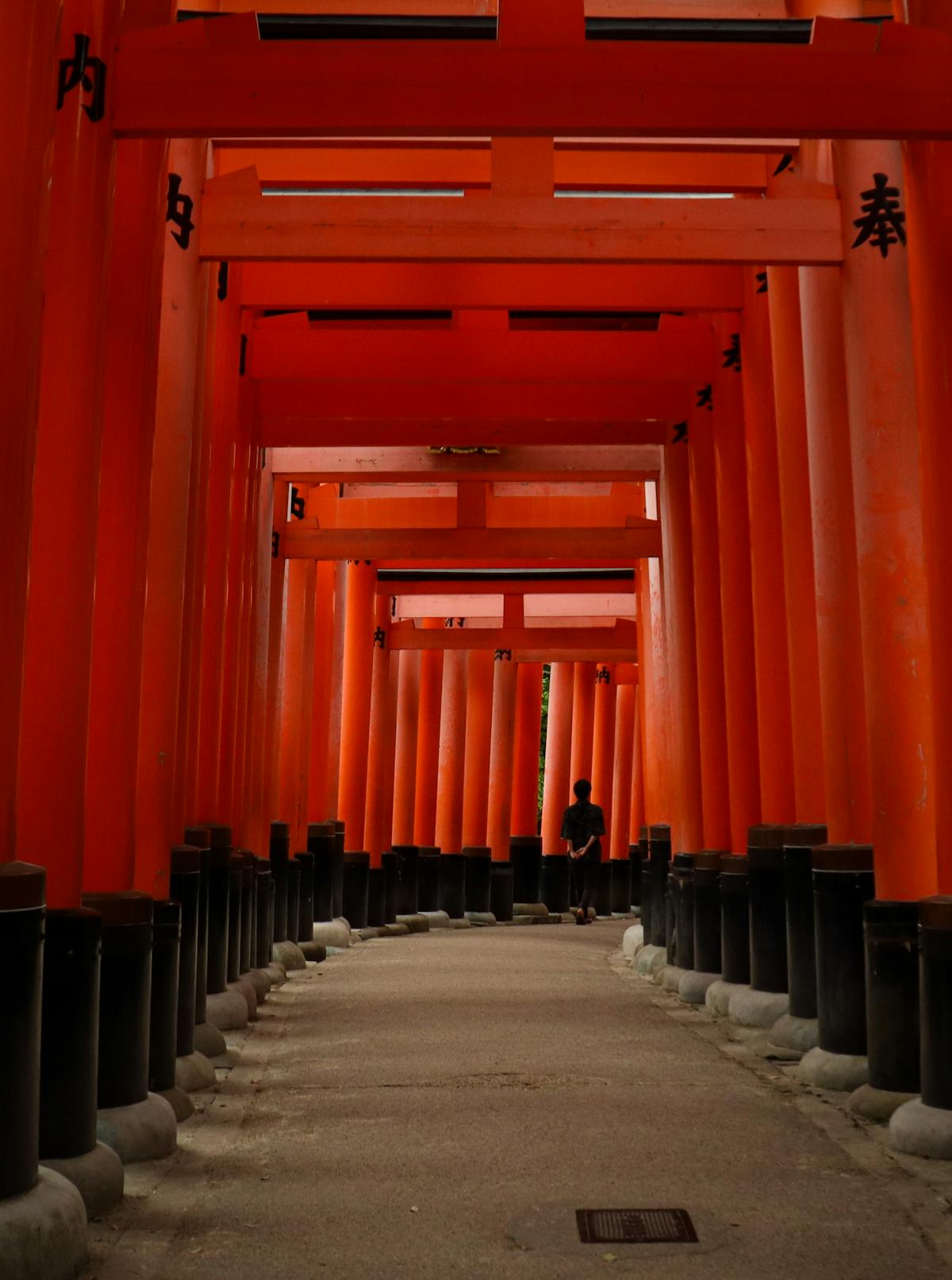
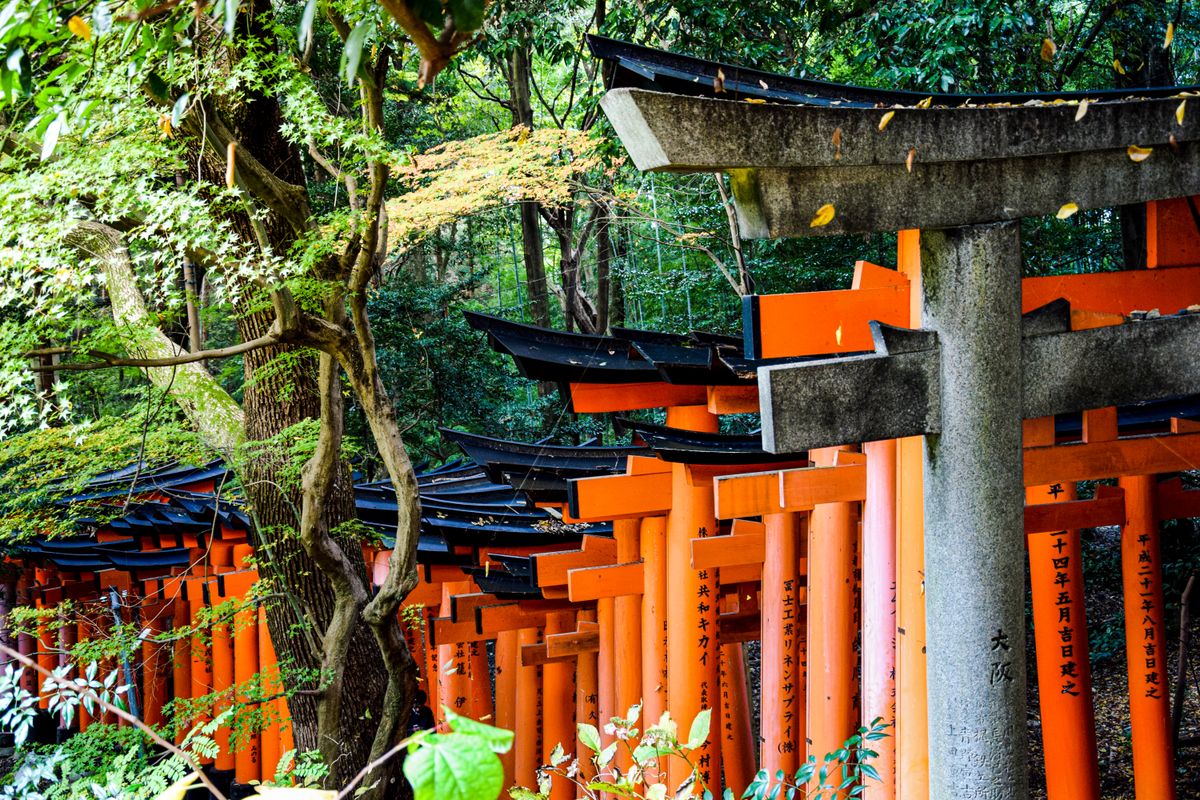
Of all the sights in Kyoto, Fushimi Inari Taisha is the one that first-time visitors consistently say left them speechless. Thousands of brilliant vermilion torii gates wind their way up Mount Inari, creating a tunnel of orange and red that looks almost otherworldly — especially in the soft, misty light of early morning.
A note from Jack, editor of Japan Real Guide:
My first visit to Fushimi Inari was in October 2013. I arrived at 10:30 AM on a Saturday with no plan and no idea how busy it would be. I spent two hours shuffling through the torii tunnels at queue pace, unable to stop for a photograph without blocking someone. The gates were there, but I could not feel the place at all.
That experience changed how I travel in Japan. Every visit since — and I have returned to Fushimi Inari six times across different seasons — has been at first light. The visit I remember most was a February morning in 2019. I took the first JR Nara Line train from Kyoto Station, walked to the entrance in the dark, and spent the first twenty minutes completely alone in the lower torii tunnels. There was frost on the stone lanterns. A single crow called from somewhere higher up the mountain. No queues, no noise.
One thing the photographs do not prepare you for: the smell. Cedar wood, cold stone, incense from the small roadside altars — it is one of the most distinctive atmospheres in all of Japan, and it only reveals itself when the crowds are absent. This guide is built around that experience. Go early.
But here is the thing most travel guides do not tell you: timing is everything at Fushimi Inari. Go at the wrong time and you will spend your morning shuffling through crowds thick enough to make a Tokyo rush hour look peaceful. Go at the right time — and you will have one of the most magical experiences Japan has to offer.
This guide covers everything you need to know: the best time to go, how to get there, the full trail explained station by station, what to bring, where to eat, where to stay, and honest answers to every question first-time visitors ask. Whether you have a few hours or a full day, this is the only Fushimi Inari guide you need.
What Is Fushimi Inari Taisha?
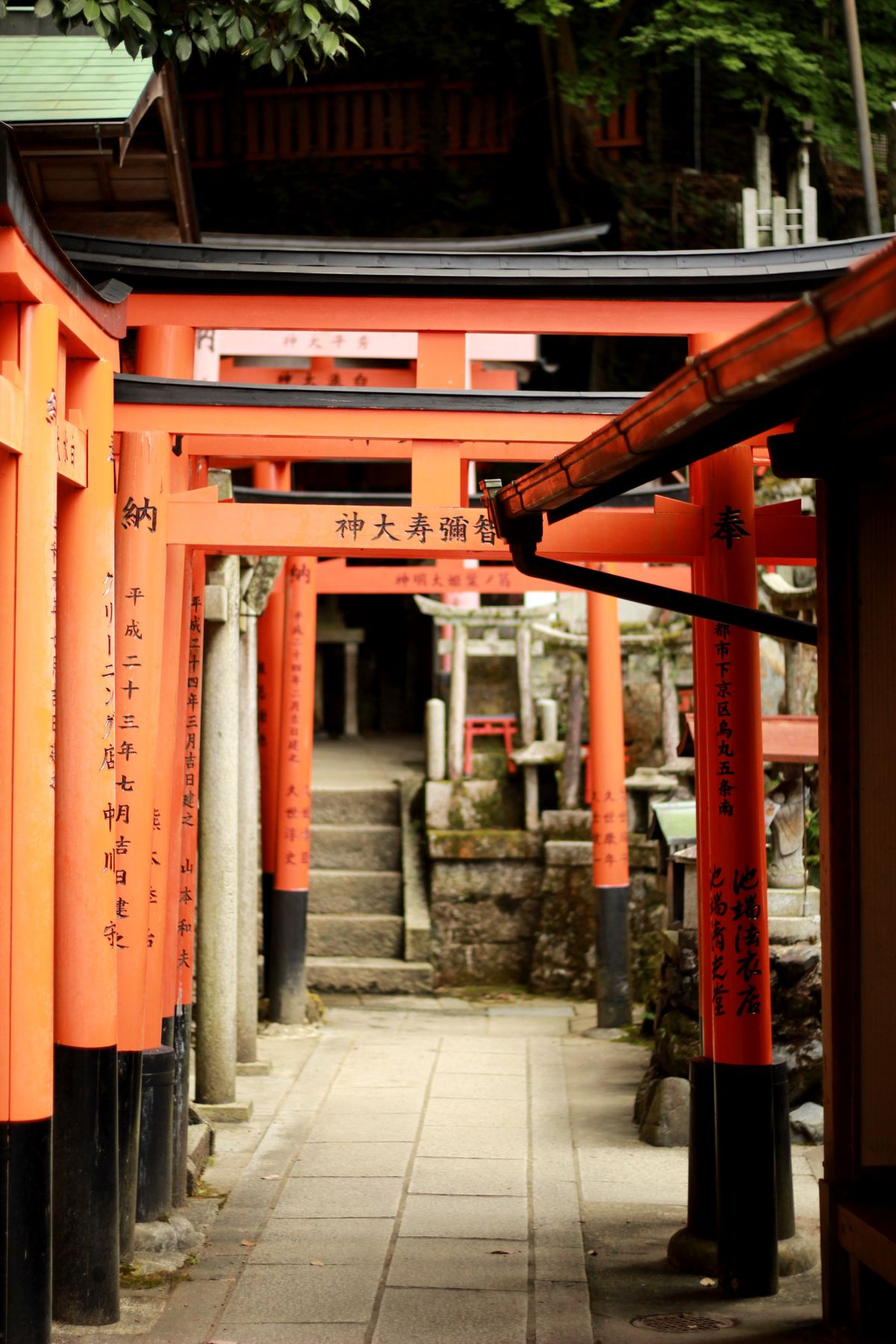
Fushimi Inari Taisha is the head shrine of approximately 30,000 Inari shrines spread across Japan. Dedicated to Inari, the Shinto deity of rice, agriculture, industry, and worldly success, it has been a place of worship and pilgrimage for over 1,300 years. The shrine was formally established in 711 AD, though some records suggest worship on Mount Inari dates back even further.
The famous torii gates — there are estimated to be around 10,000 of them — were donated by businesses and individuals as offerings to Inari. Each gate bears the name of the donor on its back face, and the density of gates along the main trail is so high that they form a nearly continuous tunnel for much of the lower portion of the mountain.
Mount Inari itself rises to 233 meters (764 feet) above sea level. The main trail to the summit and back covers approximately 4 kilometers (2.5 miles) of walking, gaining about 200 meters of elevation. The full round trip typically takes 2 to 3 hours at a comfortable pace, though many visitors choose to go only part of the way up.
Admission to Fushimi Inari Taisha is free and the grounds are open 24 hours a day, every day of the year. This unrestricted access is part of what makes early morning visits so rewarding: there are no tickets to buy, no booking required, and no closing time to rush against.
Before you travel, make sure you have reliable internet access — whether for navigating the trail, translating Japanese signs, or simply looking up train times on the fly. Get your Japan eSIM (Stay connected from day 1) →
Why Visit Early in the Morning?
Fushimi Inari Taisha is one of the most visited tourist attractions in all of Japan, drawing millions of visitors per year. During peak daytime hours — roughly 9:00 AM to 4:00 PM — the lower portion of the trail is crowded enough that walking freely is difficult, photography is challenging, and the serene atmosphere that makes the shrine so special is largely lost in a sea of selfie sticks and tour groups.
The solution is simple: arrive before 7:30 AM, ideally between 6:00 AM and 7:00 AM.
In the early morning, Fushimi Inari is transformed. The air is cool and often carries a gentle mist, especially in autumn and spring. The light filters through the trees in shafts of gold and green. The only sounds are birdsong, the occasional wind through the bamboo, and the soft crunch of gravel underfoot. Photographers and dedicated hikers are usually the only other people you will encounter.
Even on the busiest days of the year — cherry blossom season (late March to mid-April), Golden Week (late April to early May), and the autumn foliage season (mid-November) — an early arrival between 6:00 AM and 7:30 AM will give you a reasonably uncrowded experience on the main trail.
There is also a practical advantage to going early: by the time you finish your hike and return to the city, it is usually still mid-morning. You have the rest of the day free for other Kyoto sightseeing without feeling like you have wasted half the day standing in a queue.
How to Get to Fushimi Inari Taisha
From Central Kyoto (Kyoto Station)
Fushimi Inari is exceptionally easy to reach from Kyoto Station. The most straightforward option is the JR Nara Line, which stops directly at Inari Station — the station closest to the shrine’s main entrance. The journey takes just 5 minutes and costs ¥150 (approximately USD 1.00). Trains run frequently throughout the day, and the first train typically departs Kyoto Station around 5:30 AM, making early morning visits entirely feasible.
A second option is the Keihan Main Line from Tofukuji Station (a short walk from Kyoto Station) to Fushimi Inari Station. This journey takes about 6 minutes and costs ¥170 (approximately USD 1.15). From Fushimi Inari Station on the Keihan Line, the shrine entrance is a 7-minute walk — slightly further than from JR Inari Station, but still very convenient.
If you are traveling with a JR Pass, use the JR Nara Line — your pass covers this journey entirely and it is the most direct option.
From Osaka
Fushimi Inari is equally accessible from Osaka, which makes it an excellent half-day trip from the city. The fastest and most convenient route is via the Keihan Railway:
- Take the Keihan Main Line from Yodoyabashi Station (central Osaka) toward Demachiyanagi
- Ride approximately 40–50 minutes to Fushimi Inari Station, changing from an express to a local train at Tambabashi or Chushojima if needed (¥430 / approximately USD 2.90)
- Walk 7 minutes to the shrine entrance
Alternatively, from Osaka you can take the JR Kyoto Line (Special Rapid) from Osaka Station to Kyoto, then connect to the JR Nara Line as described above. Total journey time is approximately 50–60 minutes from central Osaka.
By Bus within Kyoto
City buses from downtown Kyoto serve the area, but given the excellent direct train connections, the bus is rarely the best option. If you are already in the Fushimi area for other sightseeing (such as Fushimi Momoyama Castle or the sake breweries along Yokomachi Street), the bus provides convenient links between attractions.
By Taxi
Taxis from Kyoto Station to Fushimi Inari cost approximately ¥1,500–¥2,000 (USD 10–13) and take about 20 minutes depending on traffic. For an early morning visit when trains are running but you prefer door-to-door convenience, this is a reasonable option. Most major taxi apps in Japan (including GO and S.RIDE) work in Kyoto.
For stress-free transport from the airport on arrival day, consider arranging a private airport transfer: Book airport transfer on Kiwitaxi →
The Trail: A Station-by-Station Breakdown
The trail at Fushimi Inari is organized around a series of stations (called isha or rest points) as you ascend the mountain. Understanding the structure of the trail helps you plan how far to go and where to turn back if you are short on time.
Main Shrine Complex (Base Level — 0 minutes)
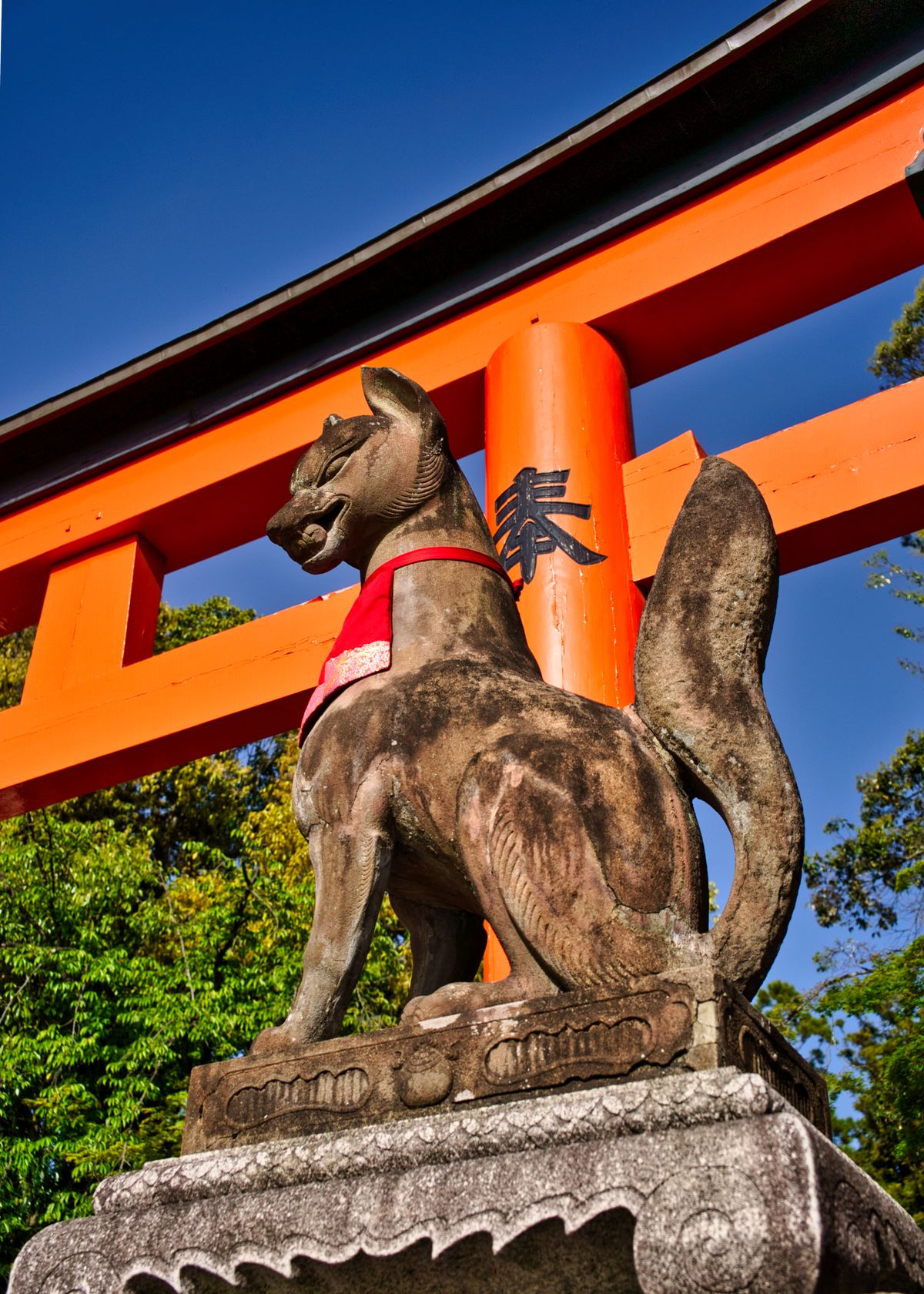
The trail begins at the main shrine complex at the base of Mount Inari. As you enter through the main torii gate (a massive vermilion structure about 6 meters tall), you will pass through the outer grounds with their fox statues, lanterns, and subsidiary shrines. The main hall (Honden) is located straight ahead and is worth a brief visit.
Kitsune, the fox, is the messenger of Inari in Shinto belief, and you will see fox statues everywhere — often holding a jewel, a sheaf of rice, a key, or a scroll in their mouths. Each item symbolizes a different blessing. Take a moment to observe the intricate details on these statues before beginning your ascent.
Senbon Torii — The Famous Gate Tunnels (5–15 minutes from base)
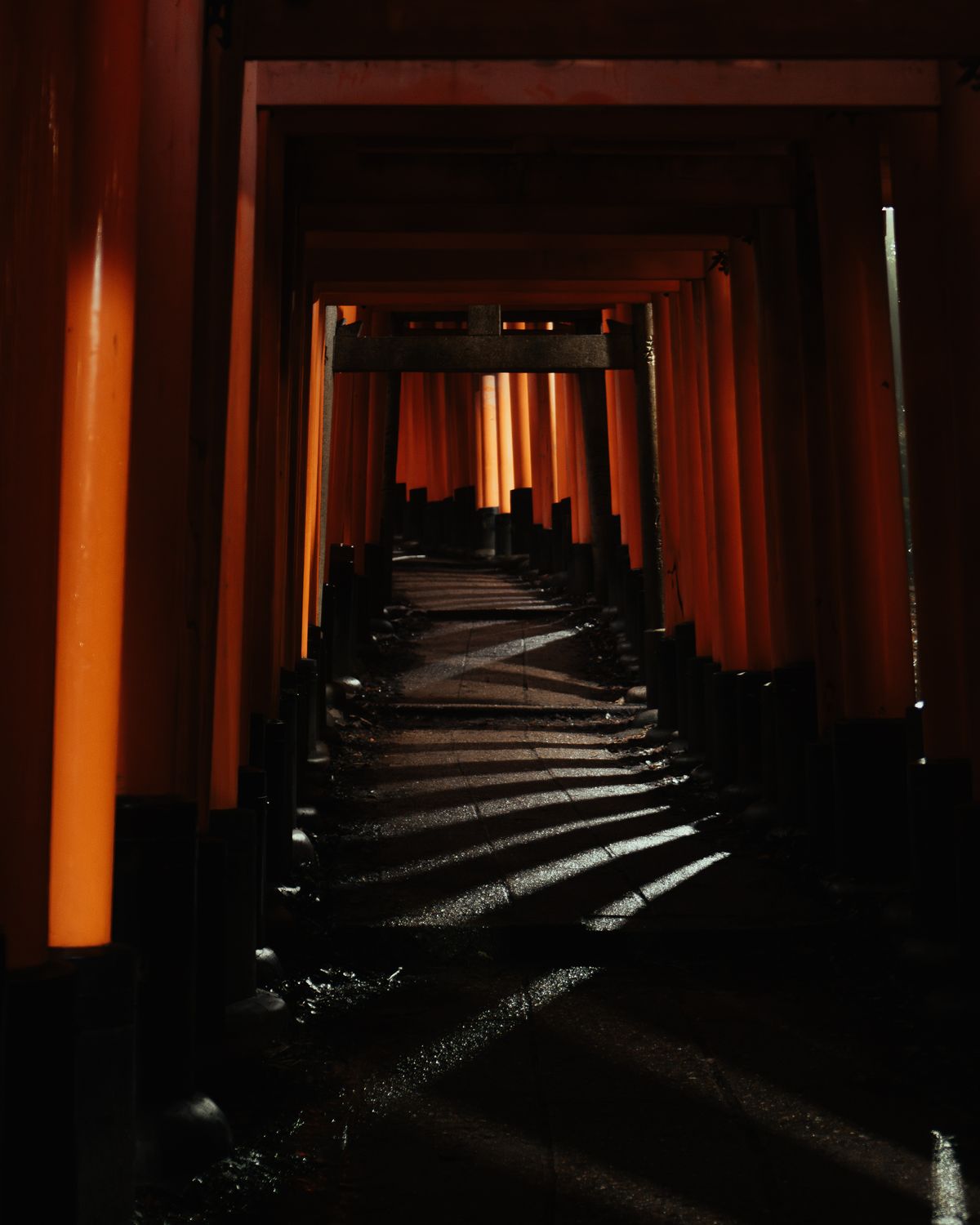
The famous double-lane torii tunnel known as Senbon Torii (literally “thousands of torii gates”) begins almost immediately after the main shrine buildings. The effect is stunning: the gates are placed so closely together that they form a nearly continuous canopy of orange-red, broken only by occasional shafts of light from above.
The path here is split into two lanes — one for those going up and one for those going down. Follow the lane on the left as you ascend, and the right as you descend. During busy periods this lane separation is informally enforced by the flow of pedestrian traffic; in the early morning you will have the luxury of wandering freely.
Kumataka-sha and Okusha Hōhaijo (20–25 minutes from base)
After the initial Senbon Torii section, the trail opens up somewhat before passing through another dense section of gates. You will reach the Okusha Hōhaijo, a worship hall backed by a rock formation, and various subsidiary shrines where visitors leave offerings. This is typically the point where many day-trippers turn around — roughly halfway up to the Yotsutsuji intersection.
Yotsutsuji Intersection (30–40 minutes from base)
Yotsutsuji is the key decision point on the trail. At this four-way junction, you have a view back down over the Fushimi district and, on clear days, the city of Kyoto in the distance. There are a few small food stalls and souvenir shops here. The benches make it a good rest point.
Most casual visitors go up to Yotsutsuji and back. The round trip from the base takes approximately 60–75 minutes at a relaxed pace and represents the “standard” Fushimi Inari experience for those with limited time.
Mitsutsuji and the Upper Mountain Loop (45–90 minutes from base)
Beyond Yotsutsuji, the crowd thins dramatically even at busy times. The trail loops around the upper section of Mount Inari, passing through Mitsutsuji (a three-way junction), several minor shrine complexes with stone lanterns and moss-covered gates, and a series of stone-paved sections that require a bit more effort.
The upper trail passes through bamboo groves and cedar forests that feel genuinely wild compared to the lower tourist sections. Small outdoor restaurants (called chaya — teahouses) are dotted along the route, typically opening around 9:00 AM. If you arrive early, most will not yet be open, so bring your own water and snacks.
The Summit — Ichinomine (90–120 minutes from base)
The very top of Mount Inari at Ichinomine is modest compared to some mountain summits — there is a small shrine complex, clusters of otsuka stone prayer mounds, and a peaceful forested atmosphere. The view is partially obscured by trees. Most hikers who make it to the top do so for the sense of accomplishment and the quiet rather than for a panoramic vista.
Total round-trip distance from the base shrine to the summit and back: approximately 4 km (2.5 miles). Total time: 2–3 hours at a comfortable pace.
What to Wear and Bring
Fushimi Inari is a proper hike, not just a short walk through a temple garden. Comfortable footwear is essential. The path is paved with stone for most of the route, but there are sections with uneven steps, loose gravel, and areas that become slippery when wet. Trainers or light hiking shoes are ideal. Sandals or high heels will make the experience significantly less pleasant.
Here is a packing checklist for an early morning visit:
- Water — Bring at least 500ml per person. Vending machines exist along the lower trail, but they may not be stocked early in the morning. On the upper trail, the teahouses do not open until mid-morning.
- A light snack — Especially if you plan to complete the full trail before the teahouses open.
- Comfortable shoes — As described above. Closed-toe, with grip.
- Layers — Mount Inari can be noticeably cooler than downtown Kyoto, especially in the early morning. A light jacket or packable fleece is useful from October through April.
- Rain gear — Kyoto receives significant rainfall, and morning mist is common. A compact umbrella or lightweight rain jacket is wise to have in your bag.
- Cash — Shrine area souvenir shops and food stalls typically only accept cash. Bring ¥1,000–¥2,000 (USD 7–14) for snacks, omamori (lucky charms), and any souvenirs you want to pick up.
- Your phone, charged — For maps, photos, and translations. Having a Japan eSIM ensures you have data even in the mountain area.
Etiquette and Rules at Fushimi Inari
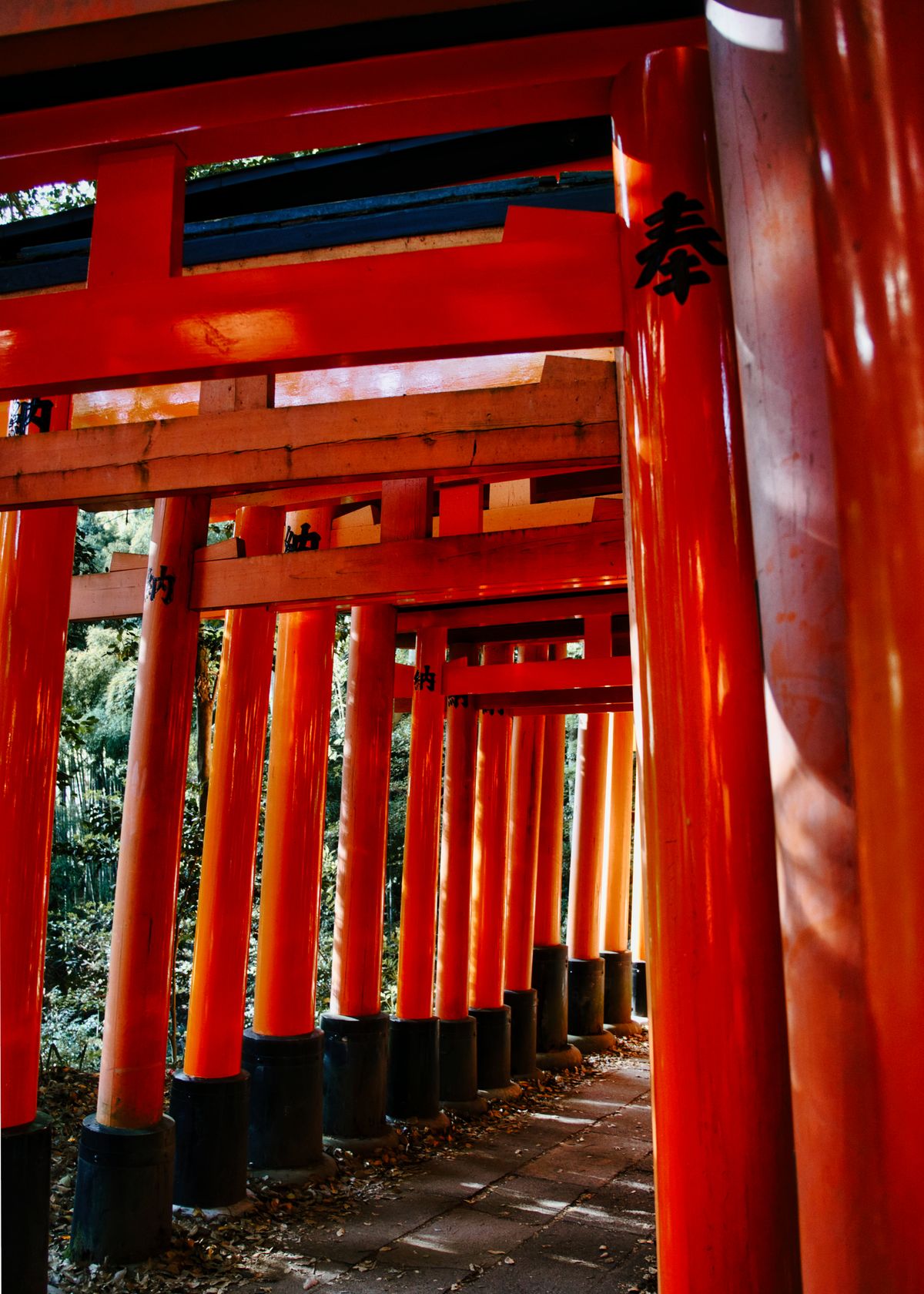
Fushimi Inari is an active place of worship, not just a tourist attraction. Visitors are welcome regardless of their religion, but the following points of etiquette will help you show respect and get more out of your visit:
- Walk on the left in the gate tunnels, especially in the narrower sections. This keeps foot traffic flowing smoothly.
- Do not touch the torii gates. They are sacred objects, not photo props to pose against.
- Keep noise down near the shrine buildings and especially in the upper mountain area, which feels and functions like an active sacred space.
- Do not eat while walking through the shrine precinct. If you need a snack, stop at one of the rest areas or teahouses.
- Drones are prohibited throughout the shrine grounds, including the entire mountain trail.
- Do not leave offerings except at designated areas. Placing coins in random locations or leaving food near the fox statues without proper ritual context is not appropriate.
Photography is generally welcome throughout the trail, including in the gate tunnels. The shrine authorities appreciate respectful, unhurried photography that does not block the path or disrupt other visitors.
Nearby Attractions: Making the Most of Your Visit
Fushimi Inari is located in the Fushimi district, which has more to offer than just the famous shrine. If you arrive early and finish your hike by 9:00 AM or 10:00 AM, here are some excellent options for the rest of your morning:
Fushimi Sake District
Fushimi is one of Japan’s most famous sake-producing areas, and the traditional brewery buildings and willow-lined canals of the Fushimi sake district are a short Keihan train ride south of Fushimi Inari (get off at Chushojima). Many breweries offer tastings from mid-morning, and the street itself is worth walking for its atmospheric architecture. Look for the decorative sugidama (balls of cedar branches) hanging from brewery eaves — the traditional sign that fresh sake is available.
Tofukuji Temple
Just two stops north on the Keihan line (or a 15-minute walk), Tofukuji is one of Kyoto’s great Zen temples and is particularly famous for its stunning autumn foliage. The temple grounds include a series of modern dry landscape gardens and a photogenic wooden bridge spanning a forested ravine. It is typically far less crowded than Fushimi Inari.
Nishiki Market
Kyoto’s famous covered food market, known as “Kyoto’s Kitchen,” is located in the heart of the city and opens around 9:00 AM. A morning hike at Fushimi Inari followed by a walking tour of Nishiki Market makes for an excellent half-day itinerary.
Where to Eat Near Fushimi Inari
The area immediately surrounding the shrine entrance has a row of shops and small restaurants that open around 8:30–9:00 AM. These include:
- Inari sushi — Inarizushi (rice stuffed into sweet tofu pouches) is the traditional food offering associated with Inari shrines. You will find vendors selling freshly made inarizushi near the entrance, typically priced at around ¥200–¥300 per piece.
- Kinako senbei — Roasted rice crackers dusted with kinako (toasted soybean flour) are sold by several vendors near the shrine gate.
- Matcha soft serve — Green tea ice cream is a Kyoto specialty available at multiple stalls from mid-morning.
- Chaya (teahouses) — The teahouses along the upper trail open later in the morning and serve simple meals including udon noodles, onigiri (rice balls), and tea. Prices are higher than in the city (expect ¥800–¥1,500 for a simple meal) but the experience of eating in a traditional teahouse partway up the mountain is uniquely enjoyable.
For breakfast before your hike, convenience stores near JR Inari Station or Kyoto Station are your best bet early in the morning. Japan’s convenience stores — Seven-Eleven, Lawson, and FamilyMart — stock excellent fresh sandwiches, onigiri, hot foods, and beverages, all at reasonable prices (typically ¥300–¥600 for a filling breakfast).
Where to Stay for Easy Fushimi Inari Access
For the best early morning access to Fushimi Inari, staying in Kyoto itself is the logical choice. The following accommodation areas put you within easy reach of the shrine:
Kyoto Station Area
Staying near Kyoto Station puts you just 5 minutes from Fushimi Inari by train. This area has a very wide range of accommodation from large business hotels (¥8,000–¥15,000 per night / USD 55–100) to budget capsule hotels and hostels (¥3,000–¥6,000 / USD 20–40). It is also well-positioned for visiting Nishiki Market, Gion, and other Kyoto highlights by bus or subway.
Gion / Higashiyama Area
The Gion area offers the most atmospheric stay in Kyoto, with traditional machiya townhouses and ryokan inns. From here, Fushimi Inari is about 20–25 minutes by a combination of walking and the Keihan railway. Prices are higher than near Kyoto Station, but the character of the neighborhood is unmatched. Expect to pay ¥12,000–¥30,000 (USD 80–200) per room per night at most guesthouses in this area.
Fushimi District Itself
A small number of guesthouses and budget hotels are located in the Fushimi neighborhood. Staying here means you can walk to the shrine in 5–10 minutes, but the area has fewer restaurant and transport options than central Kyoto. This is worth considering if Fushimi Inari is the primary reason for your Kyoto visit.
For the best hotel prices in Kyoto, compare options on Agoda (Best prices guaranteed) →
Seasonal Tips: When Is the Best Time of Year?
Fushimi Inari is worth visiting any time of year, but the experience varies significantly by season:
Spring (March–May): ★★★★★
Cherry blossom season (typically late March to mid-April in Kyoto) makes the surrounding forests spectacularly beautiful, with pale pink blossoms visible through and above the orange gate tunnels. This is peak tourist season in Kyoto overall, so early morning visits are even more important. Late April and early May (Golden Week) is extremely crowded; if you can visit in early or mid-April, you will have better conditions.
Summer (June–August): ★★★
Kyoto summers are hot and very humid — temperatures regularly reach 35°C (95°F) and the humidity makes it feel hotter. That said, summer has its own appeal: the deep green of the mountain forests is lush and rich, and the light filtering through the trees in the early morning has a beautiful, atmospheric quality. Start your hike before 7:00 AM and you will beat both the heat and the crowds. Rainy season (tsuyu) typically runs from early June to mid-July, bringing heavy morning rains but also moody, misty conditions that make for atmospheric photographs.
Autumn (September–November): ★★★★★
The ideal season for Fushimi Inari. The oppressive summer heat has passed, the air is crisp, and by late October the mountain forests begin to shift into their autumn colors — a brilliant contrast with the vermilion gates. The tourist crowds are large but slightly more manageable than during cherry blossom season. In 2026, forecasts point to a later peak in Kyoto, from late November into mid-December.
Winter (December–February): ★★★★
Kyoto winters are cold (average lows around 2°C / 36°F in January) but rarely see heavy snow. When snow does fall on Mount Inari — typically a few times per winter — the combination of white snow and vermilion gates is one of the most photographically stunning sights in Japan. Even without snow, winter offers the lowest tourist crowds of any season and a starkly beautiful atmosphere. Dress warmly and enjoy having the gates largely to yourself.
Practical Tips Summary
- Arrive by 6:30–7:00 AM for the best experience. This is not a casual suggestion — it makes a dramatic difference.
- Trains start running early. The first JR Nara Line train from Kyoto Station typically departs around 5:30 AM. Check the JR timetable the evening before to confirm current schedules.
- The hike is free. No tickets, no booking, no entrance fee ever.
- The upper trail is quieter. If you go past Yotsutsuji, crowds thin out considerably even at busy times.
- Food and drinks are limited early. Bring water and a snack from a convenience store if you plan to go early.
- Wear appropriate shoes. Not sandals or heels — comfortable trainers or hiking shoes.
- Budget approximately ¥2,000–¥5,000 (USD 13–33) for transportation, snacks, and any souvenirs.
- Allow 2–3 hours for the full mountain trail, or 60–90 minutes for the popular Yotsutsuji turnaround point.
- Have your phone charged and connected to mobile data for maps and translation apps.
Frequently Asked Questions About Fushimi Inari Taisha
Is Fushimi Inari open at night?
Yes. The grounds are open 24 hours a day and there is no entrance fee at any time. Night visits have become increasingly popular and can be spectacular, particularly on evenings when stone lanterns along the path are lit. However, the trail is steep and poorly lit in some sections, so a torch or phone flashlight is essential. The teahouses and souvenir shops are closed at night. Early evening visits (from around 6:00 PM) in summer when the light is golden can be particularly beautiful.
How long does it take to walk the full trail?
The complete trail to the summit of Mount Inari and back is approximately 4 kilometers (2.5 miles) with around 200 meters of elevation gain. At a comfortable pace, allow 2 to 2.5 hours. If you stop frequently for photos or rest, budget 3 hours. The walk to Yotsutsuji (the popular halfway turnaround point) takes about 30–40 minutes each way.
How many torii gates are there?
It is impossible to give an exact number because new gates are continuously donated and old ones are replaced. The commonly cited estimate is approximately 10,000 torii gates, though some sources suggest the number is closer to 5,000–6,000 if you count only the standing gates currently in place. You will pass through dense tunnels of gates for much of the main trail, especially in the lower sections.
Can I hike Fushimi Inari with young children?
Yes, with some caveats. The lower portion of the trail (up to Yotsutsuji) is manageable for children aged 5 and above who are reasonably fit and enjoy walking. The path is paved and clearly marked. The upper mountain sections involve more steps and are steeper; children aged 8+ should manage fine, but younger ones may find it tiring. Strollers are not practical on the trail. Carry younger children in a baby carrier if needed.
Is there a dress code at Fushimi Inari?
There is no formal dress code for visitors. You do not need to cover your shoulders or wear specific colors (unlike some Hindu or Islamic temples). Standard respectful tourist attire is appropriate. Practically speaking, comfortable clothes suitable for hiking are strongly recommended — you will be walking and potentially sweating. Many visitors wear yukatas (casual Japanese cotton robes) for photos, which is perfectly acceptable.
What does the yen coin offering at the shrine mean?
Coin offerings are made at many Shinto shrines throughout Japan. At Fushimi Inari, the most common amounts and their Japanese word associations are: ¥5 coin (pronounced “go-en,” homophone for “good relationship/fate”), which is considered especially auspicious. You can toss a coin into the offering box in front of a shrine hall, bow twice, clap twice, make a silent wish or prayer, and bow once more. This is a simple, respectful way to participate in the shrine tradition.
What is the meaning of the red/orange color of the torii gates?
The distinctive vermilion color used on Shinto shrine structures (including torii gates) is traditionally associated with the power to ward off evil and to provide spiritual protection. The paint also originally served a practical purpose — it contains mercury sulfide (cinnabar), which is toxic to insects and helped preserve the wooden structures. Modern torii are typically painted with non-toxic synthetic vermilion paint, but the symbolic significance of the color remains unchanged.
Is it possible to have a torii gate donated in your name?
Yes. Torii gate donations at Fushimi Inari are open to anyone — individuals, families, or businesses. The cost depends on the size of the gate, ranging from approximately ¥175,000 (USD 1,200) for the smallest size up to over ¥1,000,000 (USD 7,000) for large gates. Applications are handled through the shrine office. Donated gates typically take several months to be installed.
A Sample Early Morning Itinerary
Here is a sample schedule for an early morning visit from central Kyoto:
- 6:00 AM — Wake up. Grab breakfast from your hotel or the nearest convenience store.
- 6:15 AM — Depart your hotel toward Kyoto Station or nearest JR/Keihan station.
- 6:30 AM — Arrive at JR Inari Station or Keihan Fushimi Inari Station.
- 6:35 AM — Enter the main shrine grounds. Take your time at the Honden (main hall).
- 6:45 AM — Begin ascending through the Senbon Torii gate tunnel.
- 7:15–7:30 AM — Reach Yotsutsuji intersection for views over Kyoto. Decision point: turn back or continue up.
- 8:00–9:00 AM — (If continuing) Complete the upper loop and begin descending.
- 9:00–9:30 AM — Return to the base. Browse the souvenir shops and grab inarizushi for breakfast.
- 10:00 AM — Back in central Kyoto, ready for the rest of the day’s sightseeing.
This itinerary gives you the full Fushimi Inari experience and still leaves you with a full day ahead. By the time you return to the entrance at 9:00 AM, the tourist crowds will just be arriving — and you will be done.
Planning your Kyoto stay? Compare accommodation options to find the perfect base for exploring Fushimi Inari and beyond: Book your Kyoto hotel on Agoda →
Budget Breakdown: How Much Does a Fushimi Inari Visit Cost?
One of the most appealing aspects of Fushimi Inari Taisha is that the shrine itself is completely free to enter. This is unusual for a major Japanese tourist attraction. Here is a realistic breakdown of what you might spend:
- Shrine entrance fee: ¥0 (free, always)
- Train from Kyoto Station (JR Nara Line, round trip): ¥300 (approximately USD 2.00)
- Train from Osaka (Keihan round trip): ¥860 (approximately USD 5.75)
- Breakfast at a convenience store: ¥400–¥700 (USD 2.75–4.75)
- Snacks and drinks on the trail: ¥300–¥800 (USD 2.00–5.50)
- Lunch at a teahouse on the mountain: ¥800–¥1,500 (USD 5.50–10.00)
- Inarizushi snack near entrance: ¥400–¥800 (USD 2.75–5.50)
- Omamori (lucky charm) or ema (wish plaque): ¥500–¥1,000 (USD 3.50–7.00)
- Souvenir fox figurine or gift: ¥500–¥2,000 (USD 3.50–13.50)
Budget traveler total (transport + basic snacks only): approximately ¥1,000–¥2,000 (USD 7–14) from Kyoto, or ¥1,500–¥2,500 (USD 10–17) from Osaka.
Comfortable traveler total (transport + light meals + small souvenir): approximately ¥3,000–¥6,000 (USD 20–40).
This makes Fushimi Inari one of the most affordable major sightseeing experiences in Japan. Even a full day combining the hike with the Fushimi sake district and a visit to Tofukuji Temple can be done for well under ¥10,000 (USD 70) including a sit-down lunch.
Useful Japanese Phrases for Your Visit
While Fushimi Inari is highly accustomed to international visitors and most souvenir vendors understand basic English, knowing a few Japanese phrases will enrich your experience and is always appreciated:
- Sumimasen (す み ま せ ん) — “Excuse me / Sorry.” Invaluable for politely getting past other visitors in the narrow gate tunnels.
- Arigatou gozaimasu (あ り が と う ご ざ い ま す) — “Thank you very much.” Use this when shopkeepers hand you purchases or when someone helps you.
- Ikura desu ka? (い く ら で す か?) — “How much is it?” Useful at souvenir stalls and food vendors.
- Toire wa doko desu ka? (ト イ レ は ど こ で す か?) — “Where is the toilet?” Clean public restrooms are located near the base shrine and at several points along the trail.
- Shashhin wo totte moraemasu ka? (写真を撮ってもらえますか?) — “Could you take a photo for me?” Asking another visitor to photograph you and your travel companions.
- Kanpai! (乾杯!) — “Cheers!” For when you stop at the Fushimi sake district afterwards and try a cup of local sake.
- Oishi! (お い し い!) — “Delicious!” For when you try the inarizushi and it lives up to expectations.
Beyond the Hike: Connecting Fushimi Inari with a Wider Kyoto Itinerary
Fushimi Inari works beautifully as the anchor point for a full day of Kyoto sightseeing. Here are three suggested day itineraries that use Fushimi Inari as the morning centerpiece:
Option A: Fushimi Inari + Sake District + Gion (Full Cultural Day)
- 6:30 AM — Hike Fushimi Inari (2.5 hours)
- 9:30 AM — Walk to Fushimi Sake District (Gekkeikan Okura Sake Museum, Yokomachi Street)
- 11:00 AM — Train to central Kyoto, lunch at Nishiki Market
- 1:00 PM — Explore Gion neighborhood and Hanamikoji Street
- 3:00 PM — Visit Yasaka Shrine and Maruyama Park
- 5:00 PM — Stroll through Ninenzaka and Sannenzaka stone-paved lanes
- 7:00 PM — Dinner in Gion
Option B: Fushimi Inari + Temples of Eastern Kyoto
- 6:30 AM — Hike Fushimi Inari (2.5 hours)
- 9:30 AM — Train to Tofukuji (2 stops north), explore the Zen temple grounds
- 11:00 AM — Walk or bus to Sanjusangendo (Hall of 1,001 Buddha statues)
- 12:30 PM — Lunch in the Higashiyama area
- 2:00 PM — Visit Kiyomizudera Temple on the hillside
- 5:00 PM — Return to hotel
Option C: Fushimi Inari Day Trip from Osaka
- 6:00 AM — Depart Osaka via Keihan Railway from Yodoyabashi
- 6:30 AM — Arrive at Fushimi Inari, begin hike
- 9:00 AM — Finish hike, breakfast at entrance stalls
- 10:00 AM — Train to central Kyoto, visit Nishiki Market and Gion
- 1:00 PM — Train back to Osaka
- 2:00 PM — Arrive central Osaka, explore Dotonbori area in the afternoon and evening
Whatever your broader Japan itinerary looks like, an early morning visit to Fushimi Inari Taisha deserves a prominent place in it. Few experiences in Japan match the quiet magic of walking through those thousands of ancient gates as the sun rises over Mount Inari — and the best part is that it costs absolutely nothing to get in.
Related guides
- How to Read a Japanese Restaurant Menu (Even With Zero Japanese)
- Essential Japanese Phrases for Travelers (and How to Read Menus on the Spot)
- Aomori Nebuta Festival Guide 2026: A First-Timer’s Guide to Japan’s Giant Glowing Floats and How to Dance in the Parade
Going to Japan? Speak Japanese with confidence.
Hirameki Japanese — camera translate for menus and signs, a two-way conversation mode, and furigana + romaji on every phrase. Free to download with kana charts, conversation mode and starter words; a one-time purchase unlocks everything.

Plan your Japan trip
Two things every first-timer should book
Some links are affiliate links. If you book through them we may earn a small commission at no extra cost to you.