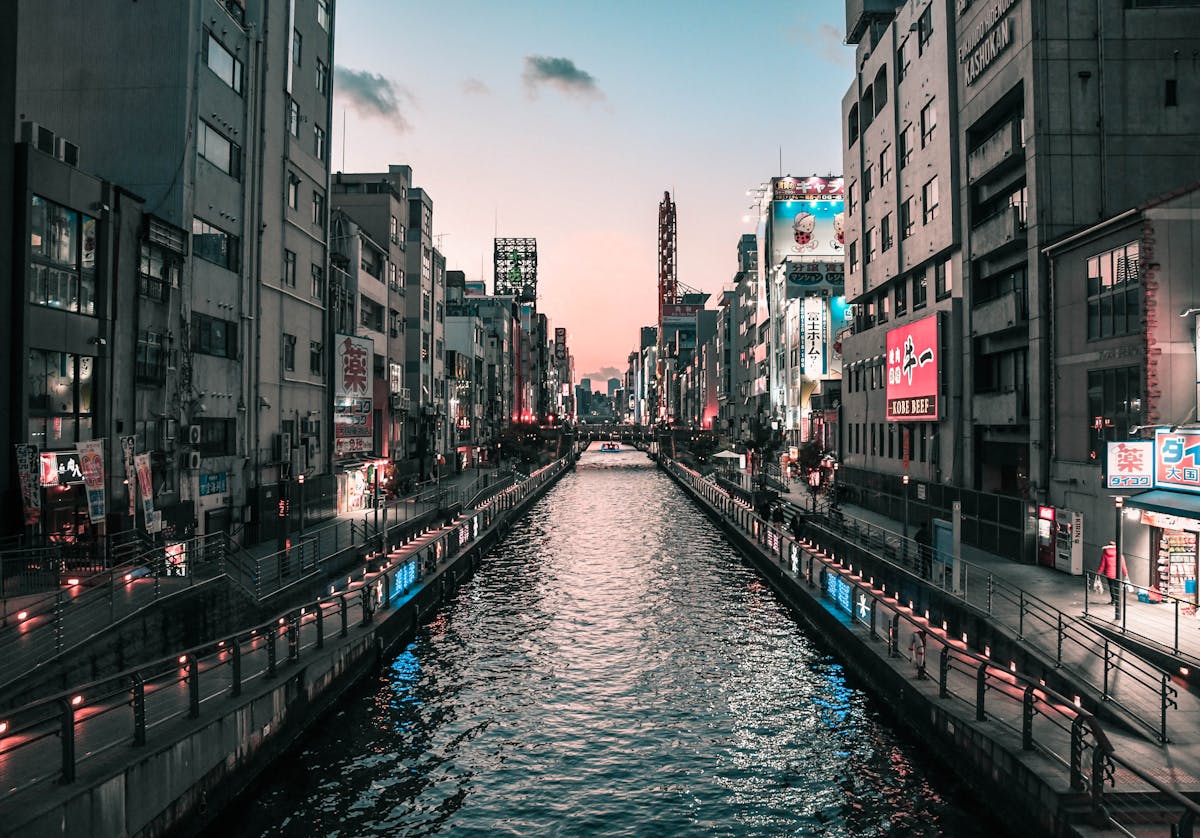
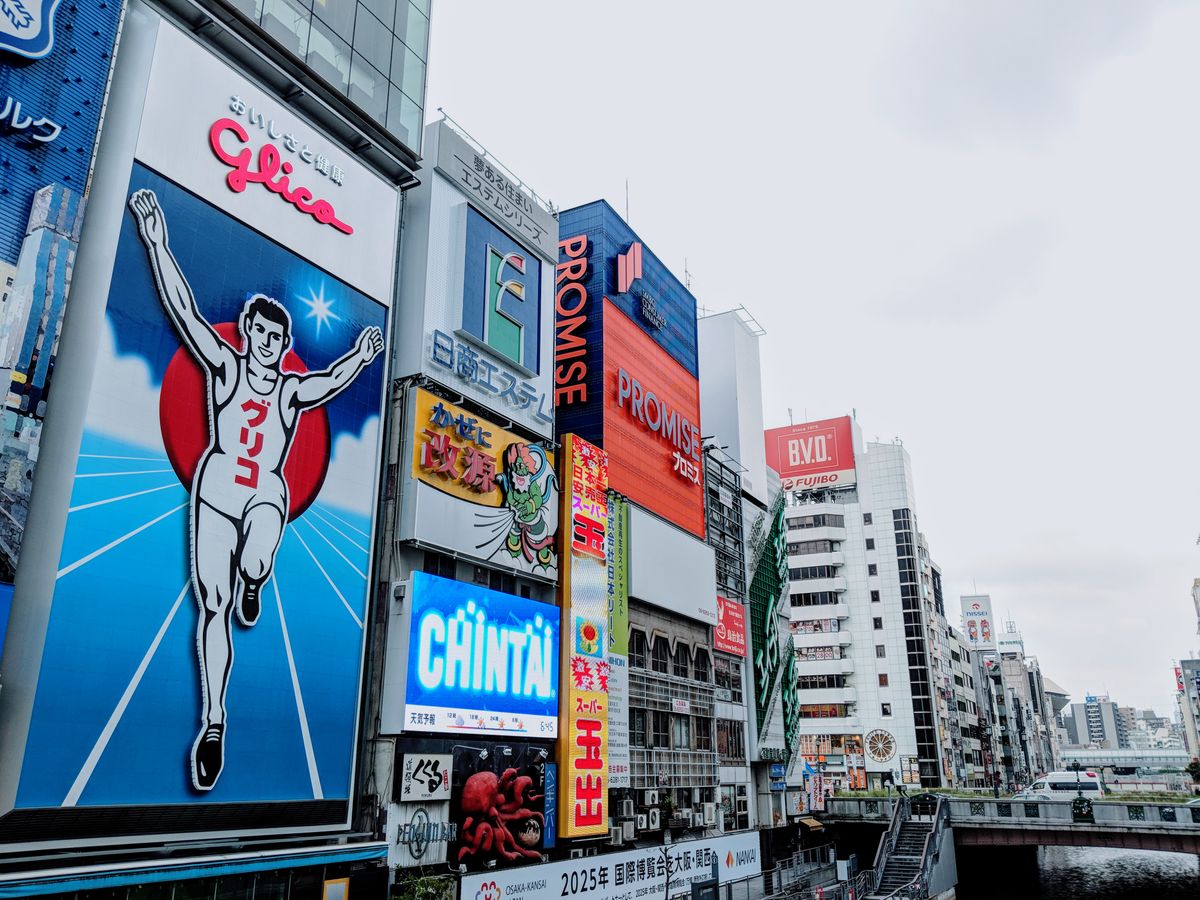
If there is one place that captures the loud, joyful, food-obsessed spirit of Osaka, it is Dotonbori. This dazzling strip along a narrow canal in the heart of the city is a riot of giant mechanical crabs, neon dragons, glowing billboards, and the famous Glico running man, all reflected in the water below. By night it becomes one of the most photographed scenes in all of Japan, and at every hour it delivers on Osaka unofficial motto, kuidaore — to eat yourself broke. For first-time visitors, a night in Dotonbori is very often the highlight of their entire trip to the Kansai region.
This guide tells you everything you need to know to enjoy Dotonbori like a savvy traveler rather than a lost tourist: what the area is and how it came to be, the must-try street foods and how much they cost in yen and dollars, the best things to do beyond eating, how to get there from Kansai Airport and Kyoto, where to stay nearby, and a long list of practical tips. Whether you have one evening or three days in Osaka, Dotonbori is the beating heart you will keep coming back to. For more ideas across the city, our Osaka travel hub is a great companion to this guide.
What and Where Is Dotonbori?
Dotonbori is a street and entertainment district running alongside the Dotonbori Canal in the Namba area of central Osaka. It stretches for roughly one kilometer between the Dotonboribashi and Nipponbashi bridges, and the most famous, sign-saturated stretch is concentrated near Ebisubashi bridge — the spot where you will see crowds photographing the Glico man across the water. The district sits in Osaka Minami (“south”) entertainment quarter, distinct from the more business-oriented Kita (“north”) around Osaka and Umeda stations.
The area takes its name from Doton Yasui, a businessman who began widening a canal here in the early 1600s to improve commerce and transport. He died before the work was finished, and the local lord named the completed canal Dotonbori in his honor. Over the following centuries the south bank blossomed into Osaka great theater district, packed with kabuki and bunraku puppet playhouses, teahouses, and restaurants serving theatergoers. The theaters are mostly gone now, but the area DNA as a place of entertainment and indulgence never left — it simply evolved into the neon food paradise you see today.
The canal and its bridges
The Dotonbori Canal is the stage on which the whole spectacle plays out. The signs and billboards face the water so their reflections shimmer across the surface at night, and the bridges crossing it — especially Ebisubashi — are the prime vantage points for photos. Ebisubashi is so popular as a meeting spot that it has earned the nickname “Hikkake-bashi,” and on a busy evening it can be shoulder-to-shoulder with people taking the same iconic shot. Walking the canal-side promenade, the Tonbori Riverwalk, lets you escape the densest crowds while still soaking in the lights.
The Iconic Signs: Glico Man and the Crab
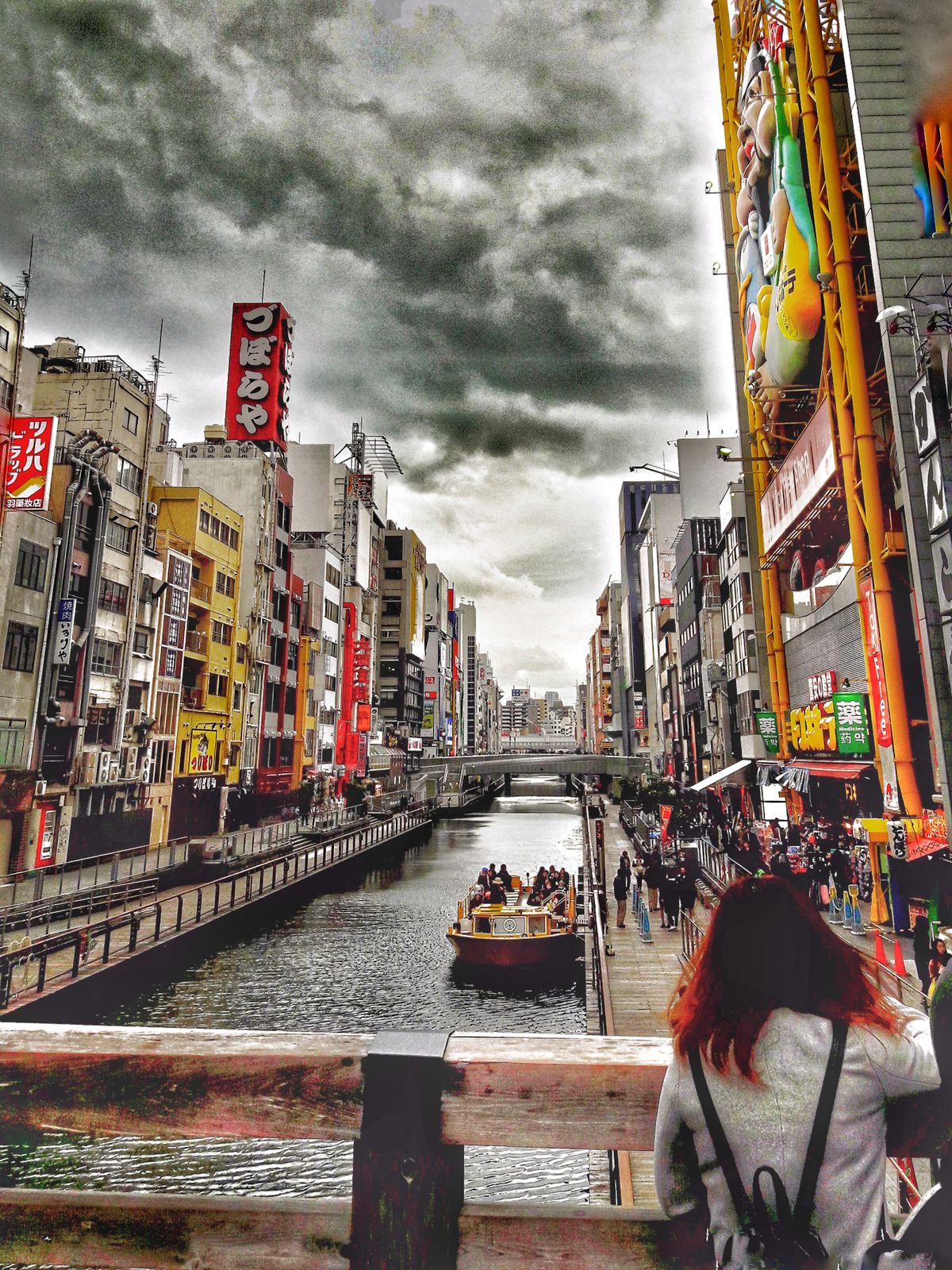
Dotonbori is famous for its over-the-top three-dimensional signage, a tradition of restaurants competing to lure diners with the boldest, most eye-catching displays. The undisputed star is the Glico running man, a glowing billboard of an athlete crossing a finish line that has advertised the Glico confectionery company since 1935. The current version is an energy-efficient LED display, and striking the running-man pose beneath it is practically a rite of passage for visitors. It is free to view, lit every evening, and best photographed from Ebisubashi bridge.
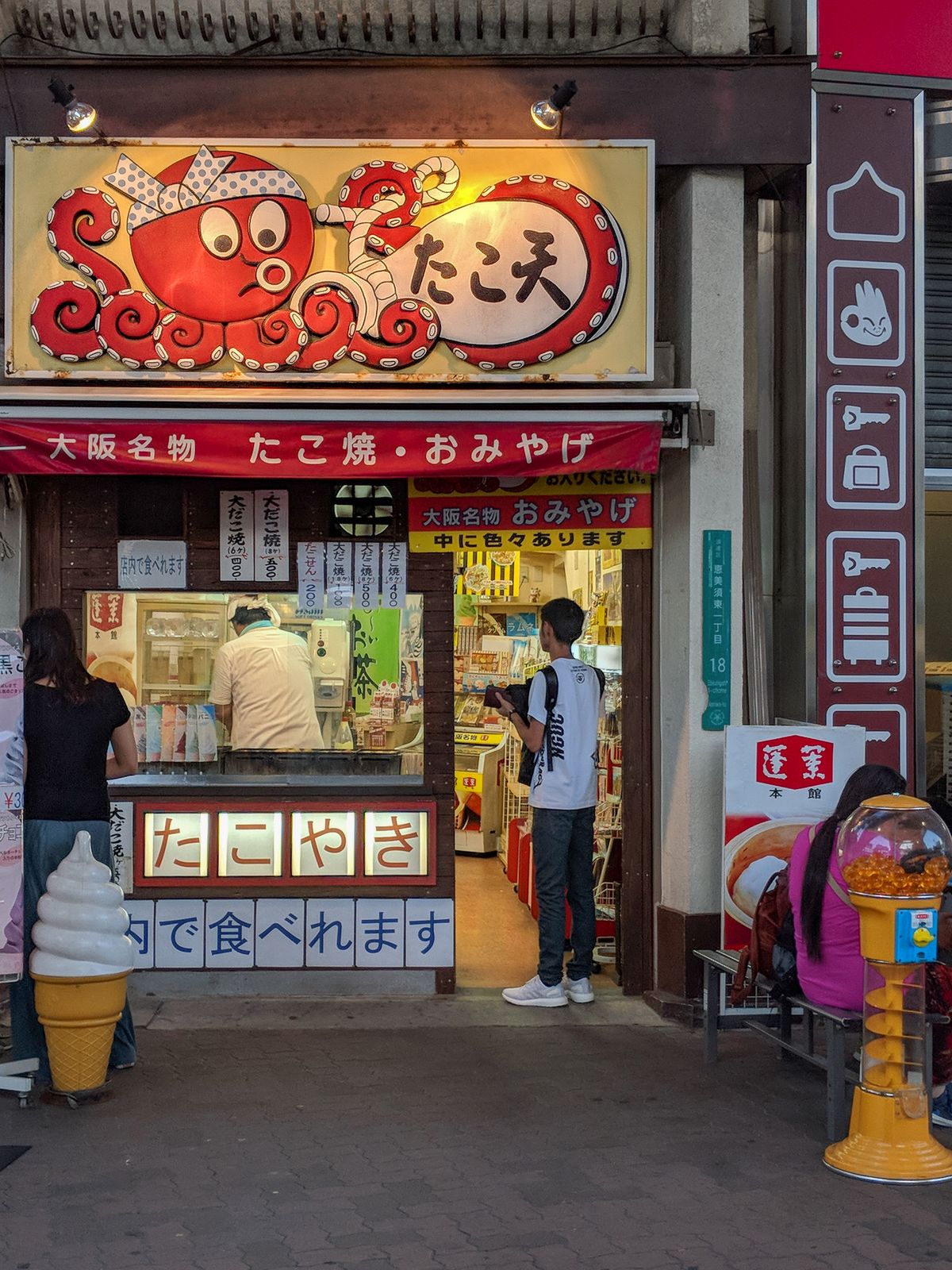
Almost as famous is the giant mechanical crab of Kani Doraku, a crab restaurant whose enormous animatronic crustacean has waved its legs over the street since 1960. Up and down the strip you will spot a colossal pufferfish lantern marking a fugu restaurant, a three-dimensional dragon curling out of a ramen shop, a vast octopus advertising takoyaki, and the rolling drum of the Kuidaore Taro mascot. Each one is a photo opportunity, and together they make Dotonbori feel less like a street and more like a permanent, edible carnival.
Dotonbori Legendary Street Food
Osaka is widely considered Japan greatest street-food city, and Dotonbori is its showcase. The local philosophy of kuidaore — eating until you drop, or until your wallet is empty — is taken seriously here. The smart approach is to graze: buy small portions from several stalls and shops as you wander, rather than committing to one big sit-down meal. Here are the essentials you should not miss. For a wider tour of Japanese street snacks, pair this section with our Japan street food guide.
Takoyaki — the must-try
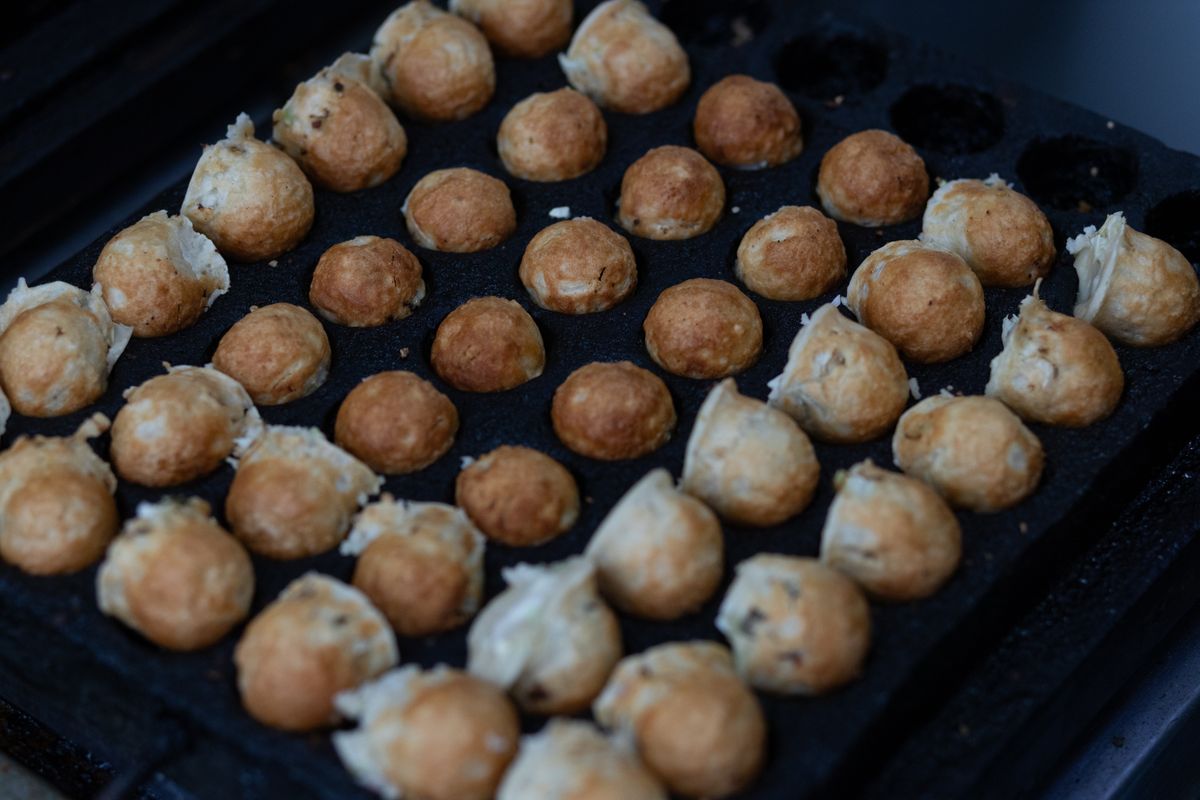
Takoyaki, golden balls of batter with a piece of octopus inside, were invented in Osaka in the 1930s and are the city signature snack. They are cooked on special dimpled griddles, flipped with picks until crisp outside and molten within, then brushed with a savory-sweet sauce, drizzled with mayonnaise, and topped with dancing bonito flakes and green seaweed. A serving of six to eight pieces costs roughly ¥500–¥700 (about $3–$5). Be warned: they arrive lava-hot, so let them cool a moment before biting. Famous Dotonbori stalls include Takoyaki Juhachiban and Kukuru, the latter known for its dramatically oversized octopus.
Okonomiyaki — the savory pancake
Often described as a savory pancake or “Japanese pizza,” okonomiyaki is a hearty griddle dish of batter and shredded cabbage mixed with your choice of pork, seafood, or cheese, cooked on a hot plate and finished with the same sauce, mayonnaise, and bonito flakes. The name means “grilled as you like it.” Many restaurants let you cook it yourself at a teppan table, which is half the fun. Expect to pay ¥800–¥1,500 (about $5–$10) per pancake, enough to share. It is filling, comforting, and quintessentially Osakan.
Kushikatsu — deep-fried skewers
Kushikatsu is Osaka beloved bar food: skewers of meat, seafood, and vegetables breaded in panko and deep-fried until golden, then dipped in a shared pot of tangy sauce. The single ironclad rule, posted in every shop, is no double-dipping — dip your skewer once before you take a bite, for everyone hygiene. Skewers run about ¥120–¥250 (roughly $1–$2) each, so you can mix and match. The nearby Shinsekai district is the kushikatsu heartland, but plenty of Dotonbori shops serve excellent versions.
More to graze on
Beyond the big three, keep an eye out for ikayaki (grilled squid), negiyaki (a thinner, scallion-heavy cousin of okonomiyaki), giant steamed crab legs, melon-pan ice cream sandwiches, and freshly fried karaage chicken. Osaka is also a ramen and gyoza town, and Dotonbori has no shortage of late-night noodle shops. Save room for dessert: the strip is dotted with stands selling matcha soft-serve, fluffy Japanese cheesecake, and fruit-topped crepes.
Things to Do Beyond Eating
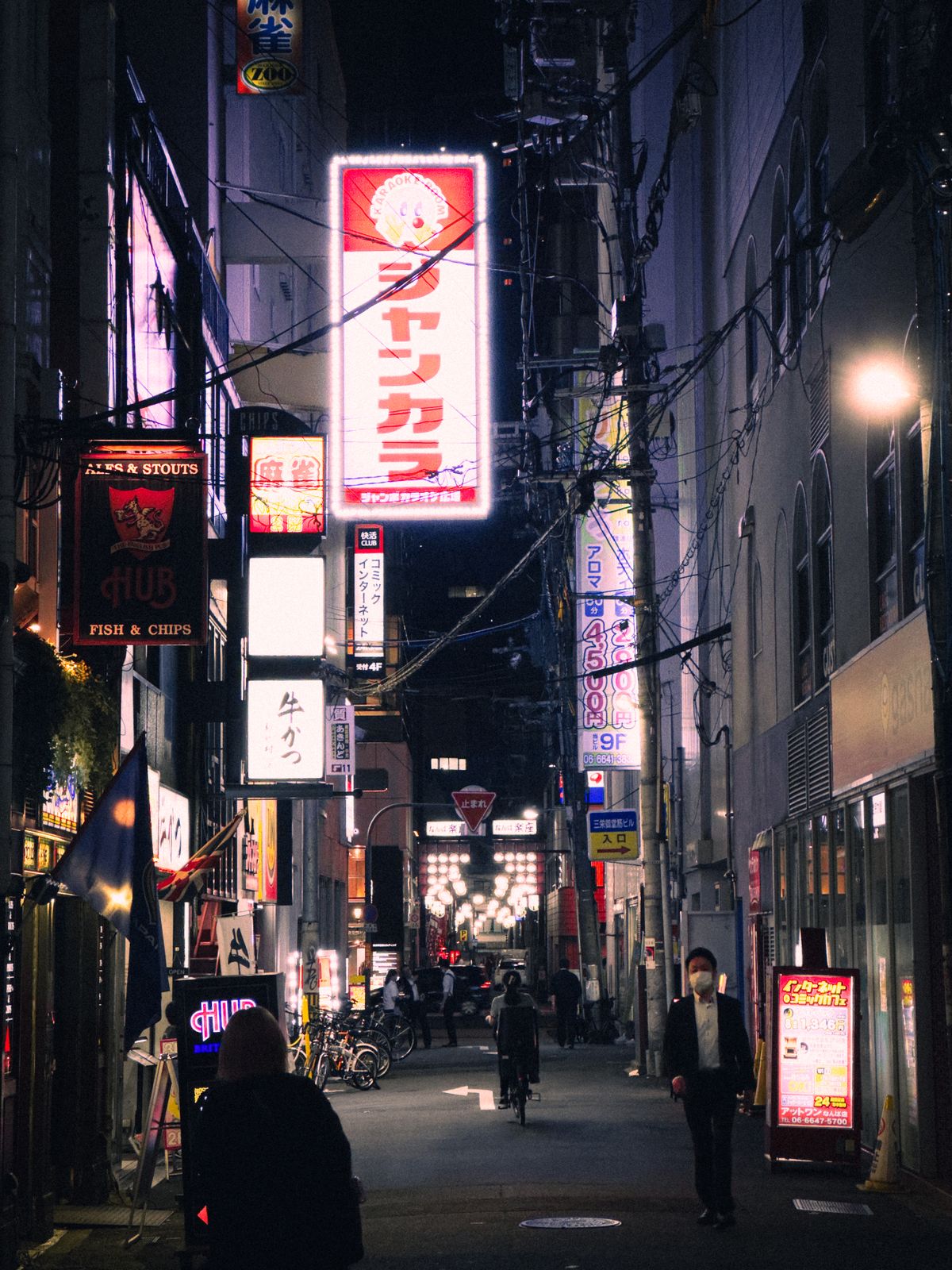
Dotonbori is more than a food court — it anchors a whole web of attractions you can fold into an evening or a full day.
Take a Tombori River Cruise
A 20-minute guided boat cruise along the Dotonbori Canal is the most relaxing way to take in the neon, gliding right beneath the Glico sign with a lively (Japanese) commentary. Tickets cost around ¥1,500 (about $10) for adults, and the cruise runs throughout the day and into the evening, when the lights are at their best. It is touristy but genuinely fun, and it gives your feet a break.
Wander Hozenji Yokocho
Just steps from the chaos lies Hozenji Yokocho, a pair of hushed stone-paved lanes that feel like a portal to old Osaka. At their heart is Hozenji Temple, home to a moss-covered statue of the deity Fudo Myoo that worshippers splash with water for good fortune — it is now completely cloaked in green moss. The surrounding alleys are packed with tiny, atmospheric bars and traditional restaurants, perfect for a quieter drink after the main-street crowds.
Shop Shinsaibashi and Amerikamura
Running north from Dotonbori is Shinsaibashi-suji, a covered shopping arcade nearly 600 meters long, lined with everything from global fashion brands to drugstores beloved by souvenir-hunters. To the west is Amerikamura (“America Village”), Osaka youthful, slightly grungy hub of vintage shops, streetwear, record stores, and cafes. Together they make the area around Dotonbori a shopping destination in its own right, easily combined with a food crawl.
Dotonbori by Day vs by Night
Most visitors picture Dotonbori at night, and for good reason — the signs blaze, the canal glitters, and the energy peaks after dark. If you only have time for one visit, make it an evening one, ideally arriving around dusk to watch the lights flicker on. The crowds are thickest from about 7 to 10 p.m., and many food stalls and restaurants stay open late, some past midnight.
That said, daytime Dotonbori has its own rewards. The crowds are thinner, the photos of the signage are clear and glare-free, and you can actually get into popular restaurants without a long wait. A smart strategy is to come during the day for lunch and unhurried photos, explore Hozenji Yokocho and the arcades, then return after dark for the full neon spectacle. Because the area is so central, doubling back is easy.
How to Get to Dotonbori
Dotonbori is exceptionally easy to reach, sitting right on top of Osaka busiest transport hub.
Nearest stations
The most convenient station is Namba, served by the Midosuji subway line (the city main artery) as well as the Yotsubashi and Sennichimae lines, plus the Nankai, Kintetsu, and Hanshin railways. From Namba, Dotonbori is a three-to-five-minute walk. Shinsaibashi station on the Midosuji line is equally close from the north. Use exit 14 from Namba or the Shinsaibashi exits and follow the crowds — you cannot miss the lights.
From Kansai International Airport (KIX)
From KIX, the Nankai Railway runs directly to Namba. The limited-express Rapi:t takes about 35–40 minutes and costs roughly ¥1,500 ($10), while the regular express does the same trip for about ¥930 ($6) in around 45 minutes. If you are arriving with heavy luggage or a group, a shared airport shuttle that drops you at your hotel door can be worth it — services like NearMe airport transfer offer fixed-price door-to-door rides that take the hassle out of navigating with suitcases.
From Kyoto and elsewhere in Kansai
From Kyoto, the Hankyu Kyoto line runs to Osaka Umeda, where you transfer to the Midosuji subway south to Namba (total around 50 minutes, about ¥600 / $4). Alternatively, the JR Kyoto line reaches Osaka Station, with the same subway connection. From central Osaka (Umeda), the Midosuji subway reaches Namba in under ten minutes. Wherever you are coming from in Kansai, all roads seem to lead to Namba. For more on getting around Osaka and the wider region, see our Osaka guide.
Where to Stay Near Dotonbori
Staying in the Namba/Shinsaibashi area puts you within walking distance of Dotonbori, which is ideal given how much livelier the district is at night. You will be able to dive into the food scene in the evening and stumble home without worrying about the last train. The area has a huge range of accommodation, from capsule hotels and budget business chains to stylish mid-range hotels and upscale properties.
Budget business hotels near Namba typically cost ¥8,000–¥14,000 (about $53–$93) per night, while smarter mid-range and design hotels run ¥15,000–¥30,000 ($100–$200). Booking early matters in Osaka, which has become extremely popular and where good-value central rooms sell out fast, especially around holidays and festivals. Comparing options on Agoda lets you filter by exact distance to Namba station, guest rating, and free-cancellation rates — handy flexibility if your plans are still taking shape. Aim for a hotel within a ten-minute walk of Dotonbori to make the most of the area nightlife.
Money, Costs, and Budget Tips
One of the joys of Dotonbori is that it can be as cheap or as splurgy as you like. A satisfying street-food crawl — a few takoyaki here, a kushikatsu skewer there, an okonomiyaki to share — can easily fill you up for ¥1,500–¥2,500 (about $10–$17) per person. Sit-down restaurants and crab or fugu specialty houses cost considerably more, sometimes ¥4,000–¥8,000 ($27–$53) per person for a full meal.
While Japan is increasingly card-friendly, many small stalls and older shops in Dotonbori still prefer cash, so carry yen. IC transit cards like ICOCA are widely accepted for small purchases and convenient for the subway. Staying connected with mobile data makes navigating the maze of lanes, checking restaurant reviews, and translating menus far easier — a prepaid travel eSIM for Japan is the simplest way to have data the moment you land, with no need to find a SIM counter at the airport.
Practical Tips for Visiting Dotonbori
- Come hungry and graze. Resist filling up at the first stall — the whole point is to sample widely across the strip.
- Carry cash. Many stalls are cash-only; keep small bills and coins handy for quick purchases.
- Visit at dusk for the best of both worlds. Arrive before dark for easy photos and shorter lines, and stay to watch the neon ignite.
- Never double-dip your kushikatsu. Dip the skewer once before eating; the sauce is shared by all.
- Mind the takoyaki temperature. The molten center can burn — give each ball a moment to cool.
- Do not eat while walking in crowds. It is considered slightly impolite and impractical; many stalls have a small standing area to eat first.
- Take your trash with you. Public bins are scarce in Japan; pocket your wrappers until you find one or return to your hotel.
- Use Namba or Shinsaibashi station. Both are a short, well-signed walk to the main strip.
- Stay connected. A Japan eSIM helps with maps, menu translation, and reviews as you explore.
- Book a riverboat cruise in advance on busy nights. It is a relaxing way to see the lights and can sell out at peak times.
Best Time to Visit Dotonbori
Dotonbori is a year-round, all-weather destination — much of it is covered arcade or indoor dining, so even rain need not spoil your visit. The lights and food are reliably wonderful in every season. That said, spring (March–April) brings pleasant temperatures and nearby cherry blossoms, while autumn (October–November) offers crisp, comfortable evenings ideal for strolling. Summer is hot and humid but buzzing with festival energy, and winter, though chilly, rewards you with steaming bowls of ramen and fewer crowds on weekdays.
Whatever the season, evenings and weekends are busiest. For a slightly calmer experience, visit on a weekday evening rather than a Friday or Saturday night. If crowds energize you, lean in — the press of people is part of what makes Dotonbori feel so alive.
From Kabuki Stages to Neon: A Short History
Dotonbori glittering present makes more sense once you know its theatrical past. After the canal was completed in 1615, the authorities encouraged the south bank to develop as a licensed entertainment quarter, and by the late 1600s it had become the center of Osaka performing-arts life. Five great kabuki theaters and several bunraku puppet playhouses lined the street, drawing audiences from across the city. The famous playwright Chikamatsu Monzaemon — sometimes called the Shakespeare of Japan — premiered works here, and the area teahouses and restaurants existed largely to feed and entertain theatergoers before and after the shows.
This long history as a place of pleasure and performance is why Dotonbori never became a quiet residential street or a staid business district. Even as the playhouses closed through the twentieth century, the area kept its identity as Osaka stage for fun, simply trading kabuki drama for the theater of giant signs and sizzling griddles. When you stand on Ebisubashi today, you are standing where Osakans have come to be dazzled and well-fed for more than four centuries. That continuity is part of what gives the place its unmistakable energy.
Why Osaka Food Tastes Like This
Osaka reputation as Japan kitchen is no accident. For centuries the city was the country commercial hub, the place where rice, fish, and produce from across western Japan were traded. Merchants, not aristocrats, set the tone, and they prized food that was generous, flavorful, and good value rather than refined and restrained. That merchant sensibility gave rise to the kuidaore ethic and to a cuisine built on bold sauces, savory umami, and affordable street snacks rather than delicate kaiseki ceremony.
It is also why so many iconic Japanese dishes were either born or perfected in Osaka. Takoyaki was invented here in 1935; okonomiyaki flourished in the post-war years as cheap, filling comfort food; kushikatsu grew up feeding laborers in the working-class Shinsekai district. Even instant ramen was invented in the Osaka suburb of Ikeda. Eating in Dotonbori, then, is not just a meal — it is a direct taste of the food culture that shaped how the whole country eats. To put these dishes in national context, our guide to Japanese street food is a useful companion.
Nearby Areas Worth Exploring
Dotonbori sits at the center of a cluster of fascinating neighborhoods, so it is easy to build a fuller day or evening around it.
Kuromon Ichiba Market
A short walk east, Kuromon Ichiba is a 600-meter covered market often called “Osaka kitchen.” Vendors sell fresh seafood, wagyu skewers, fruit, and ready-to-eat snacks, much of it grilled or sliced to order in front of you. It is liveliest in the morning and early afternoon, making it a perfect daytime complement to an evening in Dotonbori.
Shinsekai and Tsutenkaku
South of Dotonbori lies Shinsekai, a wonderfully retro district built over a century ago and crowned by the Tsutenkaku tower. This is the spiritual home of kushikatsu, with old-school shops serving skewers under glowing signs. The atmosphere is grittier and more nostalgic than Dotonbori polish, and it offers a vivid contrast within a short subway ride or a 20-minute walk.
Namba and Osaka Castle
The Namba district immediately around Dotonbori is a transport and shopping powerhouse, home to the striking Namba Parks rooftop garden complex and the historic Namba Yasaka Shrine with its giant lion-head stage. For a complete change of pace, Osaka Castle — one of Japan most famous fortresses, surrounded by a moat and a sprawling park — is a 15-minute subway ride away and pairs beautifully with a Dotonbori evening. You will find all of these and more in our Osaka travel hub.
A Sample Dotonbori Evening
If you want a ready-made plan, here is one easy way to spend a perfect evening in and around Dotonbori.
Arrive at Namba station around 4:30 or 5 p.m., while there is still daylight for clear photos of the signage. Start with a few takoyaki from a famous stall, then wander north into the Shinsaibashi arcade for some shopping and people-watching as the sun sets. Loop back to the canal at dusk to watch the Glico man and the billboards flicker to life, and grab your classic Ebisubashi bridge photo. Around 6:30, settle in for okonomiyaki or kushikatsu at a sit-down spot, cooking your own pancake at a teppan table if you can.
After dinner, take the 20-minute Tombori River Cruise to see the lights from the water, then slip into the hushed lanes of Hozenji Yokocho for a quiet drink and a glimpse of old Osaka, splashing water on the mossy Fudo Myoo statue for good luck. End the night with a sweet treat — matcha soft-serve or a slice of fluffy cheesecake — as you stroll back toward your hotel. Because the best places to stay are within a ten-minute walk (compare central options on Agoda), you can wander home full and happy without a thought for the last train.
Etiquette and Customs to Know
Dotonbori is relaxed and visitor-friendly, but a few small courtesies will help you blend in and enjoy it more. As mentioned, the most important food rule is never to double-dip a kushikatsu skewer in the shared sauce — take what you want before your first bite. When you buy street food, it is customary to step aside and eat near the stall rather than walking through the crowds with food in hand; many shops provide a small standing counter for exactly this.
Tipping is not practiced in Japan, so never leave money on the table — it can cause confusion. Keep your voice moderate indoors, even amid the outdoor exuberance, and avoid blocking the narrow bridges for long photo sessions when crowds are heavy. Because public bins are rare, hold on to your wrappers and skewers until you find a bin (often beside vending machines) or carry them back to your hotel. These habits are second nature to locals and will mark you as a considerate guest. For a fuller primer on Japanese etiquette, money, and transport, see our tips for first-time visitors to Japan.
Souvenirs and Snacks to Take Home
Dotonbori and the adjoining Shinsaibashi arcade are excellent for souvenir shopping. Osaka signature edible gifts make some of the best presents: boxes of Pablo or Rikuro cheese tarts, Glico Pocky in regional flavors, and beautifully wrapped sweets are all easy to find and pack well. Many drugstores along Shinsaibashi-suji stock cosmetics, snacks, and quirky goods at tax-free prices for foreign visitors — bring your passport to claim the exemption on qualifying purchases.
For something more distinctly Osakan, look for takoyaki-themed novelties, Kuidaore Taro merchandise, and the playful crab and pufferfish goods sold near the big signs. If you prefer keepsakes over consumables, the vintage shops of nearby Amerikamura turn up unique secondhand clothing and records. Whatever you buy, staying online to compare prices and read reviews is handy — a prepaid Japan eSIM keeps you connected as you shop.
Accessibility and Practical Logistics
Dotonbori is largely flat and walkable, and the main streets and arcades are wheelchair- and stroller-accessible, though they become very crowded in the evening, which can make navigation slower. The Namba and Shinsaibashi subway stations have elevators, and the riverboat cruise dock is reachable by ramp, though boarding the boat itself involves a step. Coin lockers at Namba station let you stash luggage while you explore, and there are conveniently located public restrooms in the department stores and larger arcades nearby.
If you are traveling with small children, the area is engaging and safe, but consider an earlier visit to avoid the densest late-evening crowds. Smoking is restricted to designated areas on Osaka streets, so use marked smoking spots rather than lighting up as you walk. With a little awareness, visitors of all ages and abilities can enjoy the spectacle comfortably.
Frequently Asked Questions
Is Dotonbori worth visiting?
Absolutely. For most first-time visitors to Osaka, Dotonbori is the single most memorable part of the city — an unbeatable combination of dazzling neon, world-class street food, and infectious energy. Even if you only have one evening in Osaka, it is the place to spend it. It is free to walk and photograph, and you can spend as little or as much as you like on food.
How much time should I spend in Dotonbori?
Plan for at least two to three hours to stroll the strip, eat your way along it, and take photos. If you add a river cruise, a visit to Hozenji Yokocho, and some shopping in Shinsaibashi or Amerikamura, you can easily fill a half-day or a full evening. Many visitors return more than once during a multi-day Osaka stay.
What food is Dotonbori most famous for?
Takoyaki (octopus balls) is the signature dish, as Osaka is its birthplace. Close behind are okonomiyaki (savory griddle pancakes) and kushikatsu (deep-fried skewers). The area is also known for crab and fugu (pufferfish) specialty restaurants marked by their giant signs. The local ethos of kuidaore means you should come ready to eat widely.
Is Dotonbori expensive?
It can be very affordable. A street-food crawl can fill you up for around ¥1,500–¥2,500 ($10–$17), though sit-down restaurants and crab or fugu houses cost more. Walking the strip and enjoying the lights costs nothing, making it friendly to almost any budget.
What is the best time of day to go?
Evening is when Dotonbori shines, with the neon at full blaze and the area at its liveliest from about 7 to 10 p.m. For thinner crowds and clearer daytime photos, visit in the afternoon. The ideal plan is to arrive around dusk to enjoy both moods in one trip.
How do I get to Dotonbori from Kansai Airport?
Take the Nankai Railway from Kansai International Airport directly to Namba station — about 35–45 minutes depending on whether you take the limited-express Rapi:t (around ¥1,500 / $10) or the regular express (around ¥930 / $6). From Namba, Dotonbori is a three-to-five-minute walk. A shared airport shuttle to your hotel is an easy alternative with luggage.
Is Dotonbori family-friendly?
Yes. The bright signs, animatronic crab, boat cruise, and endless snacks make it genuinely fun for children, and the main streets are lively but safe. Be mindful that some side lanes (and parts of nearby Namba) have bars and nightlife, and that the crowds can be intense for very young kids in the evening — a daytime or early-evening visit works well for families.
Seasonal Events and Festivals Nearby
Dotonbori is lively all year, but certain seasons add an extra layer of color. In late July, the Tenjin Matsuri — one of Japan three greatest festivals — fills central Osaka with boat processions and fireworks, and the festive energy spills into Namba and Dotonbori. Around New Year, the area buzzes with shoppers and first-shrine-visit crowds heading to nearby Namba Yasaka and other temples, and many shops sell celebratory treats. During cherry-blossom season in early April, you can combine an evening in Dotonbori with daytime hanami along the Okawa River or in the grounds of Osaka Castle.
Sports fans should know that Dotonbori has a famous, slightly raucous tradition tied to the Hanshin Tigers baseball team: when the Tigers win big, jubilant fans have been known to leap from the bridges into the canal. While the city discourages the practice, it speaks to how deeply Dotonbori is woven into Osaka civic life and celebrations. Visiting during a big game or festival lets you feel that communal spirit firsthand.
Day or night, rain or shine
Because so much of the area is covered arcade or indoor dining, Dotonbori is a dependable plan even when the weather turns. A rainy evening reflecting the neon in wet pavement can be especially atmospheric, and you are never more than a few steps from shelter and a hot bowl of something delicious. This all-weather reliability is one more reason it belongs at the top of any Osaka itinerary, which you can keep building with our destinations hub.
Can I visit Dotonbori and Kyoto in the same trip?
Easily. Kyoto is only about 50 minutes from Namba by train, so many travelers base themselves in Osaka and day-trip to Kyoto, or vice versa. Dotonbori makes a natural evening anchor for an Osaka stay, while Kyoto temples and gardens fill the daytime. The two cities complement each other perfectly within a Kansai itinerary.
Is one evening enough for Dotonbori?
One evening is enough to experience the highlights — the signs, a street-food crawl, and a stroll along the canal. But if your schedule allows, splitting your time between a daytime visit (for photos, markets, and shopping) and an evening visit (for the full neon spectacle) gives you the most complete picture. Many visitors happily return more than once.
Are English menus available?
In most tourist-facing restaurants and stalls in Dotonbori, yes — English menus, picture menus, or photo displays are common, and staff are used to international visitors. A translation app on your phone covers any gaps, especially in smaller shops, which is one more reason to keep mobile data handy.
Vegetarian, Vegan, and Dietary Options
Osaka street-food scene leans heavily on seafood and meat, and dishes like takoyaki, okonomiyaki, and kushikatsu commonly contain fish, pork, or the fish-based dashi stock that flavors many sauces, so travelers with dietary restrictions should plan ahead. The good news is that Dotonbori is large and varied enough that most people can eat well with a little care. Vegetable kushikatsu skewers, vegetable okonomiyaki (ask about the batter and sauce), grilled corn, and sweet treats are widely available, and the area has a growing number of cafes catering to plant-based and halal diets.
If you follow a strict diet, learn or save a few key phrases — or use a translation app — to ask whether a dish contains meat, fish, or fish stock, since even seemingly vegetable dishes often use dashi. Nearby Kuromon Market and the Shinsaibashi area include shops and restaurants with clearer labeling and dedicated vegetarian, vegan, or halal menus. Keeping mobile data on hand with a Japan travel eSIM makes it easy to search for suitable restaurants and read up-to-date reviews on the spot. With a bit of planning, Dotonbori abundance means no one has to go hungry. For broader trip-planning help, our first-timer tips cover dining and dietary navigation across Japan.
Final Thoughts
Dotonbori distills everything that makes Osaka one of Japan most lovable cities: it is bold, generous, a little chaotic, and utterly devoted to good food and good times. Strike your Glico pose, burn your tongue on a fresh takoyaki, dip your kushikatsu exactly once, drift down the canal under the lights, and let the city famous appetite become your own. Spend an evening here and you will understand kuidaore not as a phrase but as a way of life. To keep planning your trip, explore more of our Osaka guide, our street food guide, and our wider destinations hub.
🗾 Planning your trip? Get our free 7-Day Japan Itinerary (PDF)
Day-by-day Tokyo → Kyoto → Osaka plan with real prices and essential phrases — sent straight to your inbox.
Going to Japan? Talk to locals with confidence.
Hirameki Japanese — instant offline translation, camera translation, furigana + romaji, and 314 free flashcards. No login. Works without internet.

Plan your Japan trip
Two things every first-timer should book
Some links are affiliate links. If you book through them we may earn a small commission at no extra cost to you.