In this guide
- What an IC card is, and why you want one
- Suica or PASMO: does it matter?
- Your options in 2026, compared
- TOURIST PASMO
- Welcome Suica and Welcome Suica Mobile
- Regular Suica and PASMO cards
- Suica, PASMO and ICOCA on iPhone
- Android phones
- Phone or card: which should you choose?
- Where IC cards work, and where they don’t
- IC cards city by city
- Using IC cards on buses
- Topping up, balance and refunds
- What trains cost: some real fares
- Common problems and fixes
- Credit-card tap-to-ride
- Shopping, lockers and the shinkansen
- Children’s cards
- IC cards since 2023: a timeline
- What is changing in 2026–2027
- How to use an IC card, step by step
- Paper tickets and ticket machines
- Day passes vs IC cards in Tokyo
- Reading station signs
- Big stations and train manners
- Useful Japanese at the station
- Frequently asked questions
- Plan the rest of your trip
What an IC card is, and why you want one
An IC card is a rechargeable smart card. You load money onto it, then tap it on the reader at the ticket gate when you enter and leave a station; the fare is taken automatically. No working out fares on a map, no queuing at ticket machines, and IC fares are often a few yen cheaper than paper tickets (Keikyu, for example, charges IC fares to the yen and paper tickets in 10-yen units).
The same card works on most trains, subways and buses in Japan’s cities and can pay at convenience stores, vending machines and many shops showing the IC logo. For a first trip to Tokyo, Osaka or Kyoto, it is the single most useful thing to have in your pocket after your passport.
Suica or PASMO: does it matter?
For a visitor, hardly at all. Suica is issued by JR East and PASMO by the Tokyo-area private railways, subways and buses, but they are part of a nationwide network of ten interoperable IC cards: PASMO, Suica, Kitaca, TOICA, manaca, ICOCA, PiTaPa, Hayakaken, nimoca and SUGOCA. A Suica works on Tokyo Metro, a PASMO works on JR lines, and an ICOCA from Osaka or Kyoto works in Tokyo. (PiTaPa is the exception for shopping, as it is not part of the nationwide e-money network.)
The differences that matter are practical: where you can buy each card, which visitor versions exist, and whether your phone supports the mobile version. Buy whichever is easiest at the moment you arrive.
Your options in 2026, compared
| Option | Deposit | Validity | Where to get it | Leftover balance |
|---|---|---|---|---|
| TOURIST PASMO (visitors) | None | 28 days from purchase | Haneda (Keikyu) and Narita (Keisei) stations | Not refunded |
| Welcome Suica (visitors) | None (check) | 28 days (check) | JR East machines and centers, including Narita and Haneda T3 stations | Check JR East |
| Welcome Suica Mobile (iPhone app) | None | Balance valid 180 days from first charge (check) | App Store | Not refunded (check) |
| Regular blank PASMO | ¥500 | No short expiry | Ticket machines of member railways | Refunded with the deposit when you return the card |
| Regular Suica | ¥500 | No short expiry | JR East stations | Refunded less a fee (check) |
| Suica / PASMO / ICOCA in Apple Wallet | None | Stays in your Wallet | Wallet app on a compatible iPhone | Kept for your next trip |
“Check” means JR East’s own pages could not be read when we updated this guide; confirm the detail on JR East’s site.
TOURIST PASMO
TOURIST PASMO is the new visitor card from the PASMO group, on sale since May 2026 as a successor to the old PASMO PASSPORT (which ended in 2024). Its design is built around the kanji 旅, “journey”.
- Validity: 28 days from purchase.
- No deposit: the price you pay is all stored value.
- No refunds: unused balance is not refunded, even if you never use the card, so do not overload it at the end of your trip.
- Where to buy: at Haneda, from the traveler ticket machines at the Keikyu Terminal 1·2 station (one at the T1 gate and one at the T2 gate) and at the Terminal 3 station next to the Keikyu Tourist Information Center on the 2nd floor, in amounts of ¥1,000, ¥2,000, ¥3,000, ¥4,000, ¥5,000 or ¥10,000, payable by credit card. At Narita, from the SKYLINER & KEISEI INFORMATION CENTER at Terminal 1 and Terminal 2 stations, ¥2,000 only.
- Use: on IC-enabled trains and buses across Japan and for shopping.
- Keep the paper: the reference slip shows the expiry date and value. The card cannot be reissued if lost.
Welcome Suica and Welcome Suica Mobile
Welcome Suica (card)
JR East’s Welcome Suica is a visitor card with no deposit that is valid for 28 days, sold at Welcome Suica machines and JR EAST Travel Service Centers, including at Narita’s Terminal 1 and Terminal 2·3 stations and the Tokyo Monorail station at Haneda Terminal 3, in several amounts and in adult and child versions. JR East’s official pages could not be read when we checked, so confirm the current details, including how many you can buy and how you top it up, on JR East’s site.
Welcome Suica Mobile (iPhone app)
Launched on March 6, 2025, Welcome Suica Mobile is a visitor version of Suica that runs in an iPhone app and Apple Wallet, with no membership or deposit. According to JR East’s descriptions, you top it up with a credit card in Apple Pay, the balance is valid for 180 days from the first charge, and remaining balance is not refunded; check the app’s terms when you install it. Samsung and JR East have announced a target of supporting Galaxy phones sold outside Japan from the first half of 2027.
Regular Suica and PASMO cards
From June 2023, a chip shortage stopped sales of standard Suica and PASMO cards for well over a year. Registered cards returned in September 2024, and blank (unregistered) Suica and PASMO cards went back on sale on March 1, 2025. Older articles that say you cannot buy a Suica card are out of date.
- Blank PASMO: anyone can use it; adult fares only; cannot be reissued if lost.
- Personalized PASMO: registered with your name, date of birth and phone; can be reissued for a fee if lost.
- Deposit: a new card includes a ¥500 deposit, which you cannot spend.
- Buying: at ticket machines or commuter-pass counters of member railways; credit cards are not accepted for buying a regular PASMO.
- PASMO refund: return the card and you get the stored value plus the ¥500 deposit; you cannot refund the balance alone and keep the card. A card with ¥0 balance returns ¥500.
- Suica refund: JR East refunds the balance less a handling fee, plus the deposit, at its ticket offices; check the current fee. The Tokyo Monorail’s Suica page also confirms the ¥500 deposit is returned with the card.
Regular cards make sense if you visit Japan often (the card does not expire after 28 days) or want a refund at the end. A personalized card is the safer choice if you plan to keep a large balance, since it can be reissued if lost.
Suica, PASMO and ICOCA on iPhone
Apple Wallet supports Suica, PASMO, ICOCA and TOICA, so you can create a transit card on your iPhone without buying a physical one.
- Requirements: an Apple Account with two-factor authentication; an iPhone 8 or later on the latest iOS (iPhone 7 or later for Suica); Apple Watch Series 3 or later.
- Creating PASMO: in Wallet, tap “+”, choose Transit Card, then PASMO, pick an amount and pay. PASMO’s own guide lists iPhone 8 or later on iOS 14 or later and Apple Watch Series 3 or later on watchOS 7; the separate PASMO app is only needed for extras such as commuter passes.
- Express Mode: you can tap at the gate without unlocking the phone or using Face ID, and on some models it still works when the battery needs charging.
- Top-ups: in the Wallet app, with a card registered to Apple Pay. Some travelers report that certain foreign-issued cards fail to top up; carry a second card just in case.
- Next trip: the card stays in your Wallet, so you can use it again on your next visit.
Android phones
PASMO’s visitor page is clear: “In general, Android devices purchased outside of Japan are not compatible with Mobile PASMO.” We found no official statement that Suica works in Google Wallet on phones bought abroad. If you use Android, plan on a physical card: TOURIST PASMO at Haneda or Narita, or a Welcome Suica or regular Suica or PASMO card. Samsung Galaxy users may get Welcome Suica Mobile support from 2027.
Phone or card: which should you choose?
| Your situation | Best choice |
|---|---|
| Compatible iPhone, credit card that works with Apple Pay | Suica or PASMO in Apple Wallet, or Welcome Suica Mobile |
| Android phone bought abroad | A physical card: TOURIST PASMO, Welcome Suica or a regular card |
| Short trip, arriving at Haneda or Narita | TOURIST PASMO at the airport station |
| Frequent visitor | A regular PASMO or Suica card, or a card in Apple Wallet, which you keep for next time |
| Want a refund at the end | A regular PASMO (balance plus ¥500 deposit back) |
| Traveling with children | Child IC cards (with ID) or child tickets, not credit-card tap |
A phone-based card is convenient, but a physical card does not depend on your phone’s battery or an app. Some travelers carry both.
Where IC cards work, and where they don’t
PASMO itself notes that it “is not accepted on all train and bus networks in Japan”. In the big cities you will rarely have a problem, but outside them:
- Shikoku: on JR Shikoku, ICOCA works only in part of Kagawa; buy paper tickets elsewhere (Matsuyama’s Iyotetsu trains and buses do accept IC cards).
- Some long-distance buses do not accept IC cards; for example, the Shimanami Liner bus between Imabari and Fukuyama stopped accepting them on September 30, 2026.
- Crossing between IC areas on a single journey (for example from the Suica area into the TOICA area) may not be possible through the automatic gates; buy a ticket for long trips.
- Mountain and scenic transport varies: the Mount Takao cable car and chairlift, for example, accept IC taps from November 1, 2026.
- Shinkansen and limited expresses need a separate ticket for the train itself in most cases, even if you pay part of the fare by IC card.
IC cards city by city
- Tokyo: Suica and PASMO work on JR, subways, private railways and city buses, and 11 operators also accept credit-card tap-to-ride (not JR East). From Haneda, Keikyu and the Tokyo Monorail accept IC cards.
- Kyoto: IC cards work on all railways (JR, the subway, Hankyu, Keihan and the Randen) and on city buses, whose flat fare is ¥230. From Kyoto Station, the subway to Shijo costs ¥220 by IC card.
- Osaka: ICOCA is the local card, and Suica and PASMO work too. The Midosuji subway from Umeda to Namba costs ¥240 by IC card.
- Matsuyama (Ehime): Iyotetsu’s trams, trains and buses accept national IC cards; JR Shikoku outside Kagawa does not.
- Elsewhere: regional cards such as Kitaca (Hokkaido), manaca and TOICA (Nagoya area), Hayakaken, nimoca and SUGOCA (Kyushu) are part of the same network, so your card works there too where IC is accepted. Some local buses use their own regional cards, so check before you board.
Using IC cards on buses
Buses work a little differently from trains. Watch the signs at the door and the other passengers:
- Flat-fare city buses (common in central Tokyo and in central Kyoto) charge the same fare however far you ride. You tap once, either when you board or when you get off, depending on the system.
- Distance-based buses usually ask you to tap when you get on and again when you get off, and the fare is calculated automatically.
- Kyoto: the city plans to switch most flat-fare routes to “board at the front, exit at the back” by the end of fiscal 2028, partly because of crowding and large luggage.
- Topping up on board: possible on many buses, but only with ¥1,000 notes, so top up at a station when you can.
Topping up, balance and refunds
- At stations: top up physical cards with cash at ticket machines; the amounts available vary by machine.
- On buses: in ¥1,000 notes only.
- In shops: convenience stores and some shops can top up cards at the register.
- On iPhone: in the Wallet app with a card in Apple Pay.
- Maximum balance: ¥20,000 on IC cards.
- Accidental top-up: a PASMO top-up can be refunded without a fee only on the same day, at the same station, before you use it.
Plan your top-ups toward the end of your trip, especially with TOURIST PASMO, whose balance is not refunded. Spend what is left on drinks or snacks at a convenience store before you fly.
Planning your trip? Get our free 7-Day Japan Itinerary (PDF)
Get the free guide →Credit-card tap-to-ride
Since March 25, 2026, contactless credit and debit cards work at the gates of 11 Tokyo-area operators: Keio, Keikyu, Seibu, Tokyu, Toei, Yokohama Minatomirai, Odakyu, Odakyu Hakone, Sotetsu, Tokyo Metro and Tobu, covering 54 lines and 729 stations. Not every line or station of each operator is included yet.
- Not included: JR East and Keisei, and the Tokyo Monorail.
- Brands at Keikyu: Visa, Mastercard, JCB, American Express, Diners Club, Discover and UnionPay; some cards may not work.
- Rules on Keikyu: children pay the adult fare this way, there is no Toei transfer discount, and you must tap the same card in and out.
Tap-to-ride is a handy backup, but because JR East does not accept it, you will still want an IC card for the Yamanote Line and other JR trains.
Shopping, lockers and the shinkansen
- Shopping: pay with the IC balance at convenience stores, restaurants and shops showing the PASMO or IC logo.
- Luggage: JR West’s pikuraku PORTER lockers in Kyoto and Osaka and the Keikyu bag counter at Haneda accept transit IC cards.
- Shinkansen baggage compartments: on the Tokaido and Sanyo Shinkansen, some deck baggage compartments are locked and unlocked by tapping a transport IC card.
What trains cost: some real fares
Local fares in Japan’s cities are low. A few examples from 2026, by IC card unless stated:
| Journey | Fare |
|---|---|
| JR Tokyo → Shinjuku (after JR East’s March 2026 revision) | ¥260 |
| Osaka Metro Umeda → Namba | ¥240 |
| Kyoto subway Kyoto → Shijo | ¥220 |
| Kyoto city bus (flat fare) | ¥230 |
| Tokyo Monorail Haneda T3 → Hamamatsucho | ¥519 |
| Keisei Access Express Narita Airport → Asakusa | ¥1,276 |
| Matsuyama tram (flat fare) | ¥230 |
So a busy sightseeing day of four or five short rides in a city usually costs around ¥1,000 to ¥1,500 on an IC card. That is why most visitors do not need a city pass, and why ¥2,000 to ¥3,000 is a sensible first top-up.
Common problems and fixes
- The gate will not open: your balance may be too low, or you forgot to tap in. Use the fare adjustment machine or ask at the staffed window beside the gates.
- The reader does not respond: hold the card flat and still for a moment, and keep other IC cards (for example from home) out of the way, as two cards can confuse the reader.
- Your phone battery is low: on some iPhones, Express Mode transit cards keep working for a while after the phone needs charging, but do not count on it; a physical card is a good backup.
- Your credit card will not top up Wallet Suica: some travelers report problems with certain foreign-issued cards; try another card or top up a physical card with cash.
- You lost your TOURIST PASMO or blank PASMO: they cannot be reissued, so keep large balances on a personalized card or in your phone.
- You are about to leave Japan with money on the card: spend it at a convenience store, or refund a regular PASMO (balance plus deposit).
Children’s cards
- Child PASMO: needs official ID showing the child’s age; valid until March 31 of the year the child turns 12; you cannot buy one if the child already has another child IC card.
- TOURIST PASMO for children: usable until March 31 of the year the child turns 12.
- Welcome Suica: sold in adult and child versions (check with JR East).
- Avoid credit-card tap for children: on Keikyu, children pay the adult fare when you tap a credit card.
IC cards since 2023: a timeline
A lot has changed in a short time, which is why so much online advice is out of date.
| Date | What happened |
|---|---|
| June 2, 2023 | Sales of blank Suica and PASMO cards suspended because of a chip shortage |
| July 31, 2023 | Registered Suica and PASMO cards also suspended |
| September 1, 2024 | Registered cards back on sale |
| October 2024 | PASMO PASSPORT, the old visitor card, ends |
| March 1, 2025 | Blank Suica and PASMO cards back on sale |
| March 6, 2025 | Welcome Suica Mobile launches for iPhone |
| March 25, 2026 | Credit-card tap-to-ride on 11 Tokyo-area operators |
| May 2026 | TOURIST PASMO goes on sale at Haneda and Narita |
| Autumn 2026 | teppay code payment arrives in the Mobile Suica app |
| Spring 2027 | QR-code paper tickets replace magnetic tickets on many railways; teppay in Mobile PASMO |
| First half of 2027 (target) | Welcome Suica Mobile on Samsung Galaxy phones sold abroad |
What is changing in 2026–2027
- teppay: a code-payment feature inside the Mobile Suica app (autumn 2026) and the Mobile PASMO app (spring 2027), which can pay above the ¥20,000 IC limit; rides still use the IC balance. teppay lets users send and receive balance, but the teppay balance cannot be withdrawn to a bank account, and the IC balance itself cannot be sent. Whether short-stay visitors can register is not yet clear.
- QR tickets: from spring 2027, JR East, Keisei, Keikyu, the Tokyo Monorail, Tobu and others will replace magnetic paper tickets with larger QR-code tickets that you scan at the gate and drop in a box on exit.
- Android: Samsung Galaxy phones sold abroad are targeted to support Welcome Suica Mobile from the first half of 2027.
- Fares: JR East revised fares on March 14, 2026, and IC fares and paper-ticket fares now differ slightly.
How to use an IC card, step by step
- Get a card at the airport (TOURIST PASMO at Haneda or Narita, Welcome Suica at JR stations) or set one up in Apple Wallet.
- Load money: ¥2,000 to ¥3,000 is plenty to start in Tokyo.
- Tap in: hold the card flat on the reader at the gate until it beeps.
- Tap out at your destination; the fare is deducted and the remaining balance shown.
- If the gate closes, your balance is probably too low. Use the fare-adjustment machine near the exit to top up.
- Transfers: between lines of different companies you may tap out and in again at transfer gates; the card handles the fares.
For getting from the airport with your new card, see our Narita and Haneda to Tokyo guide.
Paper tickets and ticket machines
An IC card covers most local journeys, but you will still meet paper tickets in a few situations:
- Outside IC areas, such as most of JR Shikoku, and on some rural lines and buses.
- Shinkansen and limited expresses, which need a ticket for the train (and usually a seat) in addition to, or instead of, the basic fare.
- Long trips that cross from one IC area into another, which may not work on stored value through the gates.
Buying a ticket at a machine
- Press the English button on the screen.
- Find your destination’s fare on the route map above the machines, or search for the station on the screen.
- Choose the number of adults and children, select the fare and insert cash (many machines also take IC cards; credit cards only at some).
- Take your ticket and change. Insert the ticket at the gate and collect it again on the other side; it is kept at your destination’s exit.
If you underpay, use the fare adjustment machine near the exit gates to pay the difference. Reserved seats for shinkansen and limited expresses are bought at reserved-seat machines (with English menus) or at staffed ticket offices. From spring 2027, many railways will issue QR-code paper tickets that you scan at the gate instead of inserting.
Day passes vs IC cards in Tokyo
For most visitors an IC card is simpler than a pass, because fares within central Tokyo are low and you pay only for what you ride. A pass can save money on busy sightseeing days, especially if bundled with your airport train:
- Keisei Skyliner & Tokyo Subway Ticket: the Skyliner from Narita plus a 24-, 48- or 72-hour pass for Tokyo Metro and Toei subways, valid for six months from sale.
- KEIKYU Hanetoku Ticket & Tokyo Subway Ticket: a Haneda–Sengakuji round trip plus a 24-, 48- or 72-hour subway pass (¥1,600, ¥2,100 or ¥2,600 for adults), sold through ANA, JAL MaaS and certain packages.
- Tokyo City Pass: relaunched on September 4, 2026 (¥1,900 for a limited time, then ¥2,400), with an optional Skyliner one-way for ¥2,310.
Remember that subway passes do not cover JR lines such as the Yamanote Line, so you will still want an IC card alongside a pass. For longer trips across Japan, compare the costs in our Japan Rail Pass guide.
Reading station signs
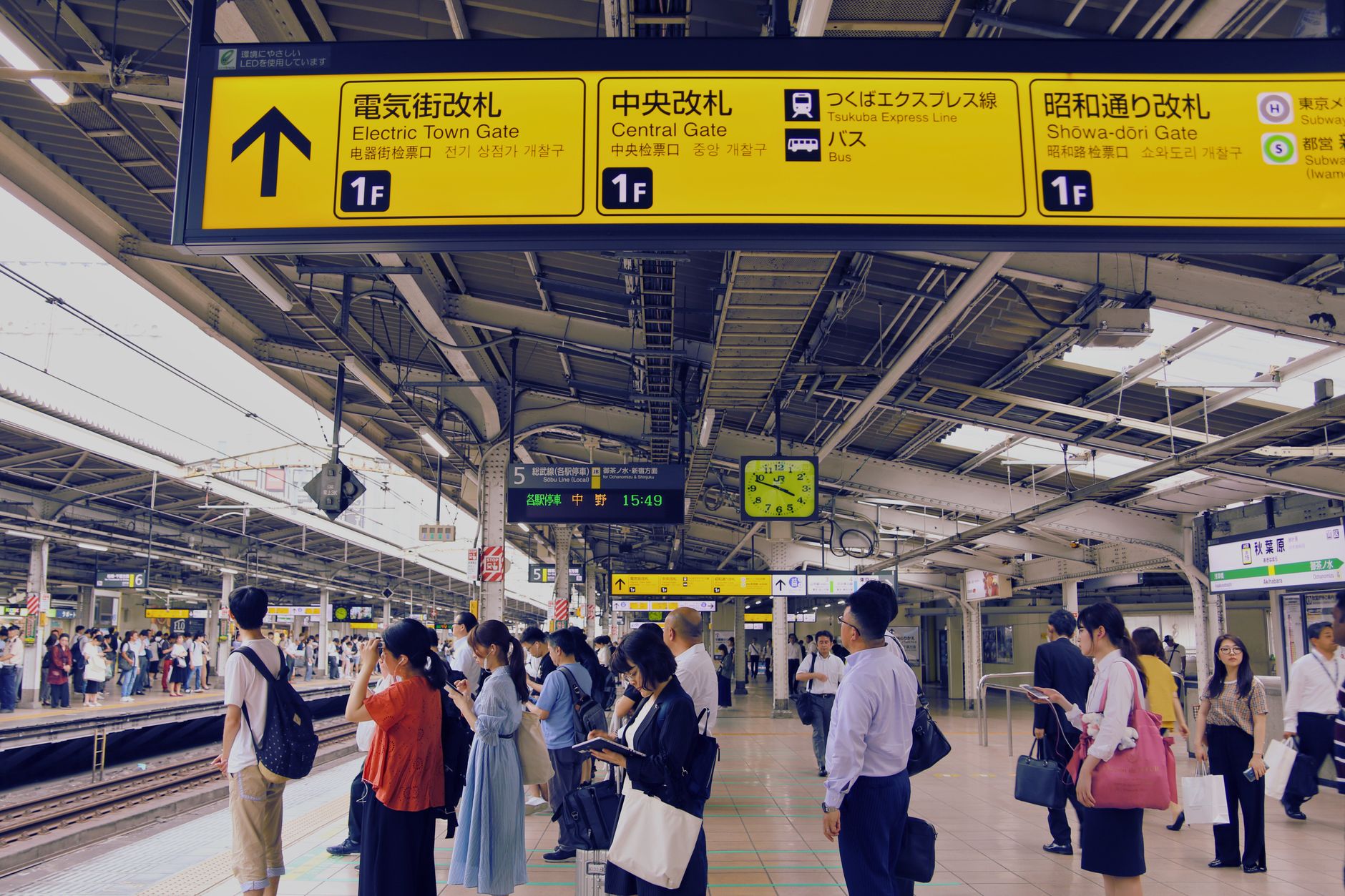
Major stations in Tokyo, Osaka and Kyoto have signs in English, but it helps to recognize a few key Japanese words for local lines, bus stops and temporary notices.
| Japanese | Reading | Meaning |
|---|---|---|
| 出口 | deguchi | Exit |
| 入口 | iriguchi | Entrance |
| 東口 / 西口 / 南口 / 北口 | higashi-guchi / nishi-guchi / minami-guchi / kita-guchi | East / West / South / North exit |
| 乗り換え | norikae | Transfer |
| のりば / 番線 | noriba / bansen | Platform (e.g. 3番線, platform 3) |
| 〜行き | … yuki | Bound for … |
| 各駅停車 / 普通 | kakueki teisha / futsu | Local (stops at every station) |
| 快速 / 急行 | kaisoku / kyuko | Rapid / Express (skips some stations, no extra fare) |
| 特急 | tokkyu | Limited express (usually needs an extra ticket) |
| 精算機 | seisanki | Fare adjustment machine |
| お手洗い / トイレ | otearai / toire | Toilet |
| エレベーター | erebeetaa | Elevator |
Station numbers and line colors
In Tokyo and other big cities, each line has a color and a letter, and each station a number, shown on maps and signs (for example, a letter for the line plus a two-digit station number). If you cannot pronounce a station name, follow the color and the letter-and-number code instead. Exits in large stations are also numbered or lettered; your hotel’s directions often name the best exit, which can save a long walk.
When signs are only in Japanese
For handwritten notices or a bus timetable, point a camera-translation app at the sign. Watch the electronic displays too; on many lines they cycle between Japanese and English.
Big stations and train manners
Surviving the giants
Shinjuku is the world’s busiest station by passenger numbers, listed by Guinness at about 3.53 million a day, and Tokyo, Shibuya, Umeda and Kyoto stations are not far behind in complexity. A few habits help:
- Follow your line’s color and code, not just the station name.
- Allow extra time for transfers between different companies, which may mean leaving one set of gates and entering another.
- Use the exit name or number in your directions, and arrange to meet people at a named exit or landmark.
- Look for the elevator signs if you have luggage or a stroller.
Manners on trains
- Queue at the marked spots on the platform and let passengers off before you board.
- Keep your phone on silent and avoid phone calls on the train.
- Leave priority seats for older people, pregnant passengers and people with disabilities.
- Take a backpack off and hold it in front of you on crowded trains.
- Avoid the busiest morning and evening rush hours with big suitcases if you can.
Useful Japanese at the station
| Japanese (romaji) | Meaning |
|---|---|
| Chaaji shitai desu. | I’d like to top up (my card). |
| Kono densha wa Shibuya ni tomarimasu ka? | Does this train stop at Shibuya? |
| Nan-bansen desu ka? | Which platform is it? |
| Higashi-guchi wa dochira desu ka? | Which way is the east exit? |
| Kaado ga tsukaemasen. | My card is not working. |
| Norikae wa doko desu ka? | Where do I transfer? |
For more, see our essential Japanese phrases.
Frequently asked questions
Should I get Suica or PASMO? It does not matter much: they work interchangeably across Japan’s IC network. As a visitor, pick whatever is easiest when you arrive, such as TOURIST PASMO at Haneda or Narita, or a card in Apple Wallet on an iPhone.
Can I buy a Suica card in 2026? Yes. Blank Suica and PASMO cards went back on sale on March 1, 2025 after a shortage, and visitor cards such as TOURIST PASMO and Welcome Suica are also available.
What is TOURIST PASMO? A visitor IC card on sale since May 2026 at Haneda and Narita stations, valid for 28 days, with no deposit. Unused balance is not refunded.
Can I use Suica on my iPhone? Yes. Apple Wallet supports Suica, PASMO and ICOCA on compatible iPhones, and the Welcome Suica Mobile app (since March 2025) offers a visitor version.
Does Suica work on Android phones from abroad? Generally not. PASMO says most Android phones bought outside Japan cannot use Mobile PASMO, and there is no official confirmation for Suica in Google Wallet. Buy a physical card.
Can I use my Suica or PASMO in Osaka and Kyoto? Yes. Suica, PASMO and ICOCA are part of the same nationwide network, so your Tokyo card works on trains and buses in Osaka and Kyoto.
Can I tap my credit card instead? On 11 Tokyo-area operators, including Tokyo Metro, Toei and Keikyu, yes, since March 2026. Not on JR East, Keisei or the Tokyo Monorail.
How much should I load? Start with ¥2,000 to ¥3,000 and top up as you go. The maximum balance is ¥20,000.
Can I get a refund on my card? A regular PASMO returns the balance plus the ¥500 deposit when you hand it back. TOURIST PASMO has no deposit and no refund of unused balance.
Do I need paper tickets in Japan? Rarely in the big cities. You need them outside IC areas (such as most of JR Shikoku), for the train itself on shinkansen and limited expresses, and sometimes for long trips that cross IC areas.
What do the train types mean? A local (各駅停車, kakueki teisha) stops everywhere; rapid (快速) and express (急行) trains skip stations at no extra cost; a limited express (特急, tokkyu) is faster and usually needs an extra ticket.
What if my card does not open the gate? Your balance is probably too low or you did not tap in. Use the fare adjustment machine near the exit, or show the card to the station staff at the window next to the gates.
Is TOURIST PASMO or Welcome Suica better? They do the same job for a short trip. Buy TOURIST PASMO at the Keikyu or Keisei stations at Haneda and Narita, or a Welcome Suica at JR East stations; choose whichever is on your route. Neither is worth buying if you already have a Suica or PASMO in your iPhone’s Wallet.
Can two people share one card? No. Each person needs their own card or ticket to pass through the gates, because the card is tapped in and out for one journey at a time. Children should have child cards or child tickets.
Plan the rest of your trip
- Narita and Haneda to Tokyo
- Is the Japan Rail Pass worth it?
- Cash or card in Japan
- Best eSIM for Japan
- Best day trips from Tokyo
- Shinkansen guide
Sources: PASMO official site and PASMO council release on TOURIST PASMO (April 2026); JR East and PASMO joint releases (August 2024, February 2025, November 2025, read via railway partners); Apple Support (Wallet transit cards, April 2026); Samsung and JR East release (April 2026); Tokyo Metro release on tap-to-ride (January 2026); Keikyu (tap to ride, fares); JR Central (shinkansen baggage); joint release on QR tickets (October 2026); teppay; JR Shikoku; Setouchi Bus; Takao Tozan Railway (checked October 2026). JR East’s own pages could not be read when we checked, so details marked “check” should be confirmed on its site. Prices and rules change; if you spot something out of date, please let us know.
Going to Japan? Speak Japanese with confidence.
Hirameki Japanese — camera translate for menus and signs, a two-way conversation mode, and furigana + romaji on every phrase. Free to download with kana charts, conversation mode and starter words; a one-time purchase unlocks everything.

Plan your Japan trip
Two things every first-timer should book
Some links are affiliate links. If you book through them we may earn a small commission at no extra cost to you.