Kyoto is the perfect base for day trips in Japan. Situated at the heart of the Kansai region, it sits within easy reach of Nara, Osaka, Hiroshima, Kobe, Himeji, Nara, and dozens of smaller towns and villages. Whether you have one day or ten based in Kyoto, you will never run out of extraordinary places to visit within a two-hour radius. This guide covers the best day trips from Kyoto, including how to get there, what to see, and how to fit multiple destinations into your itinerary.
Why Kyoto is the Perfect Day Trip Base
Kyoto’s location in central Honshu makes it exceptional for day trips. The JR network, Kintetsu Railway, and Hankyu Railway all radiate outward from Kyoto Station, connecting the city to major destinations throughout Kansai and beyond. The famous Tokaido Shinkansen passes through Kyoto, putting Hiroshima just 1 hour 40 minutes away. Osaka is just 14 minutes by the Shinkansen or 30 minutes on the cheaper Hankyu line. Nara is 45 minutes. Even Tokyo is reachable as a day trip — though a very long one.
The city also has good accommodation across all budgets, making it easy to set up camp for a week and explore. Many travellers find that basing themselves in Kyoto rather than constantly changing cities saves them time, stress, and money on luggage forwarding and hotel check-ins.
Best Day Trips from Kyoto
1. Nara — Deer, Temples, and a Giant Buddha (45 Minutes)
Nara is the most popular day trip from Kyoto and for good reason. The former imperial capital is home to Todaiji Temple and its colossal Great Buddha (Daibutsu), one of the largest bronze statues in the world at 15 metres tall. But the real star of Nara is the approximately 1,200 freely roaming sika deer that wander through Nara Park — sacred animals that have been protected since the eighth century. Visitors can buy deer crackers (shika senbei, ¥200 for a bundle) to feed them, though be warned: the deer are persistent and will nudge you firmly for more snacks.
Beyond the deer park and Todaiji, Nara offers several outstanding temples and shrines. Kasuga Taisha Grand Shrine is a beautiful vermillion-lacquered complex surrounded by ancient forest, famous for its thousands of bronze lanterns. Kofukuji Temple’s five-storey pagoda is one of Japan’s most photographed structures. The Naramachi neighbourhood has well-preserved machiya (merchant townhouses) converted into cafes, craft shops, and galleries.
Getting there: JR Nara Line from Kyoto Station to Nara Station (approximately 45 minutes, ¥720) or Kintetsu Kyoto Line from Kintetsu Kyoto Station to Kintetsu Nara Station (approximately 35–45 minutes, ¥760). The Kintetsu route puts you slightly closer to the main sights.
Best time: Autumn (mid-November) for spectacular maple foliage around the deer park. Spring for cherry blossoms along Yoshiki Stream. Avoid early January when Nara hosts major New Year festivals and can be extremely crowded.
How long to spend: A half day is sufficient to see the main sights. A full day allows you to explore thoroughly and have a relaxed lunch in Naramachi.
2. Osaka — Street Food, Nightlife, and Dotonbori (30 Minutes)
Osaka is so close to Kyoto that many travellers wonder whether to use Osaka or Kyoto as their base. If you are already in Kyoto, Osaka makes a perfect day trip for its completely different atmosphere. Where Kyoto is refined and historical, Osaka is boisterous, modern, and obsessively food-focused. The city’s culinary culture is summed up by the term kuidaore — literally “eat until you drop.”
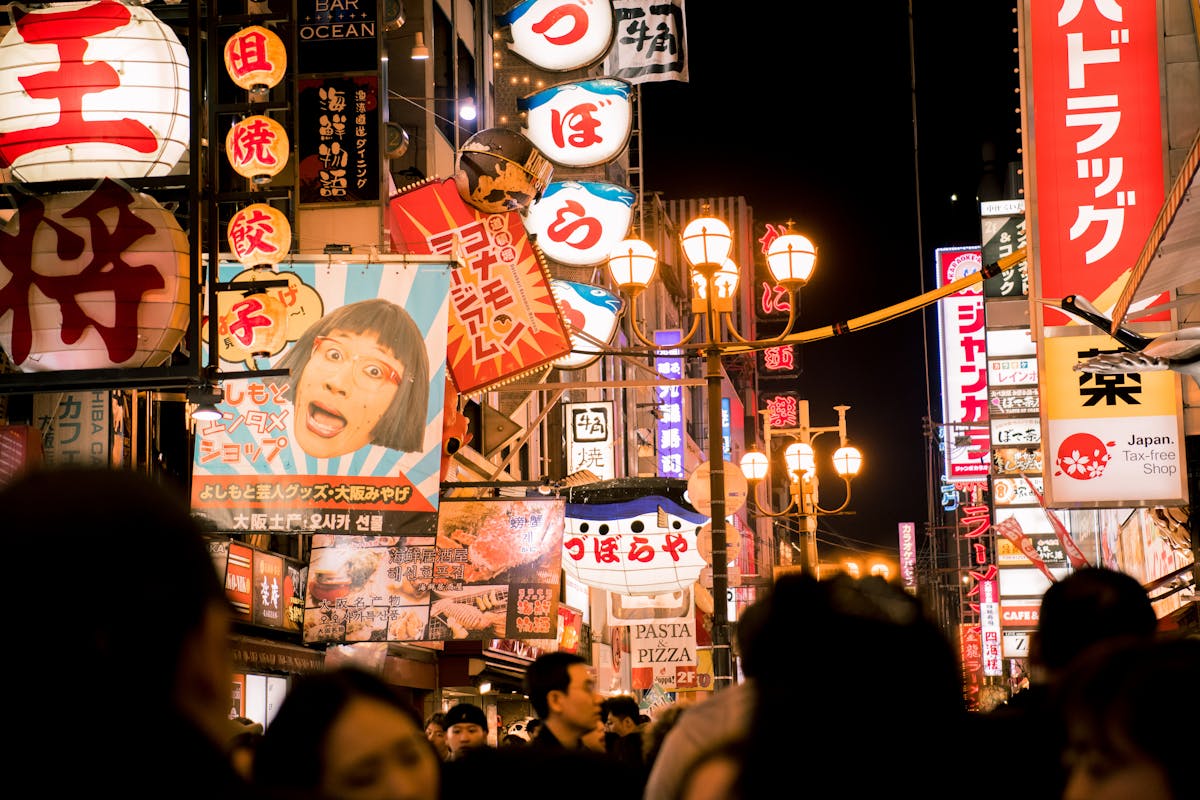
Dotonbori is the must-visit area: a canal-side street packed with neon signs, giant moving mechanical crabs, octopus-shaped takoyaki stalls, and hundreds of restaurants serving everything from ramen to fugu (pufferfish). The iconic Glico Running Man sign is here — one of Japan’s most photographed images. Nearby Shinsekai has a retro 1950s atmosphere with excellent kushikatsu (deep-fried skewers) restaurants. Kuromon Market is a bustling covered market perfect for fresh oysters, wagyu beef skewers, and fresh-cut fruit.
For something different, Osaka Castle is worth an hour of your time, particularly the surrounding park during cherry blossom season. Umeda Sky Building offers stunning views from its rooftop Floating Garden Observatory (¥1,500).
Getting there: JR Shinkansen from Kyoto to Shin-Osaka (just 14 minutes, ¥1,420) or JR Special Rapid from Kyoto to Osaka (approximately 30 minutes, ¥570). The Hankyu line (from Hankyu Kyoto-Kawaramachi to Hankyu Osaka-Umeda) is the cheapest option at ¥410 and takes about 45 minutes.
Best time: Osaka is excellent year-round. The Tenjin Matsuri festival in late July is one of Japan’s three great festivals. Winter is good for Osaka’s excellent indoor food and entertainment scene.
3. Hiroshima and Miyajima — Peace Memorial and the Floating Torii (2 Hours)
Hiroshima is the most emotionally significant day trip from Kyoto and requires a full day. The Hiroshima Peace Memorial Park and Museum provides a profoundly moving account of the August 1945 atomic bombing, with the skeletal A-Bomb Dome (Genbaku Dome) preserved as it stood immediately after the explosion. Allow at least 1.5 to 2 hours for the museum — it is thorough, thoughtful, and essential viewing for any visitor to Japan.
Combine Hiroshima with Miyajima Island (Itsukushima), a 10-minute ferry ride from Hiroshima’s Miyajimaguchi port. Miyajima’s famous floating torii gate — the brilliant orange torii of Itsukushima Shrine standing in the sea — is one of Japan’s three views (nihon sankei). The island is also home to freely roaming deer, a mountain accessible by ropeway (Mount Misen, 535 metres), and excellent fresh oysters grilled at stalls along the shoreline.
Getting there: Shinkansen from Kyoto Station to Hiroshima (about 1 hour 40 minutes on the Sakura or Kodama, ¥9,870; or 1 hour 20 minutes on the Nozomi but this is not covered by JR Pass). This is one of the best uses of a Japan Rail Pass.
Best time: Year-round, but spring (cherry blossoms in Peace Park) and autumn (maples on Mount Misen) are especially beautiful. The floating torii is best photographed at high tide.
4. Himeji — Japan’s Greatest Castle (1 Hour)
Himeji Castle is widely considered the finest surviving feudal castle in Japan — and arguably one of the most beautiful castle complexes in the world. Unlike Osaka Castle and Nagoya Castle, which were reconstructed in reinforced concrete, Himeji Castle is an original wooden structure that has survived wars, earthquakes, and the Second World War largely intact. Its brilliant white walls have earned it the nickname “White Heron Castle” (Shirasagijo). It was designated a UNESCO World Heritage Site in 1993.
The main keep is six storeys tall (seven storeys as seen from outside) and rewards a thorough exploration. The castle grounds also include the beautiful Koko-en Garden, a reconstructed Edo-period strolling garden (¥310 additional entry) that is particularly stunning in autumn. Himeji City itself is pleasant for a brief wander — Miyuki-dori shopping street leads from the station directly to the castle.
Getting there: JR Shinkansen from Kyoto to Himeji (about 50 minutes, ¥5,830 on the Hikari or Sakura). Covered by the JR Pass. Alternatively, the JR Special Rapid from Kyoto to Himeji takes about 1 hour 40 minutes and costs ¥1,520.
Best time: April for cherry blossoms surrounding the castle walls (extremely popular — arrive early). Any time of year is good, but winter can be cold and foggy which creates an atmospheric but not always pleasant experience.
5. Uji — Tea Capital and Byodoin Temple (30 Minutes)
Uji is one of Kyoto’s lesser-visited but most rewarding half-day trips. Located just south of Kyoto, this small city has two roles: it is the home of Japan’s finest matcha green tea, and it contains two UNESCO World Heritage Sites. Byodoin Temple, built in 1052, is one of the most beautiful temple complexes in Japan — its Phoenix Hall (Hoo-do) appears on the reverse of the 10-yen coin and reflects dramatically in the surrounding pond. Ujigami Shrine, just a short walk away, is the oldest surviving Shinto shrine in Japan.
The main street leading from Uji Station to the river is lined with tea shops offering everything from matcha soft-serve to traditional tea ceremony experiences. Try the matcha parfait at Nakamura Tokichi — a local institution since 1854. The price for Byodoin Temple entry is ¥700; the Phoenix Hall museum costs an additional ¥300.
Getting there: JR Nara Line from Kyoto Station to Uji Station (approximately 17 minutes, ¥240). Alternatively, the Kintetsu Kyoto Line to Kintetsu Uji Station takes about 25 minutes (¥310).
6. Fushimi — Sake Breweries and the Sanjusangendo (15 Minutes)
Fushimi is a district within Kyoto’s city limits (not a separate day trip destination) but is far enough from the central sightseeing areas to feel like its own world. Fushimi is the sake brewing capital of Japan — the pure underground water from the surrounding mountains has made it the centre of sake production for over 400 years. About 30 sake breweries operate here, and many offer tastings and brewery tours. Gekkeikan Okura Sake Museum (¥600) provides an excellent introduction to sake brewing history with a tasting at the end.
Fushimi also has the famous Teradaya Inn, a historically preserved inn where the Meiji Restoration-era samurai Sakamoto Ryoma survived an assassination attempt in 1866. The canal-side streets around Fushimi-Momoyama Station are very photogenic, particularly during the spring when the cherry trees along the canal are in bloom.
7. Amanohashidate — One of Japan’s Three Views (2 Hours)
Amanohashidate is one of Japan’s three officially designated scenic views (nihon sankei) — a 3.6-kilometre pine-covered sandbar stretching across Miyazu Bay in northern Kyoto Prefecture. The traditional way to view it is to lean forward and look at it upside down through your legs, which transforms it into a sky bridge (the name literally means “Bridge in the Sky”). It sounds gimmicky but is genuinely enchanting.
The sandbar is accessible by walking, cycling, or taking a small sightseeing boat. Viewpoints are available on both ends of the bay via gondola or chair lift (¥700). The area is less crowded than Nara or Osaka and offers a relaxed change of pace from city sightseeing. Combine with a visit to the nearby Chion-ji Temple and the atmospheric Kasamatsu Park viewpoint.
Getting there: JR San’in Line from Kyoto to Amanohashidate (approximately 2 hours, ¥2,310). Note this is a longer day trip and best as a full day.
8. Kobe — Beef, Views, and Cosmopolitan Atmosphere (1 Hour)
Kobe is Japan’s most cosmopolitan city — an international port that was opened to foreign trade in 1868 and has maintained a distinctly international flavour ever since. The Kitano district’s Western-style “ijinkan” mansions (built by foreign traders in the nineteenth century) are a fascinating window into Japan’s Meiji-era modernisation. The Nankinmachi Chinatown is compact but excellent for dumplings and char siu pork.
But let’s be honest — most people go to Kobe for the beef. Kobe Beef is a protected designation of origin product (specifically Tajima cattle raised in Hyogo Prefecture) and is widely considered the finest beef in the world, with extraordinary intramuscular fat marbling. A Kobe beef lunch at a licensed restaurant costs approximately ¥5,000–¥15,000. It is an experience worth saving up for.
Getting there: JR Shinkansen from Kyoto to Shin-Kobe (approximately 30 minutes, ¥2,960). Or take the JR Special Rapid from Kyoto to Kobe-Sannomiya (approximately 55 minutes, ¥1,100). Check our Complete Wagyu Beef Guide for more details.
9. Kurama and Kibune — Mountain Villages Above Kyoto (30 Minutes)
Kurama and Kibune are two small mountain villages just north of Kyoto, connected by a 2-kilometre hiking trail through cedar forest. They feel a world away from the city below. Kurama’s main attraction is Kurama-dera Temple, a powerful mountaintop complex accessible either by a 90-minute hiking trail or by the Kurama Cable Car (¥200). The temple complex has a mystical quality and excellent views over the surrounding mountains.
Kibune is known for its kawadoko (riverbed dining) from June to September — restaurants set tables directly over the cool mountain stream, making for one of Japan’s most magical dining experiences. In winter, the path between the two villages transforms into a snowy wonderland.
Getting there: Eizan Railway from Demachiyanagi Station to Kurama Station (approximately 30 minutes, ¥430). The entire round trip — Kurama to Kibune via the hiking trail, then Kibune River bus back to Demachiyanagi — takes about 4–5 hours.
10. Ine and Kyoto’s Sea Coast (2.5 Hours)
Ine is a small fishing village on the Sea of Japan coast of Kyoto Prefecture, famous for its unique “funaya” boathouses — buildings with garages that open directly into the sea so boats can be sheltered inside. The village has been continuously inhabited since the Edo period and appears largely unchanged. A sightseeing boat around the bay (¥1,000, about 30 minutes) gives the best views of the funaya. This is a genuinely off-the-beaten-track destination rarely visited by foreign tourists.
Getting there: JR Hashidate Limited Express from Kyoto to Amanohashidate (2 hours), then bus to Ine (40 minutes). Total approximately 2.5–3 hours.
Practical Tips for Day Trips from Kyoto
Get an IC Card: An IC Card (Suica or ICOCA) loaded with ¥3,000–¥5,000 makes paying for local trains and buses completely seamless. No need to buy separate tickets for short journeys. They work on all JR, private railways, and most bus routes throughout Kansai.
Use the JR Pass wisely: The Japan Rail Pass covers JR trains but not private railways (Hankyu, Kintetsu). For Hiroshima and Himeji, the pass is excellent value. For Osaka, the cheaper Hankyu line (not covered) may save money for those without a pass. Calculate your expected journey costs before purchasing.
Leave luggage at Kyoto Station: Most hotels will hold luggage for the day. Coin lockers at Kyoto Station are also available (¥300–¥700 per day). Consider sending heavy bags via takkyubin luggage forwarding directly to your next destination.
Start early: Popular day trip destinations like Nara and Hiroshima/Miyajima get crowded by mid-morning. Aim to be on the first or second train of the day — typically 7:00–8:30 from Kyoto Station — to have major sights largely to yourself.
Check operating hours: Many temples and shrines close or change hours seasonally. Some sights (like Byodoin Temple’s Phoenix Hall interior) require advance booking. Check official websites before departing.
Suggested Itineraries
3-day Kyoto base: Day 1 — Nara (half day) + afternoon in Kyoto. Day 2 — Hiroshima and Miyajima (full day). Day 3 — Osaka (full day for food and shopping).
5-day Kyoto base: Add Himeji and Uji/Fushimi to the above. Himeji pairs well with Kobe on the same day (train stops are sequential on the Shinkansen/JR line).
1-week Kyoto base: All of the above plus Kurama/Kibune, Amanohashidate, and a day exploring Kyoto’s own overlooked neighbourhoods (Fushimi Inari at dusk, the Philosopher’s Path in evening light).
Budget Breakdown for Kyoto Day Trips
Here is a realistic cost estimate for popular day trips from Kyoto (per person, round-trip transport + main admission):
Nara: ¥1,440 (train ¥720 × 2) + ¥600 (Todaiji) = approximately ¥2,100–¥2,500 total
Osaka: ¥1,140 (JR train ¥570 × 2) + free walking/food = ¥1,500–¥5,000 depending on food
Hiroshima + Miyajima: ¥19,740 (Shinkansen ¥9,870 × 2) + ¥1,300 (Peace Museum + Miyajima ferry) = ¥21,000+ (most economical with JR Pass)
Himeji: ¥11,660 (Shinkansen ¥5,830 × 2) + ¥1,000 (castle) = ¥12,700 (excellent with JR Pass)
Uji: ¥480 (train ¥240 × 2) + ¥700 (Byodoin) = approximately ¥1,500 total — excellent value
Frequently Asked Questions
Q: Is the Japan Rail Pass worth it for Kyoto day trips?
A: The JR Pass is excellent value if you plan to visit Hiroshima, Himeji, or do multiple Shinkansen journeys. For short trips like Nara and Uji, paying individually is usually cheaper. Run the numbers based on your specific itinerary. Read our full JR Pass analysis here.
Q: Can I do Hiroshima and Miyajima in one day from Kyoto?
A: Yes, but it requires an early start. Leave Kyoto by 7:30–8:00, arrive Hiroshima by 9:15–10:00, visit Peace Park and Museum (2–3 hours), take the ferry to Miyajima (3–4 hours), and return to Kyoto by 19:00–20:00. It is manageable but tiring — a more relaxed pace would involve staying one night in Hiroshima.
Q: What is the best day trip for first-time visitors?
A: Nara is ideal — it is close (45 minutes), affordable, and uniquely memorable. The combination of the Great Buddha and the freely roaming deer is unlike anything else in Japan. Even experienced Japan travellers consistently rate Nara as one of their favourite experiences.
Q: Can I combine multiple day trips in one day?
A: Yes — the most popular combination is Osaka + Kobe (both on the same JR line, about 30 minutes apart) or Nara + Uji (both south of Kyoto, though not on the same direct line). Hiroshima + Miyajima is already a combination. Avoid trying to combine more than two destinations unless you are comfortable with fast-paced travel.
Q: How do I get around Kyoto itself between day trips?
A: Kyoto’s bus network covers most tourist areas, with a one-day bus pass (¥700) offering unlimited rides. For eastern districts (Fushimi Inari, Gion, Higashiyama), walking or bicycle rental is often the most pleasant option. The Kyoto subway is useful for central north-south journeys.
Final Thoughts
Kyoto’s exceptional location makes it one of the best bases in all of Japan — possibly in all of Asia — for regional day trips. From ancient sacred deer in Nara to the floating torii of Miyajima, from the melancholy beauty of Hiroshima’s Peace Park to the boisterous food streets of Osaka’s Dotonbori, the range of experiences within a two-hour radius is extraordinary. Use Kyoto as your anchor, build a thoughtful itinerary of day trips around it, and you will leave Japan with memories that will last a lifetime.
Related Kyoto & Kansai Guides
Keep planning your Kyoto trip with these related guides: Arashiyama’s bamboo grove and temples, Gion, Kyoto’s geisha district, Nishiki Market, Kyoto’s kitchen, Yoshino’s sacred cherry blossom mountain, and the best day trips from Osaka.
🗾 Planning your trip? Get our free 7-Day Japan Itinerary (PDF)
Day-by-day Tokyo → Kyoto → Osaka plan with real prices and essential phrases — sent straight to your inbox.
Going to Japan? Talk to locals with confidence.
Hirameki Japanese — instant offline translation, camera translation, furigana + romaji, and 314 free flashcards. No login. Works without internet.

Plan your Japan trip
Two things every first-timer should book
Some links are affiliate links. If you book through them we may earn a small commission at no extra cost to you.