In this guide
- Haneda or Narita: what to expect
- Fastest options to the main hotel areas
- Route options by hotel area
- Your first hour: step by step
- Narita: the Keisei Skyliner
- Narita: Keisei Access Express and Main Line
- Narita: the Narita Express (N’EX)
- Narita: buses
- Narita: taxis and fixed fares
- Haneda: terminals and connections
- Haneda: the Keikyu Line
- Haneda: the Tokyo Monorail
- Haneda: buses, including late at night
- Haneda: taxis and fixed fares
- IC cards, tap-to-ride and tickets
- Luggage at the airport
- Narita ⇄ Haneda connections
- Children, families and accessibility
- Late arrivals and early departures
- Private transfers
- Train, bus or taxi?
- Money-saving tips
- Getting to the airport for your flight home
- What changed in 2025–2026
- Useful Japanese at the airport
- Frequently asked questions
- Plan the rest of your trip
Haneda or Narita: what to expect
Tokyo has two international airports, and the difference matters for your first hour in Japan.
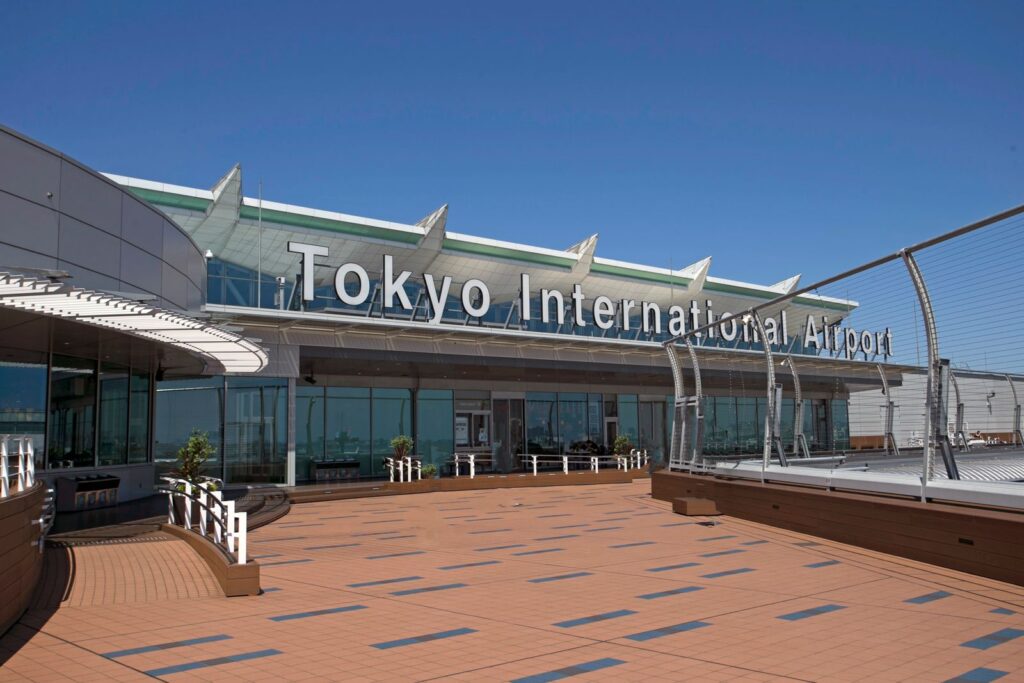
- Haneda (Tokyo International Airport) is on Tokyo Bay, inside the city. Terminal 3 is the international terminal, with stations for the Keikyu Line and the Tokyo Monorail, though some international flights use Terminal 2. Shinagawa is 11 minutes away by Keikyu, and Shinjuku or Ikebukuro about 30 to 45 minutes.
- Narita is in Chiba Prefecture, about an hour or more from central Tokyo by train. Its fast trains, the Skyliner and the N’EX, make the trip easy, but it is a longer ride, and taxis are expensive.
JR East plans a new line linking Tokyo Station and Haneda directly, but it is not expected until around fiscal 2031.
Fastest options to the main hotel areas
The official Tokyo tourism site gives these typical times. They are door-to-door estimates and vary with the time of day.
| Area | From Haneda | From Narita | Best rail option from Narita |
|---|---|---|---|
| Shinjuku | About 55 min | About 1 h 35 min by train, 2 h by bus | N’EX (direct) |
| Shibuya | 45 min by train, 55 by bus | 1 h 40 min by train, 1 h 55 by bus | N’EX (direct) |
| Ginza | 50 min by train, 35 by bus | 1 h 35 min by train, 2 h by bus | Access Express (Higashi-ginza) |
| Asakusa | About 50 min (Keikyu through trains from 34 min) | About 1 h 25 min | Access Express (direct) |
| Ueno | About 50 min | About 1 h 20 min | Skyliner (from 41 min) |
| Tokyo Station | Keikyu from 20 min; Monorail 19 min to Tokyo | About 1 h | N’EX (about 56 min) |
If you have not booked yet, the airport is worth considering when you choose a hotel. See our best hotels in Tokyo for the main areas.
Route options by hotel area
Here are the main choices for the areas where most visitors stay, with the fares and times quoted in this guide. Taxi fares from Haneda are the daytime fixed fares; “meter” means the ward is not on the fixed-fare list.
| Area | From Haneda | From Narita |
|---|---|---|
| Shinjuku | Keikyu (from 30 min) or Monorail (37 min); Limousine Bus ¥1,400; taxi ¥9,000 | N’EX (about 83 min); Limousine Bus ¥3,600 |
| Shibuya | Keikyu (from 23 min) or Monorail (30 min); Limousine Bus ¥1,300; taxi ¥8,500 | N’EX (about 77 min); Limousine Bus ¥3,600 |
| Tokyo Station / Marunouchi | Keikyu (from 20 min) or Monorail (19 min); Limousine Bus ¥1,200; taxi ¥7,600 | N’EX (about 56 min); Limousine Bus ¥3,100; TYO-NRT ¥1,500 |
| Ginza | Keikyu to Higashi-ginza (from 23 min); taxi by meter | Access Express to Higashi-ginza (¥1,330); TYO-NRT ¥1,500 |
| Asakusa | Keikyu through train (from 34 min); taxi ¥9,100 | Access Express, no change (¥1,290) |
| Ueno | Monorail and JR (27 min); taxi ¥9,100 | Skyliner (from 41 min, ¥2,580) or Main Line (¥1,030) |
| Ikebukuro | Keikyu (from 38 min) or Monorail (43 min); Limousine Bus ¥1,400; taxi ¥11,200 | Limousine Bus ¥3,600 |
| Shinagawa | Keikyu (from 11 min) | N’EX; Access Express through trains (¥1,520) |
| Yokohama | Keikyu (from 23 min); late-night bus 01:20 | N’EX (about 87 min) |
Your first hour: step by step
Arriving at Narita
- After customs, follow the signs for the railway station in your terminal; both Keisei and JR leave from Terminal 1 and Terminal 2·3 stations.
- If you are taking the Skyliner, exchange your online discount ticket or buy a Skyliner ticket at the Keisei counter or a machine before boarding, to avoid the ¥300 on-board surcharge.
- If you need an IC card, Keisei’s information centers at the airport stations sell the TOURIST PASMO (¥2,000).
- If you have a JR Pass or a N’EX ticket, go to the JR ticket office. Bring your original passport for the N’EX round-trip ticket.
- If you are taking the Limousine Bus, find its counter in the arrival lobby; reservations are web-only.
Arriving at Haneda Terminal 3
- The Keikyu and Tokyo Monorail stations are inside Terminal 3.
- Buy a TOURIST PASMO at the Keikyu station (charge of ¥1,000 to ¥10,000, cards accepted), use an IC card you already have, or tap a contactless credit card at the Keikyu gates.
- At Keikyu’s ticket machines, choose “Toei Line” for Higashi-ginza or Asakusa, or “Transfer to JR Lines” for JR connections at Shinagawa.
- On a weekend or holiday, consider the Monorail & Yamanote Line Discount Ticket (¥590).
- For a taxi, go to lane 2, stop 21, on the 1st floor; for late-night buses, check the bus stops on the 1st floor.
Narita: the Keisei Skyliner
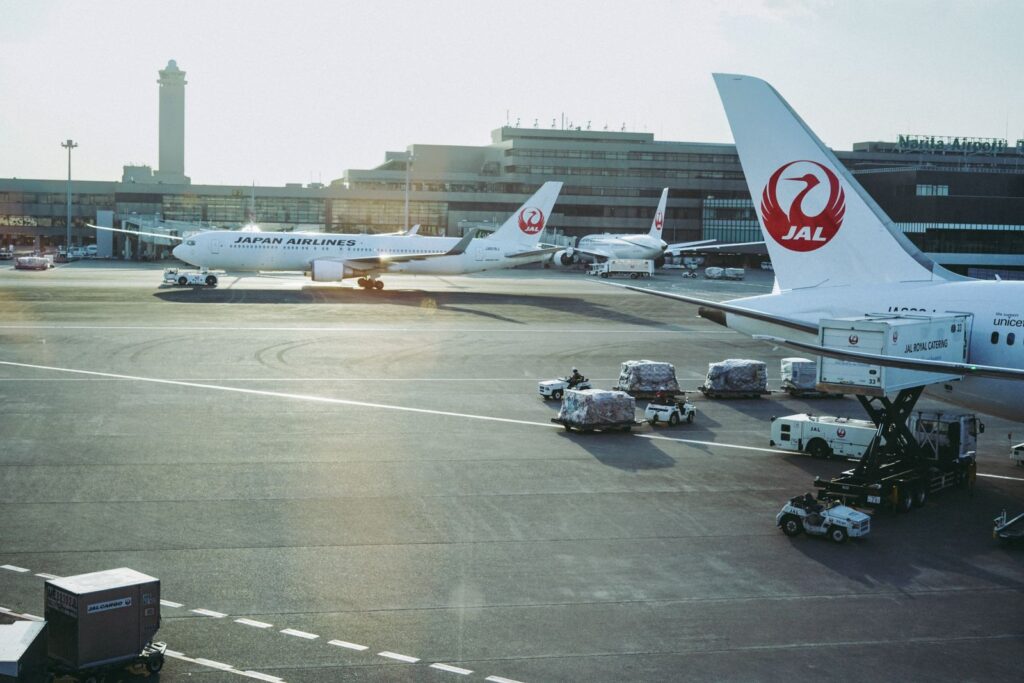
The Skyliner is the fastest train between Narita and Tokyo, running non-stop to Nippori (where you can change to the JR Yamanote Line) and Keisei Ueno. The fastest trip from Terminal 2·3 takes 36 minutes to Nippori and 41 minutes to Ueno, and there are three Skyliners an hour. All seats are reserved, with 105 cm of legroom, a power outlet at every seat, luggage space in each car and security cameras.
Fares
| Ticket | Adult | Child |
|---|---|---|
| Standard one way (fare ¥1,280 + Skyliner ticket ¥1,300) | ¥2,580 | ¥1,290 |
| Standard, paying the base fare by IC card | ¥2,567 | — |
| Skyliner Discount Ticket, one way (online) | ¥2,310 | ¥1,150 |
| Skyliner Discount Ticket, round trip | ¥4,500 | ¥2,240 |
Older guides quote ¥2,470; that figure is out of date. The discount tickets are sold online and through designated travel agencies; round-trip discount tickets can only be exchanged at the Narita Airport stations, not at Ueno or Nippori. You can book discounted Skyliner tickets on Klook before you fly. For the trip back to the airport, a Skyliner Value Ticket is also sold in Tokyo at the TOBU Tourist Information Center in Asakusa (7:20–17:00) and the SEIBU Tourist Information Center in Ikebukuro (8:00–15:00). Some low-cost airlines sell Skyliner vouchers on board, but they are not valid on flights arriving at Narita at 22:00 or later.
Buy before you board
Since December 13, 2025, if you board a Skyliner without a Skyliner ticket you pay a ¥300 surcharge (¥150 for children) on top of the ticket price. Tickets go on sale one month ahead. Keisei also offers a face-recognition boarding option, “Face Check in Go”, for e-ticket holders.
Timetable notes
Until November 20, 2026, the first weekday Skyliner from Narita Airport leaves at 7:23 and the last at 23:00 (arriving Ueno 23:48). From November 21 (weekends) and November 24 (weekdays), a new first train leaves Keisei Ueno at 5:20 and reaches Narita Airport at 6:03, useful for early flights.
Combination tickets
- Keisei Skyliner & Tokyo Subway Ticket: a Skyliner one-way or round trip plus a 24-, 48- or 72-hour pass for Tokyo Metro and Toei subways, valid for six months from sale.
- Tokyo City Pass: renewed on September 4, 2026, with a Skyliner one-way add-on for ¥2,310.
- Hands-free Liner: sold at JAL ABC counters in the arrival lobbies of Terminals 1 and 2, it combines delivery of a suitcase (up to 160 cm and 30 kg) with a Skyliner ticket; for example ¥4,770 per bag in total for delivery within the Kanto region. You then travel light on the Skyliner.
Narita: Keisei Access Express and Main Line
If you are not in a hurry, or your hotel is in Asakusa, Nihombashi or Higashi-ginza, Keisei’s regular trains are much cheaper and need no reserved ticket.
- Access Express runs via the Narita Sky Access line and through onto the Toei Asakusa Line, so it reaches Asakusa, Nihombashi, Higashi-ginza and Shimbashi without a change, and some trains continue to Shinagawa on the Keikyu Line. No limited express fare is required.
- Main Line Limited Express trains take a slower route to Ueno at a lower fare.
| From Narita Airport to | Access Express (IC / ticket) | Main Line (IC / ticket) |
|---|---|---|
| Nippori / Ueno | ¥1,235 / ¥1,240 | ¥1,025 / ¥1,030 |
| Oshiage (Skytree) | ¥1,162 / ¥1,170 | ¥973 / ¥980 |
| Asakusa | ¥1,276 / ¥1,290 | ¥1,087 / ¥1,100 |
| Higashi-ginza, Nihombashi, Shimbashi | ¥1,318 / ¥1,330 | ¥1,129 / ¥1,140 (Nihombashi, Shimbashi) |
| Shinagawa | ¥1,502 / ¥1,520 | ¥1,313 / ¥1,330 |
Fares differ by route, so tap in for the train you actually ride. At Narita’s stations, IC-card users who are not on the Skyliner pass through two gates, one after the other. From Haneda Terminal 3, Keikyu and Access Express through trains reach Narita Airport in about 92 minutes, which is handy for airport transfers.
Narita: the Narita Express (N’EX)
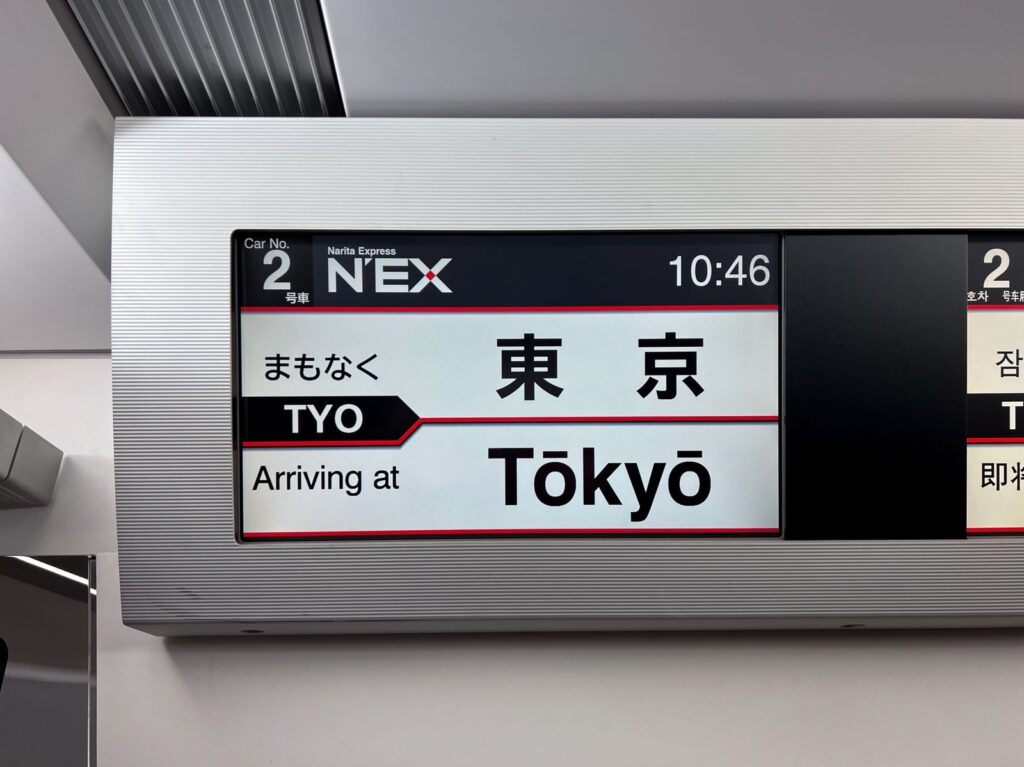
JR East’s Narita Express is the best choice for Tokyo Station, Shinagawa, Shibuya, Shinjuku and Yokohama, because it goes there directly. On a sample weekday train in October 2026, the times from Narita Airport Terminal 2·3 were:
| To | Time |
|---|---|
| Tokyo | 56 min |
| Shibuya | 77 min |
| Shinjuku | 83 min |
| Yokohama | 87 min |
On weekdays, N’EX trains leave Terminal 2·3 toward Tokyo from 7:40 to 21:47, about twice an hour; some evening trains do not run every day. All seats can be reserved, and a “seat-unassigned” ticket lets you sit in any vacant seat. JR East fare listings give one-way reserved fares of about ¥3,140 to Tokyo and ¥3,330 to Shibuya or Shinjuku after its March 2026 fare revision; check the exact price when you buy.
The N’EX TOKYO Round Trip Ticket
For foreign passport holders, JR East sells a N’EX TOKYO Round Trip Ticket, ¥5,200 for adults (¥2,600 for children) in 2026, covering one trip from Narita into the Tokyo area and one back within 14 days. Against two regular one-way fares to Tokyo (about ¥6,280) or Shinjuku (about ¥6,660), it is a good deal if you fly in and out of Narita. Check the conditions on JR East’s site before you buy, and bring your original passport to collect it.
Late trains
The last weekday JR Narita Line rapid from Terminal 2·3 that runs through to Tokyo leaves at 23:00; later rapid trains go only as far as Chiba.
Narita: buses
- Airport Limousine Bus: ¥3,600 to many hotels in Shinjuku, Shibuya, Ikebukuro, Ginza and Akasaka/Toranomon, or ¥3,100 to Tokyo Station’s Yaesu side. It is the easiest option with heavy bags if it stops at your hotel. Reservations are web-only (phone booking ended in September 2025), and timetables changed on October 1, 2026.
- TYO-NRT: a cheaper bus between Narita and Tokyo Station or Ginza, ¥1,500 by day, from about 65 minutes.
- Narita ⇄ Haneda: the Limousine Bus links the two airports for ¥3,600 in about 1 hour 40 minutes.
Narita: taxis and fixed fares
Taxis from Narita are expensive because of the distance, but they can make sense for a family with luggage arriving late. There are two fixed-fare systems.
Taxis from the rank (Narita Airport Taxi Council)
No booking needed: you pay a uniform fare by zone, plus expressway tolls, with a late-night surcharge from 22:00 to 5:00 and an extra charge if the route uses the Tokyo Bay Aqua-Line.
| Zone | Wards (examples) | Via Keiyo Road / via Bayshore |
|---|---|---|
| A | Edogawa, Katsushika, Adachi | ¥23,500 / ¥26,500 |
| B | Koto, Sumida, Odaiba, eastern Shinagawa | ¥28,000 / ¥28,000 |
| C | Chuo (Ginza), Chiyoda, Taito (Asakusa, Ueno), Bunkyo, Arakawa | ¥29,000 / ¥31,000 |
| D | Shinjuku, Shibuya, Toshima, Nakano, Meguro, Minato, Shinagawa, Ota | ¥31,500 / ¥32,500 |
| E | Itabashi, Kita, Nerima | ¥34,000 / ¥36,000 |
| F | Setagaya, Suginami, Mitaka, Musashino | ¥35,500 / ¥38,500 |
Pre-booked taxis (Tokyo Hire-Taxi Association)
If you book ahead, the Tokyo Hire-Taxi Association’s fixed fares from April 20, 2026 are lower: ¥21,000 to zone A, ¥26,000 to zone B (including Taito, Chiyoda and Chuo), ¥28,000 to zone C (including Shinjuku, Shibuya and Minato) and ¥30,000 to zone D, plus tolls; late at night (22:00–5:00) they are ¥25,000, ¥30,000, ¥33,000 and ¥36,000.
Haneda: terminals and connections
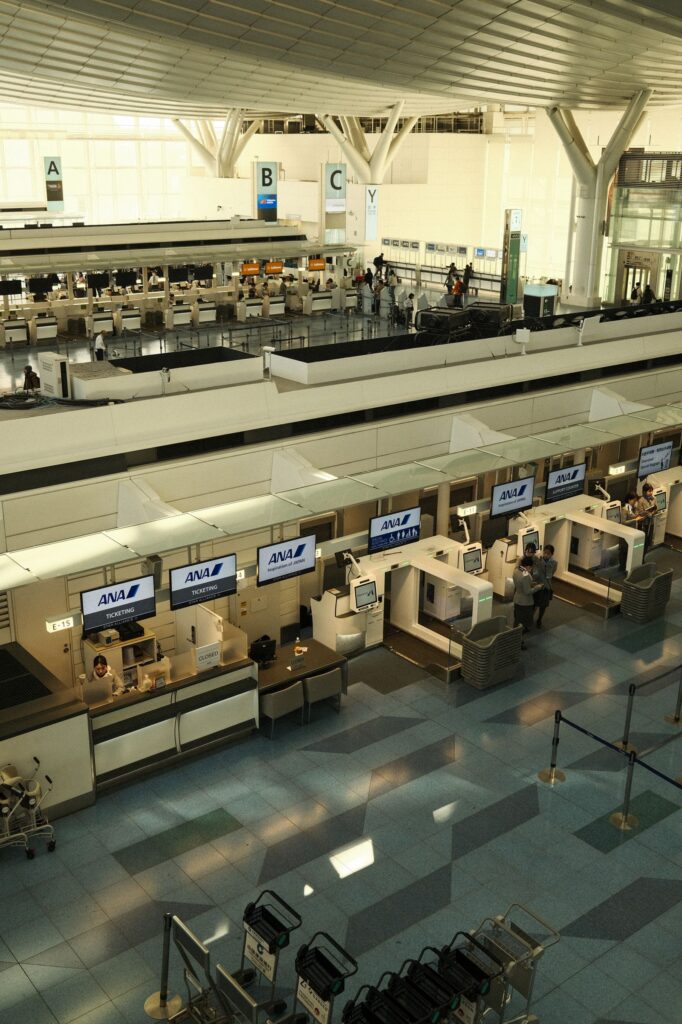
- Terminal 3 is the international terminal; some international flights depart from Terminal 2. Terminals 1 and 2 handle domestic flights.
- Free shuttle bus: links T3, T1 and T2, from 4:47 to 1:15, every 4 minutes from 5:00 to 20:00 and every 8 minutes from 20:00 to midnight. It stops at T1 1F stop 8, T2 1F stop 9 and T3 1F stop 0. T1 and T2 are also linked by an underground passage.
- Transit tickets: free “Transit Boarding Tickets” for Keikyu or the Monorail between T1/T2 and T3 are available only for international-to-domestic or international-to-international connections, on showing your passport and boarding pass.
- Hotels in the terminals: First Cabin (T1), Haneda Excel Hotel Tokyu (T2) and The Royal Park Hotel Tokyo Haneda (T3), with Villa Fontaine hotels connected to T3.
Haneda: the Keikyu Line
Keikyu is the most flexible option from Haneda: it runs to Shinagawa for JR lines and through onto the Toei Asakusa Line for Higashi-ginza, Nihombashi and Asakusa. At the ticket machines, press “Toei Line” or “Transfer to JR Lines” as needed.
| Fastest from T3 (T1·2) to | Time |
|---|---|
| Shinagawa | 11 min (14) |
| Tokyo | 20 min (23) |
| Shimbashi | 21 min (24) |
| Higashi-ginza | 23 min (26) |
| Shibuya | 23 min (26) |
| Yokohama | 23 min (28) |
| Shinjuku | 30 min (33) |
| Asakusa | 34 min (37) |
| Ikebukuro | 38 min (41) |
The fare to Shinagawa is about ¥330 (IC fares are charged to the yen, tickets in 10-yen units). The last train from T3 to Shinagawa leaves at 00:08 (arriving 00:20) and the first at 05:26.
Tap to ride with a credit card
Keikyu gates accept contactless Visa, Mastercard, JCB, Amex, Diners, Discover and UnionPay cards, but not at transfer gates such as Shinagawa and Yokohama. Children pay the adult fare this way, there is no Toei transfer discount, and you must tap the same card in and out.
Hanetoku Ticket
The KEIKYU Hanetoku Ticket & Tokyo Subway Ticket combines a Haneda–Sengakuji round trip with a 24-, 48- or 72-hour subway pass (¥1,600 / ¥2,100 / ¥2,600 for adults), but it is sold only through ANA, JAL MaaS or certain packages, not at Haneda.
Haneda: the Tokyo Monorail
The Tokyo Monorail runs from all three terminals to Hamamatsucho, where you change to the JR Yamanote Line. Trains run about every 5 minutes on average.
| From Haneda to | Time |
|---|---|
| Hamamatsucho | 13 min |
| Shimbashi | 15 min |
| Tokyo | 19 min |
| Akihabara | 23 min |
| Ueno | 27 min |
| Shibuya | 30 min |
| Shinjuku | 37 min |
| Ikebukuro | 43 min |
Terminal 3 to Hamamatsucho costs ¥520 (¥519 by IC card). On weekends, holidays and selected dates, the Monorail & Yamanote Line Discount Ticket takes you from any Haneda terminal to any Yamanote Line station for ¥590, a bargain if your hotel is near the loop. The Monorail does not accept credit-card tap-to-ride.
Haneda: buses, including late at night
- Airport Limousine Bus: ¥1,400 to Shinjuku (¥2,800 late at night), ¥1,300 to Shibuya, ¥1,400 to Ikebukuro and ¥1,200 to Tokyo Station.
- Late-night buses to Shinjuku and Ikebukuro: after midnight, buses leave T2 at 00:05, T1 at 00:10 and T3 at 00:20, 01:00, 01:40 and 02:20, from stop 4 at T1, stop 5 at T2 and stop 3 at T3.
- Late-night bus to Yokohama: a Keikyu bus to YCAT and Sakuragicho leaves T3 at 01:20 from stop 7.
Times can change with flight schedules, so check on arrival.
Haneda: taxis and fixed fares
From April 20, 2026, the Tokyo Hire-Taxi Association’s fixed fares to many Tokyo wards apply in both directions, plus tolls. Some wards are not on the list and use the meter.
| To (ward) | Day | Late night (22:00–5:00) |
|---|---|---|
| Chiyoda (Tokyo Station, Marunouchi) | ¥7,600 | ¥9,000 |
| Shibuya | ¥8,500 | ¥10,000 |
| Setagaya | ¥8,900 | ¥10,400 |
| Shinjuku | ¥9,000 | ¥10,700 |
| Taito (Asakusa, Ueno) | ¥9,100 | ¥10,800 |
| Sumida | ¥9,100 | ¥10,700 |
| Bunkyo | ¥9,300 | ¥10,900 |
| Nakano | ¥9,900 | ¥11,700 |
| Toshima (Ikebukuro) | ¥11,200 | ¥13,200 |
Chuo (Ginza), Minato (Roppongi), Shinagawa, Meguro, Ota and Koto are not on the fixed-fare list, so those trips use the meter. Taxi stands are on the 1st floor of each terminal (T3: lane 2, stop 21), and stands for app-hailed and reserved taxis are at T1 2F near Exit 7, T2 2F near Exit 2, and at T3 on the 8th floor of P5 parking.
IC cards, tap-to-ride and tickets
- TOURIST PASMO: a visitor IC card valid for 28 days, sold since May 2026 at Keikyu’s Haneda stations (charge of ¥1,000 to ¥10,000, cards accepted) and at Keisei information centers at Narita’s stations (¥2,000). Any balance left is not refunded.
- Using IC cards: Keisei’s Access Express and Main Line, Keikyu, the Tokyo Monorail and JR rapid trains accept Suica, PASMO, ICOCA and other IC cards at the gates. On the Skyliner you can pay the base fare by IC card but still need a Skyliner ticket; on the N’EX you need a limited-express ticket as well.
- Credit-card tap-to-ride: since March 25, 2026, 11 operators in the Tokyo area accept it, including Keikyu and the Toei subway, but not JR East or Keisei.
- Coming in 2027: from spring 2027, Keisei, Keikyu, JR East, the Tokyo Monorail and others will replace magnetic paper tickets with QR-code tickets.
For which card to get, see our Suica vs PASMO guide.
Luggage at the airport
- Same-day delivery from Haneda: the Keikyu and ecbo bag counter at Haneda Terminal 3 station has been open from 7:00 to 23:00 since August 17, 2026.
- From Narita: since July 22, 2026, Sagawa has counters at Terminals 1 and 2 with same-day delivery to hotels in 10 central Tokyo wards when you drop off by 14:00. The Hands-free Liner (above) combines delivery with a Skyliner ticket.
- On the trains: the Skyliner has dedicated luggage space in every car; on other trains, boarding early gives you the best chance of room for big bags.
See our luggage forwarding guide for sending bags between hotels and airports.
Narita ⇄ Haneda connections
If you fly into one airport and out of the other, or connect to a domestic flight:
- By train: Keikyu and Keisei Access Express through trains link Haneda Terminal 3 and Narita Airport in about 92 minutes, without changing.
- By bus: the Airport Limousine Bus runs between the airports for ¥3,600, in about 1 hour 40 minutes.
- Within Haneda: the free shuttle bus links Terminals 1, 2 and 3, and free transit train tickets are available for international connections.
Allow plenty of time for the journey plus check-in and security at the other airport.
Children, families and accessibility
- Child fares: the Skyliner costs ¥1,290 for children (¥1,150 with an online discount ticket), the N’EX TOKYO Round Trip Ticket ¥2,600 for children aged 6 to 11, and most other fares are about half the adult price.
- Credit-card tap-to-ride: on Keikyu, children pay the adult fare this way, so use a child IC card or a child ticket instead.
- Luggage and strollers: the Skyliner has luggage space in every car; the Limousine Bus stops at many hotels; a private transfer takes you door to door.
- Accessibility: the Tokyo Hire-Taxi Association’s fixed fares include a disability discount on showing a certificate, including the Mirairo ID app.
Late arrivals and early departures
Arriving late
- Narita: the last Skyliner leaves at 23:00, and the last JR rapid through to Tokyo at 23:00. After that, a pre-booked taxi or an airport hotel are the realistic options.
- Haneda: the last Keikyu train to Shinagawa leaves T3 at 00:08, and late-night buses run to Shinjuku and Ikebukuro until 02:20, so Haneda is much easier late at night.
Leaving early
- Narita: from November 21, 2026, a new first Skyliner leaves Keisei Ueno at 5:20 and reaches Narita Airport at 6:03.
- Haneda: the first Keikyu train leaves early in the morning (from T3 at 05:26 toward Shinagawa), and the airport has hotels inside the terminals.
Airport hotels
At Haneda, hotels inside Terminals 1, 2 and 3 have 24-hour desks; at Narita, the nine hours capsule hotel in Terminal 2 has 24-hour check-in and hourly rates. Details are in our Tokyo hotels guide.
Private transfers
For a family with luggage, a late arrival or simply a stress-free first hour, a pre-booked private transfer drives you from the arrivals hall to your hotel door. Compared with two or three train tickets and a taxi from the station, it can be good value for a group.
- Book a private transfer from Haneda or Narita with Welcome Pickups
- Compare Narita Airport transfers with Kiwitaxi
Also set up mobile data before you land so you can message your driver and check maps: Airalo’s Japan eSIM installs at home (see our eSIM guide).
Train, bus or taxi?
| Option | Choose it if… | Watch out for… |
|---|---|---|
| Express train (Skyliner, N’EX) | You want speed and reliability, and your hotel is near Ueno, Tokyo Station, Shinjuku or Shibuya | Reserved tickets; stairs and transfers at big stations with heavy bags |
| Regular train (Keikyu, Monorail, Access Express) | You travel light and want the cheapest fare, or your hotel is on the line | Commuter crowds at rush hour; luggage space is limited |
| Limousine Bus | The bus stops at your hotel, or you have heavy luggage | Traffic can add time; web-only reservations |
| Taxi | You are a group with bags, arriving late, or going to a ward with a fixed fare from Haneda | Narita taxis cost ¥21,000 or more; tolls are extra |
| Private transfer | You want to be met in the arrivals hall and driven to the door | Book ahead and share your flight number |
Money-saving tips
- Book the Skyliner online: the discount ticket is ¥2,310 instead of ¥2,580, and you avoid the ¥300 on-board surcharge.
- Use the N’EX round-trip ticket if you fly in and out of Narita and stay near Tokyo Station, Shibuya or Shinjuku.
- On weekends at Haneda, the Monorail & Yamanote Line Discount Ticket (¥590) takes you to any Yamanote Line station.
- If time is not critical, Keisei Main Line trains to Ueno cost ¥1,030, and the TYO-NRT bus to Tokyo Station or Ginza ¥1,500.
- Book Narita taxis ahead: the Tokyo Hire-Taxi Association’s pre-booked fixed fares are lower than the airport rank’s zone fares (for example ¥21,000 instead of ¥23,500 to the nearest zone).
- Combine with a subway pass: the Keisei Skyliner & Tokyo Subway Ticket bundles the airport train with 24 to 72 hours of subway travel.
Getting to the airport for your flight home
- To Narita: Skyliners leave Keisei Ueno and Nippori three times an hour; from November 21, 2026 the first leaves Ueno at 5:20. N’EX trains run from Tokyo, Shinjuku, Shibuya and Yokohama, and the Limousine Bus from many hotels.
- To Haneda: Keikyu from Shinagawa (from 11 minutes) or through trains from the Toei Asakusa Line, and the Monorail from Hamamatsucho.
- Send bags ahead: airport luggage delivery lets you travel to the airport with just a day bag; arrange it a few days before your flight.
- Check your terminal: at Haneda, most international flights use Terminal 3, but some use Terminal 2.
What changed in 2025–2026
- Skyliner: ¥300 surcharge for boarding without a ticket since December 13, 2025; standard fare ¥2,580; a new 5:20 first train from Ueno from November 21, 2026.
- JR East fares rose on March 14, 2026, including N’EX fares, and the N’EX TOKYO Round Trip Ticket rose to ¥5,200.
- Credit-card tap-to-ride started on 11 Tokyo-area operators, including Keikyu, on March 25, 2026 (not JR East or Keisei).
- TOURIST PASMO went on sale at Haneda and Narita stations in May 2026.
- Haneda’s taxi fixed fares were revised from April 20, 2026, and app-hailing taxi stands opened at T1 and T2 in October 2025.
- Keikyu’s bag counter at Haneda Terminal 3 has been open until 23:00 since August 17, 2026, and Sagawa opened same-day delivery counters at Narita in July 2026.
- Coming next: QR-code paper tickets replace magnetic tickets on airport railways from spring 2027, so paper tickets will be read by scanning a code at the gates rather than inserted.
Useful Japanese at the airport
| Japanese (romaji) | Meaning |
|---|---|
| Sukairainaa no kippu o kudasai. | A Skyliner ticket, please. |
| Kono densha wa Shinagawa ni ikimasu ka? | Does this train go to Shinagawa? |
| Rimujin basu no noriba wa doko desu ka? | Where is the Limousine Bus stop? |
| Takushii noriba wa doko desu ka? | Where is the taxi stand? |
| Kono juusho made onegaishimasu. | To this address, please (show your hotel address). |
Frequently asked questions
What is the cheapest way from Narita to Tokyo? The TYO-NRT bus to Tokyo Station or Ginza (¥1,500 by day) or Keisei Main Line trains to Ueno (¥1,030 by ticket, ¥1,025 by IC card). The Access Express to Asakusa costs ¥1,290.
What is the fastest way from Narita to Tokyo? The Skyliner to Nippori (from 36 minutes) or Ueno (from 41 minutes) for ¥2,580, or the N’EX to Tokyo Station in about 56 minutes.
Skyliner or N’EX? Choose the Skyliner for Ueno, Asakusa, Akihabara or anywhere on the east side; choose the N’EX for Tokyo Station, Shinagawa, Shibuya, Shinjuku or Yokohama.
How much is a taxi from Haneda to Shinjuku? A fixed ¥9,000 by day or ¥10,700 late at night, plus tolls, under the Tokyo Hire-Taxi Association’s fares from April 20, 2026.
Can I use Suica or PASMO from the airport? Yes, on Keikyu, the Tokyo Monorail, Keisei’s regular trains and JR rapid trains. The Skyliner and N’EX need an extra ticket. You can buy a TOURIST PASMO at Haneda and Narita stations.
Can I pay for the train with a credit card? On Keikyu, yes, by tapping a contactless card at the gate (with some limits). Keisei and JR East do not accept credit-card tap-to-ride.
Is there a surcharge on the Skyliner? If you board without a Skyliner ticket, yes: ¥300 for adults since December 13, 2025. Buy before you board, ideally online at the discount price.
What if I land at Haneda after midnight? Late-night buses run to Shinjuku and Ikebukuro until 02:20 from Terminal 3, and taxis use fixed fares to many wards.
Which Haneda terminal is international? Terminal 3, though some international flights use Terminal 2. A free shuttle bus links all three terminals.
How do I get from Narita to Shinjuku? The N’EX runs directly in about 83 minutes; the Limousine Bus costs ¥3,600 to many Shinjuku hotels. With a N’EX TOKYO Round Trip Ticket (¥5,200 for foreign passport holders), the N’EX is also good value.
How do I get from Haneda to Asakusa? Keikyu through trains run to Asakusa on the Toei Asakusa Line, from 34 minutes from Terminal 3. A taxi is a fixed ¥9,100 by day.
How do I get between Narita and Haneda? By Keikyu and Keisei Access Express through trains in about 92 minutes, or by Limousine Bus for ¥3,600 in about 1 hour 40 minutes.
Where can I buy a TOURIST PASMO? At Keikyu’s Haneda stations (with a charge of ¥1,000 to ¥10,000, cards accepted) and at Keisei’s information centers at Narita’s stations (¥2,000). It is valid for 28 days, and unused balance is not refunded.
Can I tap my credit card on the Tokyo Monorail? No. The Monorail is not one of the operators that accept credit-card tap-to-ride; use an IC card or buy a ticket. Keikyu does accept contactless cards.
Is there a direct train from Narita to Shibuya? Yes. The N’EX runs from Narita Airport to Shibuya without changing, in about 77 minutes on the sample train we checked, continuing to Shinjuku.
Does the Skyliner stop at Tokyo Station? No. It runs only to Nippori and Keisei Ueno. For Tokyo Station, take the N’EX, or the Skyliner to Nippori and change to the JR Yamanote or Keihin-Tohoku Line.
Plan the rest of your trip
- Best hotels in Tokyo
- Suica vs PASMO guide
- Best eSIM for Japan
- Tokyo neighborhoods guide
- Best day trips from Tokyo
- Is the Japan Rail Pass worth it?
Sources: Keisei Electric Railway (Skyliner fares, discount tickets, timetable release of October 20, 2026, Access Express and Main Line fares); JR East timetables; Keikyu (times, fares, tap to ride, discount tickets, bag counter); Tokyo Monorail; Narita Airport and Haneda Airport official sites (taxis, buses, terminals, shuttle); Tokyo Hire-Taxi Association fixed-fare sheet (April 20, 2026); Airport Transport Service (Limousine Bus); PASMO; Tokyo Metro (tap-to-ride release); railway joint release on QR tickets (October 13, 2026); GO TOKYO (travel times) (checked October 2026). JR East’s own fare pages could not be read when we checked, so N’EX fares are approximate. Prices and hours change; if you spot something out of date, please let us know.
Going to Japan? Speak Japanese with confidence.
Hirameki Japanese — camera translate for menus and signs, a two-way conversation mode, and furigana + romaji on every phrase. Free to download with kana charts, conversation mode and starter words; a one-time purchase unlocks everything.

Plan your Japan trip
Two things every first-timer should book
Some links are affiliate links. If you book through them we may earn a small commission at no extra cost to you.