I grew up in Ozu, about 45 minutes up the line from Uwajima, and the taimeshi I knew at home was the Uwajima kind described below. Southern Ehime gets far fewer visitors than Matsuyama, and Uwajima in particular is worth the trip. This guide uses current official information, checked in October 2026.
In this guide
- Why visit Uwajima
- Getting to Uwajima
- Getting around
- Uwajima Castle
- Tensha-en garden and the Date Museum
- Togyu: Uwajima’s bull sumo
- Taimeshi, jakoten and Uwajima food
- Kisaiya Hiroba market
- The Ushi-oni Festival
- Nearby: terraced fields and a great garden
- Uwajima through time
- Uwajima through the year
- Where to stay
- Sample itineraries and costs
- Practical information
- Families and accessibility
- Useful Japanese in Uwajima
- Frequently asked questions
- Plan the rest of your trip
Why visit Uwajima
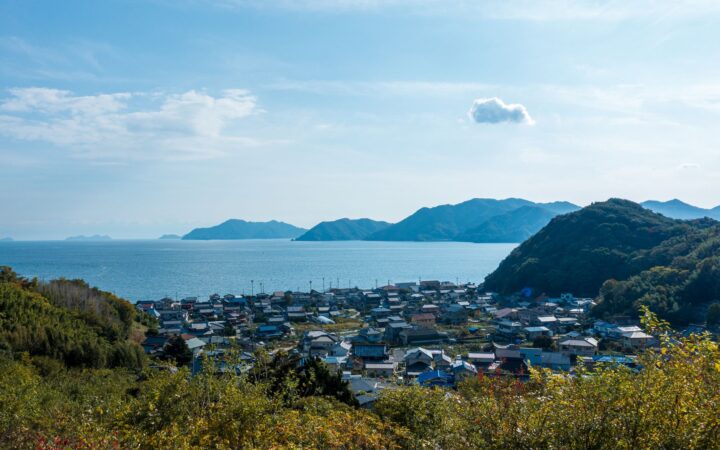
Uwajima faces the Uwa Sea in the far south of Ehime. For most of the Edo period it was ruled by a branch of the Date family of Sendai in northern Japan. The first Uwajima lord, Date Hidemune, arrived in 1615, and the connection to Sendai still shows up today, from the origins of the local fish cake to a Sendai food fair at the town’s market.
For a visitor, Uwajima offers a rare combination in one small town: an original castle keep on a wooded hill, a beautiful daimyo garden, a living tradition of bullfighting that has nothing to do with matadors, and a food culture built on the sea. It is also the gateway to the stone-walled terraced fields of Yusumizugaura and to the slow Yodo Line into Kochi.
Uwajima works as a long day trip from Matsuyama, but it is much better with one night, especially if you combine it with Ozu on the way.
Getting to Uwajima
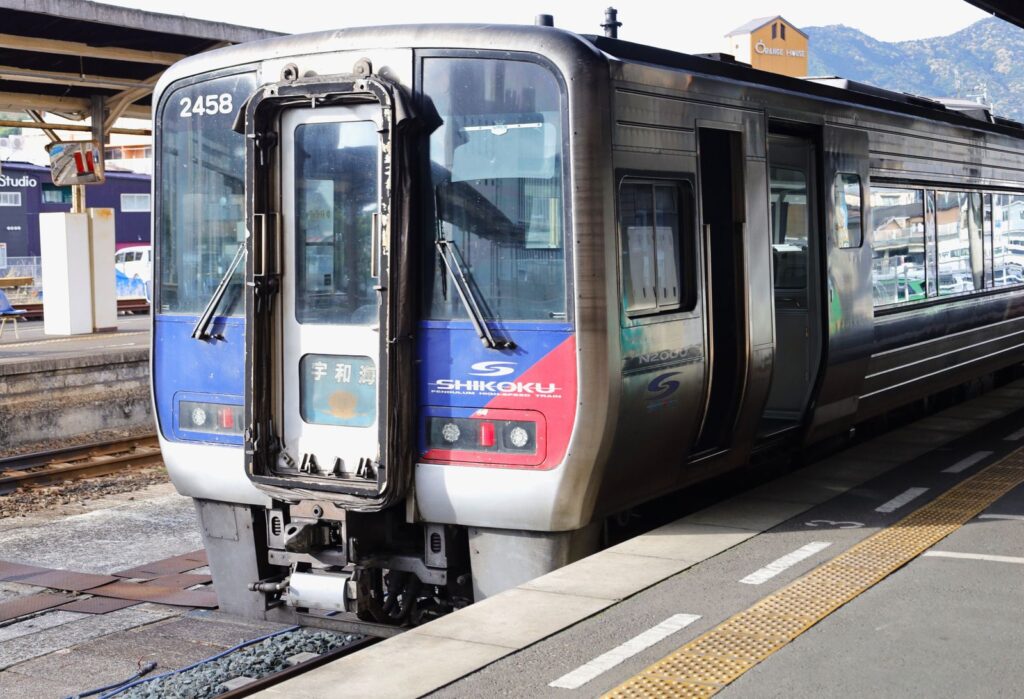
| From | How | Time | Fare (adult) |
|---|---|---|---|
| JR Matsuyama | Limited express Uwakai | About 1 h 20 min | ¥3,210 non-reserved (reserved seat fee ¥1,730 instead of ¥1,200) |
| JR Matsuyama | Local trains only | About 4 h 48 min, 2 changes | ¥2,010 |
| JR Iyo-Ozu | Limited express Uwakai | 46 min | ¥1,840 non-reserved |
| Dogo / Matsuyama | Uwajima Bus (Matsuyama line) | About 2 h – 2 h 20 min to Dogo | Round trip Dogo–Uwajima ¥3,750 (valid 7 days) |
| Osaka | Highway bus (Uwajima Bus and Hanshin Bus) | About 7 h 20 min (one daytime run each way) | ¥9,000 (¥10,500 on busy days) |
| Kochi | Local trains via Kubokawa and the Yodo Line | About 5 h, 1 change | ¥3,400 |
By train from Matsuyama
The limited express Uwakai is the practical choice. The trip takes about 1 hour 20 minutes, with Uwakai trains running through the day. Local trains cost less but take nearly five hours with two changes, so they only make sense if you have a rail pass that does not cover limited expresses. The Japan Rail Pass covers the Uwakai, and so does the ALL SHIKOKU Rail Pass (non-reserved seats), which since October 1, 2026 is sold as a 3-day pass for ¥12,000 or a 7-day pass for ¥20,000. You can buy the ALL SHIKOKU Rail Pass on Klook.
There is no direct airport bus to Uwajima. From Matsuyama Airport, take the limousine bus to JR Matsuyama Station (about 15 minutes), then the Uwakai.
By bus
Uwajima Bus runs about ten round trips a day between Uwajima and Matsuyama, stopping at Ozu, Dogo and central Matsuyama. Its timetable, routes and some stop names changed on October 1, 2026, and the Matsuyama-shi Station stop moved on the same day, so check the current timetable. For Osaka, one daytime highway bus runs each way (Uwajima 8:15 to Osaka 15:36; Osaka 12:45 to Uwajima 19:53); all seats are reserved and tickets go on sale one month ahead. The night service is suspended.
From Kochi on the Yodo Line
The JR Yodo Line runs through the mountains along the Shimanto River between Kubokawa in Kochi and Uwajima, a scenic local line. In autumn 2026, the “Shimanto Torokko” open-air trolley car is attached to one train each way on selected days (October 3, 4, 10–12, 17, 18, 24, 25, 31; November 1, 3, 7, 8, 14, 15, 21–23, 28, 29). After a landslide, the trolley sections were changed “for the time being” from July 18, 2026: the Uwajima 9:34 departure carries the trolley between Hanoke and Tosa-Taisho, and the Kubokawa 13:15 departure between Tosa-Showa and Hanoke. A trolley seat ticket costs ¥530 (child ¥260) on top of the fare and goes on sale one month before at 10:00.
Getting around
The center of Uwajima is small. The castle, Tensha-en and the Date Museum are all within reach of JR Uwajima Station on foot or by a short bus ride, and Kisaiya Hiroba market is about 1 km (around 15 minutes on foot) from the station.
- Uwajima Bus: publishes an English route map (October 2026) showing stops for Uwajima Castle, Tensha-en, Kisaiya Hiroba, Nanrakuen and Mizugaura (for Yusumizugaura). Its smartphone app sells a 3-day pass for all lines except the Osaka highway bus, and you can pay with PayPay through the app.
- Tourist information: the Uwajima City Tourism Information Center “Shiroshita” is at Marunouchi 5-1-4, open 9:00–18:00 daily except over New Year (0895-49-5700).
- By car: Uwajima Asahi IC on the Uwajima Road is right next to Kisaiya Hiroba, which has 228 parking spaces.
Uwajima Castle
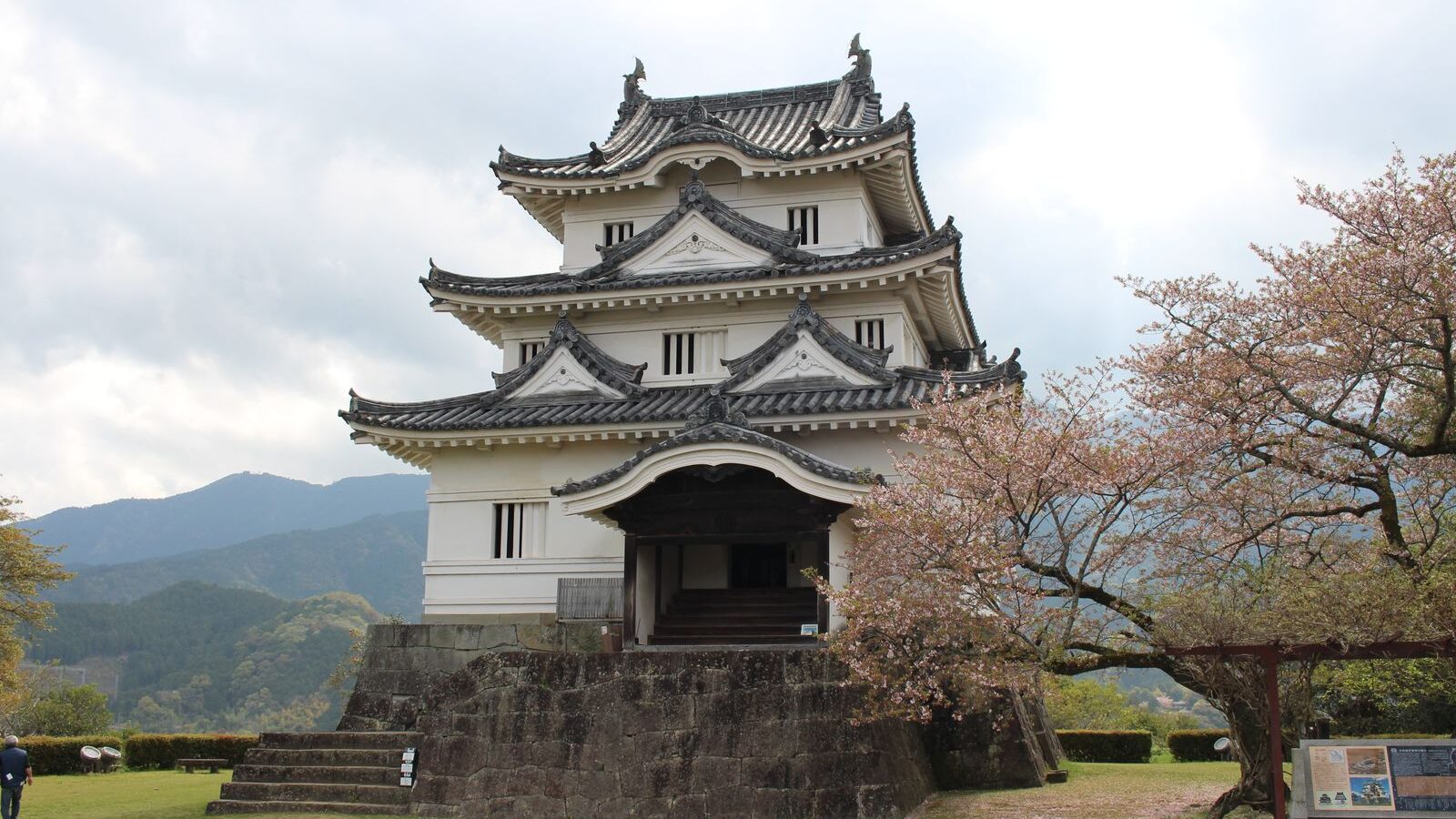
Uwajima Castle is one of only 12 castle keeps in Japan that have survived from the feudal era rather than being rebuilt in modern times. Its keep was designated a national Important Cultural Property in 1934.
The keep
The keep is small and elegant: three tiers and three floors, fully plastered in white, about 15.7 meters from the foundation stones to the ridge. The present keep comes from a rebuild by Date Munetoshi, the second Uwajima lord, around 1666, which replaced an earlier keep built by Todo Takatora around 1601; the city notes that the exact completion year is still being studied. It was repaired in 1860 and fully dismantled and restored between 1960 and 1962. The whole hill, about 73 meters high, has been a national historic site since 1937. Of the seven gates that once lined the south route, only the Noboritachi-mon survives. The keep’s cumulative visitors passed one million in 2025.
| Item | Details |
|---|---|
| Keep admission | Adult ¥200; high school and under free (show proof); age 65+ ¥160 (show ID); disability certificate holders and a helper free. Cash only. |
| Keep hours | March–October 9:00–17:00; November–February 9:00–16:00; open all year (may close in typhoons or severe weather) |
| Castle grounds | Free; March–October 6:00–18:30, November–February 6:00–17:00 |
| Shiroyama Kyodokan (former storehouse) | Free; same hours as the keep |
| Night light-up | The keep is lit from sunset to 22:00 |
| Parking below the castle | 24 hours, ¥100 per hour, 46 cars |
Path closures in 2026
Check the route before you climb. After a slope collapse, the south path from the Noboritachi-mon gate was closed on July 4, 2026. Since August 1, 2026 the section from Noboritachi-mon to the Shiroyama Kyodokan has reopened, but the section from Noboritachi-mon to the children’s park remains closed with no end date announced. The north entrance, through a samurai row-house gate, is being renovated in 2026: cars cannot enter, but walkers can still climb by a detour to the right of the entrance. Wear comfortable shoes for the climb up the hill.
For “100 Fine Castles” collectors: the stamp is at the castle, and since April 2025 it is also available at the “Shiroshita” tourist center, but only for visitors who cannot climb, such as people with disabilities.
Tensha-en garden and the Date Museum
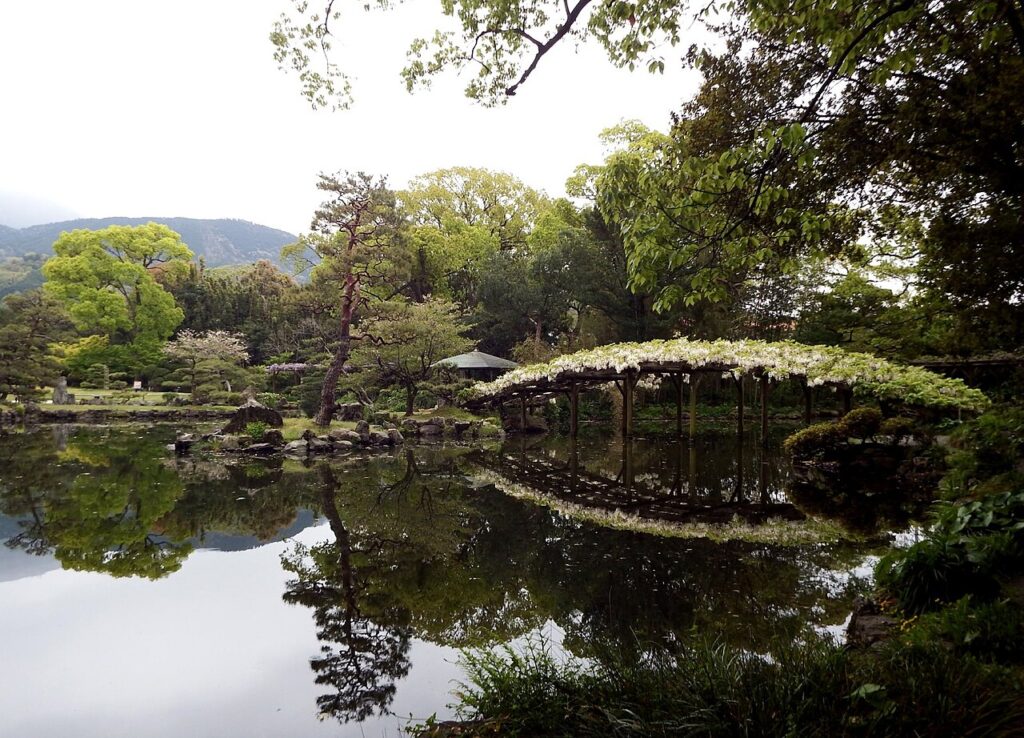
Tensha-en
Tensha-en was built by Date Munetada, the seventh Uwajima lord, as his retirement garden. It is a pond-stroll garden, designed to be walked around, and was designated a national Place of Scenic Beauty in 1968. It is best known for wisteria: six wisteria trellises bloom in April, including a famous white wisteria on a trellis over an arched bridge. In early to mid June, about 20 varieties of Edo-type irises, collected by the ninth lord, are in flower.
- Hours: April–June 8:30–17:00; July–March 8:30–16:30.
- Closed: Mondays from the second Monday of December to the end of February (the next day if Monday is a holiday), and December 28 to January 1.
- Admission: adult ¥500; high school students and those 65 and over ¥300; junior high ¥200; elementary ¥100; preschool free.
- Getting there: about 10 minutes by bus from JR Uwajima Station to the “Uwajima Jidosha / Higashi Koko-mae” stop, then a 3-minute walk. Free parking for 30 cars.
The Uwajima Date Museum
The museum displays the collections of the Uwajima Date family. It is open 9:00–17:00 (last entry 16:30) and closed on Tuesdays and from December 29 to January 3, plus a few days around exhibition changes; the city has changed its closing days, so check the calendar on its website before you go. Admission is ¥500 for adults (university students and those 65 and over ¥400; high school students and younger free). The current exhibition, on the ninth lord Date Munenori, runs from September 5, 2026 to January 18, 2027.
Plan ahead if you are coming next year: the museum will close for rebuilding from March 29, 2027 for about a year, and a new museum is planned to open in spring 2028.
The Sendai connection
Once you know that Uwajima was a Date town, you start to see the family everywhere. The first lord, Date Hidemune, came from Sendai in 1615, and local history credits him with bringing the kamaboko makers whose craft became jakoten. The seventh lord built Tensha-en, the ninth lord collected the Edo-type irises that still bloom there in June, and the Date Museum is devoted to the family’s collections; its exhibition on that ninth lord, Date Munenori, runs until January 18, 2027. Even the town market keeps the link alive, with a Sendai Fair at Kisaiya Hiroba from October 21, 2026.
The three-site pass
A pass for the castle keep, the Date Museum and Tensha-en costs ¥700 instead of ¥1,200 separately and is valid for one month from purchase. Each site gives you a colored stamp, and the five colors stack up into a picture of the castle, a nice souvenir. If you also plan to visit Nanrakuen garden (see “Nearby”), a combined Tensha-en and Nanrakuen ticket costs ¥560 instead of ¥820.
Togyu: Uwajima’s bull sumo
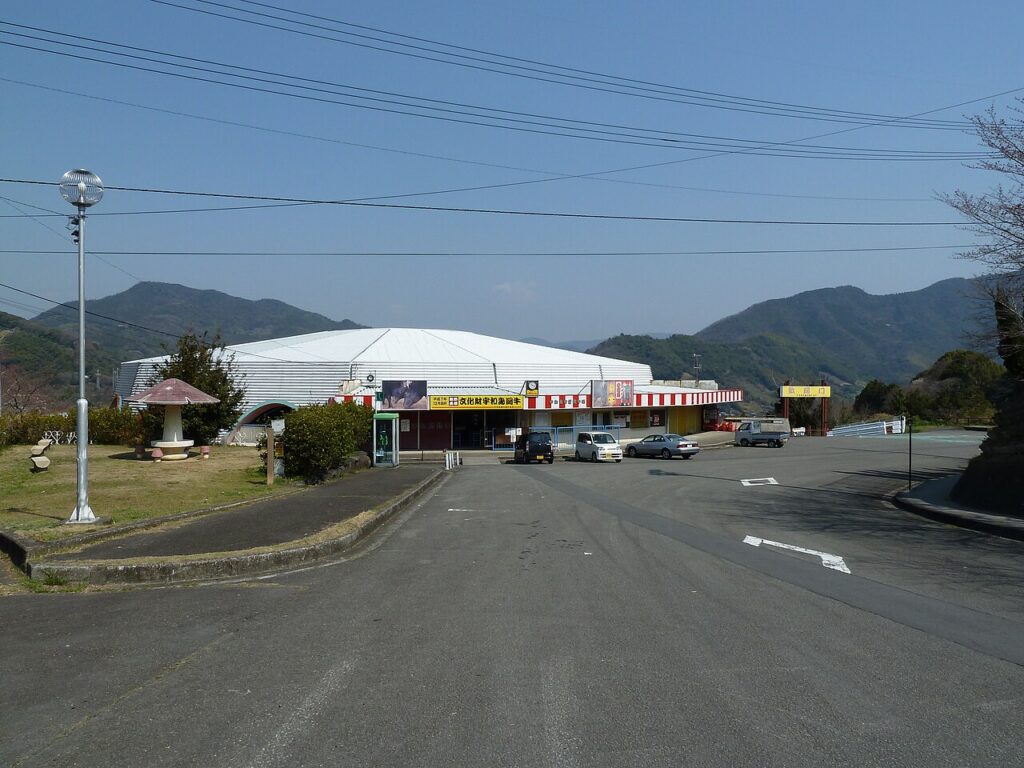
Uwajima’s togyu is often called “bull sumo”, and that is a better description than “bullfighting”. There are no matadors. Two bulls of the same rank, from maegashira up to yokozuna like sumo wrestlers, lock heads and horns and push. There is no time limit, and the bull that turns and runs away loses. Handlers called seko stay beside each bull and urge it on, and in Uwajima the handlers are swapped during a bout. Bulls weighing more than a tonne are now common, and the ring was widened from 16 to 20 meters in 1991.
A short history
According to local tradition, in the late 17th century fishermen from Fukuura rescued a drifting Dutch ship and were given two bulls in thanks, which happened to fight. Bouts in a ring were held by the early 1800s, and a document from 1856 complains of how often they took place. Togyu was at its peak in the Taisho and early Showa eras, was banned by the occupation authorities in 1948, stopped as a regular event after 1955 and was revived in 1959. The all-weather domed arena on Maruyama hill was completed in 1975.
When tournaments are held
Regular tournaments are held only a few times a year. In 2026 they were on January 2 (New Year), May 3, July 23 (during the Warei Taisai festival) and October 25 (autumn). The pattern has been the same in recent years: January 2, May 3, July 23 or 24, and an autumn tournament in late October. The 2027 dates had not been announced as of October 2026, so check the official togyu site before planning a trip around it. It has English pages under the name “Bull sumo of Uwajima”, including a mini guide and an access map.
Tickets and getting there
- Prices (2026): adults and high school students ¥2,500 in advance or ¥3,000 on the day; junior high and under free.
- Where to buy: advance tickets go on sale about a month before at FamilyMart convenience stores and local outlets, including the arena, the tourism association and Kisaiya Hiroba, until the day before. Tickets at the gate are cash only.
- On the day (autumn 2026 example): gates opened at 10:00 and bouts ran from about 12:00 to 14:00. All seats are unreserved.
- Shuttle: on tournament days a free shuttle runs every 30 minutes from 10:00 to 12:00 from the Uwajima Bus Center and from the Uwajima Jidosha office in front of JR Uwajima Station (about 15 minutes), with return runs after the event.
- Parking: about 250 temporary spaces, which can fill; roadside parking is strictly forbidden.
Taimeshi, jakoten and Uwajima food
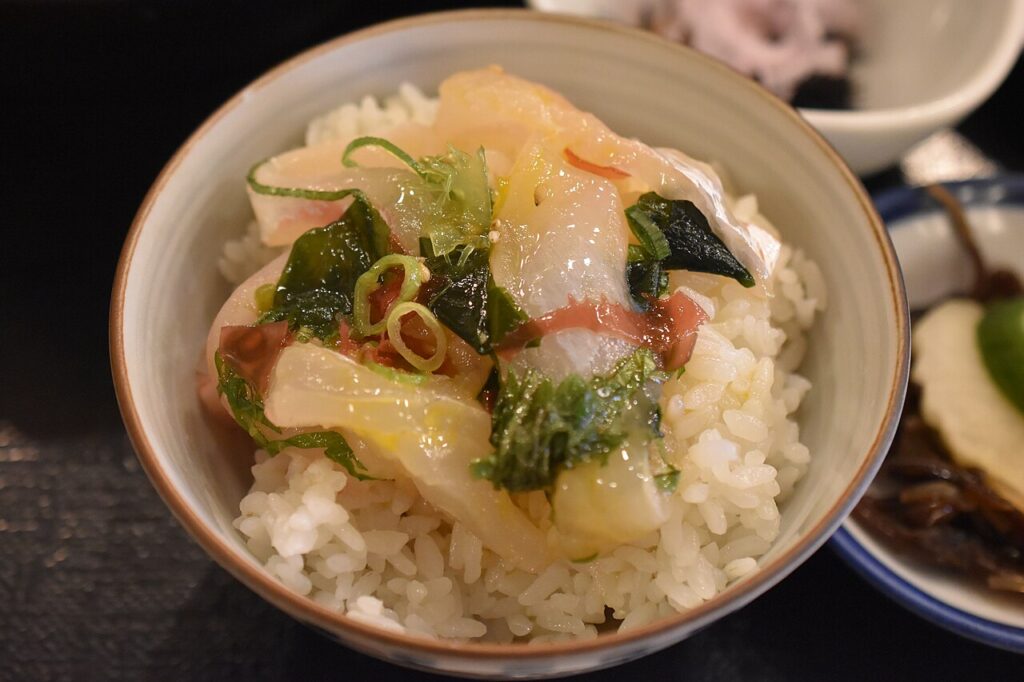
Uwajima taimeshi
Ehime has two very different dishes called taimeshi. In Matsuyama and the north of the prefecture, it means a whole sea bream cooked with the rice. In Uwajima and the south, it means slices of raw sea bream soaked in a sauce of soy sauce, mirin, egg, sesame and dashi, then poured, sauce and all, over hot rice. According to Japan’s agriculture ministry, it began as a fishermen’s meal eaten on boats where they could not light a fire, and it was often made with horse mackerel, with the sea-bream version called taimeshi.
This is the taimeshi I grew up with, and if you only try one dish in Uwajima, make it this one.
Jakoten
Jakoten is a fried fish cake made from small fish ground up with their skin and bones, mixed with flour, egg and salt and deep-fried. It is a specialty of southern Ehime, including Uwajima and Yawatahama. Local history traces it to 1615, when the first lord, Date Hidemune, brought kamaboko makers with him from Sendai. Locals put jakoten in oden, and even make “tempura curry” with jakoten instead of meat. Buy it freshly fried at the market.
Fukumen and tai-somen
Two celebration dishes from the Uwajima domain are worth knowing. Fukumen is thinly cut konnyaku completely covered (“masked”) with colored toppings, traditionally pink fish flakes for spring, green onion for summer, mikan peel for autumn and white fish flakes for winter; it is served at weddings, longevity celebrations and New Year. Tai-somen, sea bream served with somen noodles, is another festive dish often served alongside it.
Where to eat
The Uwajima City Tourism Association lists these places for taimeshi: Kaisen Kappo Isshin, Kadoya (the main shop near the station and the Bentencho shop), Shokudokoro Tomiya, Highway Restaurant Uwajima, Hozumitei, and Wabisuke (at Ebisu-machi and Nanrakuen). Kadoya also serves fukumen, and Ariake and Kadoya serve jakoten. Kadoya’s main shop by the station is open 11:00–14:30 and 17:00–21:00 (dinner only on Thursdays); Hozumitei is closed on Sundays. Kadoya, Hozumitei and Wabisuke also have restaurants at Kisaiya Hiroba.
Kisaiya Hiroba market
Kisaiya Hiroba, officially the roadside station “Minato Oasis Uwajima”, is the best place to try and buy local food in one stop. It is open 9:00–18:00 (restaurants 10:30–16:30, last order 16:00) and closed only on January 1, and its toilets are open 24 hours.
- Where: about 1 km, around 15 minutes on foot, from JR Uwajima Station, next to Uwajima Asahi IC. There is a shuttle bus to the station.
- What is there: a local products center, fresh fish shops, Kawachiya kamaboko with freshly fried fish cakes, restaurants (Kadoya, Hozumitei and Wabisuke), a local-food court, a Royce’ chocolate shop and a bakery. The address is Bentencho 1-318-16.
- Payment: cards and PayPay are accepted.
- Events: the market holds regular fairs; in autumn 2026 these include a Sendai Fair from October 21, a nod to the Date family’s roots.
The Ushi-oni Festival
Uwajima’s biggest festival is the Warei Taisai, the festival of Warei Shrine, held every year from July 22 to 24 and better known for its ushi-oni, demon-bull floats. The 2026 festival, the 60th, followed the usual pattern: fireworks over Uwajima Bay on the evening of July 22 (about 7,000), a togyu tournament on July 23, and on July 24 the ushi-oni parade and the “hashirikomi”, when men race into the Suka River. Free festival shuttles ran on the 23rd and 24th. If you are in Shikoku in late July, it is worth planning around; book accommodation early.
Planning your trip? Get our free 7-Day Japan Itinerary (PDF)
Get the free guide →Nearby: terraced fields and a great garden
Yusumizugaura terraced fields
On a peninsula in the Uwa Sea, within Uwajima City, the hillsides at Yusumizugaura are covered in stone-walled terraces rising to about 80 meters, built for growing potatoes. They were designated a national Important Cultural Landscape in 2007. The best time is mid-March, before the spring potato harvest, and viewing is free at any time. Uwajima Bus runs to the “Mizugaura” stop, a minute’s walk away, and there is free parking for about 20 cars. The local NPO’s café, Dandan Chaya, is open on weekends and holidays from 11:00 to 14:00 (drinks until 15:00; on weekdays only for groups of 10 or more with a reservation), and its shop, Dandan-ya, opens 10:00–14:00 except Mondays and Thursdays (0895-62-0091). Every April a “Dandan Matsuri” is held on the shore below the terraces.
Nanrakuen
Nanrakuen, in the Tsushima area of Uwajima City, is a 15.3-hectare pond-stroll Japanese garden, described as one of the largest in Shikoku. It is open 9:00–17:00 (closed December 29 to January 1); admission is ¥320 for adults and ¥160 for children. In 2026 its iris festival ran from May 16 to June 7 with about 30,000 plants, plum blossoms come around mid-February, and wheelchairs and strollers are lent free. By car it is about 6 minutes from Tsushima-Iwamatsu IC.
Up the line
- Ozu: 46 minutes north by limited express, a castle town with a wooden keep rebuilt in 2004, the villa Garyu Sanso and an old merchant quarter. See our Ozu guide.
- Uchiko: just beyond Ozu, a preserved street of wax merchants’ houses; see our Uchiko guide.
- Matsuyama and Dogo Onsen: 1 hour 20 minutes north; see our Matsuyama guide and Dogo Onsen guide.
- Kochi: south and east via the Yodo Line; see our Kochi guide and Shimanto River and Cape Ashizuri guide.
Uwajima through time
These dates explain most of what you will see in town.
| Year | What happened |
|---|---|
| Around 1601 | Todo Takatora builds a keep on the castle hill. |
| 1615 | Date Hidemune arrives as the first Uwajima lord and, according to local history, brings kamaboko makers from Sendai, the origin of jakoten. |
| Around 1666 | The second lord, Date Munetoshi, rebuilds the keep; this is the keep that stands today. |
| Late 1600s | By local tradition, Fukuura fishermen rescue a Dutch ship and are given two bulls, the legendary start of togyu. |
| 1801–1804 | Bullfights in a ring are recorded. |
| Edo period | The seventh lord, Date Munetada, builds Tensha-en as his retirement garden. |
| 1860 | The castle keep is repaired. |
| 1934 / 1937 | The keep becomes a national Important Cultural Property; the whole castle hill becomes a national historic site. |
| 1948 / 1959 | Togyu is banned under the occupation, then revived after a break. |
| 1960–1962 | The keep is fully dismantled and restored. |
| 1968 | Tensha-en becomes a national Place of Scenic Beauty. |
| 1975 | The domed togyu arena on Maruyama hill is completed. |
| 2007 | Yusumizugaura’s terraced fields become a national Important Cultural Landscape. |
| 2027–2028 | The Date Museum closes from March 29, 2027 for rebuilding; a new museum is planned for spring 2028. |
Uwajima through the year
| When | What to see |
|---|---|
| January 2 | New Year togyu tournament (in recent years) |
| Mid-February | Plum blossoms at Nanrakuen |
| Mid-March | Yusumizugaura terraced fields at their best, before the potato harvest |
| April | Wisteria at Tensha-en; “Dandan Matsuri” below the Yusumizugaura terraces |
| May 3 | May togyu tournament (in recent years) |
| Mid-May to early June | Iris festival at Nanrakuen (May 16 – June 7 in 2026) |
| Early to mid June | Irises at Tensha-en |
| July 22–24 | Warei Taisai and the Ushi-oni Festival, with a togyu tournament on July 23 (2026) |
| Late October | Autumn togyu tournament (October 25 in 2026) |
| October–November | Shimanto Torokko trolley car on the Yodo Line on selected days |
| Winter | Quiet streets; Tensha-en closes on Mondays from mid-December to February |
Where to stay
Uwajima has hotels around JR Uwajima Station and the town center, which is where you want to be for the castle, the restaurants and the trains. One night here lets you see the castle lit up in the evening, eat taimeshi for dinner, and do Tensha-en or the terraced fields the next morning before moving on. If you prefer a bigger base, stay in Matsuyama or in a restored townhouse in Ozu and come down for the day. To compare options, check hotels in Uwajima and Matsuyama on Agoda.
Sample itineraries and costs
A long day from Matsuyama
- Early Uwakai from Matsuyama (about 1 hour 20 minutes).
- Uwajima Castle in the morning (check which paths are open).
- Taimeshi for lunch near the station.
- Tensha-en and the Date Museum with the ¥700 three-site pass (remember the museum closes on Tuesdays).
- Kisaiya Hiroba for jakoten and souvenirs, then the train back.
Two days: Ozu and Uwajima
- Day 1: Matsuyama to Ozu (34 minutes); castle, Garyu Sanso and the old town; continue to Uwajima (46 minutes) and stay the night.
- Day 2: Uwajima Castle in the morning, Tensha-en, taimeshi lunch, Kisaiya Hiroba, then back to Matsuyama.
For a togyu tournament
Arrive the day before, buy an advance ticket at a FamilyMart or Kisaiya Hiroba, and take the free shuttle on the morning of the tournament. Spend the afternoon at the castle and the garden.
What a day costs
| Item | Price (adult) |
|---|---|
| Uwakai Matsuyama ⇄ Uwajima (non-reserved) | ¥6,420 round trip |
| Three-site pass (castle keep, Date Museum, Tensha-en) | ¥700 |
| Togyu tournament (if held that day) | ¥2,500 advance / ¥3,000 on the day |
| Nanrakuen (optional) | ¥320 |
| Yusumizugaura terraced fields | Free |
With an ALL SHIKOKU Rail Pass, the train is covered and a day in Uwajima costs little more than the ¥700 pass and lunch. Remember that the castle keep and togyu gate tickets are cash only, so carry some yen.
Practical information
On a rainy day
Uwajima is a good town for bad weather. The Date Museum is indoors, the togyu arena has been an all-weather domed building since 1975, and Kisaiya Hiroba has shops, restaurants and a food court under one roof. The Shiroyama Kyodokan storehouse at the castle is free and indoors too, though the walk up the hill is not. Save Tensha-en and the terraced fields for a dry day.
- Cash: the castle keep (and its goshuin stamp) and togyu gate tickets are cash only. Kisaiya Hiroba takes cards and PayPay.
- Tourist information: “Shiroshita”, Marunouchi 5-1-4, 9:00–18:00 (0895-49-5700).
- Closing days to watch: the Date Museum on Tuesdays; Tensha-en on Mondays in winter; Kisaiya Hiroba only on January 1.
- Weather: the castle keep may close in typhoons or severe weather.
- Phone data: buses, timetables and maps are easier with data; Airalo’s Japan eSIM installs before you fly.
- Language: English is less common than in big cities, so a few words help; see our essential Japanese phrases. A few phrases for Uwajima are below.
Useful phone numbers
| Place | Phone |
|---|---|
| Uwajima City Tourism Information Center “Shiroshita” | 0895-49-5700 |
| Uwajima Date Museum | 0895-22-7776 |
| Tensha-en | 0895-22-0056 |
| Kisaiya Hiroba | 0895-22-3934 |
| Uwajima Kanko Togyu Kyokai (weekdays) | 0895-25-3511 |
| Uwajima Bus highway bus reservations | 0895-22-0002 |
Uwajima Bus sells highway-bus seats from one month before travel, from 9:00 at the counter or by phone and from 12:00 online. Shimanto Torokko seat tickets can also be bought ticketless through JR West’s “e5489” service.
Families and accessibility
- Free for young people: high school students and younger enter the castle keep and the Date Museum free; junior high students and younger watch togyu free; preschoolers enter Tensha-en free.
- Disability certificates: holders and a helper enter the castle keep and the Date Museum free, and get a discount on togyu tickets.
- If you cannot climb the castle hill: the “100 Fine Castles” stamp is available at the Shiroshita tourist center for visitors who cannot make the climb. The castle grounds are a hill walk, and there is a paid car park below.
- Gardens: Nanrakuen lends wheelchairs and strollers free of charge.
- Breaks: Kisaiya Hiroba’s toilets are open 24 hours, and its food court is an easy stop with children.
Useful Japanese in Uwajima
| Japanese (romaji) | Meaning |
|---|---|
| Taimeshi o hitotsu kudasai. | One taimeshi, please. |
| Jakoten wa arimasu ka? | Do you have jakoten? |
| Uwajima-jo wa dochira desu ka? | Which way is Uwajima Castle? |
| Tougyu-jou made no basu wa doko desu ka? | Where is the bus to the togyu arena? |
| Genkin dake desu ka? | Is it cash only? |
| Oishikatta desu. | That was delicious. |
Frequently asked questions
Is Uwajima worth visiting? Yes, if you want to see a different side of Shikoku. It has an original castle keep, a fine daimyo garden, a unique form of bull sumo and some of the best seafood dishes in Ehime, with very few crowds.
How do I get from Matsuyama to Uwajima? Take the JR limited express Uwakai: about 1 hour 20 minutes and ¥3,210 with a non-reserved seat. It is covered by the Japan Rail Pass and the ALL SHIKOKU Rail Pass.
Is Uwajima Castle an original castle? Yes. Its keep is one of the 12 in Japan that survive from the feudal era, and it is a national Important Cultural Property. The present keep dates from a rebuild around 1666.
How much does Uwajima Castle cost? ¥200 for adults (cash only); high school students and younger are free. The castle grounds are free. A ¥700 pass also covers the Date Museum and Tensha-en.
Is the Uwajima Castle path open? Partly. Since a slope collapse in July 2026, the section of the south path from the Noboritachi-mon gate to the children’s park has been closed; the section to the Shiroyama Kyodokan reopened on August 1. The north entrance is being renovated but walkers can climb by a detour.
What is togyu? A form of bullfighting in which two bulls push each other head to head until one turns away. There are no matadors, and the bulls are ranked like sumo wrestlers. Tournaments are held only a few times a year.
When is the next bullfighting tournament in Uwajima? In recent years tournaments have been held on January 2, May 3, July 23 or 24 and in late October. The 2027 dates had not been announced as of October 2026; check the official togyu website.
What is the difference between Uwajima taimeshi and Matsuyama taimeshi? Uwajima taimeshi is raw sea bream in a sauce of soy sauce, mirin, egg, sesame and dashi poured over hot rice. Matsuyama-style taimeshi is a whole sea bream cooked with the rice.
Is the Date Museum open? Yes, until March 28, 2027. It then closes for about a year for rebuilding, with a new museum planned for spring 2028. It is closed on Tuesdays.
Where can I buy jakoten in Uwajima? Kisaiya Hiroba, the market about 15 minutes on foot from JR Uwajima Station, has Kawachiya kamaboko frying jakoten fresh, along with fish shops and a local products center. The tourism association also lists Ariake and Kadoya for jakoten.
How long do I need in Uwajima? One full day covers the castle, Tensha-en, the Date Museum, a taimeshi lunch and Kisaiya Hiroba. Add a night if you want to see the castle lit up, visit the terraced fields at Yusumizugaura, or catch a togyu tournament.
Is there an airport bus to Uwajima? There is no direct airport bus. From Matsuyama Airport, take the limousine bus to JR Matsuyama Station (about 15 minutes), then the limited express Uwakai to Uwajima (about 1 hour 20 minutes).
Plan the rest of your trip
- Ozu travel guide
- Matsuyama and Ehime travel guide
- Dogo Onsen guide
- Shikoku 88 pilgrimage guide
- Kochi travel guide
- Shimanami Kaido cycling guide
- Is the Japan Rail Pass worth it?
- Shikoku itinerary: 5 to 7 days
- Imabari travel guide
Sources: Uwajima City official site (castle, Date Museum, cultural properties, notices); Uwajima City Tourism Association; official Uwajima togyu site; Ehime Prefecture tourism site (iyokannet); Ministry of Agriculture, Forestry and Fisheries “Uchi no Kyodo Ryori” (taimeshi, jakoten, fukumen); Kisaiya Hiroba; Nanrakuen; Warei Taisai official site; JR Shikoku (Shimanto Torokko) and timetables via route search; Uwajima Bus (checked October 2026). Prices and hours change; if you spot something out of date, please let us know.
Going to Japan? Speak Japanese with confidence.
Hirameki Japanese — camera translate for menus and signs, a two-way conversation mode, and furigana + romaji on every phrase. Free to download with kana charts, conversation mode and starter words; a one-time purchase unlocks everything.

Plan your Japan trip
Two things every first-timer should book
Some links are affiliate links. If you book through them we may earn a small commission at no extra cost to you.