Perched on a forested cliffside in the heart of Yamagata Prefecture, Yamadera is one of the most spectacular temple complexes in all of Japan — and one that surprisingly few first-time visitors ever reach. The name literally means “mountain temple,” and that is exactly what you get: a string of small wooden halls, gates, and lookout points scattered up a steep, rocky hillside, connected by a winding stone staircase of more than a thousand steps. Climb to the top and you are rewarded with a view over a green river valley that has barely changed in centuries.
This guide is written for travelers visiting Yamadera for the first time. It covers the full history of the temple, a stage-by-stage walkthrough of the climb, exact costs and opening hours, the best seasons to go, detailed transport directions from Tokyo and Sendai, where to stay nearby, what to eat, and a generous set of practical tips and frequently asked questions. By the end you will know exactly how to plan a smooth, memorable half-day at one of Tohoku’s greatest treasures.
Why Visit Yamadera?
Most travelers to Japan follow a well-worn path — Tokyo, Kyoto, Osaka, perhaps Hiroshima — and never venture into the Tohoku region in the north. That is precisely why Yamadera feels so special. Even on a busy autumn weekend it rarely has the crushing crowds of Kyoto’s famous temples. You can climb at your own pace, pause on a quiet landing to catch your breath, and feel as though you have stepped into an older, slower Japan.
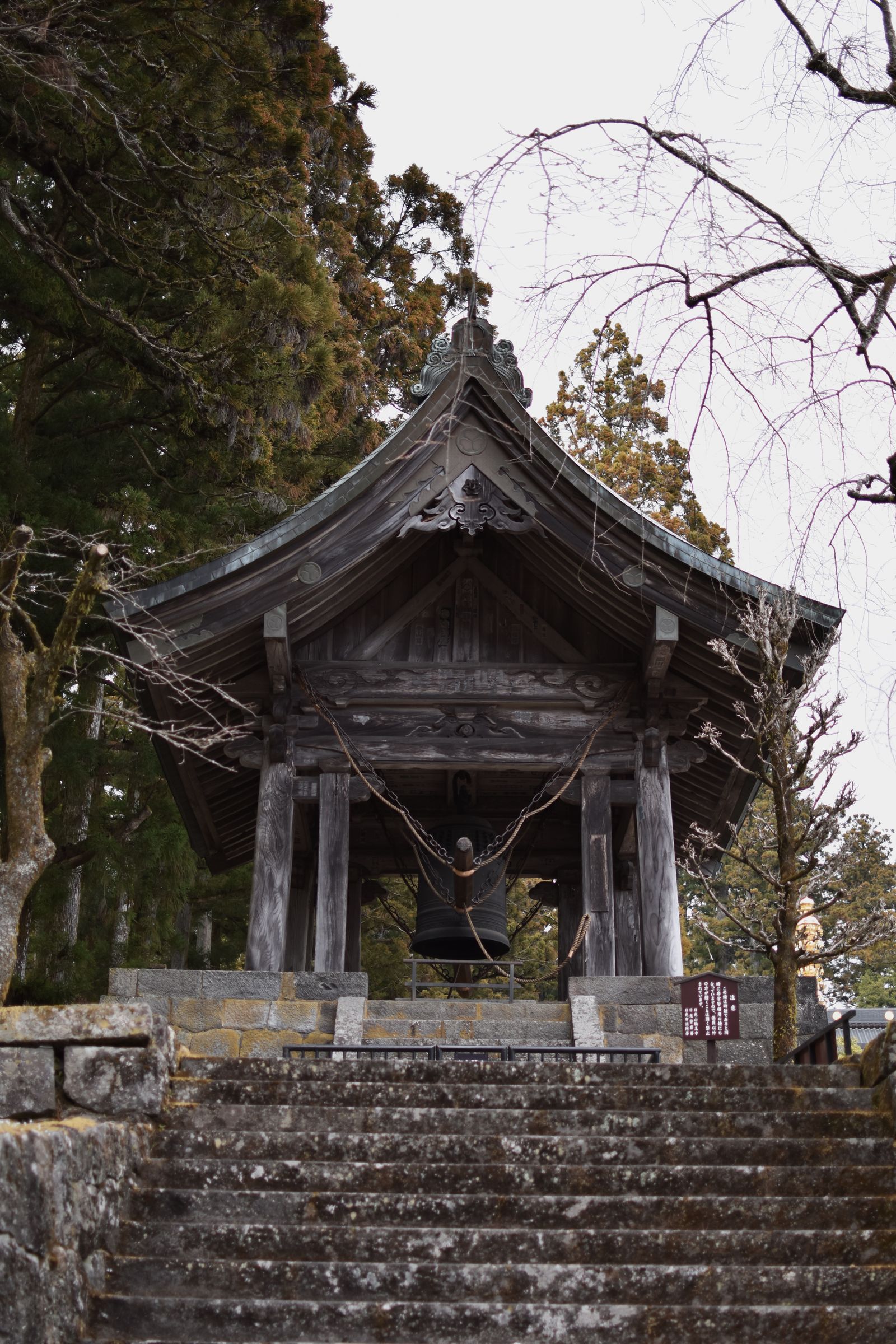
The official name of the temple is Risshaku-ji (立石寺), but almost everyone calls it Yamadera. Founded more than eleven centuries ago, it remains an active site of Tendai Buddhist worship. What makes it unforgettable is the setting. The halls are not arranged neatly on flat ground; instead they cling to ledges and tuck into caves along a cliff of weathered volcanic rock. Cedar trees tower overhead, their roots gripping the stone. As you climb, the city noise of the valley fades and is replaced by birdsong, the crunch of your own footsteps, and the occasional toll of a temple bell.
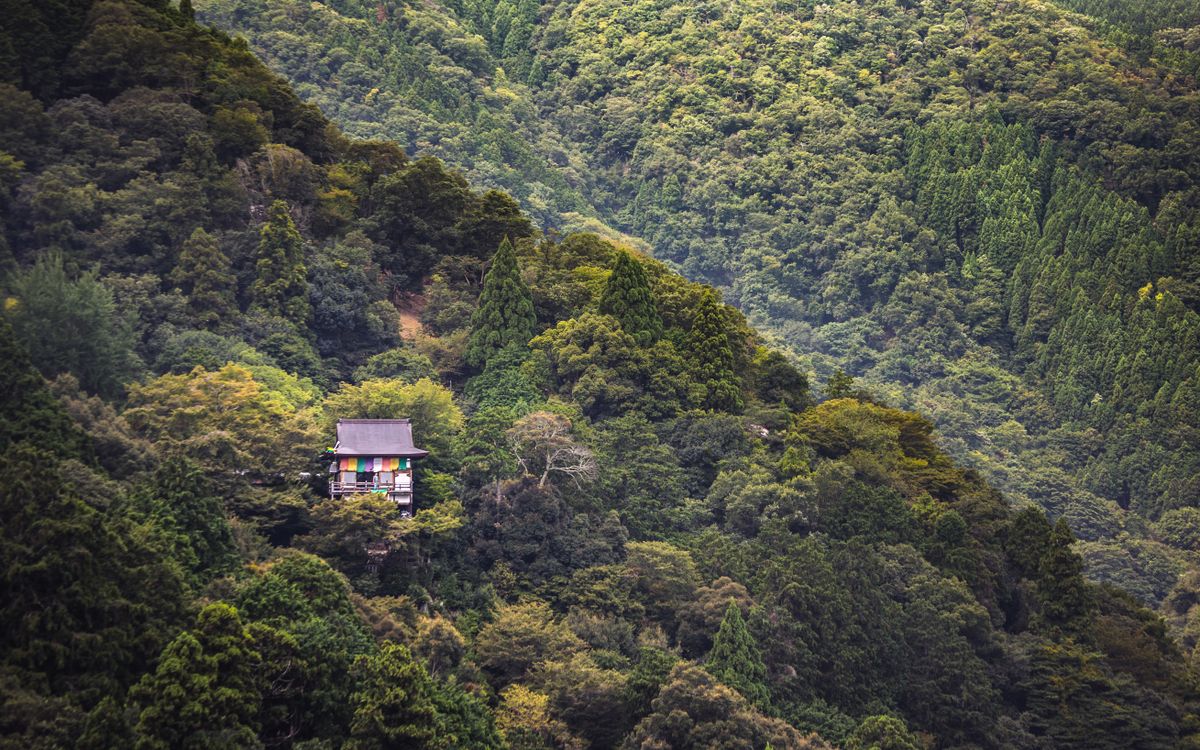
The payoff at the summit is the Godaido Hall, a wooden observation pavilion that juts out over the cliff edge. From its railing you look straight down onto the red roofs of Yamadera village, the silver thread of the Tachiya River, and the wooded ridges rolling toward the horizon. For many visitors this single view justifies the entire trip to Yamagata. It is the kind of scene that photographs beautifully but feels even better in person, with cool mountain air on your face and the satisfaction of a climb well earned.
Yamadera also carries deep literary weight. In 1689 the wandering poet Matsuo Bashō stopped here during his famous journey through the north and composed one of the most quoted haiku in Japanese literature. Walking the same path he walked, past the same mossy stones, adds a quiet layer of meaning that lingers long after you leave.
The History of Risshaku-ji and Bashō’s Famous Haiku
Risshaku-ji was founded in the year 860 by the priest Ennin, known posthumously as Jikaku Daishi, one of the most important figures in the development of Tendai Buddhism in Japan. Ennin had studied in China and returned determined to spread the teachings across the northern provinces. According to temple tradition, a sacred flame was carried here from Enryaku-ji, the great Tendai monastery on Mount Hiei near Kyoto. That flame is said to have been kept burning continuously ever since — more than a thousand years — and you can still see it enshrined within the temple grounds. During periods when Enryaku-ji itself was destroyed by fire and war, the Yamadera flame was reportedly used to relight the mother temple, making this remote mountain sanctuary a guardian of the entire lineage.
Over the centuries the complex grew into a sprawling collection of more than thirty halls and sub-temples spread across the mountainside. It drew pilgrims from across Tohoku who came to pray, to honor their ancestors, and to test their devotion on the long stone climb. The act of ascending the steps is itself considered a form of spiritual practice: with each step, worldly desires are said to fall away, so that the pilgrim arrives at the summit lighter in heart and mind.
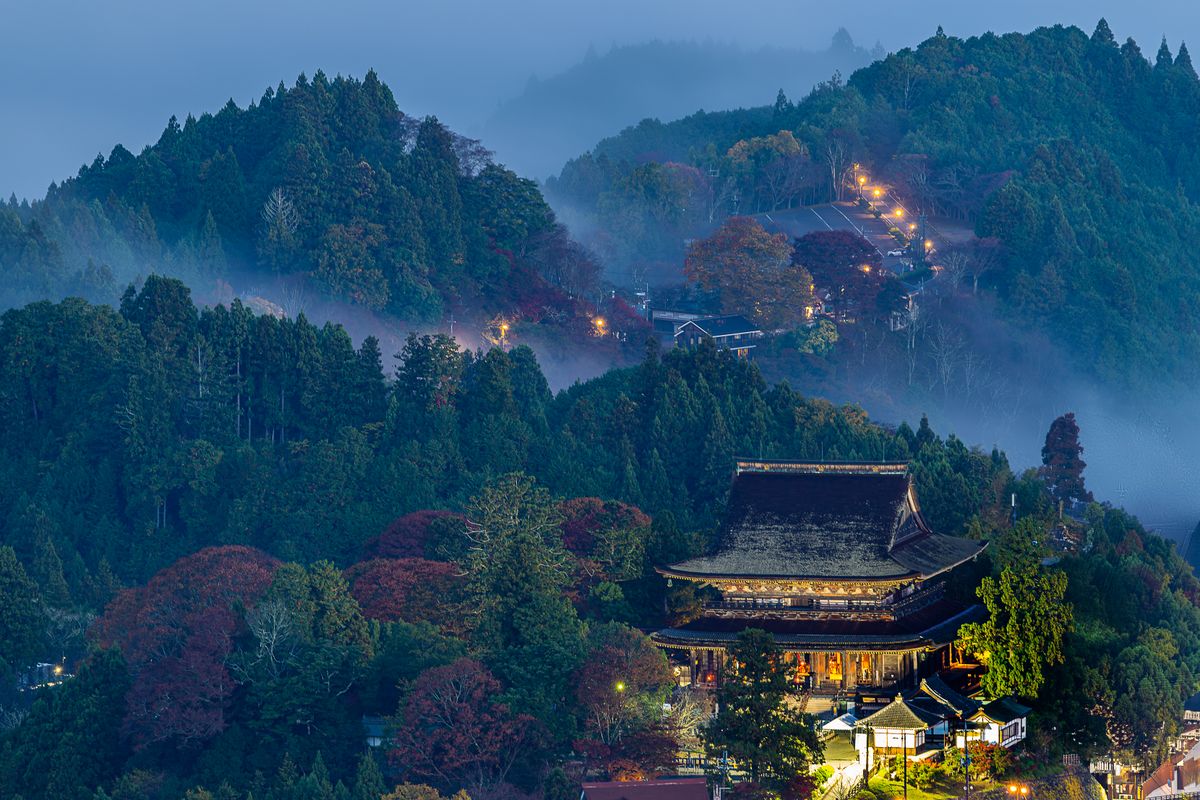
The temple’s place in Japanese culture was sealed in 1689, when the haiku master Matsuo Bashō visited during the journey recorded in his travel diary Oku no Hosomichi (The Narrow Road to the Deep North). Struck by the profound stillness of the mountain, broken only by the shrill song of cicadas, he wrote a verse that Japanese schoolchildren still memorize today. In English it is often rendered as: “Such stillness — the cries of the cicadas sink into the rocks.” Standing on the steps on a warm summer afternoon, with cicadas droning in the cedars and the rock faces radiating heat, you can understand exactly what he meant. A small statue and a stone monument near the entrance commemorate the poet, and following his footsteps up the mountain is part of the pilgrimage for literary-minded travelers.
Understanding this history transforms the climb from a simple hike into something richer. The worn grooves in the stone steps were cut by centuries of pilgrims. The carved Buddhist images and small offerings tucked into rock crevices are the accumulated prayers of generations. Yamadera is not a museum piece; it is a living temple where the past and present quietly coexist.
Climbing the 1,015 Steps: A Stage-by-Stage Guide
The full climb from the base to the upper temple involves roughly 1,015 stone steps and takes most visitors between 40 minutes and an hour and a half one way, depending on fitness and how often you stop. It is steep in places but entirely doable for anyone in reasonable health, including children and active older travelers, as long as you take your time. Wear comfortable shoes with good grip — the stones can be slick after rain or when dusted with snow — and bring a bottle of water, especially in summer.
The journey begins at Konpon Chudo, the main hall at the foot of the mountain. This dignified wooden building, rebuilt in the fourteenth century, houses the eternal flame brought from Mount Hiei. Step inside to pay your respects before you start climbing; it sets a contemplative tone for the ascent. Nearby you will also find the Bashō statue and haiku monument.
From there you pass through the Sanmon Gate, the official entrance to the mountain path and the point where you pay the admission fee. Beyond the gate the real climb begins. The lower section winds gently upward through a forest of towering cedar trees, some of them many hundreds of years old. The temperature drops noticeably under the canopy, and the light filters down in soft green shafts. Along the way you will see Semizuka, a small mound said to mark where Bashō’s cicada haiku was inspired, as well as countless stone lanterns, carved Buddhas, and weathered statues.
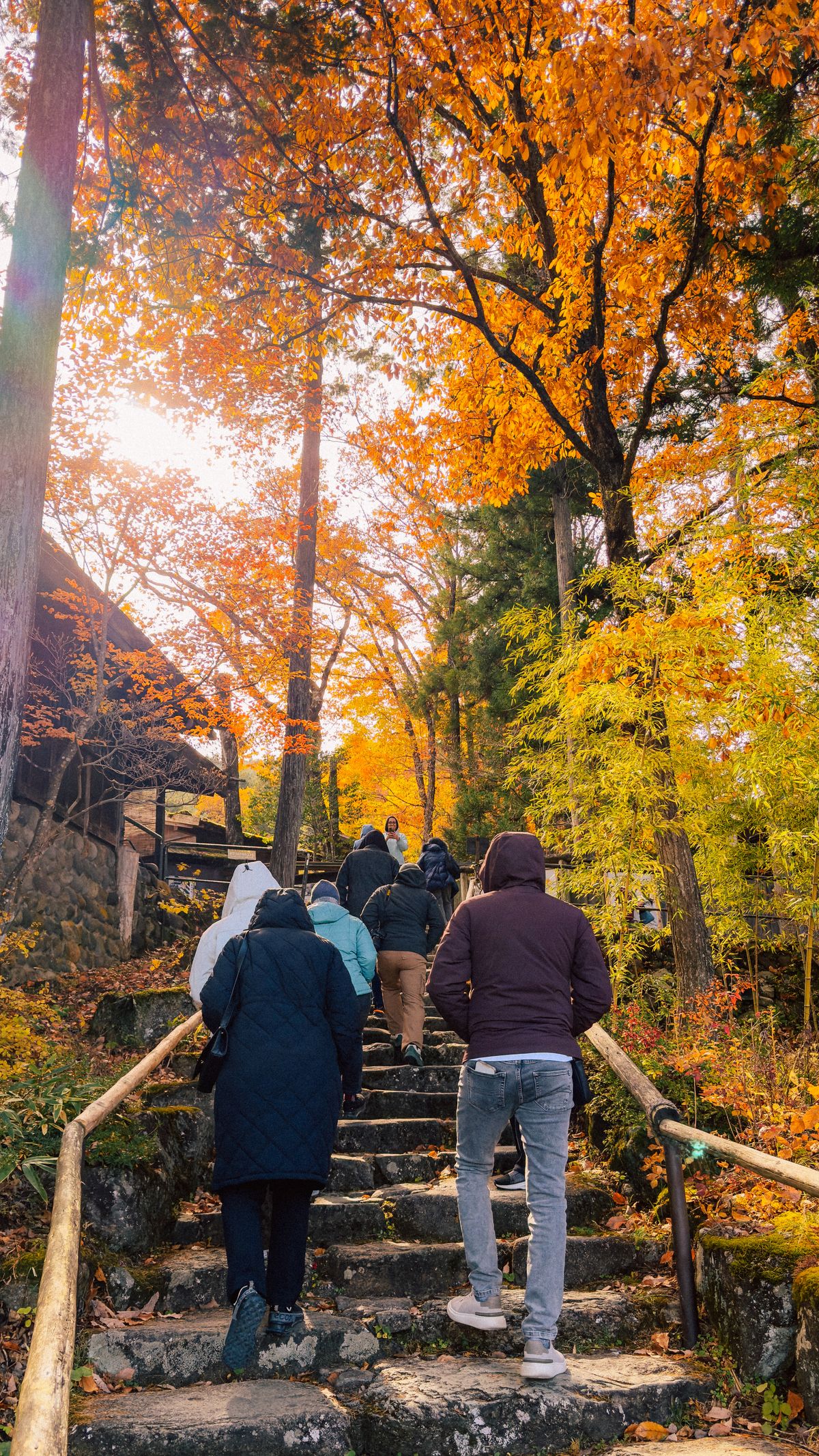
About two-thirds of the way up you reach the Niomon Gate, a striking red-painted gate guarded by fierce-looking statues of the two Nio deities, protectors of the temple. Passing through it feels like crossing a threshold into the most sacred part of the mountain. The cluster of halls here is the heart of the upper complex.
From the Niomon Gate, a short detour to the right brings you to the Kaisando and Nokyodo, two small halls perched dramatically on a rocky outcrop. The Nokyodo, a little red sutra repository balanced on the cliff, is one of the most photographed structures at Yamadera. Continue upward and to the left to reach the famous Godaido Hall, the open-sided observation deck that delivers the postcard view over the valley. This is the natural turning-around point and the spot where most visitors linger longest, taking photos and simply soaking in the panorama.
The highest building, the Okunoin inner sanctuary, sits a little beyond. Reaching it completes the traditional pilgrimage. Take your time on the descent as well — going down the worn, uneven steps can be harder on the knees than going up, and the changing light through the trees gives you a completely different view of the same path.
Costs and Practical Visiting Information
Yamadera is refreshingly affordable, especially compared with the headline attractions of Kyoto and Tokyo. The admission fee to climb the mountain path beyond the Sanmon Gate is ¥300 (about USD 2) for adults and ¥100 (about USD 0.70) for children. The main hall area at the base, Konpon Chudo, charges a small separate fee of around ¥200 (about USD 1.30) if you wish to go inside and see the eternal flame, though you can admire the building from outside for free.
The mountain path is generally open from around 8:00 a.m. to 5:00 p.m., with the last entry roughly an hour before closing. There is no need to book tickets in advance — you simply pay at the gate on the day. Allow a total of two to three hours for a relaxed visit including the climb, time at the top, and the descent. If you want to combine it with the small museums and the Bashō memorial hall in the village below, budget half a day.
Facilities are modest but adequate. There are restrooms near the base and a small one partway up the trail, vending machines selling drinks at the bottom, and a handful of souvenir and snack shops in the village. There are no large lockers at the trailhead, so if you are carrying heavy luggage it is best to use the coin lockers at Yamadera Station or, better still, visit on a day trip with only a small day pack.
For getting around the wider region and staying connected while you navigate train times and maps, a prepaid travel data plan is invaluable in rural Tohoku, where you will rely heavily on your phone for directions and timetables. Many travelers set up a Japan travel eSIM before arrival so they have data the moment they land, with no need to hunt for a physical SIM card or pocket Wi-Fi counter. If you are arriving by air and want a smooth door-to-door start to your trip, a shared airport shuttle service can take you directly from the airport to your hotel without the hassle of dragging suitcases through train stations.
Best Seasons to Visit Yamadera
Yamadera is beautiful year-round, but each season offers a completely different experience, and knowing what to expect will help you plan.
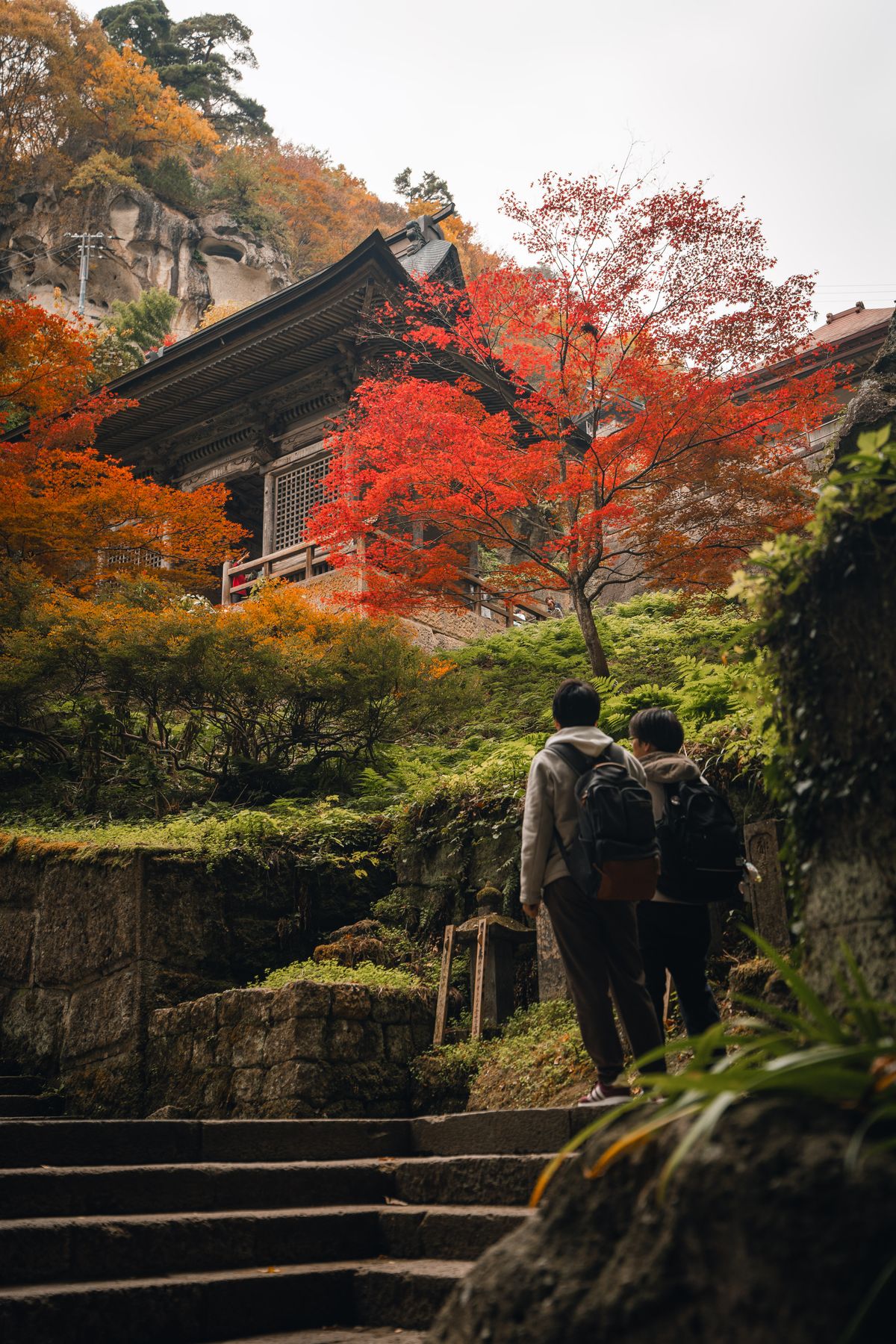
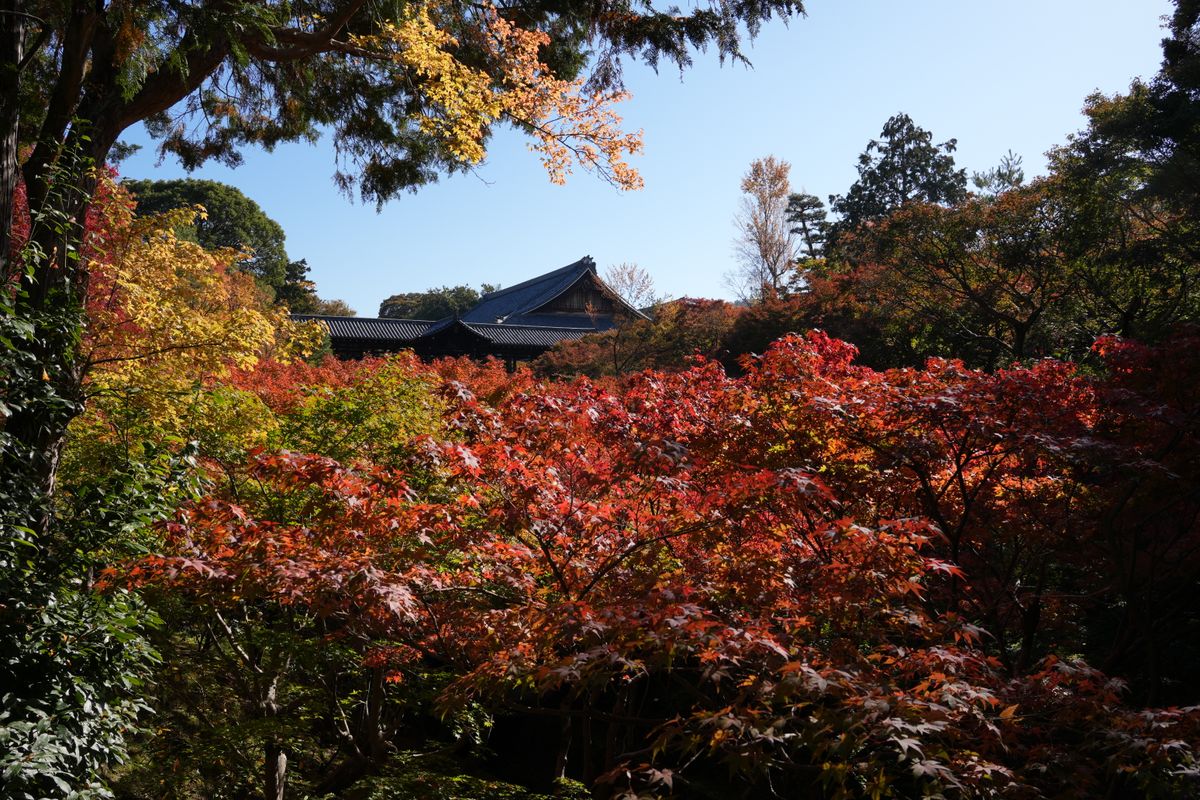
Autumn (mid-October to mid-November) is widely considered the most magnificent time to visit. The maples and other broadleaf trees on the mountainside turn brilliant shades of crimson, orange, and gold, framing the dark wooden halls and gray rock in a blaze of color. This is peak season for Japanese visitors too, so expect more company on the steps, especially on weekends, but the spectacle is worth it. Aim for a weekday morning to enjoy the foliage with thinner crowds.
Winter (December to February) turns Yamadera into a hushed, monochrome wonderland. Snow blankets the rooftops and steps, and the bare branches reveal views that the summer foliage hides. It is genuinely magical, but you must take great care: the stone staircase becomes icy and slippery, sturdy waterproof boots are essential, and some upper sections may occasionally be closed for safety. The reward is a temple that feels almost entirely your own, wrapped in silence and falling snow.
Spring (April to May) brings fresh green leaves and, in mid to late April, cherry and plum blossoms in the valley. The weather is mild and comfortable for climbing, and the crowds are lighter than in autumn. Summer (June to August) is lush and green, with the cedar canopy providing welcome shade — and, of course, the cicadas that inspired Bashō. Summer days can be hot and humid, so start early, carry plenty of water, and pace yourself on the climb.
How to Get to Yamadera
One of Yamadera’s great advantages is how easy it is to reach by train, despite its remote mountain feel. The temple has its own station, Yamadera Station, on the JR Senzan Line, and the trailhead is only a five-to-ten-minute walk from the platform — you can actually see the temple halls on the cliff as your train pulls in.
From Sendai, the largest city in Tohoku, the journey is wonderfully simple: local trains on the JR Senzan Line run directly to Yamadera in about 55 to 70 minutes and cost roughly ¥860 (about USD 6) each way. This makes Yamadera one of the most popular and rewarding day trips from Sendai. From Yamagata City, the prefectural capital, it is even closer — about 15 to 20 minutes by local train on the same line, costing around ¥240 (about USD 1.60).
Coming from Tokyo, the fastest route is to take the Yamagata Shinkansen (the Tsubasa service) directly to Yamagata Station — a journey of about two hours and forty minutes — and then transfer to a local Senzan Line train for the final short hop to Yamadera. Alternatively, you can take the Tohoku Shinkansen to Sendai and connect to the Senzan Line there. If you plan to explore Tohoku more widely, it is worth comparing rail-pass options, since the region’s distances add up quickly. Our guides to the Japan Shinkansen network and whether the Japan Rail Pass is worth it can help you decide the most economical way to reach Yamagata.
A small but important practical note: the local Senzan Line trains do not run frequently — often only once or twice an hour, and less often in the evening. Check the return timetable when you arrive so you are not left waiting at the station for a long time after your climb. For a broader overview of planning a route through the region, see our hub of Japan destination guides.
Where to Stay Near Yamadera
Yamadera itself is a tiny village with only a handful of small inns, so most travelers base themselves in either Yamagata City or Sendai and visit as a day trip. Both are excellent options with good rail connections, and each has its own appeal.
Yamagata City is the closest convenient base, just fifteen minutes away by train. It is a relaxed, walkable city with comfortable business hotels near the station, easy access to the region’s famous hot springs, and a genuinely local atmosphere that sees far fewer foreign tourists than the big tourist hubs. Staying here lets you arrive at Yamadera early, before the day-trip crowds from Sendai roll in. You can compare rates and locations for Yamagata hotels on Agoda, which lists everything from budget business hotels to mid-range properties near the station.
Sendai is a larger, livelier city about an hour away, with a wider choice of accommodation, restaurants, and nightlife, plus direct Shinkansen links to Tokyo. It makes an ideal hub if you want to combine Yamadera with other Tohoku highlights such as Matsushima Bay. For a wider price comparison across booking platforms, it is worth checking travel-deal aggregators as well, which sometimes surface package rates that bundle rail and lodging.
If you would prefer to slow down and soak away the aches of the climb, consider spending a night at one of Yamagata’s celebrated onsen (hot spring) towns, such as the nostalgic gas-lit streets of Ginzan Onsen or the hot-spring resort of Tendo, both an easy add-on to a Yamadera itinerary. A traditional ryokan stay with a multi-course local dinner and a soak in mineral-rich waters is the perfect counterpoint to a day of step-climbing.
What to Eat at Yamadera
The village at the base of the mountain has a cluster of small restaurants and snack stalls that specialize in a few beloved local treats, best enjoyed as a reward after the descent.
The signature snack is chikara konnyaku — skewers of round konnyaku (a chewy, jelly-like food made from konjac yam) simmered in a savory soy-based broth and brushed with mustard. They are sold piping hot from stalls near the trailhead for around ¥100 to ¥150 (about USD 1) per skewer, and pilgrims have eaten them for energy before and after the climb for generations. They are low in calories, warming on a cold day, and surprisingly addictive.
Yamagata is also famous for soba (buckwheat noodles), and several restaurants in the village serve hearty bowls of locally made soba, either chilled with dipping sauce in summer or in hot broth in winter. The prefecture’s cold climate and clean water are said to produce especially flavorful buckwheat. In early summer, look out for Yamagata cherries (sakuranbo), considered the finest in Japan; the region around Yamadera is prime cherry country, and seasonal stalls sell fresh fruit and cherry soft-serve ice cream. Pair any of these with a cup of local tea and you have the perfect end to your visit.
Combining Yamadera with Other Yamagata Highlights
While Yamadera deserves at least a half-day on its own, it pairs beautifully with other attractions in Yamagata Prefecture if you have more time in the region. Building a one- or two-night Tohoku loop around it is one of the most rewarding ways to escape the standard tourist trail.
Ginzan Onsen, about an hour and a half away, is a postcard-perfect hot spring town of wooden ryokan lining a small river, especially atmospheric when lit by gas lamps in the evening snow. Yamagata City itself offers Kajo Park, the ruins of Yamagata Castle, and excellent local food, including the famous Yamagata-style cold ramen and imoni (a hearty taro and beef hot pot). The Zao mountain area, reachable from Yamagata City, is renowned for its “snow monsters” — frost-covered fir trees — in winter and superb hiking and an emerald crater lake in summer.
Travelers heading toward the coast can continue to Sendai and Matsushima Bay, one of Japan’s three classic scenic views, with its pine-clad islands and oyster restaurants. With a rail pass and a couple of nights, you can string together temple, hot spring, mountain, and coast into a varied and deeply satisfying introduction to a part of Japan that most visitors never see. For first-time visitors planning a route like this, our Japan travel tips for first-timers guide covers the essentials of trains, etiquette, money, and connectivity.
Practical Tips for Visiting Yamadera
- Wear proper footwear. The stone steps are uneven and can be slippery when wet or icy. Trainers or hiking shoes with good grip are far safer than sandals or smooth-soled shoes.
- Start early. Arriving before 9:00 a.m. means cooler temperatures, softer light for photos, and far fewer people on the narrow staircase.
- Bring water and a small towel. There are vending machines at the base but few facilities higher up. In summer the climb is hot and sweaty work.
- Travel light. Leave large bags in a coin locker at Yamadera Station and carry only a small day pack up the mountain.
- Check return train times on arrival. Senzan Line trains are infrequent; note your return options before you start climbing.
- Carry cash. The admission fee, snacks, and small village shops often do not accept cards. Have some yen coins and small notes ready.
- Respect the sacred space. This is an active temple. Keep your voice low inside halls, do not climb on statues or railings, and follow any posted photography rules.
- Set up mobile data before you go. Rural Tohoku has patchy public Wi-Fi; a prepaid eSIM keeps your maps and timetables working throughout the day.
- Allow buffer time. Do not schedule the climb too tightly against your onward train; give yourself room to enjoy the summit without rushing.
- Dress in layers. The valley and the shaded upper cliffs can differ noticeably in temperature, particularly in spring and autumn.
Frequently Asked Questions
How long does it take to climb Yamadera?
The ascent of roughly 1,015 steps takes most people between 40 minutes and 90 minutes one way, depending on fitness and how often you stop for photos and rest. Including time at the summit viewpoint and the descent, plan for a total of about two to three hours on the mountain.
Is Yamadera difficult to climb? Can older travelers and children manage it?
The climb is steep but not technically difficult, and there are frequent flat landings where you can rest. Reasonably fit children, adults, and active older travelers all manage it by going at a steady, unhurried pace. Those with serious knee, heart, or mobility issues should be cautious, as there is no shortcut or lift to the top — the only way up and down is the stone staircase.
How much does it cost to visit Yamadera?
Admission to the mountain path is just ¥300 (about USD 2) for adults and ¥100 for children. Entering the main hall at the base to see the eternal flame costs an additional ¥200 or so. There is no charge to walk through the village or photograph the temple from below, making Yamadera one of the best-value major sights in Japan.
What is the best time of year to visit Yamadera?
Autumn, from mid-October to mid-November, is the most popular and arguably the most beautiful season, when the mountainside blazes with red and gold foliage. Winter offers a magical snow-covered scene but requires caution on icy steps. Spring brings blossoms and mild weather, and summer is lush and green with the famous cicadas, though hot and humid.
How do I get to Yamadera from Tokyo or Sendai?
From Sendai, take a local JR Senzan Line train directly to Yamadera Station in about 55 to 70 minutes. From Tokyo, ride the Yamagata Shinkansen to Yamagata Station (around 2 hours 40 minutes), then transfer to a short local train to Yamadera. The trailhead is a five-minute walk from Yamadera Station.
Can I visit Yamadera as a day trip?
Absolutely. Yamadera is one of the most popular day trips from both Sendai and Yamagata City, and its station-side location makes it easy to fit into a single morning or afternoon. Travel light, check return train times, and you can comfortably climb the mountain and be back at your base by evening.
Are there places to eat at Yamadera?
Yes. The village at the base has several small restaurants and stalls serving local specialties such as chikara konnyaku skewers, Yamagata soba noodles, and, in early summer, fresh local cherries. They make a perfect reward after the descent.
What to Pack for Your Yamadera Visit
You do not need specialist mountaineering gear for Yamadera, but a little preparation makes the climb far more comfortable. The single most important item is good footwear: closed shoes with a grippy sole, such as trainers or light hiking shoes, will keep you steady on the worn and sometimes slick stone steps. Avoid heels, smooth-soled dress shoes, and flimsy sandals.
Beyond shoes, pack a small bottle of water for every person, a compact towel or handkerchief to wipe away sweat, and a layer you can add or remove as the temperature shifts between the warm valley and the cool, shaded cliffs. In summer, sun protection and an insect repellent are wise, as the cedar forest is home to plenty of mosquitoes. In winter, waterproof boots with deep tread, gloves, and a warm hat are essential, and trekking poles or simple ice grips that slip over your shoes can dramatically improve safety on frozen steps. A camera or a well-charged phone is a must for the summit view, and because rural reception can be spotty, a travel data plan ensures your map and translation apps keep working when you need them. Finally, carry a small amount of cash in coins and small notes for the entrance fee, vending machines, and village snack stalls, many of which do not take cards.
Photography Tips for Yamadera
Yamadera is one of the most photogenic temples in Japan, and a few simple pointers will help you capture it well. The classic shot is the Nokyodo sutra hall and the cliffs from the Godaido observation deck, with the village and river far below. For this, the soft light of early morning or the warm glow of late afternoon is far kinder than harsh midday sun. Arriving at opening time also means fewer people in your frames.
On the way up, look for natural frames created by the cedar trunks, stone gates, and lantern-lined steps; these add depth and a sense of the climb’s atmosphere. In autumn, position yourself so that red and gold maple leaves overhang the dark temple roofs for maximum contrast. In winter, the white snow against the weathered wood and gray rock produces striking, almost ink-painting-like images. A wide-angle lens or your phone’s wide setting helps capture the sweeping valley panorama, while a slight zoom isolates the delicate halls perched on the cliffs. Remember that the interiors of some halls prohibit photography, so watch for posted signs and always be respectful of worshippers and other visitors when lining up a shot.
Yamadera for Different Types of Travelers
Part of what makes Yamadera such a satisfying stop is how well it suits very different kinds of travelers. Active hikers and outdoors lovers will relish the climb itself and the forest setting, and can easily combine it with longer trails in the nearby Zao mountains. History and culture enthusiasts will be drawn to the eleven-century-old foundation, the eternal flame, and the literary connection to Bashō, all of which reward a slower, more reflective visit.
Photographers and nature lovers will find endless compositions in every season, from autumn foliage to winter snow. Families can manage the climb with school-age children, who often enjoy counting the steps and spotting the carved statues hidden along the path, though very young children may need to be carried in parts. Budget travelers will appreciate that the entire experience costs only a few hundred yen plus the train fare, making it one of the best-value highlights in the country. And those seeking quiet and solitude — increasingly rare at Japan’s famous temples — will find that even a short distance from the main viewpoints, the upper reaches of Yamadera offer moments of genuine stillness, exactly as Bashō described them more than three centuries ago.
However you travel, the temple rewards an unhurried approach. Resist the urge to race to the top and back; instead, pause at the landings, read the small explanatory signs, light a candle or offer a coin at one of the sub-temples, and let the rhythm of the climb settle your mind. Many visitors describe a feeling of calm and clarity at the summit that has as much to do with the meditative ascent as with the view itself. If you are basing yourself nearby for the night, you can compare comfortable, well-located options on Agoda and enjoy a relaxed evening after your climb rather than rushing back to a distant city.
Final Thoughts on Visiting Yamadera
In a country overflowing with famous temples, Yamadera stands apart not because it is the largest or the most ornate, but because of the way it fuses landscape, history, and spirituality into a single unforgettable climb. The journey up the mountain is a small pilgrimage in its own right — a chance to slow down, breathe the cedar-scented air, and arrive, step by step, at a viewpoint that has moved travelers for centuries. Add in the easy train access, the tiny entrance fee, and the delicious local snacks waiting at the bottom, and it becomes clear why those who make the effort to reach Yamagata so often name Yamadera as the highlight of their entire trip to Japan.
Exploring Yamadera Village and Its Museums
Although the mountain climb is the main event, the small village clustered at the base of the cliffs is worth exploring in its own right, and it makes a gentle, rewarding finish to your visit once your legs have done the hard work. The narrow main street is lined with traditional wooden shops, soba restaurants, and stalls selling pickles, sweets, and souvenirs unique to the region. It is a pleasant place to wander slowly, sample a skewer of hot konnyaku, and watch the trains rattle across the little bridge with the temple rising dramatically behind them.
Just across the river from the trailhead you will find the Yamadera Bashō Memorial Museum, dedicated to the poet and his journey through the north. Set on a hillside with fine views back toward the temple cliffs, it displays calligraphy, scrolls, and exhibits explaining Bashō’s life and the literary significance of his visit. Even if you do not read Japanese, the building, gardens, and panorama make it a worthwhile stop for those with extra time, and it deepens your appreciation of the famous cicada haiku you encountered on the mountain.
Photographers should also seek out the spot near the railway tracks and the river where you can capture the entire temple complex strung along the cliff face — it is the classic wide shot that appears on postcards and tourism posters, and it looks especially fine in autumn and after fresh snow. Lingering in the village also lets you appreciate just how dramatically the temple is woven into the natural landscape, with halls seeming to grow straight out of the rock. After the focused effort of the climb, this slower exploration of the valley floor is the perfect way to round off your Yamadera experience before catching your train back to Yamagata or Sendai.
Yamadera proves that some of Japan’s most moving experiences lie well off the standard tourist track. With an easy train ride, a modest entrance fee, and a couple of hours of steady climbing, you can stand where Bashō stood, gaze over an unchanged mountain valley, and discover the quieter, deeper side of Japan that waits in the north.
Related Yamagata & Tohoku Guides
Explore more of Yamagata and Tohoku with these related guides: Zao’s snow monsters and onsen, Ginzan Onsen’s snow village, Morioka’s castle town and noodles, Nyuto Onsen in Akita, and Hiraizumi’s golden UNESCO temples.
Going to Japan? Talk to locals with confidence.
Hirameki Japanese — instant offline translation, camera translation, furigana + romaji, and 314 free flashcards. No login. Works without internet.

Plan your Japan trip
Two things every first-timer should book
Some links are affiliate links. If you book through them we may earn a small commission at no extra cost to you.