If you are visiting Tokyo for the first time, there are two neighborhoods that will transport you straight to old Japan: Asakusa and Ueno. Tucked away in the northeastern corner of central Tokyo, these two historic districts sit side by side along the Sumida River, forming what locals call the heart of shitamachi — the old downtown. While gleaming skyscrapers and neon-drenched crossings define modern Tokyo, Asakusa and Ueno are where you come to find traditional temples, lantern-lit alleys, world-class museums, street food sizzling on open grills, and the unmistakable energy of a city that has never forgotten where it came from.
This guide covers everything a first-time visitor needs to know about Asakusa and Ueno: the top sights, how to get there, where to eat, where to stay, practical tips, and insider advice to help you make the most of every hour. Whether you have a single afternoon or a full two days, these neighborhoods reward slow, curious exploration.
Before you arrive, make sure you have connectivity sorted. Japan’s Wi-Fi can be unreliable outside stations and hotels, so pick up a data SIM or eSIM before you land. Get your Japan eSIM (Stay connected from day 1) →
Why Visit Asakusa and Ueno?
Tokyo is a city of contrasts. Walk ten minutes in any direction and the cityscape shifts dramatically — from glass office towers to low-slung wooden shophouses, from six-lane expressways to narrow lanes barely wide enough for two people to pass. Asakusa and Ueno sit at the most compelling of these contrasts. Here you will find Tokyo’s oldest surviving temple, one of the country’s finest concentrations of museums, a zoo that has operated since 1882, a cherry blossom park famous across Japan, street food stalls unchanged in spirit for over a century, and neighborhoods where traditional craftspeople still ply their trades in tiny workshops.
First-time visitors to Japan often spend most of their time in Shibuya, Shinjuku, or Harajuku. Those neighborhoods are dazzling, but they show you the Tokyo of the present and future. Asakusa and Ueno show you the Tokyo of the past — and for many travelers, that turns out to be the most vivid, memorable experience of their entire trip.
Senso-ji Temple: Tokyo’s Most Iconic Spiritual Site
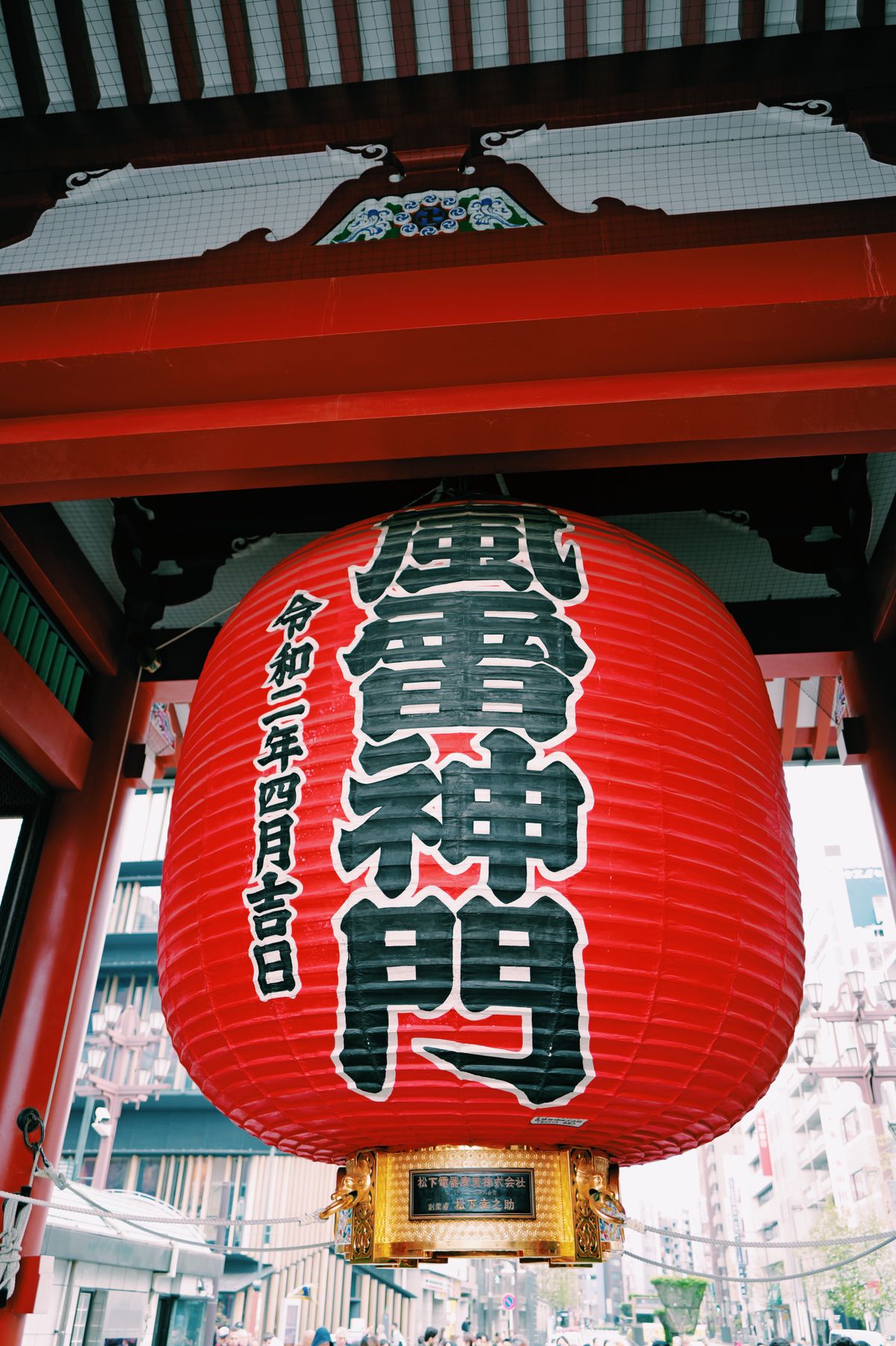
No visit to Asakusa is complete without spending real time at Senso-ji (浅草寺), Tokyo’s oldest and most visited temple. Founded in 628 AD according to legend, the temple has been a center of worship, commerce, and community life for nearly 1,400 years. The main hall has been rebuilt several times after fires and wartime destruction, most recently in 1958, but the spirit of the place feels ageless.
You approach Senso-ji through the Kaminarimon Gate (Thunder Gate), instantly recognizable by its massive red paper lantern — 3.9 meters tall and weighing 700 kilograms — hanging between the gates’ two fierce guardian statues. The gate was originally built in 941 but was lost to fire and not rebuilt until 1960, funded by Panasonic founder Konosuke Matsushita. Photograph the gate, by all means, but try to come back at different times of day: it looks spectacular at dawn, magical at dusk, and positively theatrical at night when it is lit up against the dark sky.
Beyond the gate stretches Nakamise Shopping Street, a 250-meter arcade of roughly 90 small shops selling traditional souvenirs, snacks, and crafts. This arcade has existed in some form since the 18th century, making it one of Japan’s oldest shopping streets. The shops here are unashamedly tourist-oriented — you’ll find everything from ornate folding fans and lacquerware chopsticks to matcha Kit Kats and samurai-themed trinkets — but the atmosphere is genuinely festive and the quality of many goods is excellent.
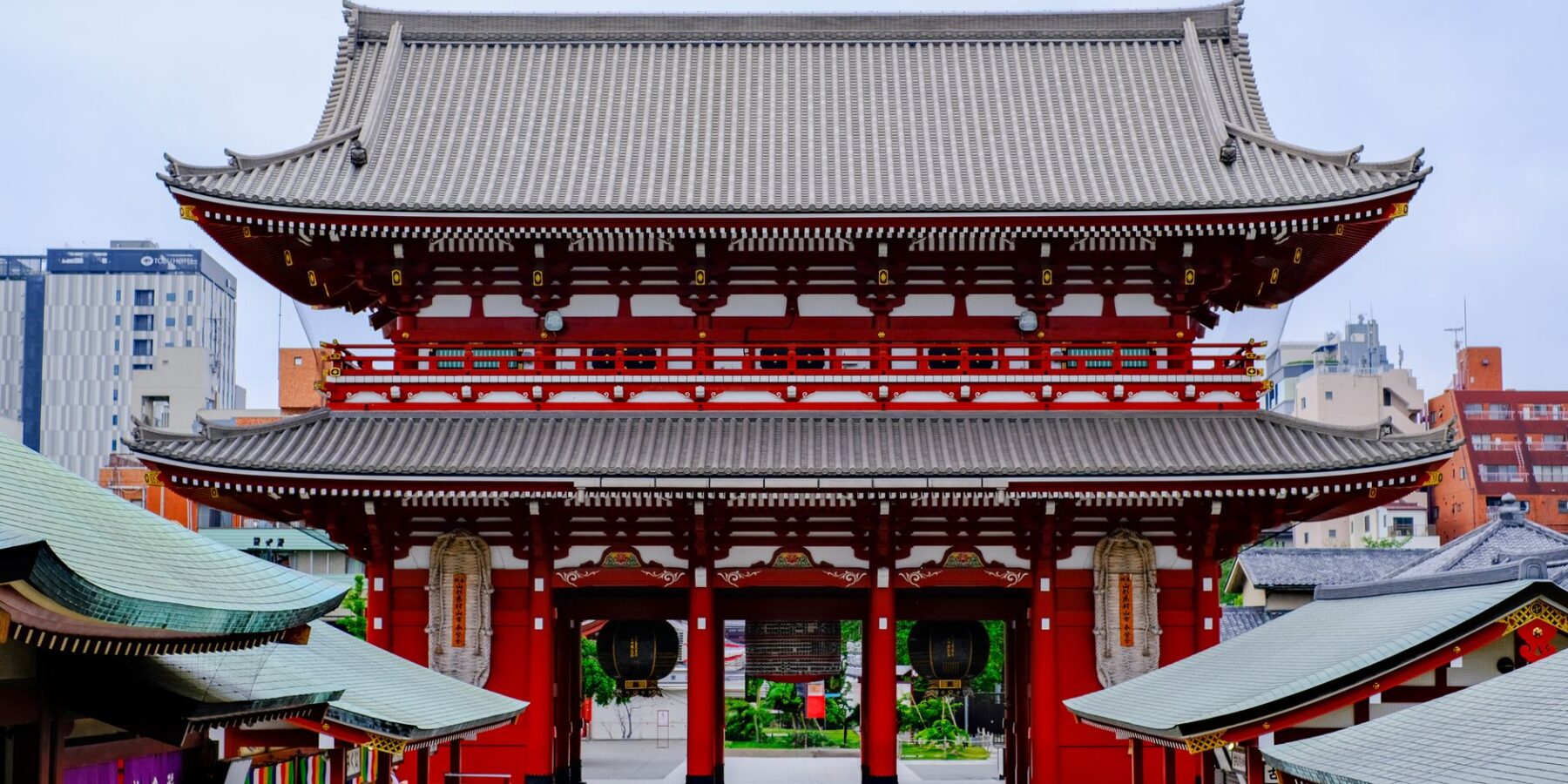
After Nakamise, pass through the Hozomon Gate (the Treasure House Gate), whose upper floors contain a number of the temple’s most prized Buddhist texts and artworks, and you enter the temple precinct proper. Here you’ll find the large bronze incense cauldron, where visitors wave fragrant smoke over themselves for good health. On busy days the smell of incense hangs thick in the air and mingles with the sweet scent of ningyo-yaki — small sponge cakes molded into the shapes of traditional Japanese figures — being cooked at stalls nearby.
The main hall itself enshrines a tiny golden image of Kannon (the goddess of mercy), though the statue is never actually shown to the public. That does not diminish the experience of standing before the hall and watching the constant flow of worshippers and visitors: older women in elegant kimono, uniformed schoolchildren on field trips, foreign tourists with cameras, young couples sharing street food. The five-storied pagoda on the western side of the precinct rises 53 meters above the surrounding streets and was rebuilt in 1973; its graceful silhouette is one of the most photographed skylines in Tokyo.
Practical details for Senso-ji: The temple grounds are open 24 hours and admission is free. The main hall is open daily from 6:00 AM (April–September) or 6:30 AM (October–March) to 5:00 PM. The best time to visit is early morning — arrive by 7:00 AM on weekdays and you’ll often have Kaminarimon almost to yourself, a far cry from the crowds that pack the gate from mid-morning onward. If your schedule only allows a daytime visit, Friday afternoons tend to be slightly less crowded than weekends.
Nakamise and the Side Streets: Shopping and Street Food
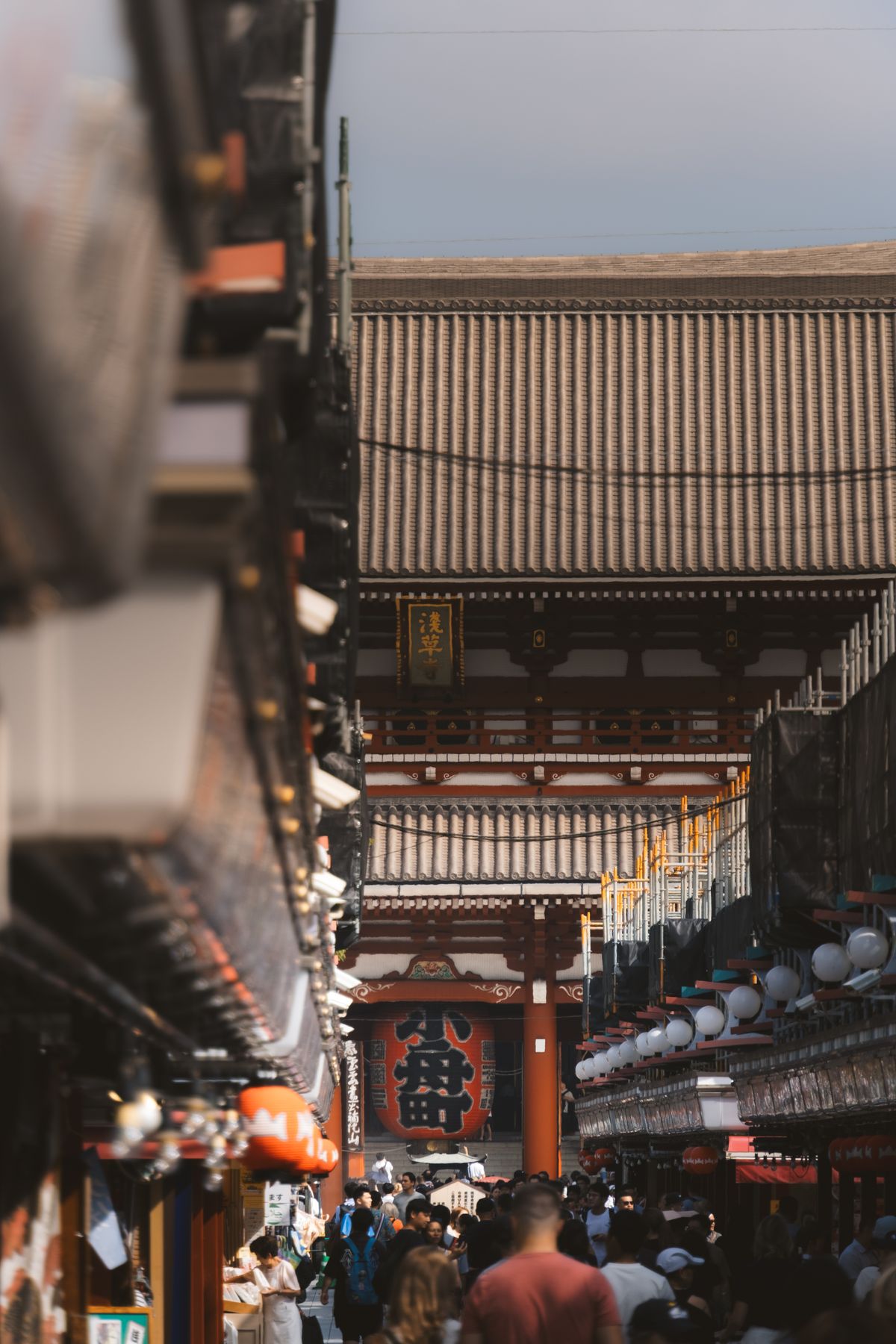
While Nakamise Shopping Street is the obvious first stop for souvenirs, the real treasures of Asakusa shopping lie in the narrow lanes running parallel and perpendicular to it. Shin-Nakamise Street (running east–west and crossing Nakamise) is more locals-oriented, with a covered arcade of everyday shops. The lanes between Nakamise and the Sumida River are home to a cluster of craft and specialty stores that are increasingly rare in modern Japan.
Kappabashi Street (known as “Kitchen Town”), a ten-minute walk northwest of Senso-ji, is one of the most unusual shopping experiences in Tokyo. This 800-meter commercial street is dedicated entirely to restaurant supplies and kitchen equipment: professional knives (Japan is world-famous for its kitchen blade craft), ceramic plates and bowls in every shape and price range, bamboo chopsticks by the thousand, lacquer trays, cooking utensils, and most famously, hyper-realistic plastic food models — the kind displayed in restaurant windows to show customers exactly what each dish looks like. Even if you don’t plan to buy anything, the sight of gleaming knife displays and impossibly perfect plastic ramen bowls is surreal and fascinating. Many shops welcome individual buyers, and picking up a good Japanese kitchen knife (santoku or chef’s knife) here costs anywhere from ¥3,000 (~$20) for a basic model to ¥50,000+ ($330+) for high-end hand-forged blades.
Asakusa Street Food Essentials
Asakusa is one of the best neighborhoods in Tokyo for street food. Here are the items you should not miss:
- Ningyo-yaki — small filled cakes in the shape of traditional figures (Kaminarimon, pigeons, etc.), usually filled with sweet red bean paste (anko). One piece costs around ¥80–120 (~$0.50–0.80).
- Melonpan — crusty sweet bread with a cookie-dough exterior. The version sold hot from Asakusa’s street vendors, particularly on Nakamise, is a beloved Tokyo snack. Around ¥200 (~$1.30).
- Menchi katsu — deep-fried minced meat cutlet, sold piping hot from delicatessen counters along Nakamise’s side streets. Around ¥250 (~$1.65).
- Agemanju — deep-fried sweet buns, with various fillings. The smell alone will guide you to the stalls.
- Kakigori (in summer) — shaved ice topped with vivid fruit syrups, sometimes condensed milk. Asakusa vendors use quality ingredients and the result is genuinely refreshing on hot Tokyo summer days.
For more detailed coverage of Japan’s incredible street food culture, see our complete Japan Street Food Guide.
Ueno: Museums, Parks, and a World-Class Zoo
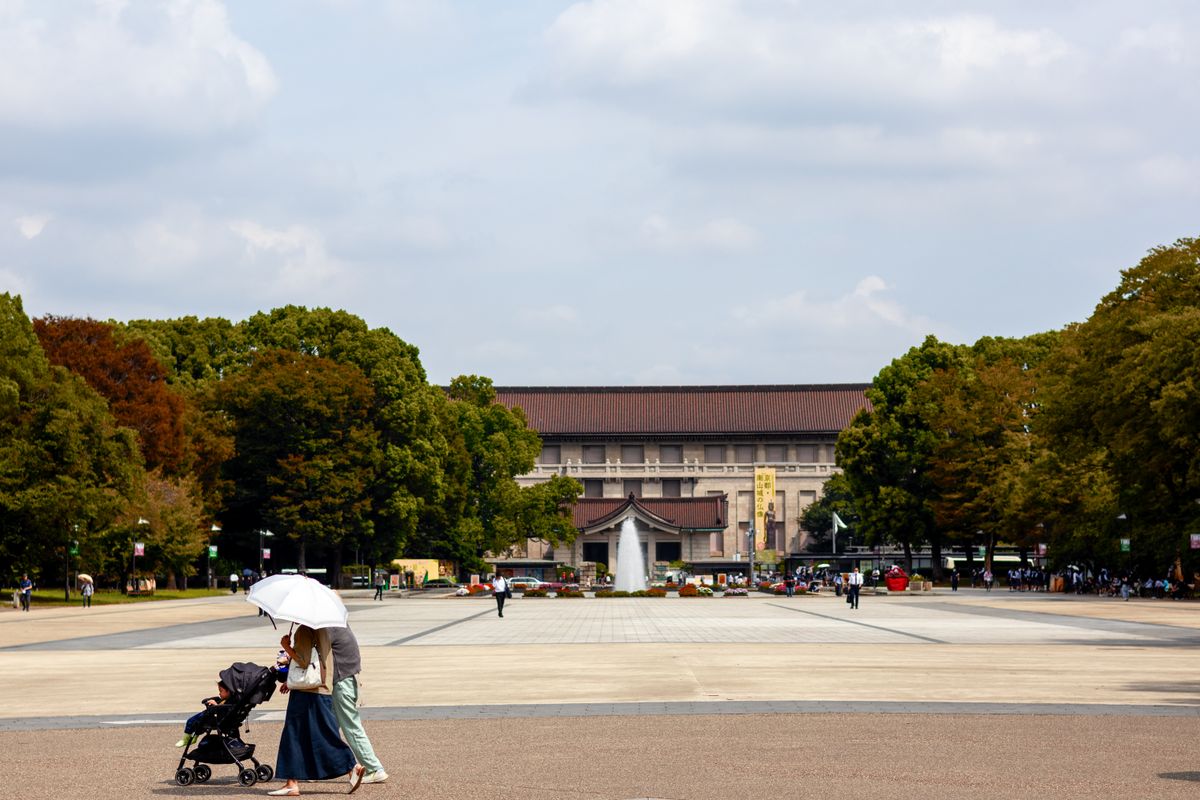
A 25–30-minute walk or a short three-stop Ginza Line ride west of Asakusa brings you to Ueno, one of Tokyo’s great cultural districts. Ueno’s character is defined by Ueno Park, a sprawling 53-hectare green space that contains an extraordinary concentration of museums and cultural institutions, as well as a zoo, several shrines and temples, ponds, and fountains. The park is famous throughout Japan for cherry blossoms in late March and early April, when tens of thousands of revelers gather under the trees for hanami (flower-viewing) parties. At peak bloom, Ueno Park is one of the most beautiful — and crowded — places in all of Japan.
Ueno Park Museums
The cluster of museums within and around Ueno Park is unmatched in Japan, and competes with the great museum districts of any city in the world.
Tokyo National Museum (TNM) is the oldest and largest museum in Japan, housing the world’s most comprehensive collection of Japanese art and antiquities: roughly 117,000 objects including swords, samurai armor, ceramics, Buddhist sculpture, painted screens, calligraphy, ukiyo-e woodblock prints, and archaeological finds dating back 10,000 years. Admission: ¥1,000 (~$6.50) for adults. Closed Mondays. Allow at least two to three hours; a full day is not too long.
National Museum of Nature and Science is one of the most engaging natural history museums in Asia, with exhibits spanning everything from dinosaur skeletons to the evolution of Japanese technology, life-size blue whale models, and an impressive collection of specimens documenting Japan’s extraordinary biodiversity. Admission: ¥630 (~$4). The outdoor garden contains a famous giant sequoia and a blue whale skeleton sculpture.
National Museum of Western Art (NMWA) holds Japan’s finest collection of European art, with particular strength in French Impressionism and Post-Impressionism. The museum building was designed by Le Corbusier and is part of the UNESCO World Heritage listing “The Architectural Work of Le Corbusier.” Admission: ¥500 (~$3.25). The outdoor plaza features original sculptures by Rodin, including “The Thinker” and “The Gates of Hell.”
Tokyo Metropolitan Museum of Art hosts major temporary exhibitions throughout the year, covering Japanese and international art. Check the schedule before visiting as the program changes regularly. Admission varies by exhibition.
Ueno Zoo (Ueno Zoological Gardens) is the oldest zoo in Japan, opened in 1882 and home to roughly 3,000 animals representing 400 species. The giant pandas are the perennial star attraction, though visitors need to book viewing time slots in advance online due to high demand. Admission: ¥600 (~$4) for adults. Closed Mondays.
Ueno Park Shrines and Temples
Tosho-gu Shrine in Ueno Park is a spectacular example of Edo-period religious architecture, built in 1627 and extensively renovated in 1651. The shrine was dedicated to Tokugawa Ieyasu, founder of the Edo shogunate that ruled Japan for over 250 years. Its “karamon” (Chinese gate) is covered in gold leaf and elaborate carved decorations, and the 50 stone lanterns lining the approach path create an unforgettable visual. Admission: ¥500 (~$3.25) to enter the inner compound. The outer grounds and lantern avenue are free.
Shinobazu Pond, in the southern part of Ueno Park, is divided into three sections. The central pond features a small islet connected by a causeway to the shore, topped by Bentendo Temple, a small, charming hall (rebuilt after the war) dedicated to Benzaiten, the goddess of art and beauty. The pond is famous for its lotus flowers, which bloom brilliantly in July and August, covering the water in wide, flat pads topped by pink and white blossoms. In winter, the pond attracts migratory birds. Paddle boats can be rented at the southwest shore for around ¥700 (~$4.50) for 30 minutes.
Yanaka: Old Tokyo’s Most Atmospheric Neighborhood
Between Ueno and the quiet residential hills of Bunkyo lies Yanaka, a neighborhood that miraculously survived both the 1923 Great Kanto Earthquake and the 1945 firebombing raids that destroyed much of the rest of Tokyo. As a result, Yanaka retains a townscape that no longer exists almost anywhere else in the city: narrow lanes flanked by wooden houses, small neighborhood shrines tucked between buildings, family-run workshops producing lacquerware or paper goods, and an air of tranquil, slightly melancholic beauty.
Yanaka Cemetery is a strange but genuinely beautiful place to walk: a vast, quiet park-like cemetery with gnarled old cherry trees, ornate stone tombs of famous Edo-period merchants and Meiji-era statesmen, and an atmosphere of deep peace that feels far removed from the city. The main avenue through the cemetery is one of Tokyo’s finest sakura spots in spring. The grave of the last Tokugawa shogun, Yoshinobu, is here.
Yanaka Ginza is a small shopping street of about 170 meters lined with tiny old shops — a fishmonger, a tofu maker, a sweets shop, a sake specialist — that is beloved by Tokyoites who prize authenticity over spectacle. Come here in the late afternoon when the shopkeepers are out chatting, the smell of grilled fish drifts from the izakaya, and the neighborhood takes on the warm amber light of the setting sun. It’s one of those rare Tokyo experiences that feels completely unperformed.
Where to Eat in Asakusa and Ueno
Both neighborhoods offer excellent eating across a wide range of budgets and styles, with a particularly strong showing of traditional Japanese food.
Asakusa Dining
Tempura is arguably Asakusa’s signature dish. The neighborhood has been associated with tempura since the Edo period, when vendors at street stalls (known as yatai) fried seasonal seafood and vegetables in oil heated over portable burners beside the river. Today, Asakusa has numerous excellent tempura restaurants. Daikokuya, founded in 1887, is the most famous and usually has a queue: its signature is a rich, darker tempura batter that is distinctly old-school Tokyo. Expect to pay ¥2,000–4,000 (~$13–26) for a set meal. Less-famous but excellent alternatives include Tempura Nakagawa and Tempura Marumi.
Sukiyabashi Jiro’s Honten may be in Ginza, but Asakusa has excellent conveyor-belt sushi at highly accessible price points. Sushiro and Hama Sushi near Asakusa Station offer fresh rotating sushi at around ¥165–330 (~$1–2) per plate.
Unagi (freshwater eel) restaurants cluster around Asakusa: the neighborhood has a centuries-long association with this delicacy. Komagata Dozeu (founded 1801) is technically a dozeu (loach fish) specialist, but their unagi preparations are exceptional. Budget ¥3,000–6,000 (~$20–40) for a full meal.
For budget dining, the food stalls around Senso-ji, the lunchtime specials at Nakamise’s back-street restaurants, and the basement food halls of the nearby Matsuya Asakusa department store offer satisfying meals from ¥700–1,500 (~$4.50–10).
Ueno Dining
Ueno has several distinct dining zones. Ameya-Yokocho (Ameyoko), the open-air market running beside the train tracks south of Ueno Station, is one of Tokyo’s most atmospheric eating and drinking spots: a long, chaotic strip of food stalls, seafood vendors, discount clothes shops, and yakitori grills that gets louder and smokier as the day wears on. Wander through in the early evening, snack on skewers (¥100–200 each), sip cold draft beer (¥500 a glass), and watch the cross-section of Tokyo life stream past.
Around Ueno Park, cafes and restaurant terraces cater to museum-goers, and the National Museum of Western Art has an elegant cafe with outdoor seating beside the Rodin sculptures. For a proper meal, head slightly north toward Ueno-Hirokoji where you’ll find traditional Japanese restaurants serving katsu, soba, and kaisendon (seafood rice bowl) at reasonable prices.
For the full picture of Japanese food culture, from street stalls to multi-course kaiseki dinners, explore our Best Japanese Food Experiences guide.
Where to Stay Near Asakusa and Ueno
Asakusa and Ueno are among the best areas in Tokyo to stay for first-time visitors who want to be near the old city while having good transport connections to everywhere else. The neighborhood has excellent subway and bus links and is on the Asakusa Line, Ginza Line, and Tobu Skytree Line (for easy trips to Nikko, the Tobu Nikko Line departs from Asakusa Station).
Luxury options: The most famous hotel in the area is the Asakusa View Hotel, a high-rise with sweeping views of Senso-ji from its upper floors. The Ryokan Asakusa Shigetsu is a beautifully maintained traditional inn within a five-minute walk of Senso-ji, with tatami rooms, futon beds, and in-house Japanese baths. Expect to pay ¥15,000–35,000 (~$100–230) per room per night for ryokan-style accommodation.
Mid-range options: The Dormy Inn Asakusa is an excellent value business hotel with a large natural hot spring bath on the top floor — an unusually luxurious amenity for this price point. Standard rooms run ¥9,000–14,000 (~$60–93) per night. Remm Asakusa and Richmond Hotel Premier Asakusa are well-located, modern, and comfortable.
Budget options: Asakusa has a long tradition of budget accommodation dating to the days when pilgrims came to visit Senso-ji. Today that tradition continues in the form of well-run guesthouses and capsule hotels. Khaosan Tokyo Origami and Nui. Hostel (near the river) offer dormitory beds from ¥2,500–3,500 (~$16–23) per night and private rooms from ¥5,500–8,000 (~$36–53).
For the best hotel rates across all price points, Book your hotel on Agoda (Best prices guaranteed) →
Prefer a luxury ryokan experience? Find luxury hotels on Agoda →
Getting to Asakusa and Ueno
Both neighborhoods are extremely well connected by public transport.
From Tokyo’s Airports
From Narita Airport: The most direct and affordable option is the Keisei Skyliner to Ueno Station (approximately 41 minutes, ¥2,570 / ~$17). The Skyliner departs multiple times per hour and deposits you at Keisei-Ueno Station, a three-minute walk from JR Ueno Station and a short Ginza Line ride from Asakusa. Alternatively, the Keisei Limited Express (stopping at Nippori and Ueno) takes about 70–75 minutes and costs ¥1,250 (~$8.30).
From Haneda Airport: Take the Keikyu Line from Haneda to Asakusa Station (approximately 40–50 minutes, ¥650 / ~$4.30) via Shinagawa and the Asakusa Line. Some Keikyu trains run straight through onto the Toei Asakusa Line to Asakusa; on others you change at Sengakuji or Shinagawa. This is one of the most convenient airport-to-destination journeys for any neighborhood in Tokyo.
For a stress-free door-to-door arrival, especially if you’re traveling with luggage, consider a shared airport transfer. Book airport transfer with Welcome Pickups →
Within Tokyo
Asakusa Station is served by three lines: the Tokyo Metro Ginza Line (connecting to Shibuya, Omotesando, and Ginza), the Tobu Skytree Line (for Tokyo Skytree), and the Toei Asakusa Line (with through trains to and from the Keikyu Line) connecting to Haneda Airport, Shinagawa, and Shimbashi. Ueno Station is a major hub served by the JR Yamanote Line, JR Keihin-Tohoku Line, Tokyo Metro Ginza Line, and Tokyo Metro Hibiya Line. Between Asakusa and Ueno, the two stations are connected by the Ginza Line (three stops, about 5 minutes) or a pleasant 25–30-minute walk through the old city.
Practical Tips for Visiting Asakusa and Ueno
- Best time to visit: Spring (late March to early April) for cherry blossoms in Ueno Park; summer (July–August) for lotus flowers at Shinobazu Pond and the lively Sumida River Fireworks Festival; autumn (October–November) for fewer crowds and comfortable temperatures; winter (December–February) for the New Year crowd at Senso-ji (one of Japan’s largest hatsumode pilgrimage events, with over 3 million visitors in the first three days of January).
- Getting a Suica card: Load money onto a Suica IC card at any Ueno or Asakusa station for seamless travel on all Tokyo trains and buses — and to pay at convenience stores, vending machines, and many restaurants. Cards are available from automated ticket machines at JR stations.
- Cash vs cards: While more shops in Asakusa now accept credit cards, many small street food vendors and traditional craft shops are still cash only. Bring ¥5,000–10,000 (~$33–66) in cash per person per day.
- Etiquette at Senso-ji: You may enter the temple grounds and main hall at no cost. Photography is generally permitted outdoors but not inside the main hall. Fortune slips (omikuji) cost ¥100 (~$0.65) — if you draw a “bad luck” slip (kyo), there are racks throughout the grounds where you can tie it to drive away the bad luck rather than taking it home.
- Luggage storage: Coin lockers are available inside Asakusa Station (Ginza/Tobu lines), and Cloak Asakusa (next to Kaminarimon) offers full-day luggage storage for ¥600–800 per bag. This lets you explore hands-free and pick up purchases without worry.
- Crowds: Asakusa is at its most crowded on weekends between 10 AM and 4 PM. Even a 7:30 AM start transforms the experience — you’ll have Kaminarimon almost to yourself and can watch the monks and maintenance staff prepare the temple for the day.
- Dress code: There is no formal dress code at Senso-ji, but respectful attire is appreciated. Several rental kimono shops near Kaminarimon offer full kimono rental (including dressing assistance and hair styling) for ¥3,000–6,000 (~$20–40) for a half-day, which is a wonderful way to experience the neighborhood.
A Suggested One-Day Itinerary for Asakusa and Ueno
If you have one full day to explore both neighborhoods, here is a practical route:
7:00 AM — Arrive at Senso-ji. Walk the Nakamise arcade in near-solitude, photograph Kaminarimon in the morning light, visit the main hall and burn incense. 7:45 AM — Breakfast at a kissaten (traditional coffee shop) near the temple, or pick up fresh taiyaki or ningyo-yaki from the first opening stalls. 9:00 AM — Explore Kappabashi Kitchen Street. Browse knife shops, photograph the plastic food displays, consider picking up a ceramic souvenir or quality kitchen tool. 10:30 AM — Walk or take the subway to Ueno. Visit the Tokyo National Museum (allow at least 90 minutes, more if you have a deep interest in Japanese art). 12:30 PM — Lunch at Ameyoko Market — graze on street food, fresh seafood, or sit at a stall for yakitori and cold beer. 2:00 PM — Visit either the National Museum of Nature and Science or the National Museum of Western Art (one museum per afternoon is more satisfying than rushing through two). 3:30 PM — Walk through Ueno Park, stopping at Tosho-gu Shrine and Shinobazu Pond. In cherry blossom season, add extra time here. 5:00 PM — Walk through Yanaka toward the Nishi-Nippori area for a golden-hour wander through old Tokyo streets. 6:30 PM — Dinner in Asakusa — splurge on a traditional tempura set or try the lively izakaya-lined alleys west of Senso-ji. 8:00 PM — Senso-ji by night: the illuminated pagoda and Kaminarimon are spectacular after dark and the crowds have largely gone home.
Day Trips from Asakusa and Ueno
Asakusa’s position at the terminus of the Tobu Nikko Line makes it a natural starting point for some of Tokyo’s best day trips. Nikko, home to the extraordinarily ornate Tosho-gu Shrine complex in the mountains of Tochigi Prefecture, is reachable in about two hours by the Tobu Limited Express (¥2,740 / ~$18 one way). Kawagoe (Little Edo), with its preserved Edo-period merchant quarter and famous sweet potato street food, is about an hour away. For a complete overview of day trip options from the capital, see our guide to the Best Day Trips from Tokyo.
Frequently Asked Questions About Asakusa and Ueno
How much time do I need to see both Asakusa and Ueno?
A single full day (7–8 hours) gives you a meaningful experience of both neighborhoods, provided you are selective about which museums you visit. If you want to go deep on the Tokyo National Museum, add a second half-day. Dedicated Asakusa exploration — including Kappabashi and Yanaka — warrants its own half-day.
Is Senso-ji safe to visit alone, and is it open at night?
Senso-ji is one of the safest and most welcoming tourist sites in Japan. The temple grounds are open 24 hours, and the main gate and pagoda are dramatically lit after dark. Solo travelers, female travelers, and families are all very welcome at any hour.
What is the best souvenir to buy in Asakusa?
Quality items that travel well include: traditional Japanese fans (sensu) from specialty shops off Nakamise — genuine handmade fans start at ¥1,500 (~$10); ningyo-yaki sweets in attractive boxes make great gifts; a quality Japanese kitchen knife from Kappabashi is a practical, high-value souvenir. Avoid mass-produced plastic items labeled as Japanese but manufactured elsewhere.
Are the Ueno museums worth the entrance fees?
Absolutely. The Tokyo National Museum in particular represents extraordinary value: ¥1,000 (~$6.50) gives you access to one of the world’s great art collections. Even if you only spend 90 minutes, you will see objects — ancient Buddhist sculptures, samurai armor, Edo-period woodblock prints — that are unmatched in quality and quantity outside Japan. The National Museum of Nature and Science is also excellent value at ¥630 (~$4).
Can I see geisha in Asakusa?
Asakusa is one of the few remaining geisha districts (hanamachi) in Tokyo. It is home to a small community of geisha known locally as shinzo and geigi. You are most likely to spot them in the early evening heading to or from engagements — typically in the narrow Kannon-ura streets behind (north of) Senso-ji between 5:00 PM and 7:00 PM. If you do see a geisha, please be respectful: do not block their path or insist on photographs. Legitimate geisha performances for visitors can be arranged through some Asakusa ryokan and restaurants as part of a formal dinner package.
How do I get from Asakusa to Shibuya or Shinjuku?
Take the Ginza Line (orange) from Asakusa Station directly to Shibuya (approximately 30 minutes, ¥260 by ticket or ¥252 by IC card), or change at Ueno to the JR Yamanote Line and head to Shinjuku (approximately 30 minutes total, ¥180 Metro plus the JR fare). Both routes are straightforward and the journeys are short enough that you can easily visit multiple Tokyo neighborhoods in a single day.
What is the best thing to do in Asakusa in the rain?
Asakusa is actually wonderful in the rain — the slick cobblestones, the paper lanterns, and the old buildings all take on a beautiful melancholy quality. Senso-ji is worth visiting in any weather. Practical indoor options include the Asakusa Culture Tourist Information Center (a striking modern building opposite Kaminarimon, free entry, with observation decks offering views over the temple), the covered Nakamise shopping arcade, and the nearby Sumida Hokusai Museum — a striking contemporary museum dedicated to the great woodblock print master Katsushika Hokusai, who was born in Sumida Ward. Admission ¥400 (~$2.60).
The Sumida River Waterfront: Tokyo’s Scenic Heartbeat
Running along the eastern edge of Asakusa, the Sumida River has been central to Tokyo’s identity since the city was first established as Edo in the early 17th century. In the Edo period, the river was the main artery for commerce and transport, its banks lined with warehouses, fish markets, and pleasure boats. Today the waterfront is a linear park and promenade, and a walk along the embankment rewards with dramatic views: the Skytree to the north, the Art Deco ironwork of old bridges, low-slung water buses gliding under them, and across the water, the rooflines of Sumida Ward’s low-rise districts.
The Sumida Park section of the riverbank, running north from Azuma Bridge toward Sakura Bridge, is planted with over 600 cherry trees — one of Tokyo’s most celebrated sakura spots. In late March to early April, the trees form a tunnel of blossoms with Senso-ji’s pagoda glowing behind them and pink petals falling onto the water below. The Sumida River Fireworks Festival, held on the last Saturday of July, is the oldest fireworks display in Japan, dating to 1733. Over 22,000 fireworks are launched in two locations along the river, drawing nearly a million spectators who spread picnic sheets along the embankment hours in advance. This is a genuine bucket-list Tokyo experience.
The Tokyo Skytree, visible from everywhere in Asakusa, is a 15–20-minute walk east across the Sumida River. At 634 meters, it is the tallest structure in Japan. The two observation decks — Tembo Deck at 350 meters and Tembo Galleria at 450 meters — offer extraordinary 360-degree views. On a clear winter day, Mt. Fuji floats 100 kilometers to the southwest. Tickets: ¥1,800–3,600, varying by date, for the lower deck. Book online in advance to avoid long queues. The Solamachi shopping complex at the base has over 300 shops and restaurants and is worth exploring.
Asakusa for Families: Bringing Children to Old Tokyo
Asakusa and Ueno rank among the most family-friendly destinations in all of Tokyo. Children are genuinely welcomed everywhere, and there is an unusually high concentration of hands-on experiences for young visitors.
At Senso-ji: The omikuji fortune-telling ritual — shake a canister until a numbered stick falls out, then retrieve your fortune slip from the matching drawer — fascinates children of all ages. The ningyo-yaki street stalls let kids choose their favorite shape and watch the cakes cook in molds in real time. The incense cauldron ritual, where visitors wave smoke over themselves for good health, gives young travelers an authentic cultural participation rather than passive observation.
Ueno Zoo is the obvious family destination, with giant pandas as the marquee attraction. But equally popular are the gorilla habitat, the polar bear viewing platform, and the Children’s Zoo area where kids can interact with small animals under supervision. A gentle walking route links the East and West Gardens, easy going even for the youngest visitors. Zoo admission is affordable at ¥600 (~$4) for adults, and maps in English are clear.
National Museum of Nature and Science offers interactive exhibits, life-size dinosaur casts, and a globe-shaped theater showing nature documentaries — far more engaging for children than a traditional art museum. Allow at least two hours for families with curious kids.
For family-friendly accommodation near Asakusa, Search hotel deals on Agoda → to compare family room rates across multiple properties before booking.
Kimono Rental in Asakusa: Dress the Part
One of the most popular activities in Asakusa for first-time visitors is renting a traditional kimono and spending several hours exploring the neighborhood in full Japanese dress. Multiple rental shops cluster around Kaminarimon and Nakamise, and the process is simpler than you might expect. You choose a kimono from a wide selection of patterns and colors, staff dress you (including proper tying of the obi sash), and optionally style your hair with traditional accessories. The entire preparation takes about 30–40 minutes. Rental including dressing assistance runs ¥3,000–6,000 (~$20–40) for a half-day (typically until 5 PM), or slightly more for premium fabrics or full hair styling.
Walking through Nakamise, posing before Kaminarimon, and visiting the temple in a well-fitted kimono transforms the experience significantly — both visually (the photos are beautiful) and psychologically. You become part of the scenery rather than a viewer of it. Shops that receive consistently good reviews include Asakusa Kimono Rental WARGO and Vasara Asakusa, both of which offer online advance reservations.
In summer, the more comfortable option is a yukata — a lighter cotton summer version of the kimono — which can be rented at the same shops for slightly less. In winter, a haori (short jacket) can be added over the kimono for warmth. Rental shops provide special sandals, bags, and accessories as part of the package; you do not need to bring anything special.
Conclusion: The Soul of Old Tokyo
Asakusa and Ueno are not simply tourist attractions — they are living, breathing communities that have shaped Tokyo’s identity for centuries and continue to do so today. The incense smoke at Senso-ji has wafted over countless generations of worshippers. The stalls of Nakamise have sold sweets and souvenirs since the Edo era. The museums of Ueno have been collecting and displaying the heritage of Japan and the world for over 140 years. Walking these streets is to participate, however briefly, in a chain of human experience that stretches back far longer than any living person can fully grasp.
For first-time visitors to Japan, spending a morning at Senso-ji and an afternoon in Ueno Park is not merely sightseeing — it is the beginning of understanding what makes Japan different from anywhere else on earth. Start early, walk slowly, eat everything that smells interesting, and let the neighborhood reveal itself to you at its own pace. You won’t regret it.
Ready to plan your Tokyo trip? Explore all our Japan destination guides →
Going to Japan? Speak Japanese with confidence.
Hirameki Japanese — camera translate for menus and signs, a two-way conversation mode, and furigana + romaji on every phrase. Free to download with kana charts, conversation mode and starter words; a one-time purchase unlocks everything.

Plan your Japan trip
Two things every first-timer should book
Some links are affiliate links. If you book through them we may earn a small commission at no extra cost to you.