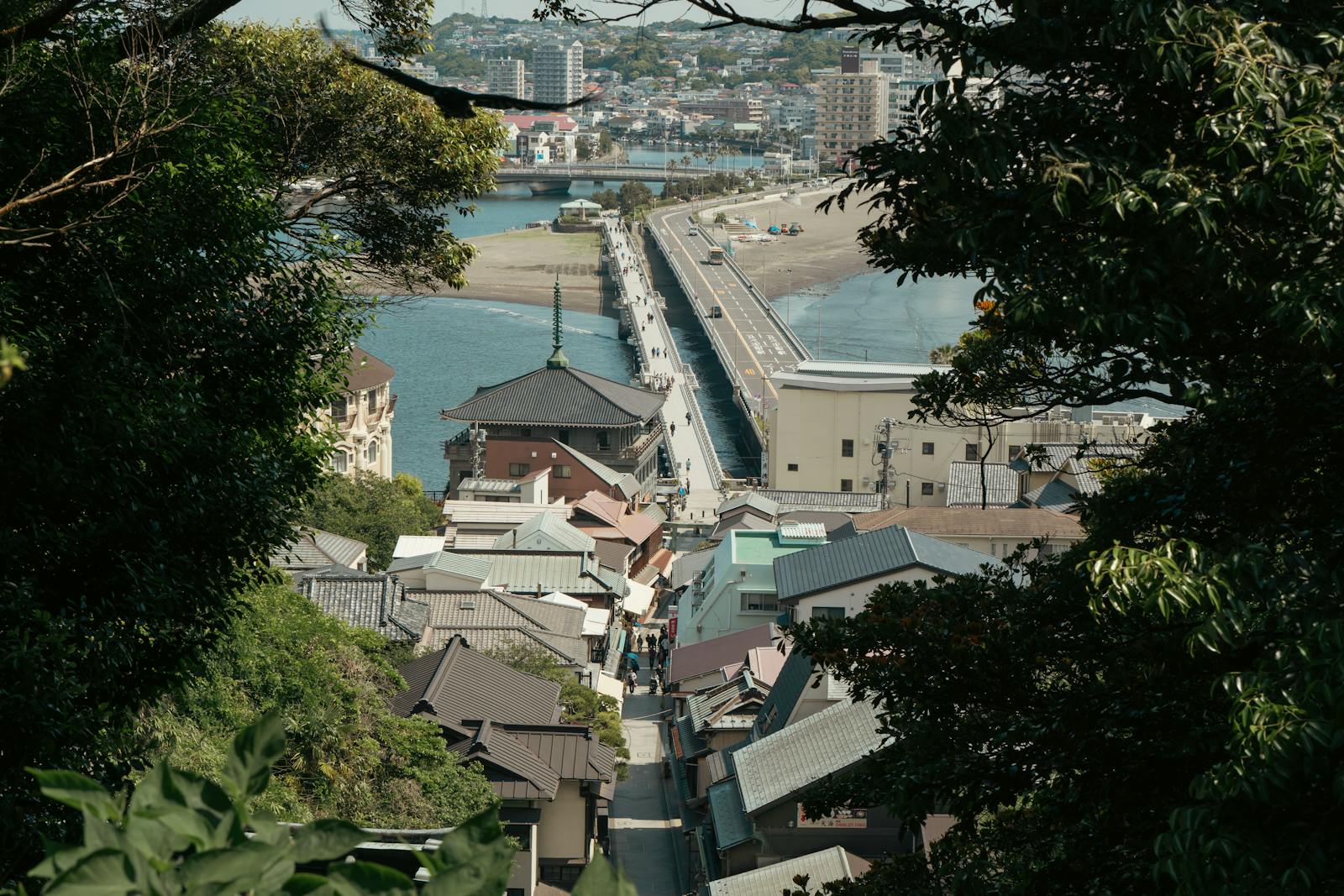
Just over an hour from central Tokyo, where the Sagami Bay meets the foothills of the Kanagawa coastline, sits a small green island connected to the mainland by a single white bridge. This is Enoshima — a 4-kilometre-around lump of forested rock that has been a place of pilgrimage, sea bathing, summer escape and stylish day-tripping for the people of Tokyo for more than 1,200 years. Today it is one of the easiest, most photogenic and most underrated day trips from the capital, and one of the few places near Tokyo where you can climb to a forested shrine, walk through sea caves carved by the Pacific and eat raw whitebait while watching surfers ride glassy waves — all in the same afternoon.
This guide is written for first-time foreign visitors who want to understand exactly what Enoshima offers, how to get there from Tokyo, what to see in the right order, what to eat along the way, and how to combine it with nearby Kamakura for a full day out. By the time you finish reading you will know which train to take, which shrine to head for first, where to find the best octopus rice crackers, and whether the climb to the lighthouse is worth your time. (Spoiler: it is.)
What and Where Is Enoshima?
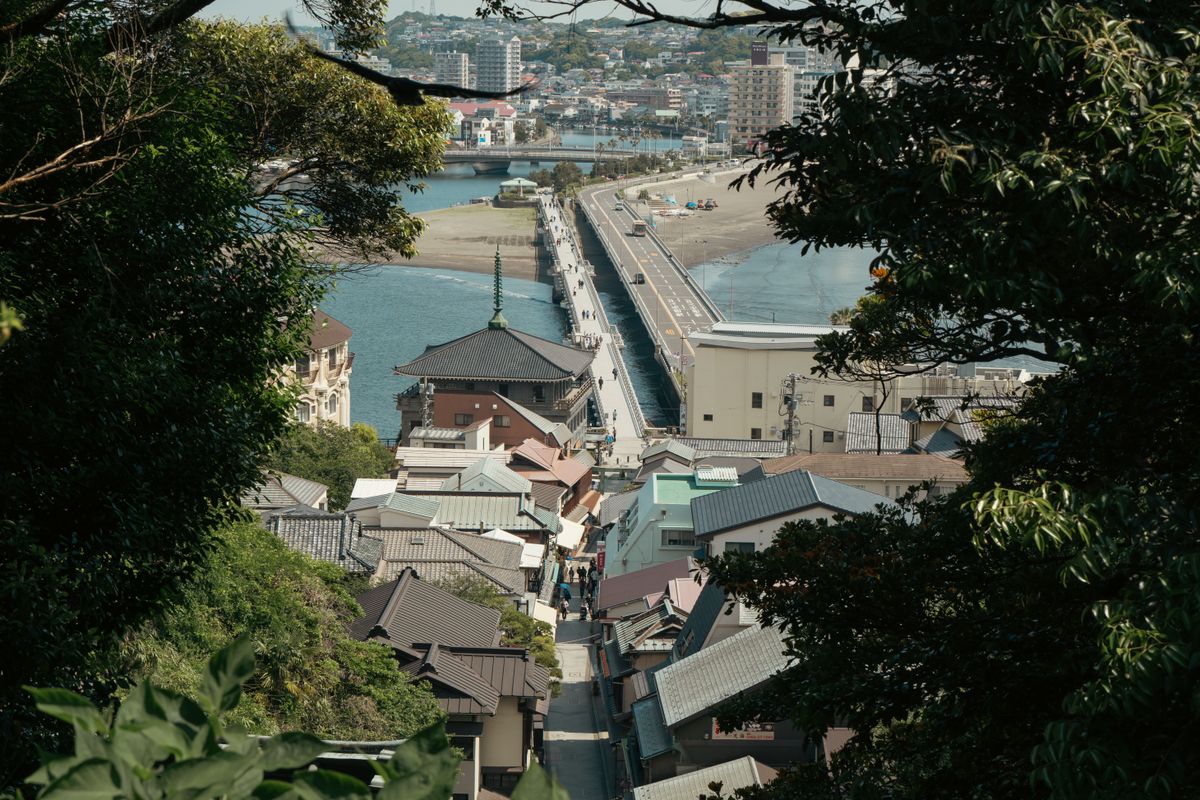
Enoshima (江ノ島 or 江の島) is a small offshore island roughly 4 kilometres in circumference, joined to the city of Fujisawa in Kanagawa prefecture by the 600-metre Benten Bridge. It sits at the western edge of the Shonan Coast, a sweep of beach that has been Tokyo’s seaside playground since the early 20th century and that gives its name to a whole subculture of Japanese surf and beach style.
The island itself rises 60 metres above sea level at its highest point. Three Shinto shrines, a botanical garden, a small lighthouse-observation tower, two sets of sea caves, multiple seafood restaurants and a maze of stair-stepped lanes climb up and over its forested back. The whole island can be circumnavigated on foot in around 90 minutes, but most visitors spend a half-day or more here exploring slowly. Importantly, Enoshima is not just for foreign tourists — Japanese visitors from Tokyo come constantly to enjoy summer beaches, autumn views and winter sunsets across the bay.
The island is famous in Japanese mythology as the home of Benzaiten, the goddess of music, eloquence and good fortune. Local legend claims she rose from the sea here in the 6th century to subdue a five-headed dragon, and the island grew from the ripples of that encounter. The three shrines you will visit are all dedicated to her. On clear winter days, Mount Fuji floats on the horizon directly behind the island — one of the most reliably stunning views of Fuji in all of Japan.
How to Get to Enoshima from Tokyo
Option 1: Odakyu Romancecar (Easiest)
The simplest and most comfortable option is the Odakyu Limited Express “Romancecar” departing from Shinjuku Station. Take the train to Katase-Enoshima Station, which is a 5-minute walk from the bridge to the island. Journey time is about 65 minutes. Reserved seat fare is ¥1,490 (~$10) one way. The Odakyu line also sells a discounted “Enoshima–Kamakura Free Pass” for ¥1,640 (~$11) that covers the round-trip from Shinjuku plus unlimited rides on the Enoden line between Fujisawa, Enoshima and Kamakura. If you plan to do both Enoshima and Kamakura, the free pass essentially pays for itself.
Option 2: JR Tokaido or Yokosuka Line
From Tokyo Station or Shinagawa, take the JR Tokaido or Yokosuka Line to Fujisawa Station (about 50 minutes, ¥990 / ~$6.70). Transfer to the Odakyu Enoshima Line for one stop to Katase-Enoshima, or to the Enoden line for two stops to Enoshima Station. This is the route most JR Pass holders take, since both Tokaido and Yokosuka lines are fully covered.
Option 3: Enoden Vintage Train (Most Atmospheric)
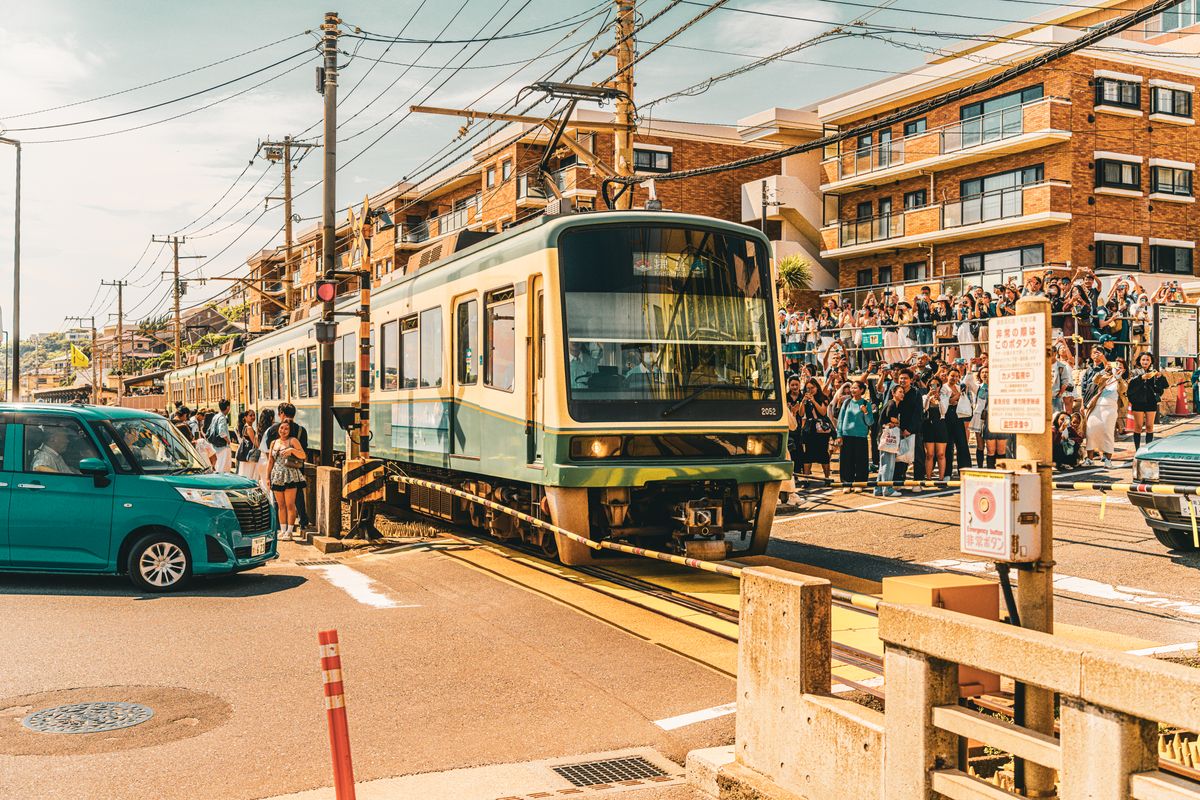
The Enoshima Electric Railway, known to everyone as the Enoden, is a 100-year-old narrow-gauge line that hugs the coastline between Fujisawa, Enoshima and Kamakura. The trains run through people’s back gardens, between fences and walls just centimetres from the carriage, and along a famous stretch of beach. If you arrive from Tokyo via Fujisawa or Kamakura, take the Enoden at least one direction — it is part of the experience. Single ride ¥260 (~$1.75); one-day pass ¥800 (~$5.40).
Option 4: Taxi or Private Transfer
A taxi from central Tokyo to Enoshima takes about 90 minutes in light traffic and costs around ¥20,000–¥25,000 (~$135–170). This is rarely the best choice unless you have lots of luggage or are traveling with elderly companions. A pre-booked airport transfer or private hire car is a more sensible alternative if you want door-to-door comfort.
Book airport transfer with NearMe →
Approaching the Island: The Bridge and the Bronze Torii
From any of the three stations — Katase-Enoshima, Enoshima or Shonan-Enoshima — the walk to the island bridge takes 5–15 minutes. You will cross a wide modern pedestrian bridge running parallel to the road bridge, with the island unfolding ahead of you like a curtain rising over green hills. Take your time on the bridge. The views from the centre — Sagami Bay on both sides, Mount Fuji on the horizon to the west, fishing boats bobbing in the foreground — are some of the best photo opportunities of the entire day.
At the far end of the bridge, you pass through a large bronze torii gate — the gateway to the sacred precinct — and arrive at Enoshima Benzaiten Nakamise-dori, a 200-metre lane of souvenir shops, dried seafood stalls, ice cream stands and small restaurants. Resist the urge to eat everything immediately. There is more food at the top, and you will want to save room.
A Brief History of Enoshima
Enoshima’s recorded history begins in 552 AD, when, according to the Enoshima Engi text, the goddess Benzaiten descended from the sky and caused the island to rise from beneath the sea — calming a five-headed dragon that had been terrorising the Sagami coastline. Whatever the mythology, the island has been a sacred site for at least 1,400 years, with continuous worship at its shrines dating back to the 6th century. In the 12th century the warlord Minamoto no Yoritomo, founder of the Kamakura shogunate, prayed at the Iwaya Caves before his military campaigns. His patronage transformed Enoshima into one of the most visited pilgrimage destinations in eastern Japan.
During the Edo period (1603–1868), the island became a popular pilgrimage and leisure spot for the merchants and townspeople of Tokyo (then Edo). Wood-block prints by Hiroshige and Hokusai famously depict the island, the bridge, and the surf rolling onto Shonan Beach. With the Meiji Restoration, Enoshima opened up to foreign visitors — the British botanist Samuel Cocking built his garden here in 1880, and a colony of artists and writers began spending summers in Fujisawa and Kamakura. By the early 20th century, the new Enoden railway had connected the island to the rest of Kanagawa, and Enoshima became a defining symbol of modern Japanese seaside leisure. The 1964 Tokyo Olympics held the sailing competitions in the harbour just north of the bridge — and the 2020 Tokyo Olympics returned the sport to the very same waters.
The Three Shrines of Enoshima
Hetsumiya — The Lower Shrine
At the top of Nakamise-dori, you arrive at the red wooden torii gate of Enoshima Shrine. This is the lower of the three shrines, called Hetsumiya (辺津宮). It is the largest and most visited of the three, dedicated to Tagitsuhime no Mikoto, one of the three Benzaiten goddesses. The most famous feature here is the octagonal Hōan-den hall, which houses two small images of Benzaiten — one a serene seated Buddhist version, the other a naked white statue holding a biwa (Japanese lute). Admission to view the statues is ¥200 (~$1.35). Most visitors find the small shrine garden and the koi pond at least as interesting as the statues themselves.
Nakatsumiya — The Middle Shrine
Climbing further up a paved path lined with stone lanterns, you reach Nakatsumiya (中津宮), the middle shrine. Built in 853 and reconstructed in 1689, this brightly painted vermilion-and-gold hall is small but exquisite — the entire interior is panelled with carved birds and waves. A small viewing platform here gives a stunning sea view across to the Miura Peninsula. Many Japanese visitors stop to pray here for success in love, beauty and the performing arts (Benzaiten’s domains). The walk from Hetsumiya takes about 10 minutes including stairs.
Okutsumiya — The Inner Shrine
Another 15 minutes’ walk further into the island brings you to Okutsumiya (奥津宮), the innermost and oldest shrine. The current main hall dates from 1842 and houses the original Benzaiten icon. Look up at the ceiling above the entrance to see a famous painted dragon — when you stand directly below it, the dragon’s eyes appear to follow you no matter which way you turn. Behind the shrine, the small Ryūren no Kane (“Dragon’s Love Bell”) is a popular spot for couples, who ring the bell together and attach padlocks to a wire fence — Japan’s own version of the love-lock tradition.
The Iwaya Caves: Sea Caves Carved by the Pacific
Beyond Okutsumiya, the path leads down a long flight of stairs to the western tip of the island, where the Iwaya Caves cut into the cliffs. These are two separate sea caves that have been worn into the soft volcanic rock by 30,000 years of Pacific waves. They were the original reason for the island’s sacred status — early Buddhist monks meditated inside them, and the warlord Minamoto no Yoritomo prayed here in the 12th century before launching the campaign that founded the Kamakura shogunate. Admission to both caves is ¥500 (~$3.40).
The First Cave (Iwaya 1) is the larger and deeper. You enter with a small handheld candle-lantern that the staff give you at the entrance, and follow a dimly lit corridor about 152 metres into the cliff. Halfway in, the cave splits into two branches. The left branch ends at a small stone Buddha; the right branch leads to a deeper chamber housing votive stones inscribed by 19th-century pilgrims. Pause in the candlelight and listen — you can hear the ocean against the rock on the other side.
The Second Cave (Iwaya 2) is smaller and dedicated to the dragon legend. A bronze five-headed dragon model in the centre roars at random intervals to startled tourists. It is gimmicky but charming, and there is an excellent viewing platform just outside with views straight down the rocky coastline. Allow 45 minutes to do both caves properly.
Enoshima Sea Candle: The Lighthouse Observation Tower
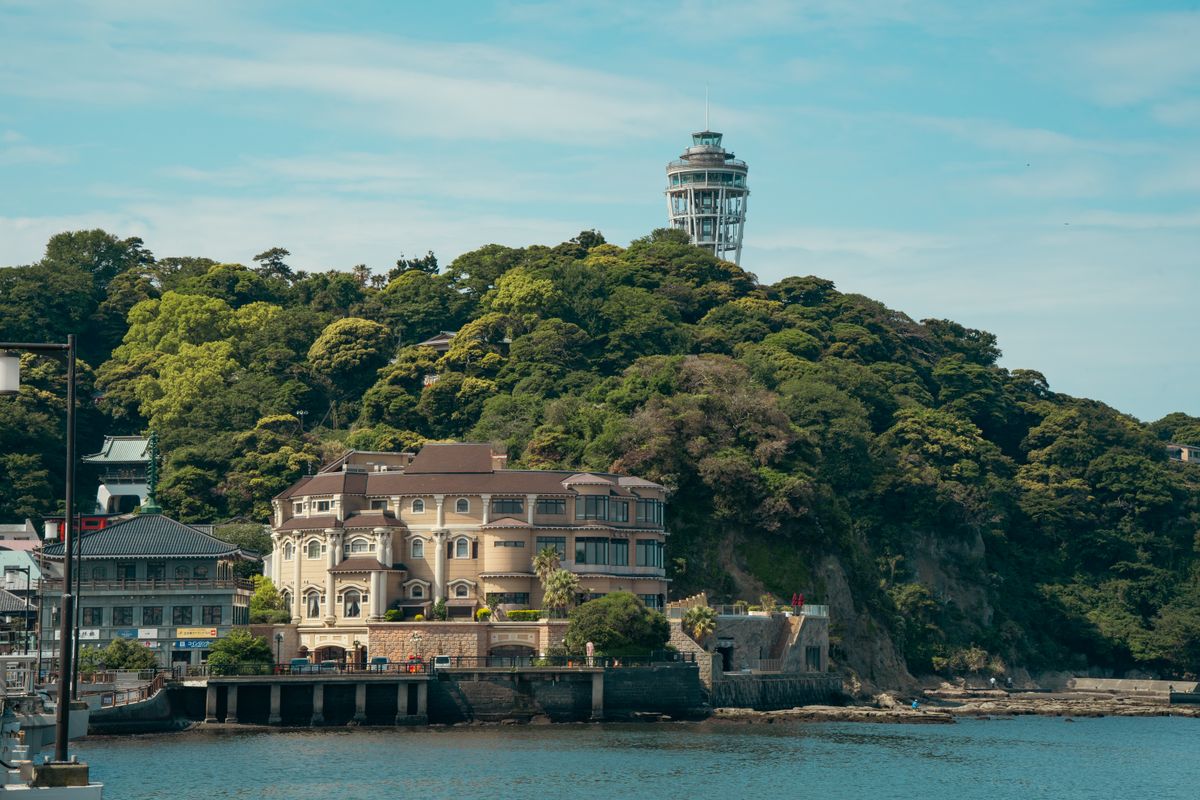
Back near the centre of the island sits the Enoshima Sea Candle (江の島シーキャンドル), a 60-metre lighthouse-and-observation tower opened in 2003. From the upper deck at 41 metres above ground (and 101 metres above sea level), you get a 360° panorama: Mount Fuji to the west, the Boso Peninsula to the east, Kamakura’s hills to the north, the open Pacific to the south. On a clear day in winter, this is one of the most extraordinary viewpoints in Greater Tokyo.
Admission to the tower is ¥500 (~$3.40), or ¥800 (~$5.40) for a combined ticket that includes the Samuel Cocking Garden surrounding it. The tower is open daily 9:00–20:00, and night admission gives you the lit-up garden plus the lights of the Shonan coast spread out below you. From late November to mid-February the garden is decorated for the “Shonan Candle” winter illumination, which uses millions of LED lights and is one of the most romantic evening events in Kanagawa.
Samuel Cocking Garden
Surrounding the Sea Candle is the Samuel Cocking Garden, a botanical garden first laid out in 1882 by an English merchant of that name who fell in love with the island. The original Victorian-era greenhouse was destroyed in the 1923 Great Kanto Earthquake; today’s garden preserves a portion of the original brick foundations alongside a modern tropical conservatory. In spring you will see cherry blossoms; in summer, tropical flowers; in autumn, fiery maple; and in winter, dazzling illuminations. It is a pleasant 30-minute walk if the weather is nice.
The Escalators: A Brilliant Touch for Tired Legs
Enoshima is hilly, with hundreds of steps between the base and the top of the island. Fortunately, the Enoshima Escar — a system of three connected outdoor escalators — runs from the base of Nakamise-dori up to a point near Hetsumiya shrine. A combined “Eno Pass” ticket covers the escalators, the Sea Candle tower, the Samuel Cocking Garden and the Iwaya Caves for ¥1,100 (~$7.45). If you are visiting with older travelers, with children in strollers, or simply prefer not to climb 200+ steps, this is essential. The escalators only run uphill — you have to walk back down — but by then you will have done your sightseeing and the downhill stairs feel like a victory lap.
Where and What to Eat on Enoshima
Shirasu — The Local Delicacy
Enoshima’s most famous food is shirasu (whitebait) — tiny, almost translucent young sardines and anchovies pulled fresh from Sagami Bay. They come in two forms: nama-shirasu (raw, slippery, slightly sweet) and kama-age shirasu (boiled, fluffy, salty). Both are served piled over a bowl of rice, sometimes with grated ginger, soy sauce or a raw quail egg on top. The classic place to try them is Tobiccho, a restaurant chain with several locations on the island. A “shirasu-don” set costs around ¥1,500–¥2,000 (~$10–$14). Note that raw shirasu is only available when the bay’s whitebait fishing season is open (April–December), and even within those months only on days when boats actually catch fresh whitebait — your luck will vary.
Tako-senbei — The Giant Octopus Cracker
The most photographed snack on the island is the tako-senbei (octopus cracker) — a whole baby octopus pressed flat between two hot iron plates until it becomes a single, plate-sized crispy disc. The original shop, Asahi Honten, sits just before the bronze torii on Nakamise-dori and has the queue to prove it. A single cracker costs ¥500 (~$3.40) and is enormous; share it with one or two friends. There are also ebi-senbei (shrimp cracker) versions for the squeamish.
Sazae no Tsuboyaki — Grilled Turban Shell
Stalls along the lanes grill huge spiral turban shells (sazae) over coals, then serve them in their own shells with a drizzle of soy sauce. ¥800–¥1,200 (~$5.40–$8) each. Be brave — the slightly chewy, smoky flesh is one of the most distinctive flavours on the Shonan Coast.
Other Bites You Should Try
- Maguro-katsu — Tuna cutlet served with shredded cabbage, like a tonkatsu made from raw tuna.
- Manju — Steamed sweet buns filled with red bean paste, available everywhere.
- Ice cream — Many shops serve interesting flavours like wasabi, shirasu (yes, whitebait ice cream is a thing), or local citrus.
- Beer — Local craft brewer Enoshima Beer makes a crisp lager perfect for hot summer days.
For broader food inspiration across Japan, see our Japan Street Food Guide and our Japan Food Experiences guide.
Spas, Hot Springs and Onsen with Sea Views
For a small island, Enoshima has a surprising number of bathing options. The most famous is Enoshima Island Spa (Enospa), a modern onsen complex on the western side of the island with multiple indoor and outdoor baths, all with sweeping ocean views. Day-use entry is ¥2,750 (~$18.60) for adults; ¥1,200 (~$8) for children. The outdoor infinity bath at sunset, with the sea below and Mount Fuji on the horizon, is one of the best onsen experiences in greater Tokyo and a wonderful way to recover after a day of climbing stairs.
Note that as with all Japanese onsen, you will need to bathe naked, and tattoo restrictions may apply. If you are unsure about onsen etiquette, our Japanese onsen etiquette guide explains exactly what to expect.
Book your hotel on Agoda (Best prices guaranteed) →
Shonan Beach: Surfing, Sunsets and Summer
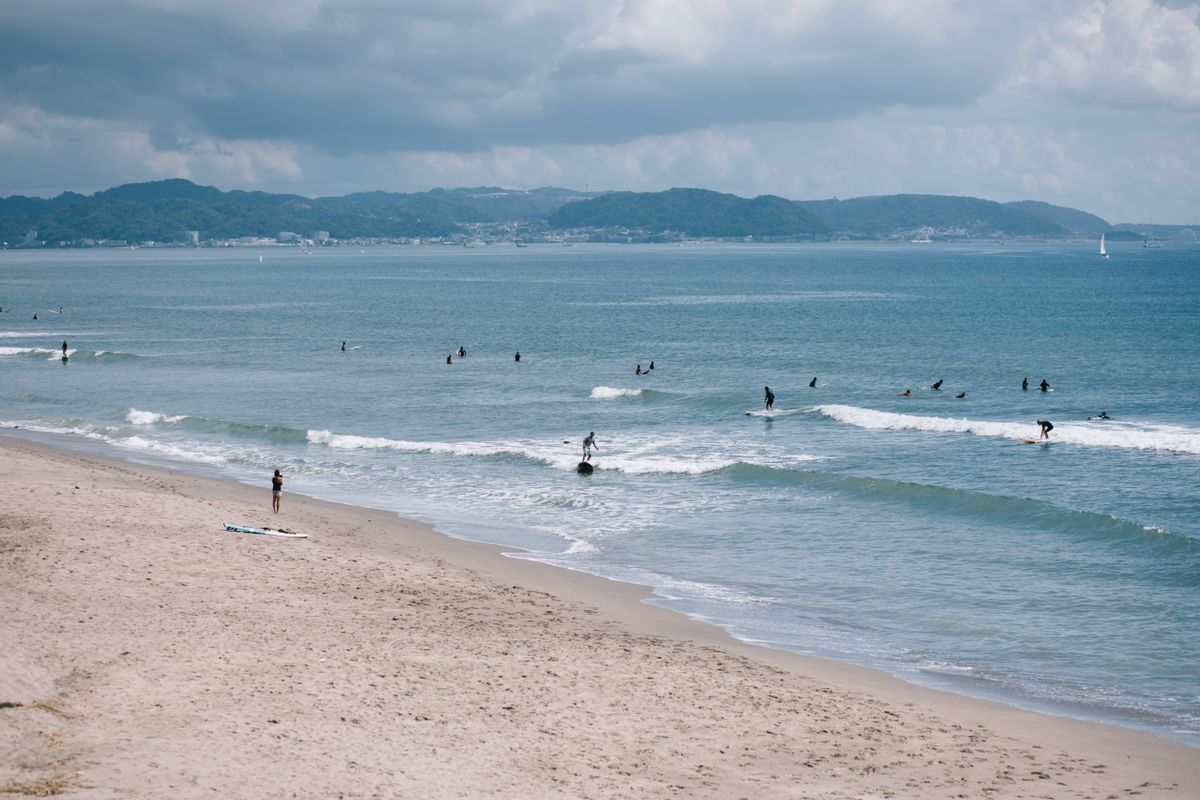
The mainland stretches on either side of the bridge — Katase-Higashihama Beach to the east, Katase-Nishihama Beach to the west — are some of the most popular swimming and surfing beaches near Tokyo. From early July to late August, both are official “swimming beaches” with lifeguards, beach houses, rental gear and family crowds. Outside the swimming season they remain busy with surfers — Enoshima is one of the most consistent surf spots on Honshu’s Pacific coast, with reliable shoulder-high waves in autumn and winter.
If you visit between July and August, plan to combine your sightseeing with an afternoon on the beach. The water is warm, the bay is sheltered, and the post-swim shower facilities are excellent. Outside summer, the beach is wonderful for long walks at sunset — and the silhouette of Enoshima against the orange evening sky is one of those views you will see again and again on postcards.
Combining Enoshima with Kamakura
The single best one-day itinerary from Tokyo combines Enoshima with Kamakura, the medieval capital just over the hills to the east. The two are connected by the Enoden vintage train (a 25-minute ride) and the Odakyu–Enoden Free Pass covers both. A classic combined day looks like this:
Morning: Take the Odakyu Romancecar from Shinjuku to Katase-Enoshima. Walk across the bridge, visit the three shrines, the caves and the Sea Candle. Lunch shirasu-don on the island.
Early afternoon: Take the Enoden from Enoshima Station east to Hase, the stop nearest the Great Buddha. Visit Kotokuin Temple (home of the bronze Daibutsu) and Hasedera Temple with its sea views.
Late afternoon: Continue on the Enoden to Kamakura Station. Walk Komachi-dori shopping street, visit Tsurugaoka Hachimangu shrine.
Evening: Return to Tokyo from Kamakura Station on the JR Yokosuka Line (1 hour back to Tokyo Station).
For more on the medieval capital, see our Kamakura Day Trip Guide. For more day-trip options from the capital, see our Tokyo Day Trips overview.
The Best Mount Fuji View Photo Spot
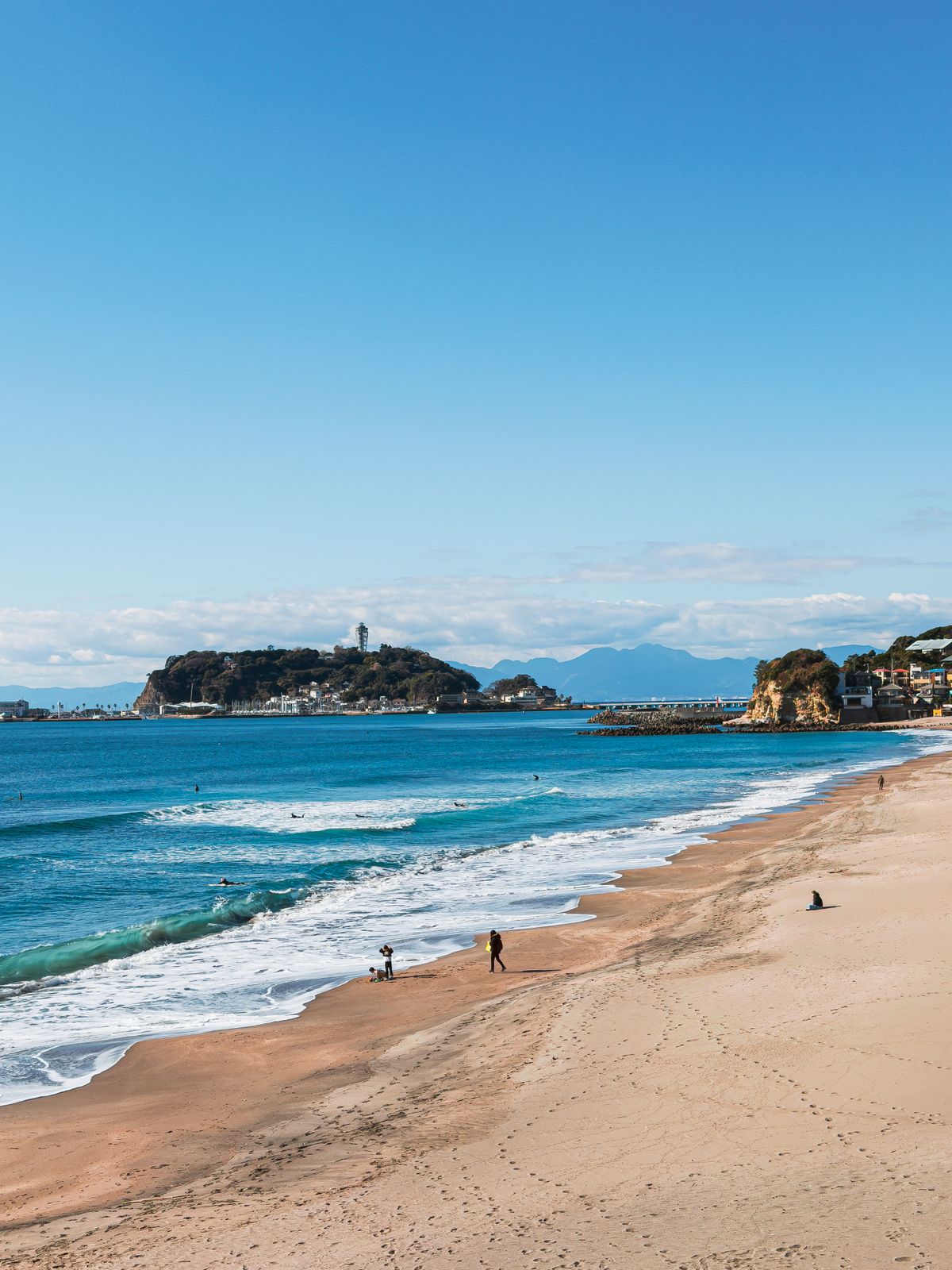
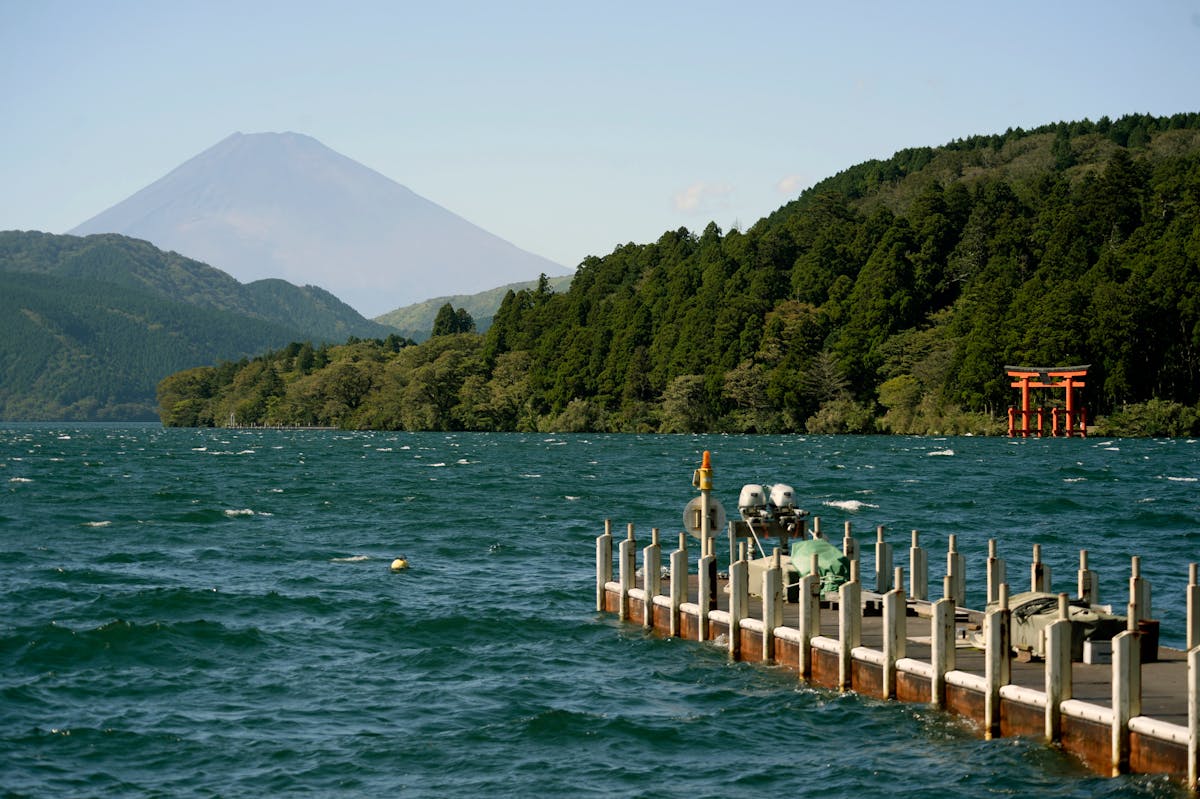
One of Enoshima’s quiet superpowers is its perfect alignment with Mount Fuji. From the western side of the island, especially from the platforms behind Okutsumiya and the area near the Iwaya Caves, the symmetrical cone of Fuji appears about 70 kilometres away across Sagami Bay. The classic composition includes the island’s torii gate or rocky shoreline in the foreground and Fuji in the background. The best conditions are clear winter mornings (December to February) or cold dry days in late autumn (November) when the air is sharpest. Summer humidity often hides the mountain entirely. Sunset golden hour, when Fuji silhouettes against orange skies, is the most beloved time of day for photographers.
If you are chasing Mount Fuji shots more seriously, our Mount Fuji guide covers the best viewpoints across Honshu.
Where to Stay: Enoshima vs Fujisawa vs Kamakura
Most foreign visitors do Enoshima as a day trip from Tokyo, but it is increasingly popular as an overnight base, especially in summer. Three options to consider:
On the island itself: A handful of small ryokan and pensions sit on the island’s slopes, offering quiet evenings after the day-trippers leave. Expect ¥18,000–¥35,000 per night (~$120–$240).
Fujisawa or Shonan-Enoshima area: Practical, well-priced business hotels around Fujisawa Station, with easy access to Enoshima and Kamakura. Expect ¥7,000–¥15,000 (~$47–$100) per night.
Kamakura: If you want a more cultural overnight, Kamakura town itself has several beautiful traditional inns. Expect ¥15,000–¥40,000 (~$100–$270) per night.
Find luxury hotels on Ikyu.com →
Practical Tips for Your Visit
Best Time of Year
Enoshima is a year-round destination, but each season offers something different:
- Spring (March–May): Cherry blossoms in the gardens, comfortable weather, no crowds outside Golden Week.
- Summer (June–August): Beach season; very crowded on weekends. Avoid August Saturdays if you dislike crowds.
- Autumn (September–November): Best month for Fuji views, autumn leaves, mild weather, fewer day-trippers.
- Winter (December–February): Clearest air, best Fuji views, the famous Shonan Candle illuminations, mostly mild temperatures.
How Much Time to Allow
A minimum of 4 hours covers the island highlights (shrines, caves, tower). 6 hours allows a relaxed pace with food stops and a spa. 8 hours combined with Kamakura makes a full and rewarding day trip from Tokyo.
What to Bring
- Comfortable walking shoes (stairs are unavoidable even with escalators)
- Cash — many smaller stalls and shrines do not accept cards
- Sunscreen and a hat in summer
- A light raincoat in June (rainy season)
- Camera or phone with plenty of storage
- Swimming gear if visiting July–August
- A small towel — useful at the spa or after beach time
Staying Connected
Mobile coverage is excellent across the island, with several free Wi-Fi spots. For navigation and ordering food in English, a Japan eSIM is invaluable — most foreign visitors find it the single best ¥1,000 they spend on their entire trip.
Get your Japan eSIM (Stay connected from day 1) →
Crowds and Timing
Enoshima is a Tokyo weekend favourite, so Saturdays and Sundays — especially in summer — can be packed. If your schedule allows, visit on a weekday. If you must visit on a weekend, arrive before 9:30 a.m. and you will have the shrines and caves to yourself for the first hour or two. By mid-afternoon the bridge, Nakamise-dori and the food stalls become almost shoulder-to-shoulder in peak months.
Money and Cards
Bring cash. Some larger restaurants and the Sea Candle ticket office now accept cards, but the majority of shrine donations, small food stalls and Iwaya Cave admission still require yen coins and notes. ¥10,000 in cash per person is more than enough for a full day on the island.
Frequently Asked Questions
Is Enoshima worth visiting if I only have a week in Japan?
Yes — but only if your itinerary already includes some time in Tokyo or Kanagawa. Enoshima is an excellent half-day-to-full-day side trip from the capital but not a destination to fly into the country for. Travelers with a week typically combine Enoshima with Kamakura on the same day, leaving the other 5–6 days for Tokyo, Hakone, Kyoto and one other region. If you only have 3 days, focus on Tokyo and skip Enoshima this trip.
Can I see Mount Fuji from Enoshima?
Yes, on a clear day. Mount Fuji sits about 70 kilometres west of the island and is visible from the western shores, especially from the area behind Okutsumiya shrine, the Iwaya Caves viewing platform and the upper deck of the Sea Candle. The mountain is visible most reliably in cold, dry months (November to March). Summer humidity and clouds often hide it entirely. Sunrise and sunset are the most photographed times.
Are the Iwaya Caves scary or dark?
The first cave is lit only by handheld candle-lanterns and gets fairly dim in places, but the path is wide, level and well-supervised by staff. Most children find it exciting rather than scary, and there is plenty of headroom — you do not need to crouch. People with severe claustrophobia might want to skip the deeper branch of cave 1, but the rest of the caves are very approachable.
Is Enoshima accessible by wheelchair or stroller?
Partially. The bridge to the island is fully accessible, and the lower lane (Nakamise-dori) is mostly flat. From there, the escalators (Eno Escar) make Hetsumiya and Nakatsumiya reasonably accessible — though there are short flights of stairs between escalator segments. Okutsumiya and the Iwaya Caves require more substantial stair climbing and uneven paths. The Sea Candle tower itself is accessible by elevator. Strollers can be folded and carried up the escalators.
Is the bronze Buddha at Enoshima?
No — the famous Great Buddha (Daibutsu) of Kamakura is at Kotokuin Temple in Kamakura, not Enoshima. They are two different places. However, since they are only 25 minutes apart on the Enoden vintage train, the vast majority of day-trippers visit both in a single outing, which is probably why the confusion is common.
What is the difference between Katase-Enoshima, Enoshima and Shonan-Enoshima stations?
Three different train lines reach the island, each with its own station. Katase-Enoshima Station is on the Odakyu line from Shinjuku — the largest and prettiest station, with a recently rebuilt dragon-palace facade. Enoshima Station is on the Enoden line that connects to Kamakura. Shonan-Enoshima Station is on the Shonan Monorail from Ofuna. All three are 5–10 minutes’ walk from the bridge. Pick whichever line is most convenient from your starting point.
Can I visit Enoshima at night?
Yes, and many Japanese visitors specifically come in the evening. The Sea Candle is open until 8:00 p.m., the Samuel Cocking Garden has winter illuminations, and most restaurants stay open until 8 or 9 p.m. The bridge is lit, and the lights of the island reflected in the bay are spectacular. After the last restaurants close around 9 p.m., the island goes very quiet and the last train back is around 11 p.m. Check current Enoden and Odakyu schedules before staying late.
Is Enoshima good for couples? Solo travelers? Families?
All three. Couples love the dragon-bell love-lock fence at Okutsumiya and the winter illuminations. Solo travelers enjoy the contemplative shrine atmosphere and the easy pace of the island. Families come for the beach in summer, the dragon caves, the giant octopus crackers, and the fact that everything can be done in a few hours without exhausting young legs. There is no demographic Enoshima fails to charm.
Do I need to take off my shoes at the shrines?
Only inside the small worship halls if you choose to enter — and most of the time you simply pray from outside, where shoes stay on. The exception is the Hōan-den hall housing the Benzaiten statue, where you remove shoes and pay a small fee. The general etiquette is the same as at any Shinto shrine: bow once before entering the torii gate, wash hands at the temizuya basin, and avoid walking through the centre of the path (which is reserved for the deity).
Are there entry fees for the island itself?
No. The island is free to enter — the bridge is a public road. You only pay if you want to enter specific paid attractions: the Hōan-den Benzaiten hall (¥200), the Sea Candle tower (¥500), the Samuel Cocking Garden (¥500), and the Iwaya Caves (¥500). The “Eno Pass” combo ticket bundles the escalators, the tower, the garden and the caves for ¥1,100 (~$7.45) — excellent value if you plan to do everything.
What is the Enoshima Aquarium and is it on the island?
The Enoshima Aquarium (新江ノ島水族館, Enosui) is a popular family attraction located on the mainland directly across from the bridge, not on the island itself. It is a 10-minute walk from Katase-Enoshima Station and features one of the largest jellyfish exhibits in Japan, a dolphin and sea lion show, and live touch pools. Adult admission is ¥2,800 (~$19). If you are traveling with children, consider adding the aquarium before crossing the bridge to the island.
What is the cherry blossom season like on Enoshima?
While Enoshima is not a top-tier cherry blossom destination like Yoshino or Hirosaki Castle, it has perhaps 100 sakura trees scattered across the Samuel Cocking Garden and the slopes near Nakatsumiya shrine. Peak bloom is typically late March to early April. The combination of pink blossoms, the sea, and (on lucky clear mornings) Mount Fuji creates a beautiful but underrated photo opportunity. Crowds in this season are noticeably smaller than at famous sakura spots inside Tokyo, which is one of the island’s quiet advantages in early April.
Practical Tips Summary
- Buy the Odakyu Enoshima–Kamakura Free Pass (¥1,640) for unlimited round-trip access from Shinjuku.
- Arrive by 9:30 a.m. on weekends to avoid crowds.
- Bring cash — many stalls do not accept cards.
- Use the Eno Escar escalators if you have any mobility concerns.
- Eat raw shirasu (whitebait) only in season (April–December).
- Combine with Kamakura for a perfect single-day Tokyo escape.
- Visit November–February for the best Mount Fuji views.
- Bring swim gear in July–August for Shonan beach.
- The Sea Candle observation deck is best at sunset.
- Iwaya Caves take 45 minutes — do not skip them.
- Spend ¥2,750 on Enospa onsen for the perfect end to your day.
- An eSIM is invaluable for Google Maps and ordering food in English.
Seasonal Festivals and Events
Enoshima holds several local festivals worth timing your visit around. The Enoshima Tenno Festival in mid-July sees a portable shrine carried into the surf by men dressed only in white loincloths — one of the more dramatic festival traditions in Kanto. The Shonan Candle illuminations in winter turn the Samuel Cocking Garden into a glittering nightscape from late November through February. The Enoshima Lighting Up event in October to January lights all three shrines in coloured floods, giving the island a magical evening atmosphere unlike anywhere else near Tokyo. Check the official Fujisawa City tourism website before your visit to confirm exact dates.
Final Thoughts
Enoshima manages a rare trick: it sits less than 90 minutes from one of the world’s largest cities and yet feels, on a quiet midweek morning, like a fishing village from another century. Climb to the highest shrine while seagulls wheel above the bay. Walk a candle-lit cave that monks meditated in 1,000 years ago. Eat a whole octopus pressed flat into a cracker. Soak in an onsen looking at Mount Fuji on the horizon. Watch surfers carve up evening waves while you eat shirasu on a wooden veranda. There is nothing else quite like it within striking distance of Tokyo, and it is genuinely one of the easiest, most rewarding side trips a first-time visitor to Japan can plan.
If you have a free morning, a free afternoon, or — best of all — a free full day, do not miss it.
For more first-timer guidance on planning your trip, see our Japan Travel Tips for First-Timers, our Tokyo Neighborhoods Guide, and our Japan Destinations overview.
Going to Japan? Talk to locals with confidence.
Hirameki Japanese — instant offline translation, camera translation, furigana + romaji, and 314 free flashcards. No login. Works without internet.

Plan your Japan trip
Two things every first-timer should book
Some links are affiliate links. If you book through them we may earn a small commission at no extra cost to you.